A tiger can weigh hundreds of pounds, but some of the world's wild cats are barely larger than a house cat—and a few are even smaller.
These tiny felines live in remarkably different places. Rusty-spotted cats move through forests and rocky landscapes in South Asia. Black-footed cats hunt across the dry grasslands of southern Africa. Sand cats survive in deserts, while margays use the forests of Central and South America.
“Small wild cats” is not a formal taxonomic group. It is a convenient way to describe the many wild members of the cat family that are much smaller than lions, tigers, leopards and other large felids.
Here are eight of the most fascinating small wild cat species in the world.
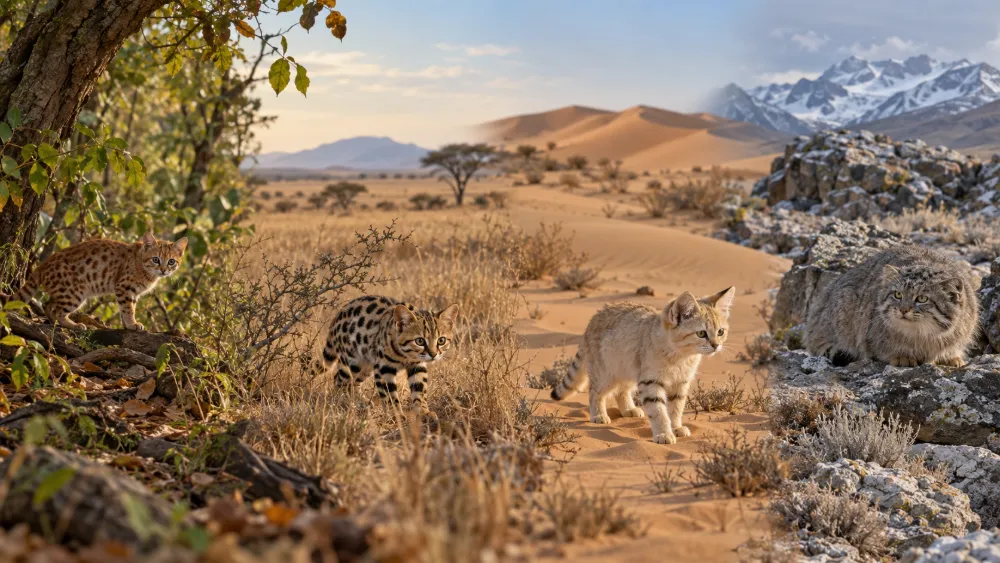
Small Wild Cats at a Glance
| Species | Approx. Adult Weight | Main Range | Standout Adaptation |
|---|---|---|---|
| Rusty-spotted cat | 1–2 kg | India, Sri Lanka, Nepal | Extremely small, agile hunter |
| Black-footed cat | 1–2.5 kg | Southern Africa | Smallest African wild cat |
| Sand cat | 1–3.5 kg | North Africa and Asia | Specialized desert survival |
| Kodkod / Güiña | 1.5–3 kg | Chile and Argentina | Tiny forest-dwelling cat |
| Northern tiger cat | 1.8–3.5 kg | Central and South America | Miniature spotted-cat appearance |
| Pallas's cat | About 2–5 kg | Central Asia | Extremely thick cold-weather fur |
| Flat-headed cat | About 2 kg | Southeast Asia | Wetland and fish-hunting adaptations |
| Margay | 2.3–4.9 kg | Central and South America | Exceptional tree-climbing ability |
1. Rusty-Spotted Cat
The rusty-spotted cat (Prionailurus rubiginosus) is one of the smallest wild cats on Earth.
Adults generally weigh only around 1 to 2 kilograms. That can make a full-grown rusty-spotted cat lighter than many ordinary domestic cats.
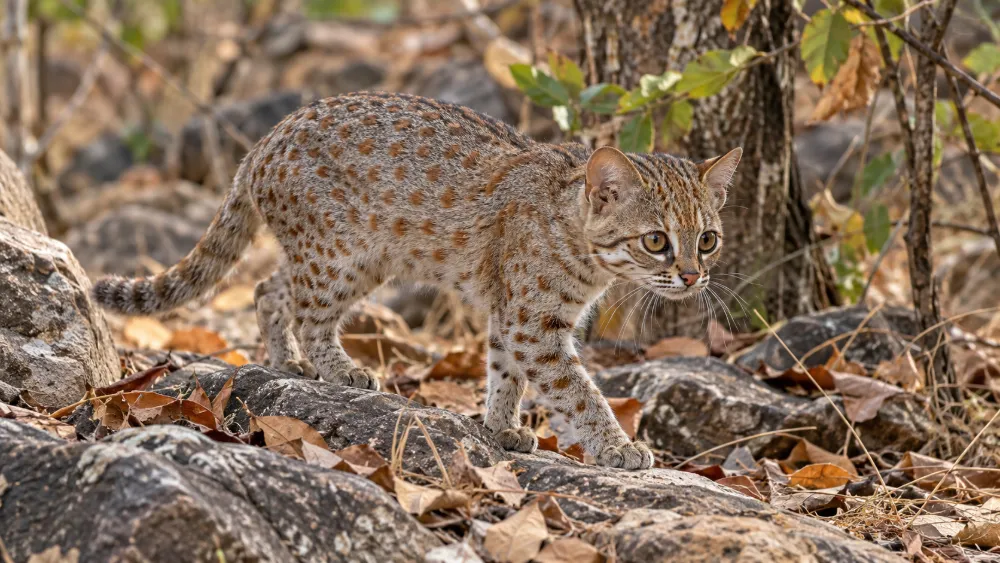
The species has a short grayish-fawn coat covered with reddish-brown spots and streaks. Its large eyes and compact face can make it look surprisingly kitten-like even as an adult.
Rusty-spotted cats occur in India, Sri Lanka and Nepal. They use several habitats, including dry and moist forests, scrub, rocky landscapes and some modified agricultural areas.
Despite their size, they are capable predators. Reported prey includes rodents, birds, insects, reptiles and frogs.
The IUCN Cat Specialist Group currently classifies the species as Near Threatened and identifies habitat loss and land conversion among its major pressures.
2. Black-Footed Cat
The black-footed cat (Felis nigripes) is the smallest wild cat in Africa and one of the smallest felids anywhere in the world.
Adults weigh roughly 1 to 2.5 kilograms, with males generally larger than females.
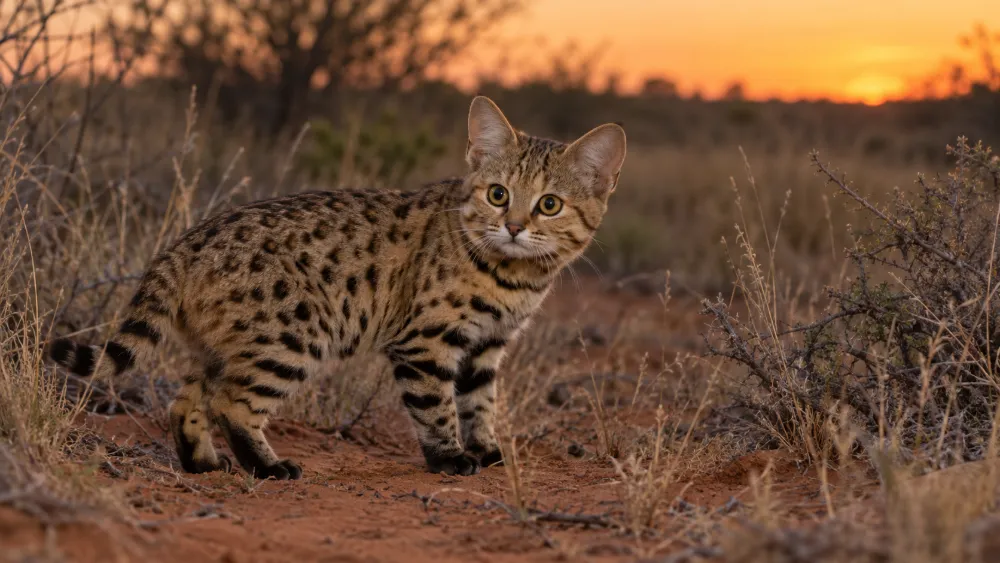
Its name does not mean the entire foot is black. The dark coloration is especially noticeable on the pads and underside of the feet.
The coat is tawny or golden and covered with dark spots and bands, providing camouflage in dry grasslands and semi-desert environments.
Black-footed cats occur primarily in South Africa, Namibia and Botswana, with a much more limited distribution than many other African felids.
They are primarily nocturnal and spend much of the night moving through open habitat in search of small mammals, birds, reptiles and invertebrates.
The species is currently classified as Vulnerable.
3. Sand Cat
The sand cat (Felis margarita) looks almost like a domestic cat designed specifically for desert life.
Adults typically weigh around 1 to 3.5 kilograms and have a body length of roughly 45 to 57 centimeters, excluding the tail.
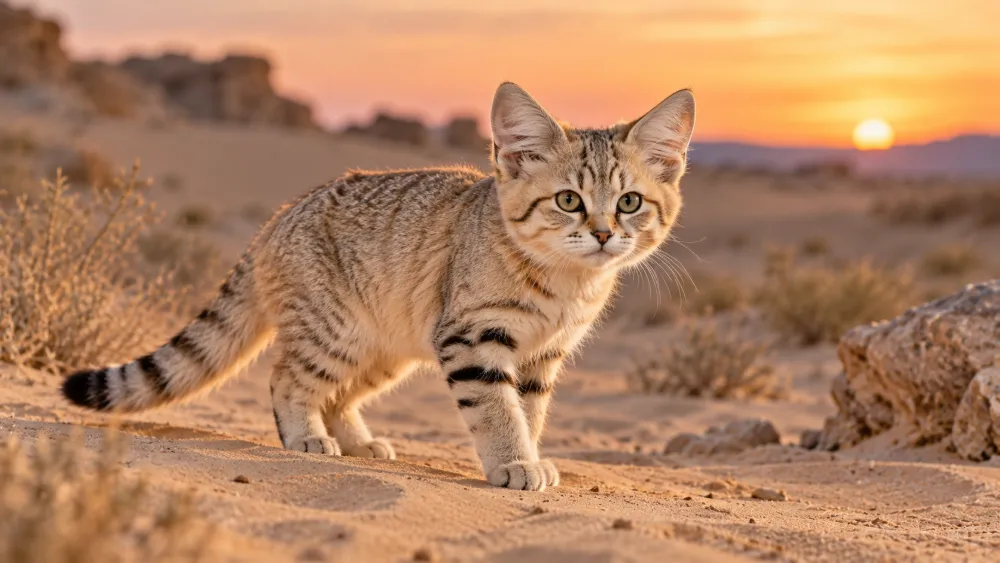
Their unusually broad heads and large, low-set ears help them detect prey in open desert landscapes.
Sand cats also have fur covering the pads of their feet. This provides protection from hot sand and improves movement across loose desert surfaces.
They occur across parts of the Sahara, Arabian Peninsula and western and central Asia.
They obtain much of the water they need from prey and can live in environments where permanent surface water is extremely limited.
Despite their resemblance to small house cats, sand cats are true wild animals and are not domesticated pets.
4. Kodkod, or Güiña
The kodkod, more commonly called the güiña in much of its range, is one of the smallest wild cats in the Americas.
Its scientific name is Leopardus guigna.
Adults generally weigh around 1.5 to 3 kilograms and measure approximately 37 to 56 centimeters in head-and-body length.
The güiña lives mainly in Chile and a smaller area of Argentina, where it is closely associated with forests and dense vegetation.
Its coat is usually buff, grayish or brown and covered in small dark spots. Fully melanistic, or very dark, individuals also occur.
Like several other small South American cats, it can climb well and use forest structure to move, hide and hunt.
The species illustrates an important point about small wild cats: being tiny does not mean having a tiny habitat requirement. Survival still depends on connected landscapes with enough prey and cover.
5. Northern Tiger Cat
The northern tiger cat (Leopardus tigrinus) is sometimes called the oncilla or northern tigrina.
It looks like a miniature version of a larger spotted cat, with a slender body and a yellowish to brown coat patterned with dark spots and rosettes.
Adults weigh approximately 1.8 to 3.5 kilograms.
The species occurs in parts of Central and South America, although its taxonomy and exact distribution are more complicated than the simple name suggests.
Scientists have found that several populations traditionally grouped under “tiger cats” are genetically distinct, and the classification of some regional populations is still being studied.
Northern tiger cats use a wide range of environments, from tropical forest and montane cloud forest to savanna and semi-arid scrub.
They are excellent climbers but spend much of their hunting time on the ground, where small mammals make up an important part of their diet.
6. Pallas's Cat
Pallas's cat (Otocolobus manul), also called the manul, is a perfect example of why fur can make a wild cat look much bigger than it really is.
Under all that hair, it is roughly the size of a small, stocky domestic cat.
Adults typically weigh around 4 to 11 pounds, or roughly 2 to 5 kilograms.
Pallas's cats live across dry, rocky landscapes and grasslands in Central Asia.
Their extremely thick coat is an adaptation to severe winter conditions. Low-set rounded ears, short legs and a flattened body profile also help them remain inconspicuous while stalking prey across exposed terrain.
Their main prey includes small mammals such as pikas, voles, gerbils and other rodents.
Despite their famously expressive faces, Pallas's cats are wild predators and should not be confused with Persian cats or other flat-faced domestic breeds.
7. Flat-Headed Cat
The flat-headed cat (Prionailurus planiceps) is one of the strangest small wild cats in Asia.
Adults weigh around 2 kilograms and have a head-and-body length of roughly 45 to 52 centimeters.
Its name comes from the long, narrow head and flattened forehead.
Unlike most cats, the flat-headed cat is strongly associated with wetlands. It occurs around rivers, swamps, peat forests and other lowland aquatic habitats in parts of Sumatra, Borneo and the Malay Peninsula.
Several features suggest specialization for catching aquatic prey. Its toes are relatively well webbed, its claws remain partly visible when retracted, and its teeth are suited to gripping slippery prey.
Fish and frogs are thought to be important foods.
The species is classified as Endangered, with wetland loss, habitat conversion and water pollution among its major threats.
8. Margay
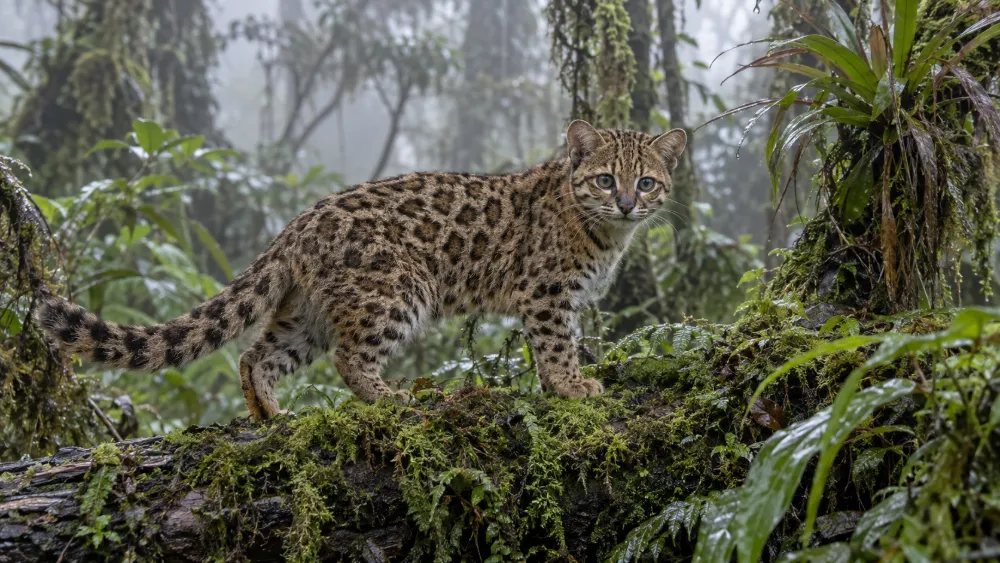
The margay (Leopardus wiedii) is larger than the tiniest cats on this list, but it is still a relatively small wild felid.
Adults typically weigh about 2.3 to 4.9 kilograms.
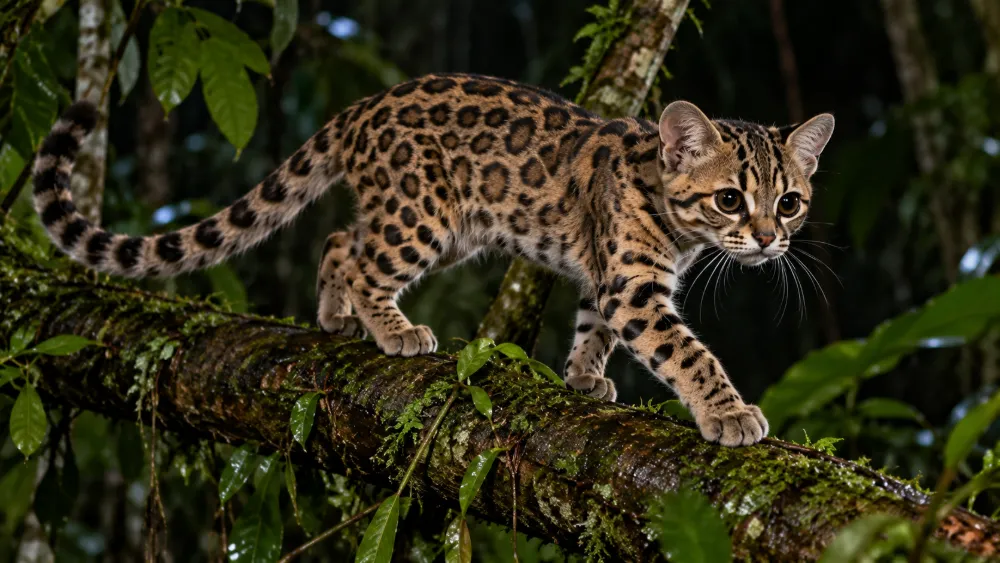
The margay lives from parts of Mexico through Central America and much of South America.
Its spotted coat resembles that of the larger ocelot, which is why the margay is sometimes described as a “little ocelot.”
Its most remarkable feature is its climbing ability.
Margays have exceptionally flexible hind ankles that can rotate to help them grip while climbing. They can descend trees headfirst and may even hang from branches using their hind feet.
A very long tail acts as a counterbalance during movement through vegetation.
Although margays are excellent climbers and commonly rest in trees, research indicates that they also travel and hunt extensively on the ground.
What Is the Smallest Wild Cat in the World?
The rusty-spotted cat and black-footed cat are generally considered the smallest wild cat species.
Which one receives the title depends partly on whether you compare body length, adult weight, sex or individual animals.
The rusty-spotted cat is often lighter, with adults around 1 to 2 kilograms. Black-footed cats overlap substantially in size but can reach around 2.5 kilograms.
For this reason, it is more accurate to describe them as two of the world's smallest wild cats rather than pretending that every individual of one species is always smaller than every individual of the other.
Are Small Wild Cats Related to House Cats?
Yes. Domestic cats and all wild cats belong to the family Felidae.
But that does not mean every small wild cat is the direct ancestor of the house cat.
The black-footed cat and sand cat belong to the genus Felis, which places them relatively close to domestic cats within the feline family tree.
Other small species belong to different lineages. Rusty-spotted and flat-headed cats belong to Prionailurus, while margays, tiger cats and güiñas belong to Leopardus.
You can see the broader relationships in our Types of Felines guide.
Can Small Wild Cats Be Pets?
Looking similar in size to a house cat does not make a wild species domesticated.
Sand cats, black-footed cats, rusty-spotted cats and other wild felids have evolved for life in specialized natural environments rather than human homes.
The Smithsonian National Zoo specifically notes that sand cats should be cared for by professionals rather than treated as pets.
Wild cats can have very different territorial, dietary, veterinary and behavioral requirements from domestic cats.
There can also be legal restrictions on private ownership depending on the species and jurisdiction.
If you want an unusual-looking domestic cat, it is much better to learn about established rare domestic cat breeds rather than seeking a wild feline.
Small Wild Cats vs. Rare Wild Cats
Small does not automatically mean rare.
A species can be small but relatively widespread, or larger but highly threatened and difficult to find.
Likewise, the words “rare,” “endangered” and “small population” are not interchangeable.
Conservation status should be based on population assessments rather than how often people see a species on social media or in zoos.
For cats chosen specifically because they are unusual or seldom known to the public, see our existing guide to 12 Rare Wild Cats You Probably Didn't Know Existed.
Why Are Small Wild Cats Important?
Big cats receive enormous conservation attention, but small felids also play important ecological roles.
Many hunt rodents, birds, reptiles, amphibians and other small animals. They form part of complex predator-prey systems and can help shape local animal communities.
At the same time, small cats can be especially difficult to study.
Many are nocturnal, solitary and naturally occur at low densities. Some live in thick forest, rocky mountains or remote deserts where direct observation is difficult.
This is why scientists often rely on camera traps, radio collars, DNA and other indirect techniques to understand them.
FAQ
What is the smallest wild cat?
The rusty-spotted cat and black-footed cat are among the smallest living wild cats. Rusty-spotted cats usually weigh about 1 to 2 kilograms, while black-footed cats weigh roughly 1 to 2.5 kilograms.
Are sand cats smaller than house cats?
Many are. Adult sand cats weigh about 1 to 3.5 kilograms, which makes them smaller than many domestic cats. Their broad head and thick coat can make them look larger in photographs.
What is the smallest wild cat in Africa?
The black-footed cat is Africa's smallest wild cat. It occurs mainly in dry grasslands and semi-desert environments in southern Africa.
What is the smallest wild cat in the Americas?
The güiña, or kodkod, is one of the smallest wild cats in the Americas. Adults generally weigh only about 1.5 to 3 kilograms.
Is a Pallas's cat a domestic cat?
No. Pallas's cat is a distinct wild species from Central Asia. Its thick coat and flattened facial appearance can resemble certain domestic breeds, but it is not a domestic cat.
Can a rusty-spotted cat be kept as a pet?
It is a wild species, not a domesticated cat breed. Wild felids have specialized needs and may also be protected by national and international wildlife laws.
Are all small wild cats endangered?
No. Conservation status differs among species. Some have relatively secure global classifications, while others, such as the flat-headed cat, face much more serious conservation threats.
Final Thoughts
The cat family is far more diverse than lions, tigers and leopards.
At the other end of the size spectrum are wild cats weighing only a few pounds: rusty-spotted cats slipping through South Asian forests, black-footed cats crossing African grasslands and sand cats disappearing almost completely against desert terrain.
Other small felids have evolved equally remarkable lifestyles. Flat-headed cats specialize around wetlands, margays climb through tropical forests and Pallas's cats survive bitter Central Asian winters beneath extraordinarily dense fur.
They may be small, but they are fully adapted wild predators—not miniature versions of domestic pets.
For more unusual species, continue with our Rare Wild Cats guide or explore the entire family in Types of Felines.