A newly described wild cat has been identified in Bolivia. The species, named Leopardus tilcayo or simply the tilcayo, lives in the Yungas cloud forests on the eastern slopes of the Andes. Scientists formally described it in September 2026 after genomic research showed that it is genetically distinct from other South American tiger cats. The tiny spotted feline is smaller than an average house cat, and much of its ecology is still unknown.
The discovery is especially remarkable because entirely new living cat species are rarely recognized. The research also changes scientists' understanding of South America's tiger cats, showing that animals once grouped together under a small number of names actually represent several distinct evolutionary lineages.
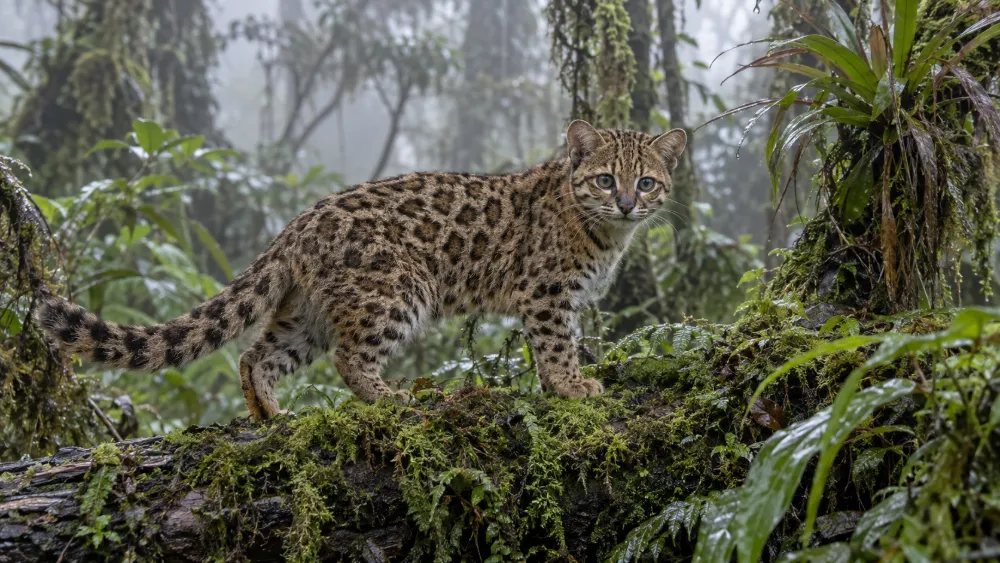
Illustrative reconstruction of Leopardus tilcayo based on its published description. The newly described wild cat is known from Bolivia's Yungas region.
Tilcayo at a Glance
| Feature | What We Know |
|---|---|
| Scientific name | Leopardus tilcayo |
| Common name | Tilcayo |
| Animal group | Small wild cat in the family Felidae |
| Genus | Leopardus |
| Known range | Bolivian Yungas on the eastern slopes of the Andes |
| Approximate size | One documented male was about 45 cm in head-and-body length and roughly 1.3 kg |
| Appearance | Light brown coat with large, irregular dark rosettes and a relatively long tail |
| Activity | Preliminary evidence suggests mainly nocturnal activity |
| Diet | Poorly known; early observations suggest small rodents may be important prey |
| Formal description | 2026, in the journal Current Biology |
What Is Leopardus tilcayo?
Leopardus tilcayo is a newly recognized species of small South American wild cat.
It belongs to the genus Leopardus, which includes several spotted cats found across Central and South America, such as ocelots, margays and tiger cats.
Tilcayo is part of the group commonly known as tiger cats. These cats are much smaller than true tigers and have no close relationship to the genus Panthera. The name refers only to their spotted or patterned appearance.
The 2026 study concluded that the South American tiger cat complex contains more distinct evolutionary lineages than previously recognized.
Why Is the Discovery So Important?
Scientists regularly describe new insects, fishes and other small animals, but recognizing a previously unknown living cat species is exceptionally unusual.
Cats are comparatively large, charismatic mammals and have been studied intensively for centuries. Discovering that an overlooked population represents its own evolutionary lineage therefore shows how much biodiversity can remain hidden even among familiar animal groups.
The researchers described Leopardus tilcayo after combining modern genomic analysis with museum specimens and field observations.
Rather than being a newly evolved animal, the tilcayo had existed for a very long time without being formally recognized as its own species.
When Was the Tilcayo Discovered?
The story began years before the species received its scientific name.
In 2016, Bolivian biologist Paola Nogales-Ascarrunz was contacted about an unusual small spotted cat at the Senda Verde wildlife refuge in Bolivia.
The animal had reportedly been found as a kitten near a forest road. A local resident initially believed it was some type of domestic cat and kept it for a period before its obviously wild behavior led to its transfer to a sanctuary.
Nogales-Ascarrunz photographed the animal and initially considered it a member of the already known tiger cat group.
Later, while comparing photographs and studying South American wild cats, she noticed that the animal's markings did not match typical descriptions of other tiger cats.
That observation eventually led to a much larger genetic investigation.
How Did Scientists Prove It Was a New Species?
The strongest evidence came from DNA.
The research team analyzed complete genomes from 38 individuals belonging to the South American genus Leopardus. Twenty-six represented different populations within the complicated tiger cat species complex.
Modern genomic techniques allowed researchers to compare millions of genetic markers rather than relying only on fur color, body measurements or skull shape.
The results showed that the Bolivian tilcayo formed a distinct evolutionary lineage.
Genetic analysis suggests that its lineage separated from related tiger cats roughly 1.4 million years ago.
That is far too much evolutionary separation to explain as a recent local color variation.
What Does the Tilcayo Look Like?
The tilcayo is a very small, slender wild cat with a spotted coat.
The published description distinguishes it from related tiger cats using several characteristics, including:
relatively short fur;
a lower-contrast coat pattern;
large, irregular and often open rosettes;
a relatively long tail;
irregular markings on the tail rather than broad, complete dark bands;
small rounded ears;
a light brown overall coat tone.
These differences can be subtle. That is one reason the animal could remain scientifically hidden despite being known to local people.
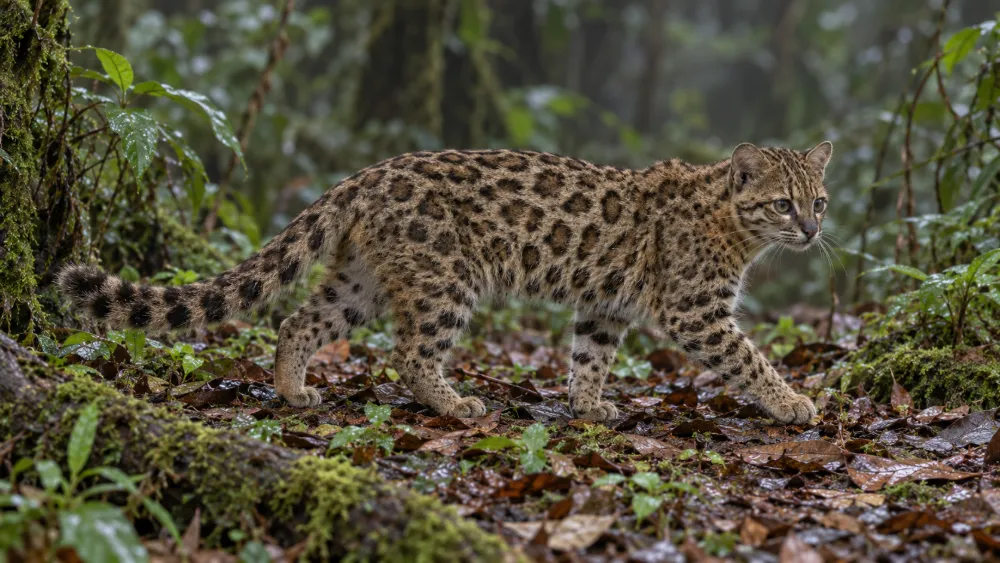
Illustrative side-profile reconstruction showing the tilcayo's small size, irregular rosettes and relatively long tail.
How Big Is a Tilcayo?
The tilcayo is smaller than the average domestic cat.
One well-documented male associated with the discovery measured roughly 45 centimeters (18 inches) from the head to the end of the body and weighed around 1.3 kilograms (3 pounds).
Its tail adds additional length.
However, scientists have examined too few living animals to define a reliable full adult size range for the species.
Future field studies may show how much males and females differ in size and whether body size varies across the species' range.
Where Does the Tilcayo Live?
Current evidence places Leopardus tilcayo in the Bolivian Yungas.
The Yungas form a dramatic band of humid forest along the eastern slopes of the Andes, where high mountains descend toward the Amazon Basin.
The region contains:
cloud forests;
steep mountain valleys;
dense subtropical vegetation;
high rainfall and humidity;
large changes in elevation over relatively short distances.
These conditions have helped create exceptionally high biodiversity and many geographically restricted species.
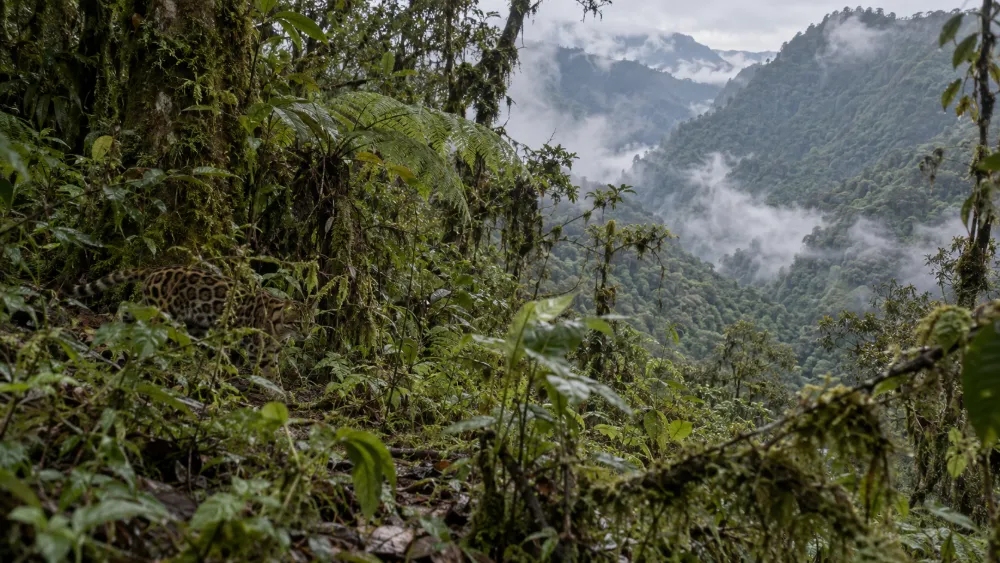
The Bolivian Yungas are humid Andean cloud forests forming a transition between high mountains and the Amazon Basin.
Why Was the Tilcayo Hidden From Science for So Long?
The tilcayo was hidden mainly because tiger cats are difficult to distinguish.
Several South American Leopardus cats share:
small body size;
spotted coats;
similar facial patterns;
secretive behavior;
nocturnal activity;
remote forest habitats.
A photograph alone may therefore not be enough to identify one population as a separate species.
Museum specimens also played an important role in the new study. By extracting and comparing genetic information from older preserved material, researchers could reconstruct relationships that were almost impossible to see from appearance alone.
This combination of genomics and museum science is sometimes called museomics.
What Does the Name “Tilcayo” Mean?
The scientific name honors the local name already used for the animal: tilcayo.
Researchers chose to preserve that traditional regional name rather than inventing an entirely new English label.
According to accounts from the research team, local people had used the name for generations, although there does not appear to be a clear modern Spanish or Quechua translation explaining its original meaning.
The species therefore became:
Leopardus tilcayo
and the researchers proposed tilcayo as its English common name.
Is the Tilcayo a Tiger?
No.
The term “tiger cat” is a common name for several small spotted cats in the genus Leopardus.
True tigers are Panthera tigris, enormous Asian cats belonging to a completely different genus.
A tilcayo weighs only a small fraction of what a tiger weighs.
Calling it a “tiger cat” describes its spotted appearance and traditional grouping, not a close relationship to the large tiger.
Is the Tilcayo Related to the Ocelot?
Yes, more closely than it is related to domestic cats or true tigers.
Both the tilcayo and ocelot belong to the South American genus Leopardus.
However, an ocelot is considerably larger and has its own distinct evolutionary lineage.
The genus also contains species such as margays, pampas cats and other tiger cats.
Is the Tilcayo a Domestic Cat?
No.
The animal involved in the discovery was initially mistaken for a domestic cat when it was young, but genetic analysis proved that it belongs to a wild South American cat lineage.
The similarity is partly due to its small size.
Its body is comparable in size to, or smaller than, many house cats, but its behavior, genetics and ecology are those of a wild predator.
Can a Tilcayo Be Kept as a Pet?
The tilcayo should be regarded as a wild animal, not a pet species.
Wild felids have specialized behavioral, dietary, territorial and environmental needs that domestic cats do not.
The discovery animal's history actually demonstrates the problem: it was initially kept because it was mistaken for a domestic cat, but its wild behavior eventually made clear that it belonged in professional wildlife care.
Keeping rare wild animals can also create conservation, welfare and legal concerns.
What Does the Tilcayo Eat?
Scientists do not yet have a detailed dietary study for Leopardus tilcayo.
Preliminary observations suggest that small rodents may be among its prey, which would be consistent with the diet of other small South American wild cats.
However, it is too early to publish a detailed prey list as though the species were already well studied.
Future research will need to examine scat, prey remains, camera-trap behavior and possibly stable-isotope evidence to understand its diet more accurately.
Is the Tilcayo Nocturnal?
Early evidence suggests that the tilcayo may be largely nocturnal, but scientists still have very limited behavioral data.
Small forest cats often benefit from being active at night because darkness can help them approach prey and avoid larger predators or people.
Camera traps will be especially important for determining the species' true daily activity pattern.
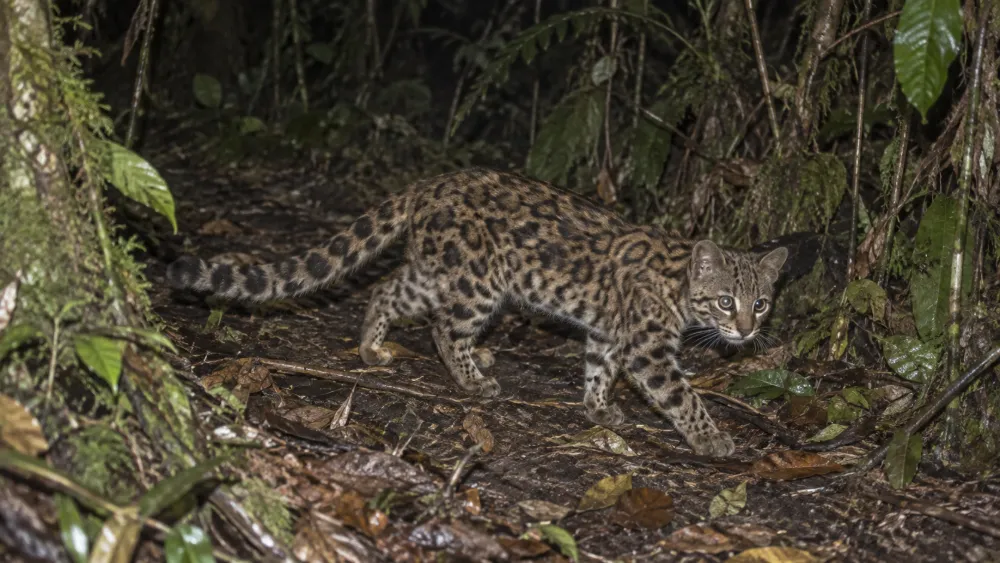
Illustrative camera-trap-style reconstruction. Researchers still know very little about the tilcayo's daily behavior.
How Many Tilcayos Are Left?
No reliable population estimate currently exists.
This is one of the most important facts to understand about such a newly recognized species.
Scientists have information from only a very small number of confirmed individuals and records. That is not enough to calculate a population size.
The absence of a population estimate does not automatically mean that only a few tilcayos exist. It means researchers do not yet know how common or rare they are.
Is the Tilcayo Endangered?
The tilcayo is so newly described that it does not yet have a well-established independent global conservation assessment comparable with long-recognized species.
Researchers have warned, however, that splitting previously combined tiger-cat populations into smaller species can reveal much higher extinction risk.
A population that looked relatively widespread when grouped together may turn out to occupy only a small geographic area once the species are separated.
That means conservation scientists now need to determine:
the tilcayo's full geographic range;
population size and density;
degree of habitat fragmentation;
genetic diversity;
reproductive biology;
major causes of mortality.
What Threats Could the Tilcayo Face?
The Bolivian Yungas are biologically rich but under significant human pressure.
Researchers and conservationists have highlighted threats including:
deforestation;
agricultural expansion;
forest fires associated with human activity;
mining;
roads and habitat fragmentation;
possible wildlife persecution or trafficking;
diseases that may spread from domestic animals.
For a small-range wild cat, loss of forest connectivity can be particularly serious because isolated populations may become genetically and demographically vulnerable.
Why Does Recognizing a New Species Matter for Conservation?
Taxonomy can directly change conservation priorities.
Imagine that scientists believe one species occurs across several countries and contains a large population. That species may appear relatively secure.
If genetic evidence later shows that the supposed single species is actually several separate species, each one may have:
a much smaller range;
fewer individuals;
different habitat requirements;
different threats;
different levels of genetic diversity.
Each species then needs its own conservation assessment.
This is one reason the new tiger-cat study matters far beyond simply adding another name to the cat family tree.
How Many Tiger Cat Species Are There Now?
The 2026 genomic study concluded that the South American tiger cat complex contains five distinct species.
The study also proposed a newly recognized subspecies from Peru, Leopardus tigrinus antisuyo.
This represents a major revision of a group that had historically been difficult to classify because several populations look remarkably similar.
The findings may also encourage scientists to re-examine other poorly understood South American small cats using modern whole-genome methods.
What Is Museomics?
Museomics is the use of modern molecular techniques to recover biological information from museum specimens.
Natural-history museums contain skins, skulls, bones and preserved tissues collected across decades or centuries.
Older specimens are extremely valuable because they may represent:
populations that are now rare;
locations that can no longer be sampled;
historical genetic diversity;
animals that were originally misidentified.
Combining museum DNA with genomes from living animals gives researchers a much deeper picture of evolutionary history.
Could More New Cat Species Still Be Discovered?
Yes.
The tilcayo discovery shows that even one of the world's most recognizable mammal families can contain hidden diversity.
Small wild cats are especially difficult to study because they tend to be:
secretive;
nocturnal;
naturally uncommon;
distributed across remote habitats;
similar in appearance to related species.
Genomics may reveal additional evolutionary lineages that photographs and traditional measurements alone could not reliably distinguish.
Why the Yungas Are So Important
The Yungas form one of South America's most biologically diverse mountain environments.
Rapid changes in elevation create many climate zones within a relatively short distance. Moist forests on steep slopes can isolate animal populations from one another, encouraging evolutionary divergence.
That geographic complexity helps explain why organisms in Andean regions can develop into distinct local forms and species.
Protecting the Yungas therefore does more than protect one newly discovered cat. It protects an ecosystem that may still contain other poorly known species.
Frequently Asked Questions
What is the new cat species discovered in Bolivia?
The newly described species is Leopardus tilcayo, commonly called the tilcayo. It is a small spotted wild cat from Bolivia's Yungas cloud forests.
When was Leopardus tilcayo discovered?
The unusual animal that helped start the investigation was examined in Bolivia in 2016, but the species was formally described scientifically in September 2026.
Is the tilcayo really a new species?
Yes. Whole-genome analysis showed that the tilcayo represents a distinct evolutionary lineage separate from other South American tiger cats.
How big is a tilcayo?
One documented male was about 45 centimeters long in head-and-body length and weighed roughly 1.3 kilograms, making it smaller than many domestic cats.
Where does the tilcayo live?
Current confirmed records are from the Bolivian Yungas, a humid forest region on the eastern slopes of the Andes.
Is the tilcayo a tiger?
No. “Tiger cat” is a common name for small spotted cats in the genus Leopardus. The tilcayo is not closely related to the true tiger, Panthera tigris.
Is the tilcayo a domestic cat?
No. It is a wild South American feline. One individual was initially mistaken for a domestic cat because of its small size.
What does the tilcayo eat?
Its diet is still poorly known. Preliminary information suggests small rodents may be among its prey, but more field research is needed.
Is Leopardus tilcayo endangered?
Its independent conservation status is still being evaluated. Researchers are concerned because its known habitat is limited and the Yungas face deforestation and other human pressures.
Why did it take so long to recognize the tilcayo?
Tiger cats are secretive and physically similar to one another. Modern whole-genome analysis revealed evolutionary differences that were difficult to detect from appearance alone.
Scientific and Reference Sources
Current Biology (2026): Lescroart, J. et al. “Phylogenomics and museomics reveal five distinct species of tiger cats in South America.” DOI: 10.1016/j.cub.2026.08.059.
National Geographic (September 17, 2026): Report on the formal recognition and discovery history of Leopardus tilcayo.
Reuters (September 17, 2026): Report on the newly identified Bolivian wild cat and its conservation significance.
Scientific American (September 17, 2026): Overview of the tilcayo and the revised South American tiger-cat complex.
Final Takeaway
Leopardus tilcayo is a newly described small wild cat from Bolivia's Yungas cloud forests. It is smaller than many domestic cats, has a light brown coat covered in large irregular rosettes, and belongs to South America's diverse Leopardus lineage.
Its discovery was made possible by combining field observations, museum specimens and whole-genome sequencing. Scientists still know remarkably little about its population size, diet, reproduction and full geographic range.
That uncertainty is exactly why the discovery matters. Recognizing the tilcayo as its own species gives conservationists the chance to study and protect it before habitat loss or other threats become impossible to reverse.