Wolves (Canis lupus) are large canids historically spread across much of the Northern Hemisphere. In the past, their range reached closer to the tropics, but habitat change, hunting, and human expansion pushed many populations northward and into scattered strongholds. Even so, wolves are highly adaptable—and over time, that adaptability produced many regional forms often described as subspecies.
Below are 20 notable “types of wolves” commonly referenced in wildlife guides and regional classifications. Each entry highlights quick identification points, range, and key notes.
1) New Guinea Singing Dog (Canis lupus hallstromi)
Native to New Guinea, north of Australia. It’s called a “singing dog” because it can modulate its howl in a distinctive way. Often described as small to medium in size (around 35–50 cm in body length in some references). It has been considered possibly extinct in the wild, with last widely cited sightings dating back decades.

2) Mexican Gray Wolf (Canis lupus baileyi)
Found in North America and widely described as the smallest gray wolf on the continent. It has an ash-gray coat and can reach around 135 cm in length. After being declared extinct in the wild in the mid-20th century due to intense hunting, captive breeding and reintroduction efforts helped rebuild populations in parts of its former range.

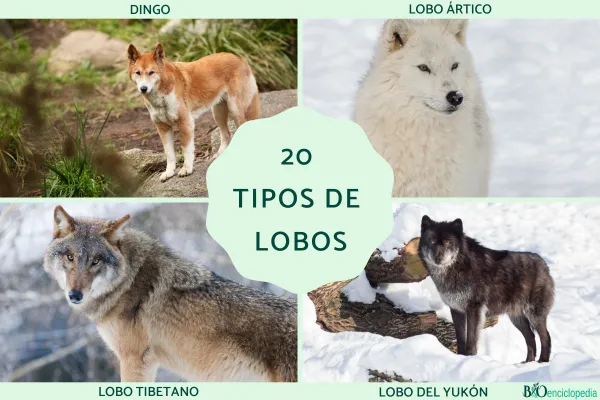
3) Dingo (Canis lupus dingo)
Australia’s iconic wild canid, typically with a reddish coat. Adults are often described around 60 cm at the shoulder in many sources. Dingoes can look like domestic dogs, but they are not truly domesticated and behave as wild animals.

4) Arctic Wolf (Canis lupus arctos)
Often recognizable by its white coat, adapted for snow-covered landscapes. Commonly described at 1.0–1.4 m in body length. Ranges across parts of Canada, Alaska, and Greenland. Because prey can be scarce, it may travel long distances to find food.

5) European Wolf / Common Wolf (Canis lupus lupus)
One of the most widely distributed wolf forms in the Old World. Known for strong adaptability across climates. It has a thick coat and is often described at about 1.0–1.5 m in length, depending on region and population.

6) Iberian Wolf (Canis lupus signatus)
Endemic to the Iberian Peninsula. It is often described as relatively smaller and notable for dark markings—including characteristic black patches along the back. It has faced pressure from hunting and conflict with humans in parts of its range.

7) Italian Wolf (Canis lupus italicus)
Recognized as a subspecies in the early 20th century, described as having a distinct skull shape compared with broader European populations. It lives mainly in the Western Alps and the Apennines and is often listed at roughly 1.0–1.4 m in length. Historically persecuted, it has been vulnerable in the past due to hunting and habitat pressures.

8) Florida Wolf (Canis lupus floridanus)
A historical example of a wolf type that is often described as extinct. It was once found only in Florida (USA) and was reportedly eliminated by hunting in the early 1900s. Some accounts describe it as very dark or black-coated.
9) Tibetan Wolf (Canis lupus chanco)
Associated with the Tibetan Plateau and neighboring highland regions, with reports extending into parts of the Himalayas, Mongolia, and nearby areas. Typically described with a sandy coat, darker hairs along the back, and a lighter underside. Body length is often given around 90–160 cm in regional descriptions.

10) Vancouver Coastal Wolf (Canis lupus crassodon)
Found in southern Alaska and on Vancouver Island. Because it lives near the coast, it may show semi-aquatic habits and is known for strong swimming ability—sometimes moving between islands. Diet can include marine resources such as fish and shellfish, alongside terrestrial prey.

11) Steppe Wolf (Canis lupus campestris)
Reported from broad steppe and semi-steppe regions around the Urals, parts near the Caspian Sea, and extending through sections of Eastern Europe and Central Asia. Often described as relatively small, with a dense, shorter coat and darker back shading into lighter tones toward the legs.

12) Greenland Wolf (Canis lupus orion)
Lives in Greenland, with many individuals occupying protected northern areas. Often described as small to medium in size and around 1.5 m in length in some sources.

13) Himalayan Wolf (Canis lupus laniger)
Linked to high-altitude regions of the Himalayas (including parts of India, China, and Nepal). Often described as pale beige on the back with near-white face, belly, and legs. Some classifications list it as vulnerable and emphasize that it is adapted to thin-oxygen environments at high elevations.

14) Tundra Wolf (Canis lupus albus)
Found across northern Eurasia, including regions from Russia toward Finland. It has a long, thick, pale coat—often described as white for snow camouflage. Commonly listed at about 1.1–1.3 m in length, with a body built to reduce heat loss in cold climates.

15) Ethiopian “Red Wolf” (often referring to a highland canid)
Some popular lists use the label “red wolf” for a high-altitude African canid described as living in very specific mountain areas and facing serious conservation threats. It is typically described as smaller (about 80–100 cm in length) with a shorter coat and restricted distribution at high elevations.

16) Hokkaido Wolf (Canis lupus hattai)
Once lived on Hokkaido, Japan, and is widely described as extinct. Accounts often state it disappeared after being systematically eliminated due to perceived risk to livestock, including poisoning campaigns. It was sometimes described as gray in summer and lighter gray in winter.
17) Indian Wolf (Canis lupus pallipes)
Often described as one of the most threatened wolf forms. It occupies warmer regions from parts of Southwest/West Asia toward the Indian subcontinent. Because it lives in hot climates, it typically does not develop the heavy seasonal coat changes seen in northern wolves. Many descriptions place it around 60–70 cm at the shoulder.

18) Yukon Wolf (Canis lupus pambasileus)
Frequently listed among the largest wolves, with body length sometimes described around 1.5–1.9 m. Found in interior Alaska and the Yukon in Canada. Coat color varies widely—beige, gray, white, or black—often matching local habitat.

19) Mackenzie Valley Wolf (Canis lupus occidentalis)
Associated with the Mackenzie River region in Canada. Often described as large, with a shoulder height sometimes noted around 80 cm. Coat color is highly variable from white to black with many gray shades between. It keeps a longer coat much of the year but can shed into a shorter coat in warmer months.

20) Baffin Island Wolf (Canis lupus manningi)
Found in Baffin Island and nearby Arctic islands in Canada. It is typically very pale—often appearing white but sometimes described as very light gray. Many lists describe it as among the smallest Arctic wolf forms.
Why “Wolf Types” Vary So Much
Climate: colder regions favor thicker coats and larger body mass for heat retention.
Prey and terrain: diet and landscape shape body size, endurance, and hunting strategy.
Isolation: islands and mountain systems encourage distinctive local traits over time.
Human impact: hunting pressure and habitat change can shrink ranges and fragment populations, accelerating local differentiation.