Amphibians go through a remarkable life cycle: they begin fully dependent on water, then transform through metamorphosis as legs and lungs develop. Salamanders are part of this group, and while many species are small, a few are truly enormous. The Chinese giant salamander is famous for its impressive size—often reaching around 1.5 meters in length—which is extraordinary for an amphibian.
Below is an optimized overview of what the Chinese giant salamander is, where it lives, what it eats, how it behaves and reproduces, and why it is now one of the world’s most threatened amphibians.

Key Characteristics of the Chinese Giant Salamander
The Chinese giant salamander’s scientific name is Andrias davidianus. It is a unique amphibian known for its massive body and highly aquatic lifestyle.
Size and appearance
Length: commonly up to 1.5 meters, which can be comparable to the height of a child.
Tail retained: like other salamanders, it does not lose its tail during metamorphosis—adults keep it.
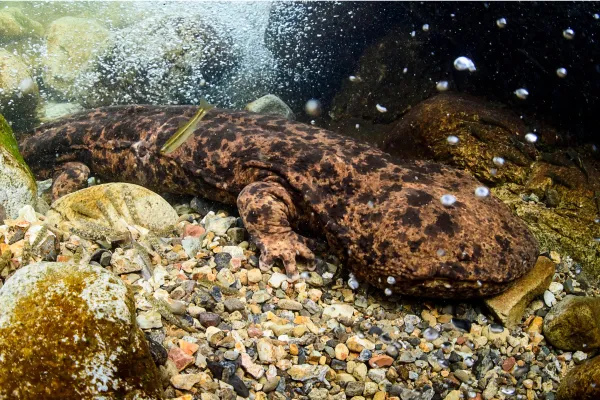
Flattened head: the head is broad and flattened from top to bottom, and the neck region is clearly distinct from the rest of the body.
Short legs: limbs are relatively short; loose folds of skin are common along the body.
Dorsal fin fold: a fin-like ridge runs along the back and can extend forward toward the snout.
Small eyes, poor vision: eyesight is weak; they rely more on other senses and water vibrations.
Throat tubercles: small paired bumps in the throat region can help distinguish it from other giant salamanders, such as the Japanese giant salamander (Andrias japonicus).
Coloration: typically brown with darker, irregular blotches. Rare variants may show orange-and-black patterning, and albinos are occasionally reported.
Where the Chinese Giant Salamander Lives
The Chinese giant salamander has a very limited and fragmented range. It is native to China and occurs in only a few remaining localities, historically associated with river systems connected to the Yangtze and Yellow River basins and nearby mountainous regions.
Freshwater habitat requirements
Fully aquatic: they live in water year-round and depend on it to avoid drying out.
Clear, cool, flowing rivers: they prefer fresh, clean water with a current (lotic habitats), but not so fast that they are easily swept away.
Gravel or rocky bottoms: riverbeds with gravel and stones are favored for shelter and hunting.
Vegetated riverbanks: dense surrounding vegetation—valley habitats and forested areas—helps maintain water quality and stable microclimates.
Caves and crevices: they rely on underwater cavities, burrows, or rock shelters to hide during the day and during breeding.

What the Chinese Giant Salamander Eats
Because of its large body size, this salamander can take relatively large prey and gains substantial energy from each successful capture.
Typical diet
Crustaceans
Insects and insect larvae
Worms
Other salamanders
Frogs
Fish
Occasionally small mammals (such as shrews) if available
They usually hunt in water, ambushing prey from shelter and striking quickly at close range.
Behavior of the Chinese Giant Salamander
The Chinese giant salamander is well known for its secretive habits and unusual vocalizations.
Notable behaviors
Vocal and sound-producing: they can emit a variety of sounds—often described as surprisingly loud, sometimes compared to a child’s cry.
Nocturnal activity: they are mainly active at night, when they forage and move between shelters.
Depth differences by age: adults often occupy deeper areas than juveniles.
Strong parental defense: males can become highly aggressive while guarding eggs or larvae.

Reproduction and Life Cycle
Breeding typically occurs in warmer months when water temperatures rise.
Breeding season
Timing: commonly from July to September, when temperatures can approach around 20°C.
Egg-laying and fertilization
Egg numbers: females may release roughly 300 to 600 eggs in an underwater cave or sheltered chamber.
External fertilization: eggs are fertilized outside the female’s body, typically close to the guarding male.
Male guarding: the male protects the nest for around 60 days, helping reduce predation and disturbance.
Larval development
Larvae hatch with gills and a more fish-like body form.
Early feeding may include plankton and small aquatic organisms.
As they grow, they develop forelegs first, then hind legs.
Eventually, they lose external gills and develop functional lungs as they transition toward a more adult form—while still remaining strongly tied to aquatic life.

Is the Chinese Giant Salamander Endangered?
Yes. The Chinese giant salamander is classified as Critically Endangered, and many wild populations have declined drastically.
Main reasons for decline
Habitat loss and degradation: deforestation, land-use change, and development near rivers reduce shelter, raise water temperatures, and increase erosion.
Water infrastructure impacts: dams and water projects can alter flow, increase turbidity, and disrupt breeding caves and feeding zones.
Pollution: contaminated runoff and declining water quality harm both salamanders and their prey.
Severe fragmentation: remaining groups are isolated, making it harder for individuals to meet and reproduce, weakening long-term survival.
Overexploitation for consumption: the species has been captured for food for decades. In some areas, intensive harvesting has driven sharp local collapses.
Destructive capture methods: practices such as poisoning or electric fishing can kill non-target wildlife and damage aquatic ecosystems.
Protection status
The species is protected internationally under wildlife trade controls, meaning that removal from the wild and commercial trade are illegal in many contexts. Even so, enforcement and habitat pressures remain ongoing challenges.
Interesting Facts About the Chinese Giant Salamander
How big can it get? Exceptional individuals have been reported at around 1.8 meters.
How long does it live? It can be very long-lived—records suggest lifespans up to 55 years in some cases.
Protective skin secretions: the skin produces a sticky secretion that can help deter predators and may protect against microbes.
Is it venomous? No—despite its size, it is not venomous and is not considered inherently dangerous to humans.
“Living fossil” reputation: it retains ancient-looking traits—large body size, deep aquatic dependence, and a lineage that feels reminiscent of earlier amphibian eras.