The American horseshoe crab, Limulus polyphemus, is often described as one of Earth’s most ancient-looking animals. Despite its common name, it is not a true crab. Horseshoe crabs are arthropods more closely related to spiders and scorpions than to crabs or lobsters. Their armored body, unusual blue blood, and mass spawning events on sandy beaches make them one of the most fascinating coastal animals in the world—and also one of the most discussed in conservation and biomedical science.
Below is a detailed, reader-friendly guide to what horseshoe crabs are, where they live, why their blood matters, how they behave, and what threatens their survival.
Quick Facts
Scientific name: Limulus polyphemus
Common names: Horseshoe crab; also called “pan crab” or “bayonet crab” in some regions
Animal group: Arthropod (subphylum Chelicerata)
Closest relatives: Spiders, scorpions (not true crabs)
Habitat: Shallow coastal waters, sandy/muddy bottoms, estuaries
Famous feature: Blue blood used in medical safety testing
Danger to humans: Generally harmless (no venom, not aggressive)
Characteristics and Anatomy
Horseshoe crabs have a distinctive body plan that has changed very little over geological time:
1) Body sections and “armor”
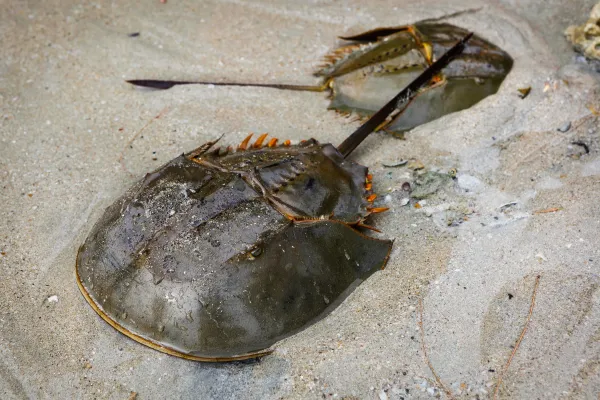
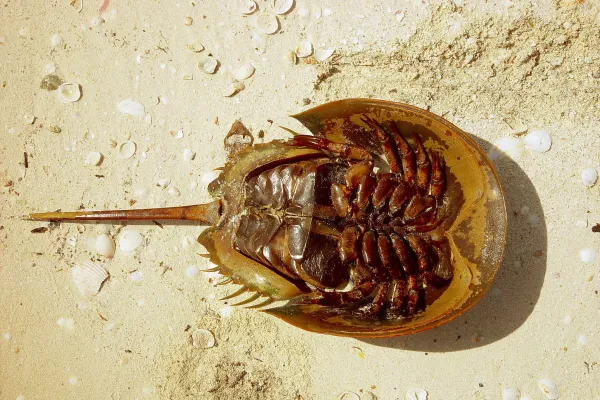
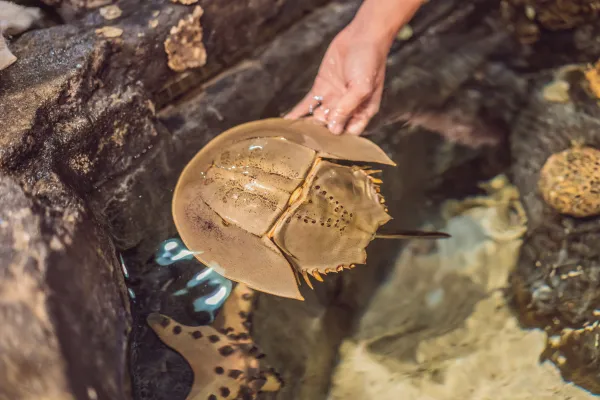
Their body looks like a hard helmet and is typically described in three main parts:
Prosoma (front shield): the large horseshoe-shaped carapace that protects the main organs
Opisthosoma (rear section): a smaller shield behind the prosoma
Telson (tail spine): a long, pointed tail
The shell can resemble a turtle-like shield—tough, smooth, and built for life on the seafloor.
2) Size
Adults vary widely by age and sex.
Many individuals measure up to ~60 cm in total length (including the tail) and around ~30 cm wide, depending on the population and measurement method.
Very large individuals have been reported in popular sources, but most adults are smaller than 1 meter overall.
3) The tail spine (telson): not a stinger
A common misunderstanding is that the tail is used to sting. In reality:
The telson is mainly used to right itself if waves flip it upside down.
It can also help with movement in sediment and orientation in the surf zone.
4) Is the horseshoe crab dangerous?
For people, horseshoe crabs are not considered dangerous:
They do not attack humans
They do not inject venom
The main “risk” is accidental scratches from the sharp tail or shell edges if handled carelessly.
5) Role in the ecosystem
Horseshoe crabs are important in coastal food webs:
They help regulate populations of small seafloor invertebrates
Their eggs become a critical seasonal food source for migratory shorebirds, which time migrations to spawning events in some regions.
The Famous Blue Blood of Horseshoe Crabs
Horseshoe crab blood is blue because it uses copper-based hemocyanin (not iron-based hemoglobin) to carry oxygen.
Why the blood matters to medicine
Their blood contains immune cells that react strongly to certain bacterial toxins called endotoxins (from Gram-negative bacteria). This property has been used by the biomedical industry to help test whether:
injectable drugs
IV fluids
vaccines
implantable medical devices (such as heart valves and prosthetics)
are contaminated.
This is why horseshoe crabs are collected and bled in regulated industries in some places. The topic is controversial because overharvesting, handling stress, and mortality can affect populations.
Where Horseshoe Crabs Live
Regional distribution
Limulus polyphemus occurs along the western Atlantic, especially:
the U.S. Atlantic coast (notably from the Northeast down through the Southeast)
the Gulf of Mexico, including areas around the Yucatán Peninsula
Some sources also report limited occurrences in parts of the Caribbean (e.g., islands such as Cuba, Jamaica, and the Bahamas), often with smaller or less stable populations compared to major mainland breeding areas.
Habitat type
They typically live on:
sandy or muddy bottoms
shallow coastal waters
estuaries and tidal flats
They often rest or feed in sediment—sand, silt, and mud—where many of their prey animals live.
Behavior
Horseshoe crabs are often described as:
solitary and shy for much of the year
excellent diggers that spend long periods partially buried
more active during certain seasons and tidal conditions
Mass beach gatherings
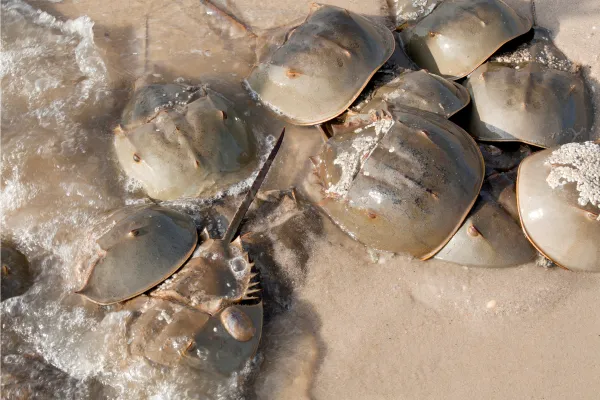
Their most dramatic behavior happens during the breeding season:
hundreds to thousands may gather on beaches at once
spawning often aligns with tides and seasonal cycles
these events can create “egg-rich” beaches that attract birds and other coastal wildlife.
Diet and Feeding
Horseshoe crabs are mainly predators/scavengers of small bottom-dwelling animals. They commonly eat:
worms (including annelids)
mollusks (small clams and similar prey)
other small invertebrates living in sand and mud
They often forage at night or under low-light conditions. After crushing prey, they may leave behind indigestible remains such as shell fragments.
Reproduction and Life Cycle
Horseshoe crabs are egg-layers (oviparous).
Females dig into sand and deposit eggs below the surface.
A female may lay many eggs over her lifetime—popular summaries often cite totals on the order of tens of thousands to over 100,000.
Each nesting event can include large clusters of eggs placed in the sand, sometimes described as up to ~20,000 per nesting under favorable conditions (figures vary across sources and locations).
Eggs hatch into larvae that develop through multiple molts as they grow into juveniles and eventually adults.
Threats and Conservation
Horseshoe crabs face multiple pressures, and the intensity depends on region:
1) Biomedical bleeding and harvest
Horseshoe crabs have been harvested because their blood is valuable for endotoxin detection.
Even when returned to the ocean, handling can cause stress, injury, and—depending on practices—mortality or reduced reproduction.
2) Bait and food harvesting
In some regions, horseshoe crabs are collected:
for bait in fisheries
for human consumption (less common in some areas, more in others)
3) Habitat loss and pollution
Coastal development can reduce spawning beaches and degrade estuaries. Pollution risks include:
heavy metals
industrial runoff
habitat contamination in bays and river mouths
4) Climate change
Warming water, sea level rise, stronger storms, and shifting shorelines can affect:
spawning beach quality
egg survival
timing of breeding and food availability for dependent wildlife (like migratory birds)
Conservation status (important note)
Different sources describe risk differently (local declines vs. global classification). In many conservation discussions, horseshoe crabs are considered of concern due to population drops in certain key regions since the late 20th century, even when the species may not be globally classified as “endangered.” Management commonly focuses on:
harvest limits
protected spawning beaches
monitoring programs
reducing pollution and restoring coastal habitats
Interesting Facts
Horseshoe crabs have existed for hundreds of millions of years (often cited as 300+ million).
They are called a “living fossil” because their body plan has changed relatively little in appearance over extremely long time scales.
Their eggs can function like a seasonal “energy bank” for migrating shorebirds, helping birds refuel for long journeys.
They can tolerate low-oxygen conditions for periods, which helps survival in sediment and shallow coastal habitats.
They may swim upside down at times, moving with legs and body angle to reorient.
FAQ
Are horseshoe crabs actually crabs?
No. They are chelicerate arthropods, closer to spiders and scorpions than to true crabs.
Can the tail sting you?
No. The tail spine is not a stinger; it helps them flip back over and navigate.
Why is their blood used in medicine?
Their blood reacts strongly to certain bacterial endotoxins, helping detect contamination in medicines and medical devices.
What should you do if you find one on the beach upside down?
If local rules allow and it’s safe, you can gently flip it back over by holding the shell edge (not the tail). Avoid lifting by the telson.