The “24,000-year-old animal revived” was not a mammoth, dinosaur, or large Ice Age beast. It was a microscopic animal called a bdelloid rotifer. Scientists recovered it from ancient Siberian permafrost, thawed it under laboratory conditions, and found that it could return to active life and reproduce asexually. The discovery showed that some tiny multicellular animals can survive in a frozen, inactive state for tens of thousands of years.
Quick Facts About the 24,000-Year-Old Animal
| Feature | Answer |
|---|---|
| Animal involved | Bdelloid rotifer |
| Approximate age | About 24,000 years old |
| Where it was found | Siberian Arctic permafrost |
| Animal type | Microscopic multicellular animal |
| Survival state | Cryptobiosis, a suspended state with extremely reduced activity |
| What happened after thawing? | It became active again and reproduced asexually |
| Was it a dinosaur? | No |
| Was it a mammal? | No |
| Why it matters | It reveals the extreme survival ability of some tiny animals under freezing conditions |
| Main science field | Cryobiology, evolutionary biology, permafrost biology, and astrobiology |
What Animal Was Revived After 24,000 Years?
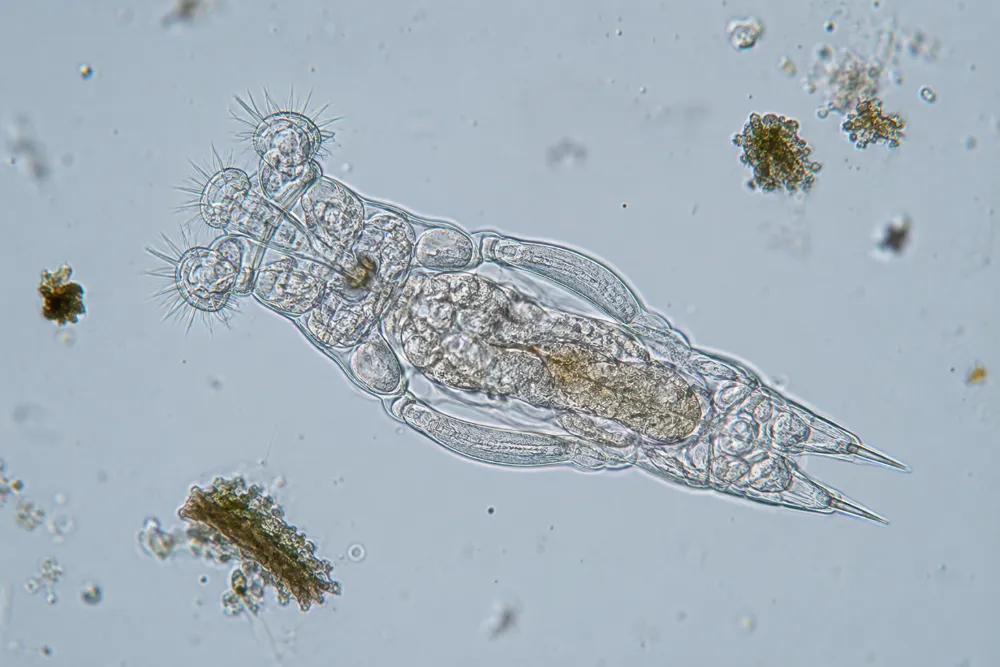
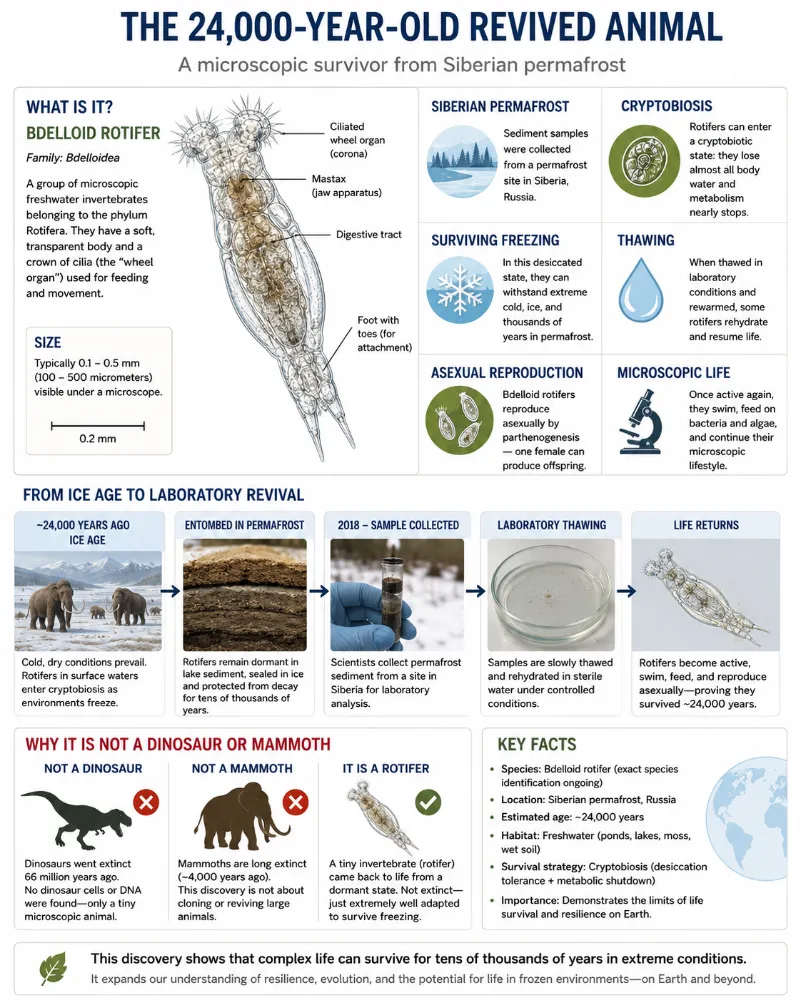
The revived animal was a bdelloid rotifer, a tiny aquatic animal that is usually too small to see clearly without a microscope. Rotifers are sometimes called “wheel animals” because the cilia around their mouth can look like spinning wheels when they feed.
Bdelloid rotifers are especially famous among biologists because they can survive extreme conditions. Many can dry out, freeze, lose most visible activity, and later return to normal life when water and suitable conditions return.
The 24,000-year-old rotifer was found in permanently frozen ground, known as permafrost. When researchers thawed the sample, the rotifer resumed activity. Even more remarkably, it reproduced by parthenogenesis, meaning it produced offspring without mating.
What Is a Rotifer?
A rotifer is a microscopic animal that usually lives in freshwater, moist soil, moss, lichen, temporary pools, or wet sediments. Although rotifers are tiny, they are true animals. They have bodies made of many cells, a digestive system, muscles, nerves, and specialized feeding structures.
Most rotifers feed on bacteria, algae, tiny organic particles, and other microscopic food. They are important members of freshwater and soil ecosystems because they help transfer energy from microbes and algae to larger organisms.
Bdelloid rotifers are one major group of rotifers. They are especially interesting because they reproduce mostly or entirely without males and have extraordinary abilities to survive drying, freezing, and other environmental stress.
What Does “Revived” Really Mean?
In this case, “revived” does not mean scientists resurrected a dead animal in a science-fiction sense. The rotifer was not dead in the ordinary way. Instead, it had likely remained in a deeply inactive state for thousands of years.
This state is called cryptobiosis. During cryptobiosis, an organism’s metabolism becomes extremely low or nearly undetectable. It does not grow, feed, move normally, or reproduce. It is essentially paused until conditions improve.
When the frozen permafrost sample was thawed, the rotifer returned to active life. That is why the discovery is often described as an animal being “revived,” even though it is more accurate to say the animal survived long-term frozen cryptobiosis.
What Is Cryptobiosis?
Cryptobiosis is a survival state used by some small organisms when conditions become too harsh for normal life. In cryptobiosis, the organism shuts down most visible biological activity and waits for better conditions.
Different forms of cryptobiosis can occur in response to different stresses. Some organisms enter a dry state when water disappears. Others survive freezing, low oxygen, high salt, or extreme cold. The basic idea is the same: the organism temporarily suspends normal life processes.
Cryptobiosis is not the same as sleep, hibernation, or ordinary dormancy. It is much more extreme. A cryptobiotic animal may appear lifeless under normal observation, yet still retain the biological machinery needed to restart life later.
How Could a Tiny Animal Survive for 24,000 Years?
The rotifer survived because of a combination of biology and environment. Bdelloid rotifers are naturally resilient animals. Their bodies can tolerate severe stress, and they can protect cells from damage during drying or freezing.
The permafrost environment was also important. Permanently frozen ground can act like a natural deep freezer. Low temperatures slow chemical reactions, reduce microbial decay, and help preserve biological material for long periods.
However, survival for 24,000 years is still extraordinary. Ice crystals, radiation, chemical damage, and time can all harm cells. The discovery suggests that bdelloid rotifers have unusually effective ways to protect or repair cellular damage after long-term freezing.
Where Was the Rotifer Found?
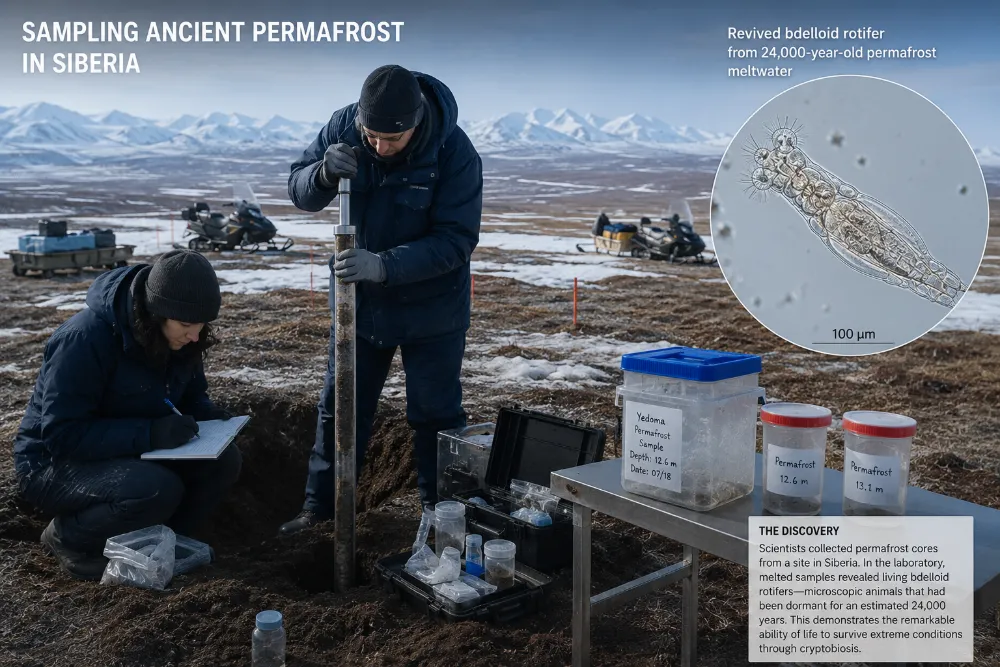
The rotifer was recovered from Arctic permafrost in northeastern Siberia. Permafrost is ground that remains frozen for at least two consecutive years, but some Arctic permafrost has stayed frozen for thousands or even tens of thousands of years.
Ancient permafrost can preserve plant fragments, microbes, pollen, tiny animals, and even the remains of Ice Age mammals. In this case, the frozen ground preserved a living microscopic animal in a state that allowed it to restart activity after thawing.
Siberian permafrost is especially important for this kind of research because it contains very old frozen sediments from the Late Pleistocene, the Ice Age period when mammoths, woolly rhinos, steppe bison, and other cold-adapted animals lived across northern landscapes.
Was the Animal Really 24,000 Years Old?
The age refers to the ancient frozen sediment from which the rotifer was recovered. Researchers used dating methods to estimate that the permafrost layer was about 24,000 years old.
That does not mean the rotifer was crawling around for 24,000 years. It means the animal was preserved in a frozen inactive state within ancient permafrost for roughly that length of time.
This distinction is important. The rotifer’s body was not active for thousands of years. It survived by being biologically paused in a frozen environment until thawing allowed it to resume life.
Why This Discovery Surprised Scientists
Before this discovery, scientists already knew that bdelloid rotifers were tough. They could survive drying, freezing, starvation, and other stresses far better than many animals. But surviving in frozen permafrost for tens of thousands of years pushed that ability to an extreme level.
The discovery showed that at least some multicellular animals can remain viable in natural frozen conditions for much longer than previously demonstrated for rotifers.
This matters because multicellular animals are generally more complex than bacteria or single-celled organisms. Keeping an entire animal body viable for thousands of years requires preservation of many cells, tissues, membranes, proteins, and genetic material.
Did the Rotifer Reproduce After Thawing?
Yes. One of the most important parts of the discovery was that the rotifer did not merely move after thawing. It was able to reproduce asexually.
Bdelloid rotifers reproduce by parthenogenesis. This means females produce offspring without fertilization by males. In practical terms, a single surviving bdelloid rotifer can restart a small population if conditions are suitable.
This reproductive ability made the discovery even more impressive. Movement alone might suggest partial survival, but reproduction shows that the animal’s biological systems were functioning well enough to continue its life cycle.
Why It Was Not a Dinosaur or Mammoth
Headlines about a “24,000-year-old animal revived” can sound like a giant Ice Age creature was brought back to life. That is not what happened. The animal was microscopic.
Large animals such as mammoths, cave lions, and woolly rhinos have been found frozen in permafrost, but they have not been revived. Their tissues may be preserved, but their cells and organs are not alive in a way that allows the animal to restart life.
A tiny rotifer is very different from a mammal. Its small body, simple structure, and cryptobiotic abilities make long-term survival far more plausible than revival of a large vertebrate.
Could Scientists Revive a Frozen Mammoth the Same Way?
No. The rotifer discovery does not mean scientists can thaw and revive a mammoth. A mammoth is a large, warm-blooded mammal with complex organs, a brain, blood vessels, immune systems, and billions of specialized cells.
When a large animal freezes, ice crystals and decay damage tissues on a massive scale. Even if the body looks well-preserved from the outside, the animal is not simply paused like a cryptobiotic rotifer.
Some scientists study ancient DNA and de-extinction concepts, but that is a different field from reviving a frozen animal. Reviving a microscopic cryptobiotic animal is biologically very different from resurrecting an extinct mammal.
Why Bdelloid Rotifers Are So Tough
Bdelloid rotifers have several traits that help them survive extreme conditions. They can tolerate drying, repair DNA damage, survive freezing, and restart activity when water returns. Their small size also helps because oxygen, water, and temperature changes affect them differently than large animals.
Many bdelloid rotifers live in temporary habitats such as mosses, puddles, wet soil, and seasonal water films. These habitats can dry out or freeze, so rotifers that survive stress have a major advantage.
Over evolutionary time, these animals developed remarkable survival strategies. The 24,000-year-old rotifer case shows just how far those strategies can go under the right frozen conditions.
Rotifers vs Tardigrades
Rotifers are often compared with tardigrades because both are tiny animals known for extreme survival. Tardigrades, sometimes called water bears, can survive drying, freezing, high pressure, radiation, and even exposure to space-like conditions in some experiments.
Rotifers are different animals. They have wheel-like feeding structures, different body organization, and different evolutionary history. Bdelloid rotifers are especially famous for their asexual reproduction and resistance to drying and freezing.
Both rotifers and tardigrades show that small animals can survive environmental stress in ways that larger animals cannot. They are important models for studying the limits of life.
Rotifers vs Ancient Nematodes
Rotifers are not the only tiny animals reported from ancient permafrost. Nematodes, or roundworms, have also been recovered from old frozen sediments and revived under laboratory conditions.
Like rotifers, nematodes are small animals with bodies that can sometimes tolerate extreme stress. Their survival helps scientists study how animal cells endure freezing, starvation, and long periods without normal metabolism.
The broader lesson is that permafrost can preserve more than bones and fossils. Under rare conditions, it can preserve living organisms in suspended states for extremely long periods.
What Scientists Can Learn From This Animal
The revived rotifer gives scientists a natural example of long-term biological preservation. By studying how it survives freezing, researchers may learn more about cell protection, DNA repair, membrane stability, and stress tolerance.
This research could help fields such as cryobiology, which studies life at low temperatures. Cryobiology is important for preserving cells, tissues, embryos, seeds, microbes, and other biological materials.
The discovery also interests astrobiologists. If tiny animals can survive long periods in frozen Earth environments, it raises questions about whether life could persist in icy habitats elsewhere, such as on Mars-like environments or icy moons, although that remains speculative.
Does This Discovery Mean Ancient Animals Are Waking Up Everywhere?
No. The rotifer case is extraordinary, not ordinary. Most animals trapped in ancient ice or permafrost do not survive. Long-term revival requires the right organism, the right survival state, and the right preservation conditions.
However, warming permafrost is exposing ancient biological material more often. Some of it may include dormant microbes or tiny organisms. This does not mean extinct monsters are returning, but it does mean permafrost biology is an important scientific field.
As Arctic regions warm, scientists are paying closer attention to what melting permafrost releases: carbon, methane, preserved organic matter, ancient DNA, microbes, and rare living organisms.
Is the Revived Rotifer Dangerous?
There is no reason to think the revived rotifer itself is dangerous to humans. Rotifers are common microscopic animals in freshwater and wet soils. They do not attack people, and they are not large enough to be seen without magnification.
The larger safety discussion is about permafrost thaw in general. Ancient frozen ground can contain microbes, organic matter, and chemical changes that scientists need to study carefully. But the rotifer itself is not a monster, parasite, or threat.
For animal science education, the rotifer should be seen as a remarkable survival specialist rather than a dangerous revived creature.
What the Discovery Teaches About Life
The 24,000-year-old rotifer teaches an important lesson: life can be far more resilient than it appears. Some organisms are not limited to active growth and constant movement. They can pause their lives, survive extreme conditions, and resume activity when the environment improves.
This ability challenges our everyday idea of what it means to be alive. In cryptobiosis, an animal may seem inactive or lifeless, yet its biological structures remain organized enough to restart.
For zoologists, the discovery is a reminder that some of the most extraordinary animals on Earth are not large predators or colorful birds. Sometimes they are microscopic creatures living quietly in mud, moss, water films, and frozen ground.
Simple Identification Summary
| Question | Answer |
|---|---|
| What was the 24,000-year-old revived animal? | A bdelloid rotifer |
| Was it visible to the naked eye? | No, it was microscopic |
| Was it extinct? | No, bdelloid rotifers still exist today |
| Was it brought back from death? | Not exactly; it survived in frozen cryptobiosis |
| Could it reproduce? | Yes, by asexual reproduction |
| Why is it important? | It shows extreme long-term survival in a multicellular animal |
Final Verdict: The 24,000-Year-Old Animal Revived
The 24,000-year-old animal revived from Siberian permafrost was a bdelloid rotifer, a microscopic multicellular animal known for extreme survival abilities. It survived in a frozen cryptobiotic state, returned to activity after thawing, and reproduced asexually.
This discovery does not mean large extinct animals can be thawed back to life. Instead, it shows that some tiny animals have extraordinary biological tools for surviving freezing, drying, and long periods of inactivity. The rotifer is not a science-fiction monster. It is a small but powerful example of life’s ability to endure at the edge of possibility.
FAQs About the 24,000-Year-Old Animal Revived
What animal was revived after 24,000 years?
The animal was a bdelloid rotifer, a microscopic freshwater animal known for surviving extreme conditions.
Was the 24,000-year-old animal a dinosaur?
No. It was not a dinosaur. It was a tiny microscopic animal called a rotifer.
Was the revived animal a mammoth?
No. Mammoths have been found preserved in permafrost, but they have not been revived. The revived animal was a microscopic rotifer.
How did the rotifer survive for so long?
It likely survived in cryptobiosis, a state in which normal biological activity becomes extremely reduced. The frozen permafrost environment helped preserve it.
What is cryptobiosis?
Cryptobiosis is a suspended survival state that allows some organisms to endure extreme conditions such as drying, freezing, or lack of oxygen.
Did the rotifer reproduce after being thawed?
Yes. The rotifer was able to reproduce asexually after thawing, which showed that it had returned to functional life.
Are rotifers animals?
Yes. Rotifers are microscopic multicellular animals with specialized body structures, digestive systems, muscles, and nerves.
Can humans survive frozen for 24,000 years?
No. Humans cannot survive freezing in the same way. Large mammals have complex organs and tissues that are badly damaged by freezing.
Are revived ancient organisms dangerous?
The revived rotifer itself is not considered dangerous. However, thawing permafrost can release ancient biological material, so scientists study it carefully.
Why is the 24,000-year-old rotifer important?
It expands our understanding of how long multicellular animals can survive in frozen cryptobiosis and helps scientists study the limits of life.