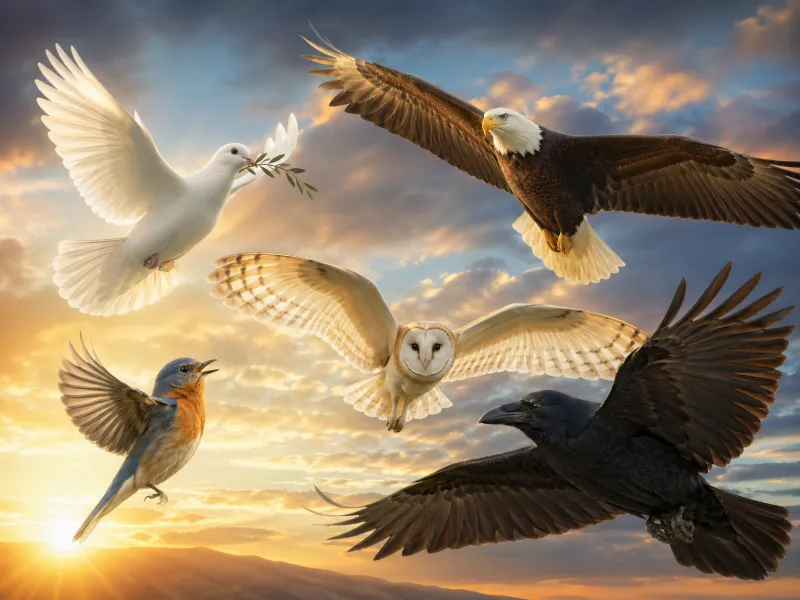
Birds have inspired superstition for centuries because they move between الأرض and sky in ways that once seemed mysterious, symbolic, and even supernatural. Across many cultures, birds have been seen as omens of luck, death, love, weather, messages, and spiritual change. Some superstitions portray them as signs of hope or protection, while others treat them as warnings. In reality, these beliefs tell us more about human fear, imagination, and storytelling than about the birds themselves.
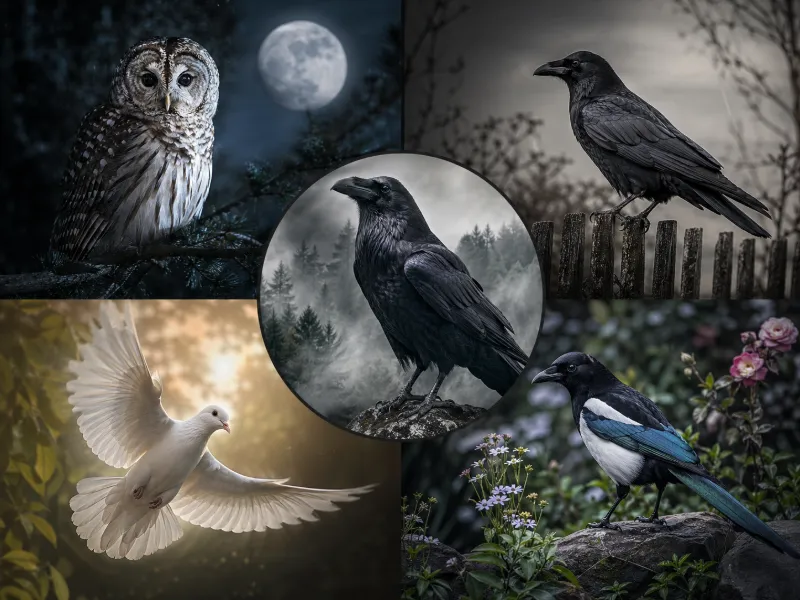
Long before modern biology explained migration, courtship, nesting behavior, and seasonal movement, people watched birds closely and tried to find meaning in what they saw. A bird appearing at the window, calling at night, circling a house, or suddenly vanishing into the sky could feel like a message from another world.
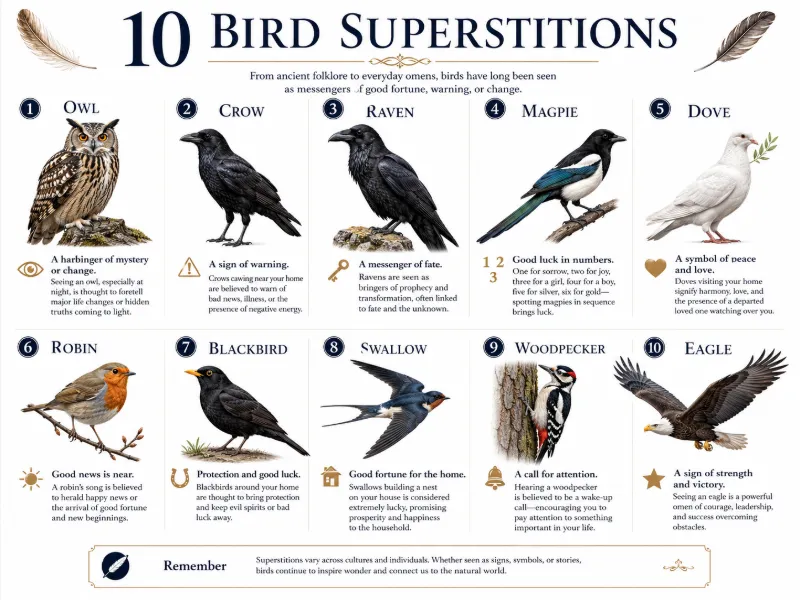
In this guide, you will explore ten well-known superstitions about birds, what they traditionally mean, and why certain species became so symbolic in folklore.
Quick comparison table
| Bird or sign | Traditional superstition | Common meaning |
|---|---|---|
| Owl calling at night | A warning or omen | Death, mystery, or hidden knowledge |
| Bird flying into a house | A powerful sign | Change, message, or bad luck in some traditions |
| Crow near the home | An omen bird | Intelligence, death, trickery, or news |
| Raven appearing repeatedly | A sign from the unseen world | Prophecy, transformation, or warning |
| Magpie seen alone | A bad luck sign in some folklore | Sorrow, imbalance, or misfortune |
| Dove near a person or home | A positive sign | Peace, love, purity, or spiritual comfort |
| Robin appearing after loss | A comforting message | Hope, visitation, or remembrance |
| Blackbird call or presence | A mysterious sign | Secrets, transition, or warning |
| Birds circling overhead | A sign to pay attention | Weather, danger, or spiritual meaning |
| Bird dropping on you | A lucky accident | Unexpected good fortune |
Owls and the fear of the night
Owls are among the most superstition-rich birds in the world. Because they are active at night, have forward-facing eyes, and can appear suddenly and silently, many people have seen them as eerie or otherworldly creatures.
In some traditions, hearing an owl call near the house was taken as a warning of death, illness, or bad news. In others, the owl was associated not with death but with wisdom, hidden truth, or spiritual sight. This double image makes the owl especially interesting in folklore.
The reason owls inspired so much fear is easy to understand. To people living without electric light, a strange voice in the dark could feel supernatural. The owl’s real biology is impressive enough on its own, but in folklore, it became a messenger from mystery itself.
A bird flying into the house
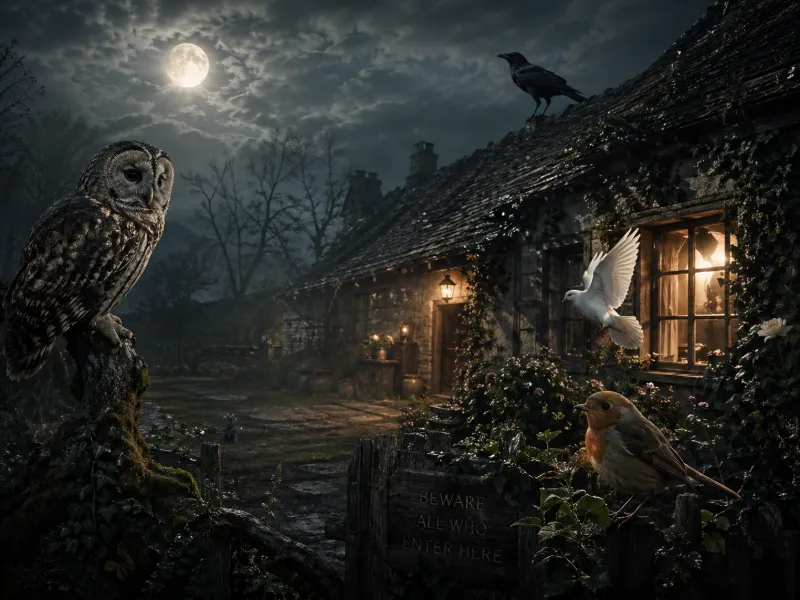
One of the most widespread bird superstitions is that a bird entering the home is a sign of something important about to happen. In many traditions, this event is treated as more than an accident.
Some people saw it as a warning of death or misfortune, especially if the bird seemed frantic or entered through a window unexpectedly. Others viewed it as a message from the spirit world or a sign that major change was coming.
Today, there is usually a simple explanation. Birds may fly toward reflected light, become confused by glass, or enter a room through an open door. Even so, the emotional power of the old superstition remains strong because homes are deeply symbolic places in human culture.
Crows as omens of news and death
Crows are highly intelligent, vocal, and socially complex birds, but folklore often casts them in darker roles. Their black feathers, loud calls, and habit of gathering around carrion helped link them with death, battlefields, and bad omens in many traditions.
In superstition, a crow near the home could signal bad news, an approaching death, or a warning to stay alert. In other stories, crows were clever messengers or trickster figures who carried information between worlds.
What makes crows so powerful in folklore is that they are both familiar and uncanny. They are common enough to be seen often, but intelligent enough to seem strangely observant, which made people feel they meant something when they appeared.
Ravens and prophecy
Ravens are larger, heavier, and even more dramatic in folklore than crows. In many traditions, they are linked with prophecy, battle, fate, and transformation. A raven appearing repeatedly could be treated as a sign that something significant was unfolding.
Because ravens are bold, adaptable, and often found in harsh landscapes, they became symbols of survival and hidden knowledge. Their deep croaking call and dark plumage only increased their mysterious reputation.
Some superstitions treat ravens as negative omens, while others see them as sacred guides or beings connected to wisdom. This mixed symbolism is common in bird folklore, where fear and respect often exist together.
Magpies and the luck rhyme
Magpies are famous in folklore largely because of old counting rhymes about how many are seen at once. In some English-speaking traditions, seeing a single magpie is said to bring sorrow or bad luck, while seeing two may mean joy, and larger numbers carry different meanings.
This superstition became so well known that some people still greet a lone magpie out loud, almost as a ritual to avoid bad luck. It is a striking example of how a simple folk rhyme can shape real behavior.
Magpies themselves are intelligent, social birds with bold black-and-white coloration. Their striking appearance and curiosity probably helped them become powerful symbolic birds in everyday superstition.
Doves as signs of peace and blessing
Not all bird superstitions are gloomy. Doves are often seen as positive signs connected with peace, purity, loyalty, comfort, and divine blessing. Seeing a dove near the home or after a difficult event is often interpreted as reassuring rather than threatening.
Because doves are gentle in appearance and strongly associated with love and pair bonding, they became symbols of harmony in many traditions. White doves in particular are often linked with spiritual peace and emotional healing.
In folklore, a dove may symbolize a message of comfort, a sacred presence, or the hope of reconciliation. Their reputation is one of the clearest examples of a bird becoming a positive omen rather than a fearful one.
Robins as visitors after loss
In some modern and traditional beliefs, robins are seen as comforting birds that appear after bereavement or emotional pain. A robin showing up near a grieving person may be interpreted as a sign that a loved one is near in spirit or that healing is beginning.
This idea is especially strong because robins are familiar garden birds that often appear boldly and visibly around people. Their bright chest and alert behavior make them easy to notice, which helps reinforce the feeling that the appearance is meaningful.
Whether taken literally or symbolically, the robin superstition is less about fear than about emotional connection. It shows how bird folklore can also help people process grief and hope.
Blackbirds and hidden warnings
Blackbirds have often been treated as mysterious or symbolic birds, especially when their songs or sudden appearances stand out in quiet places. In some folklore, a blackbird near the home or heard at an unusual time could suggest secrecy, warning, or change.
Part of this symbolism comes from color. Dark-feathered birds have long been associated with shadow, the unknown, and the boundary between ordinary life and the unseen world. Their songs, especially when haunting or repetitive, can make them feel even more symbolic.
At the same time, blackbirds are also admired for their beauty and musical calls. This blend of elegance and mystery makes them especially strong carriers of superstition.
Birds circling overhead
Birds flying in circles above a place or person have often been treated as signs that something unusual is happening. In folklore, this might suggest danger, weather change, death, or spiritual attention.
Part of this belief likely came from practical observation. People noticed that birds often respond quickly to changes in wind, prey movement, storms, or the presence of dead animals. Over time, that natural behavior gained supernatural meaning.
Even now, circling birds can feel dramatic, especially when large birds are involved. The movement naturally draws the eye upward, and humans tend to assign meaning to such striking patterns.
A bird dropping as a sign of luck
Perhaps the strangest bird superstition of all is the belief that a bird dropping on you is lucky. This idea survives in many places and is often repeated half-jokingly, especially because the event is so inconvenient and unpleasant.
Why would something messy be considered good luck? One reason may simply be rarity. Because it does not happen often, people may treat it as a strange accident that must carry meaning. In folklore, unusual and unlikely events are often reinterpreted as signs of coming fortune.
This superstition also reflects a classic human habit: turning annoyance into hope. Instead of seeing the event as purely bad luck, people convert it into a promise that something good will follow.
Why bird superstitions became so common
Birds inspired superstition more than many other animals because they are highly visible, highly mobile, and often unpredictable. They appear suddenly, vanish into the sky, call at unusual times, and gather in ways that can seem meaningful to observers.
Before science explained migration, seasonal breeding, flocking, navigation, and vocal behavior, many bird actions looked mysterious. A bird at the window, an owl calling in the dark, or a crow watching from a roof could easily seem like a message rather than ordinary animal behavior.
Birds also move between earth and sky, which made them powerful symbols in religions, myths, and folk beliefs. In the human imagination, that often placed them between the natural world and the supernatural one.
What bird superstitions reveal about people
These superstitions are less about birds being magical and more about people trying to make sense of uncertainty. Humans naturally look for patterns, especially during grief, fear, danger, love, or change. Birds, because they are so noticeable and symbolic, became perfect carriers of those meanings.
Some traditions use birds as warnings. Others use them as comfort. Some treat them as sacred messengers, while others see them as tricksters or omens. Together, these beliefs show how closely human culture has always watched the natural world.
Even if we no longer believe every old superstition literally, the stories remain powerful because they connect emotion, memory, and wildlife in memorable ways.
Final takeaway
Bird superstitions have lasted for centuries because birds are visible, symbolic, and often mysterious in human eyes. Owls, crows, ravens, magpies, doves, robins, and blackbirds have all been linked with luck, death, warning, love, or spiritual messages in different traditions. While these beliefs are not scientific facts, they remain fascinating examples of how people turned everyday bird encounters into stories about fate, fear, and hope.
FAQs
Why are birds so common in superstition?
Birds are common in superstition because they are highly visible, can appear suddenly, and have long been seen as symbolic creatures between earth and sky.
Are owls always considered bad omens?
No. In some traditions owls are linked with death or warning, while in others they represent wisdom, knowledge, or spiritual insight.
Why is a magpie considered unlucky in some places?
A lone magpie is linked with bad luck in some folklore because of old counting rhymes that assign different meanings to the number of magpies seen.
Do bird superstitions have any scientific basis?
Bird superstitions are cultural beliefs rather than scientific facts, though some may have grown out of careful observation of bird behavior and weather patterns.