At first glance, a seahorse looks nothing like a “typical” fish. It swims upright, has a horse-shaped head, a curled tail and no visible scales. So it’s normal to wonder: is a seahorse really a fish or not?
Yes, the seahorse is a fish. Seahorses belong to the class Actinopterygii, the same group as salmon, tuna and most other bony fishes. They share key traits with other fish:
A bony skeleton
Gills for breathing underwater
A swim bladder to control buoyancy
In this article we’ll go over what makes seahorses fish, their main characteristics, how they differ from other fish, and some fun facts that many people don’t know.
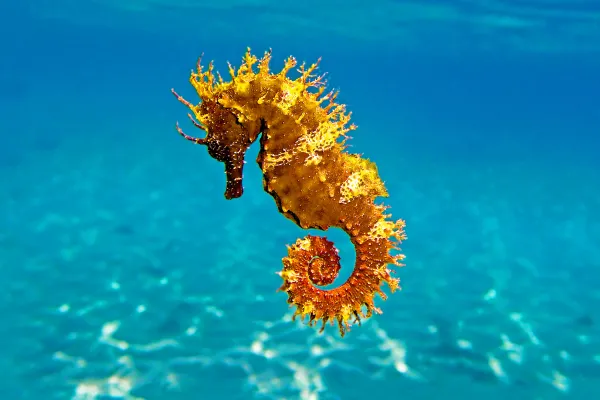
Is a Seahorse a Fish or Not?
Even though its body shape and swimming style are very unusual, the seahorse is scientifically classified as a fish.
It belongs to the genus Hippocampus, within the class Actinopterygii (ray-finned fishes).
It has a bony internal skeleton, gills, and a swim bladder, which are all typical fish features.
Seahorses are closely related to:
Pipefish
Seadragons
Together they form the family Syngnathidae, whose name comes from Greek and means “fused jaws” – a reference to their long, tube-like snout.
Some key points about seahorses:
There are at least 40 recognized species living in warm temperate and tropical seas.
They have a square, prehensile tail they use to grip seagrasses, corals and algae.
Their camouflage abilities are vital for avoiding predators.
Instead of scales, they’re covered in a kind of bony segmented armour that protects them without making them completely rigid.
Main Characteristics of Seahorses
Seahorses are marine fish with a very distinctive body plan and lifestyle.
Body structure
Their body is covered with segmented bony plates, not scales.
They lack a caudal (tail) fin, which most other fish use for propulsion.
The head is bent at an angle and resembles a miniature horse’s head.
Mouth and feeding
They have a small, toothless, tubular mouth, ideal for:
Sucking in tiny crustaceans and zooplankton
They do not have a true stomach, so food passes quickly through the digestive system and they need to feed very frequently.
Reproduction: males get “pregnant”
In seahorses, it’s the male that becomes “pregnant”:
Males have a brood pouch on the front of the body.
During courtship, the female deposits her eggs into this pouch.
The eggs are fertilised and develop inside the male’s pouch until the young are ready to be born.
The male then expels fully formed miniature seahorses into the water.
Colour change and camouflage
Seahorses can change colour:
To blend in with their surroundings (camouflage).
During courtship and social interactions.
Some species also grow skin filaments that look like seagrass or algae, making them even harder to spot.
Tail and movement
They have a square, prehensile tail:
Used to anchor themselves to corals, sponges or seagrass.
Helps them stay in place in strong currents.
They are weak swimmers:
Move mainly by rapidly vibrating their dorsal fin (up to 70 beats per second).
The small pectoral fins on the sides of the head act like steering fins.
Often let themselves drift with the current, rather than actively swimming long distances.
Habitat and environmental needs
They live in shallow coastal waters, such as:
Seagrass meadows
Mangroves
Coral reefs
They tolerate a range of temperatures and salinities, but:
Light levels and dissolved oxygen strongly affect their health and breeding success, especially in captive breeding.
Growth and life cycle
They reach sexual maturity in roughly 100 days (depending on species and conditions).
Reproductive activity is highest between 20 and 30 °C.
Size varies a lot:
From less than 2.5 cm in the smallest species
To more than 30 cm in the largest
Weight can range roughly between 200–450 g for larger species.
Seahorses communicate mainly through:
Colour changes
Body movements
Intertwining their tails
These behaviours are used for:
Courtship
Pair bonding
Territorial signalling
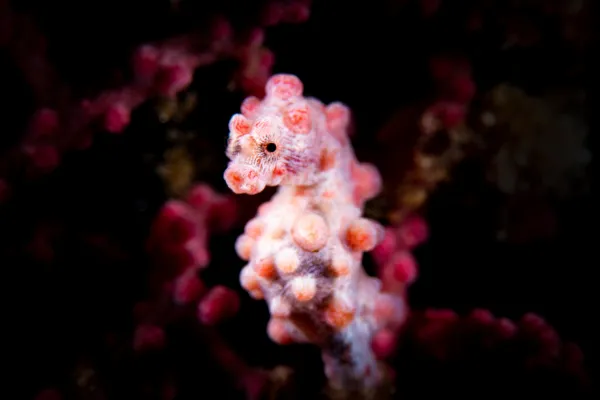
How Are Seahorses Different from Other Fish?
Seahorses are fish, but they break almost every stereotype we have about what a fish “should” look like.
1. Body armour instead of scales
Most fish have overlapping scales.
Seahorses have rigid, segmented bony plates under the skin:
These plates form a kind of external armour.
Give the body a distinctive, angular look.
Provide protection without completely limiting movement.
2. Unusual body shape and swimming style
Typical fish have a streamlined, hydrodynamic body designed for speed.
Seahorses:
Hold their body upright
Swim slowly and somewhat clumsily
Rely on stealth and camouflage, not speed
This vertical posture is very rare among fish and suits life among seagrass and coral structures.
3. Reversed roles in reproduction
In most fish:
The female carries or guards the eggs (if there is any parental care at all).
In seahorses:
The male has a brood pouch where the eggs are deposited.
The male incubates and nourishes the embryos until birth.
This kind of male pregnancy is:
Very unusual in the animal kingdom.
Also seen in their relatives, the pipefish, but is still rare among fishes in general.
4. Miniature adults at birth and no later care
Seahorse babies are born as fully formed miniatures of the adults.
Once they leave the pouch:
They are completely independent.
There is no prolonged parental care, unlike in some fish that guard their fry for a while.
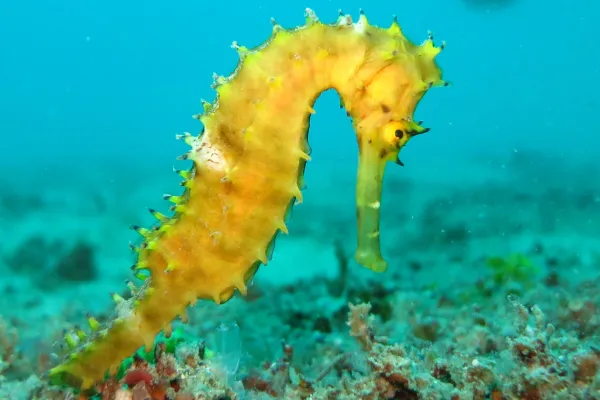
Fascinating Facts About Seahorses
In the United Kingdom, there are only two native seahorse species:
Hippocampus guttulatus – long-snouted seahorse
Hippocampus hippocampus – short-snouted seahorse
Both species are protected by law.Seahorses are the only fish that swim fully upright on a regular basis.
Their swim bladder helps them:
Fine-tune their buoyancy
Rise or hover in the water column with little effort.
They are mostly solitary, but:
They maintain territories.
The female’s territory can be up to 100 times larger than the male’s.
The survival rate of the young is extremely low:
Often less than 0.5% of the fry survive to adulthood.
In captivity, life expectancy usually ranges from 1 to 5 years, depending on the species and conditions.
Major threats include:
Capture for traditional medicine
The souvenir trade (dried seahorses)
The aquarium trade
Habitat loss (destruction of seagrass beds, mangroves and reefs)
Millions of seahorses are removed from the oceans every year, many of them illegally.
Many species are at risk:
At least 12 species are listed as Vulnerable
2 species are listed as Endangered on the IUCN Red List.
They live in shallow marine waters between roughly 50° north and 50° south latitude, especially in:
The western Atlantic
The Indo-Pacific region
Referencias
Seahorses. IUCN Red List Of Threatened Species: https://www.iucnredlist.org/es/search/list?query=Caballito%20de%20mar&searchType=species
Osterloff, E. (s.f.). Are seahorses the ocean's quirkiest fish? https://www.nhm.ac.uk/discover/are-seahorses-the-quirkiest-fish.html
Nature. (2022). Seahorse Fact Sheet. https://www.pbs.org/wnet/nature/blog/seahorse-fact-sheet/
Noaa. (2024). How do seahorses differ from all other animals? https://oceanservice.noaa.gov/facts/seahorse.html
FAO. (1990). Brief introduction to mariculture of five selected species in China. https://www.fao.org/4/ab736e/AB736E01.htm