Hippos are famous for spending most of the day in water… and for something even more surprising: a thick reddish liquid that looks very much like blood running over their skin. This has given rise to the popular idea that hippos sweat blood.
But is that really true? What exactly is this red fluid and what is it for?
In this guide you’ll learn:
Whether hippos really sweat blood
Why their “sweat” is red
What this secretion does for their health and survival
Extra FAQs and curiosities about hippos and their skin
Do Hippos Really Sweat Blood?
Short answer: no, hippos do not sweat blood.
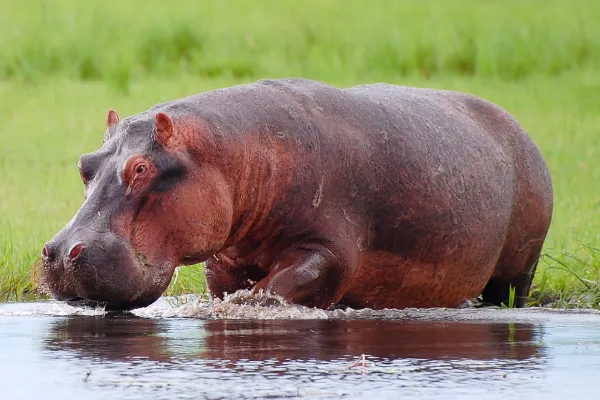
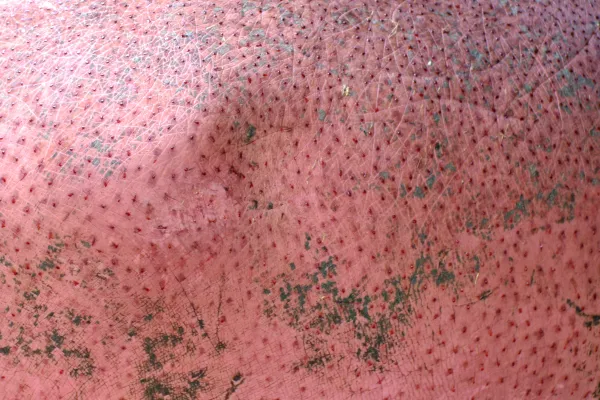
What people see as “bloody sweat” is actually a thick, reddish secretion produced by special skin glands. Under certain lighting it looks very similar to blood, but it isn’t.
Key points:
Hippos do not sweat like humans.
They produce a special oily fluid, not a watery sweat.
This fluid is known as hipposudoric acid and it plays a protective role.
When the secretion first appears on the skin it is almost colourless. After a short time, when it reacts with the air and oxidises, it turns pink, orange or reddish, which is why it is so often mistaken for blood.
And is hippo “red sweat” dangerous?
No. The pink or red protective secretion of hippos is not harmful to people, to the hippo itself, or to other animals.
It is simply a natural protective coating produced by their skin.
Why Is Hippo “Sweat” Red?
The characteristic red colour is caused by two main chemical compounds in the secretion:
Hipposudoric acid – reddish
Norhipposudoric acid – more orange
When these two acids mix and come into contact with oxygen in the air, the colour intensifies and the skin seems to be covered in blood.
These compounds:
Tint the skin a pinkish or reddish colour
Act like a natural sunscreen
Work as a mild antibacterial shield
You can think of them as a built-in mix of sunblock + disinfectant that the hippo produces itself – no cream or pharmacy needed.
Thanks to this system:
Even under the strong African sun, hippos rarely suffer sunburn.
If they get a cut or scratch, this secretion helps reduce the risk of infection, which is vital for an animal that spends so much time in muddy, dirty water.
What Is the Red Secretion For?
This reddish secretion is not just a visual curiosity. It fulfils three essential functions for hippos:
1. Natural sunscreen
Hippos have very sensitive skin and live in regions where the sun can be extreme.
Their red secretion:
Acts as a natural sunblock, filtering ultraviolet (UV) rays.
Helps prevent sunburn when they are out of the water.
Even though they spend many hours submerged, when they come out to feed or move on land, this “chemical sunscreen” protects them.
2. Antibacterial protection
Hippos live in rivers, lagoons and pools where the water is often:
Muddy
Warm
Full of microorganisms
In these conditions, small cuts and wounds could easily become infected. The red secretion has antibacterial properties, helping to:
Inhibit the growth of bacteria
Protect wounds and scratches
Reduce the risk of serious skin infections
3. Skin hydration
When hippos stay too long in the sun, their skin can dry out quickly.
This secretion also:
Helps retain moisture
Keeps the skin more flexible and hydrated
Prevents cracking and damage caused by dryness
In other words, it works as a natural combo of:
sunscreen + antibacterial gel + moisturising lotion
perfectly adapted to the harsh environment where hippos live.
FAQs About Hippo “Sweat” and Other Curiosities
Do hippos sweat like humans?
No. Hippos do not sweat like we do.
Humans have sweat glands that release a watery liquid (mostly water and salts) to cool the body.
Hippos lack this type of gland in their skin.
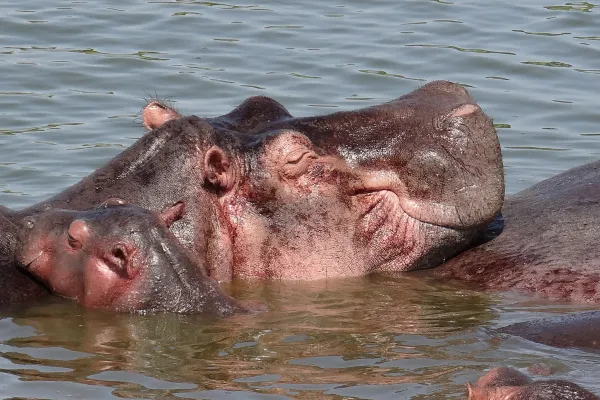
Instead, hippos have unique subcutaneous glands that produce the red secretion. Its purpose is not to cool the body, but to protect the skin from:
Sun
Bacteria
Dehydration
To regulate their body temperature, hippos use a different strategy:
They spend most of the day submerged in rivers and lakes.
The water keeps them cool and protects them from the sun.
When they leave the water, the skin secretes this protective red layer.
So, although we often say “hippos sweat blood”, in reality what they produce is a special protective secretion, not true sweat.
How do zoos care for hippos’ skin?
In the wild, hippos:
Spend many hours in natural bodies of water.
Produce their red secretion whenever needed.
In zoos and parks, caretakers try to replicate these conditions:
They provide large pools with suitable water temperature so hippos can stay submerged whenever they want.
They create shaded areas and shelters so animals can avoid the strongest sunlight.
In some cases, they use special animal-safe sunscreens or extra barriers when natural protection is not enough.
They carry out regular skin checks to detect wounds or infections early and apply antibacterial treatments if needed.
They ensure a balanced diet to support a strong immune system and healthy skin.
With proper care, captive hippos can keep their skin in good condition and their natural secretion can continue to do its job.
What other defence mechanisms do hippos have?
Besides their red protective secretion, hippos have several powerful defence tools:
Very thick, tough skin, which protects them from bites and blows.
Huge size and strength – adults are extremely strong and difficult to attack.
Long canines (tusks) that can reach up to 50 cm and cause serious injuries.
Aggressive, territorial behaviour when they feel threatened, especially in water.
They can run surprisingly fast on land and move quickly in shallow water.
In rivers and lakes, they can submerge and stay underwater for several minutes to avoid threats.
For all these reasons, hippos are considered one of the most dangerous animals in Africa, despite being herbivores.
Other curiosities about hippos
Some extra facts that often surprise people:
Hippo calves are born in the water.
They have complex social behaviour, living in groups with dominant animals.
They are very territorial in water, especially males.
They are considered an invasive species in Colombia, where escaped hippos from private collections have formed wild populations.
Bibliography
The “blood sweat” of the pygmy hippos at Bioparc. Fuengirola TV. Available at: https://fuengirolatv.com/el-sudor-de-sangre-de-los-hipopotamos-pigmeos-de-bioparc/
Scientific American. (May 6, 2002). Do hippopotamuses actually have pink sweat? Available at: https://www.scientificamerican.com/article/do-hippopotamuses-actuall/
Kean, S. (July 29, 2018). Sweating Blood. Science History Institute. Available at: https://www.sciencehistory.org/stories/magazine/sweating-blood/
Higgs, E. (November 10, 2022). IFL Science. Yes, Hippos’ Sweat Is Red, But It’s Not Blood. Available at: https://www.iflscience.com/yes-hippos-sweat-is-red-but-it-s-not-blood-66152