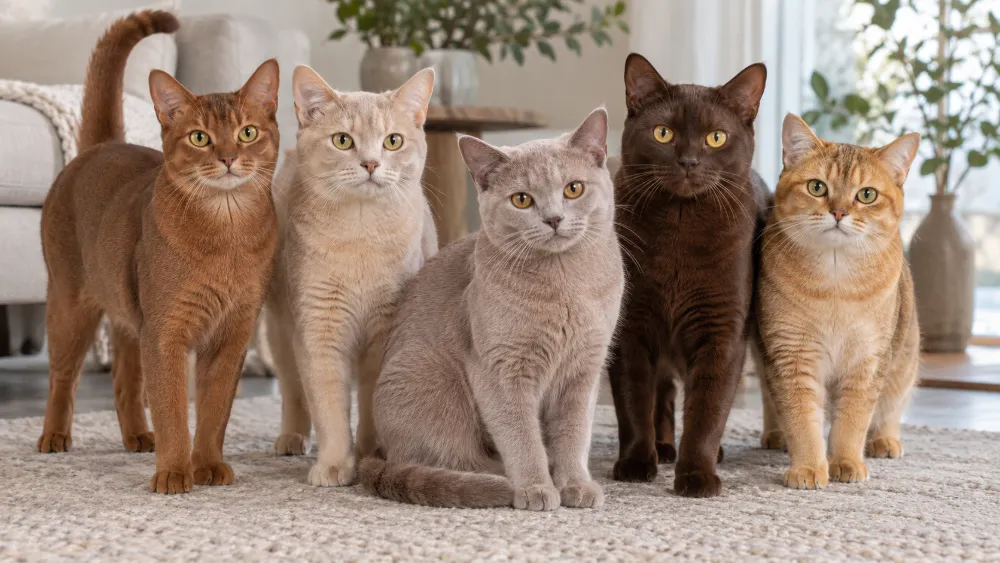
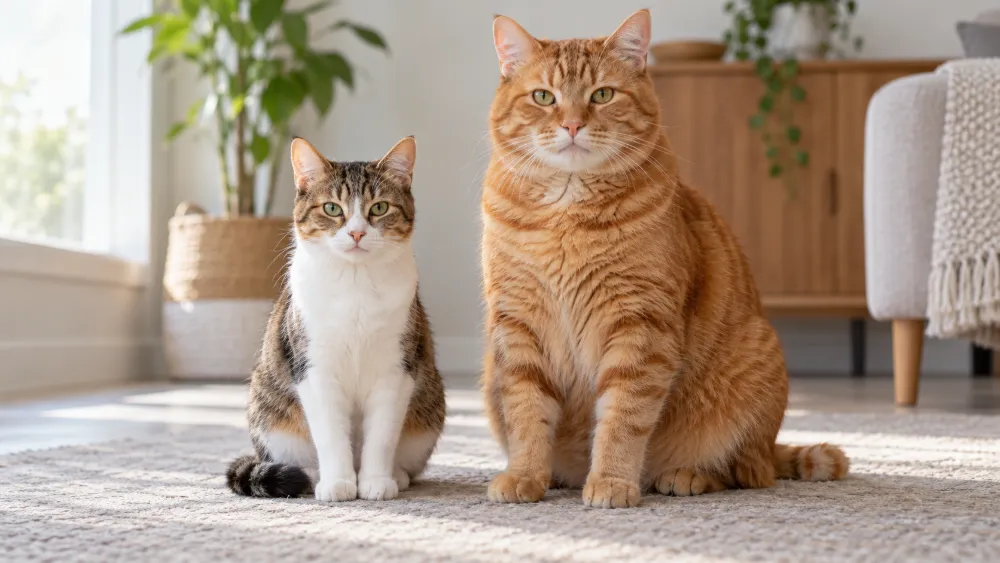
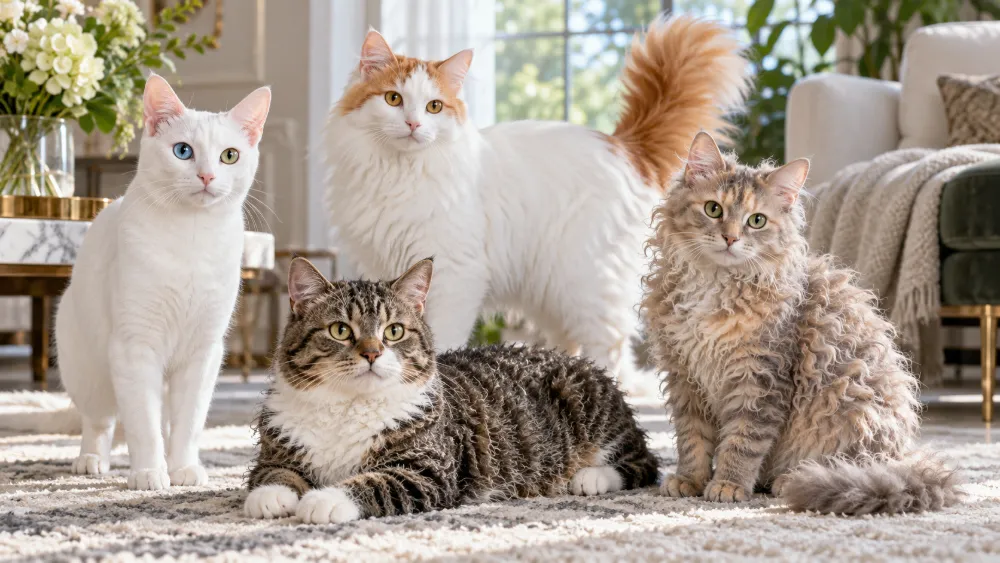
A zoologist would begin with the obvious but important point: a Maine Coon and a lion are both cats, but they live at completely different biological scales. The Maine Coon is one of the largest domestic cat breeds within the species Felis catus, while the lion is a true big cat, Panthera leo, and one of the largest living members of the family Felidae. So this comparison is best treated as a fun body-size and anatomy contrast, not as a serious “versus” contest.
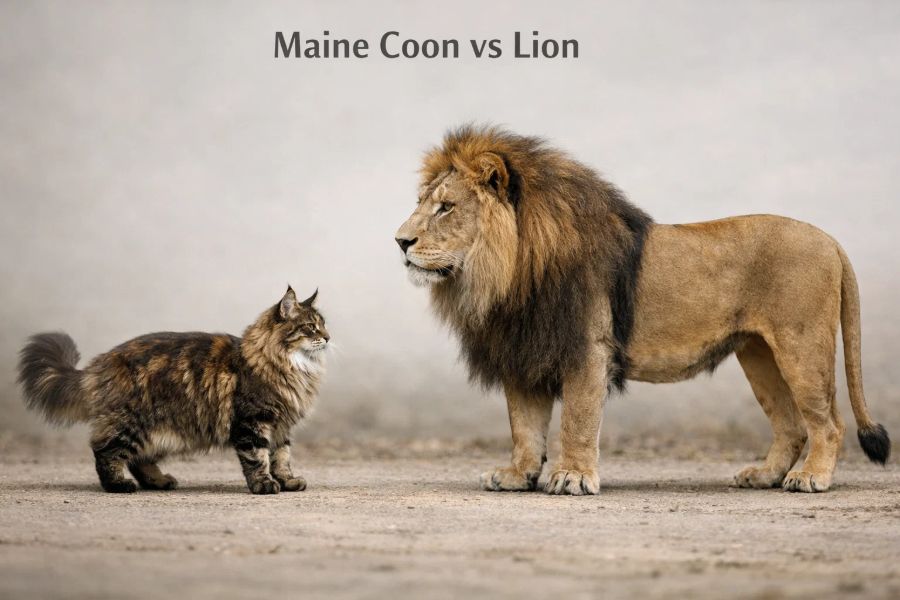
The short answer is simple: the lion is vastly larger in every major body-size category—weight, shoulder height, skull size, paw size, and raw muscular power. But the fun part is that the Maine Coon still gives us a useful miniature look at many classic feline traits: tufted ears, a long tail for balance, retractable claws, predatory teeth, and the strong, flexible body plan shared across cats. In that sense, a Maine Coon is not a “little lion,” but it does showcase the same feline blueprint on a much smaller scale.
Quick comparison table
| Feature | Maine Coon | Lion | What it means |
|---|---|---|---|
| Scientific identity | Domestic cat breed, Felis catus | Big cat, Panthera leo | Same family, different genus and scale |
| Typical adult weight | Males commonly about 13–18 lb; females about 9–13 lb; some males exceed 20 lb | Adult lions commonly about 120–190 kg, with males much larger than females | The lion outweighs the cat many times over |
| Maximum commonly cited breed figure | Up to about 22 lb (10 kg) | Large adult males can exceed the average range substantially | Even the biggest Maine Coon is tiny beside a lion |
| Body form | Long, rectangular, muscular domestic cat | Deep-chested, heavily muscled large predator | Both are felids, but one is scaled for home life and the other for megafaunal predation |
| Shoulder height | Much lower than a lion; a large house cat stands only a fraction of a lion’s height | Britannica describes lions as large, powerfully built cats; adult body mass and frame far exceed domestic cats | The lion dominates vertical scale too |
| Tail | Long, bushy domestic-cat tail | Long tail ending in a tuft | Both use tails for balance, but the lion’s is much heavier and longer |
| Lifestyle | Companion animal breed | Social apex predator | Anatomy reflects very different ecological roles |
The Maine Coon figures above come from CFA, TICA, and Britannica, while lion taxonomy and overall scale come from Britannica.
First, they are both felids—but not remotely the same kind of felid
The domestic cat belongs to the species Felis catus, which Britannica describes as the domesticated member of the family Felidae and the smallest member of that family in the ordinary household context. Lions belong to the genus Panthera, the big-cat lineage that also includes tigers, leopards, and jaguars. That taxonomic split already tells us something important: the Maine Coon is a breed within a domestic species, while the lion is a wild big-cat species with a very different evolutionary role.
This means the comparison is not just “big cat versus bigger cat.” It is really domestic felid versus apex wild felid. The Maine Coon was shaped by natural and human selection in the northeastern United States as a rugged longhaired domestic cat, while the lion evolved as a large carnivore specialized for hunting large vertebrate prey and defending territory in social groups.
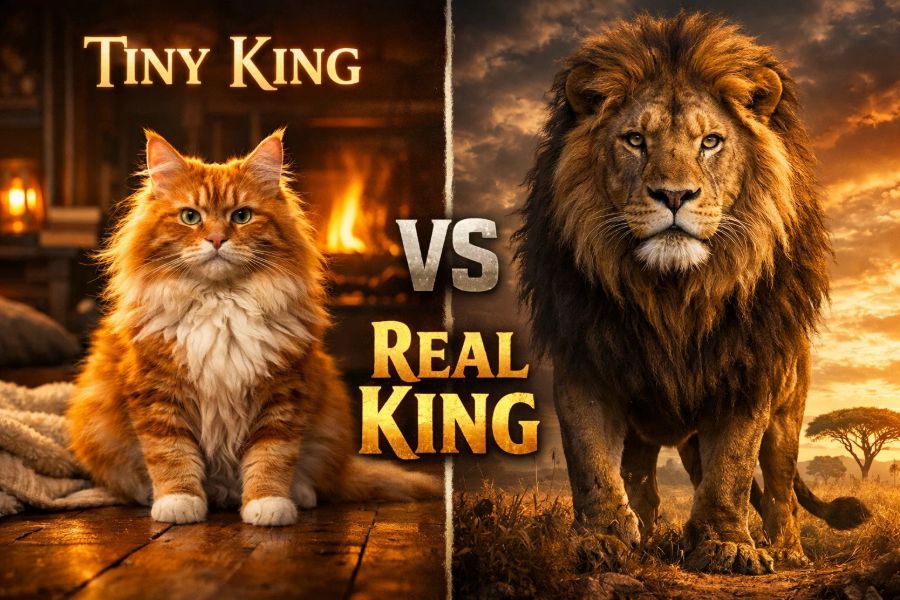
Body weight: this is where the gap becomes enormous
For Maine Coons, official and major breed sources are fairly consistent. TICA says mature male Maine Coons average about 13–18 pounds, and females average about 9–13 pounds. CFA says mature males commonly average around 12–15 pounds, with some reaching 20 pounds or more, and Britannica notes that Maine Coons can weigh up to 22 pounds (10 kg).
Lions operate in a completely different category. Britannica describes the lion as a large, powerfully built cat, and standard zoological references consistently place adult lions in the hundreds of pounds, not the teens. Even before one compares exact sex-based ranges, the main biological fact is clear: a lion outweighs a Maine Coon by a huge multiple. A very large Maine Coon is still tiny beside even an average adult lion.
A good way to picture it is this: a Maine Coon is “large” in the world of domestic cats, while a lion is “large” in the world of all living cats. Those are not remotely equivalent scales.
Length and silhouette: the Maine Coon looks giant only in house-cat terms
Part of the Maine Coon’s reputation comes from its long rectangular body, heavy coat, large tail, and substantial bone. GCCF describes the breed as having a long rectangular body with a broad chest, and CFA describes it as a massive, broad-chested cat with a long body and flowing coat. That combination makes Maine Coons look even larger than their weight alone suggests.
Lions also have long bodies and tails, but their silhouette is built around heavy predatory musculature rather than domestic-cat elegance. Britannica places them firmly among the big cats, and their deep chest, powerful forequarters, and large skull create a body shape meant for tackling large prey, not climbing cat trees or lounging on a sofa. So while both animals are recognizably feline in outline, the lion’s version is far more heavily engineered for force.
Height and posture: the lion is not just heavier, but much taller
Domestic cats are low-slung predators, and the Maine Coon—despite its size—is still fundamentally a house cat in posture. Breed descriptions emphasize body length, muscle, and substance more than unusual height. By contrast, lions are large enough that their overall standing presence is imposing in a way no domestic cat can approach.
This matters because people often focus only on body weight. But a lion is not simply a scaled-up house cat by mass; it is also taller at the shoulder, broader through the chest, and far larger in head size, limb thickness, and paw dimensions. In other words, the difference is three-dimensional, not just a number on a scale. That conclusion follows directly from the species’ overall size profiles.
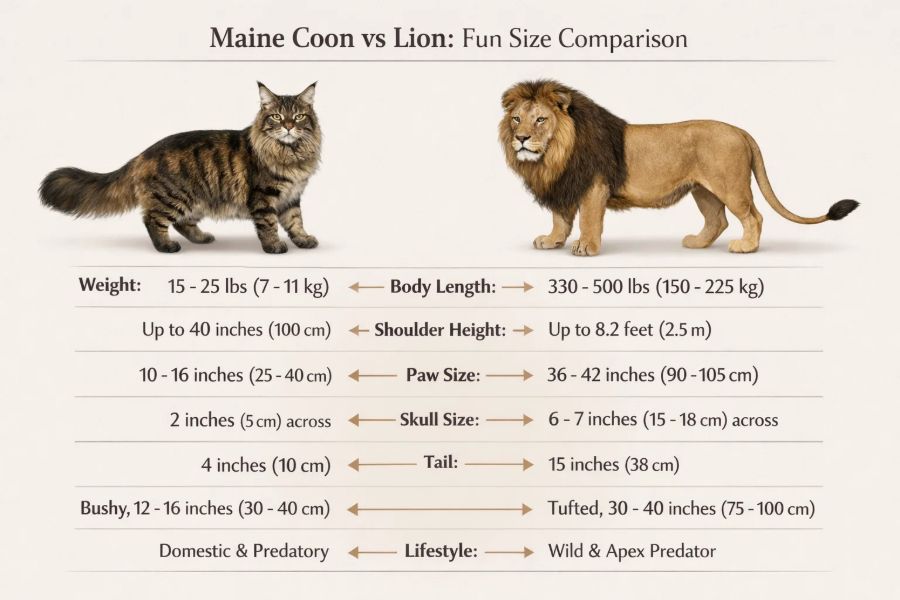
Head, jaws, and paws: same blueprint, radically different power
Britannica’s general cat overview describes domestic cats as having retractable claws, powerful bodies, acute senses, and specialized teeth adapted for hunting prey. Lions share that same feline toolkit—retractable claws, slicing carnassials, flexible spine, padded feet—but on a far larger and stronger frame.
That is one of the most interesting scientific parts of this comparison. A Maine Coon still has the core anatomy of a predator: grasping forelimbs, claws, forward-facing eyes, whiskers, and a carnivore’s dentition. But the lion’s head and jaw system are scaled for subduing large herbivores, not mice or toys. So the fun lesson here is not merely that lions are bigger, but that the same basic feline design can be scaled from a 10-kg domestic breed to one of the world’s most formidable large carnivores.
Coat and appearance: the Maine Coon can look more dramatic than the numbers suggest
Maine Coons have a visual advantage in one category: they often look enormous because of their long, shaggy coat, ruff, ear tufts, and huge plume-like tail. CFA and GCCF both emphasize the breed’s long flowing coat and broad, substantial body. A wet Maine Coon and a dry Maine Coon can appear very different in apparent size.
Lions, especially males, also benefit from visual exaggeration through the mane. But unlike the Maine Coon’s fur illusion, a lion’s visual bulk is backed by massive real-body scale underneath. So the Maine Coon may win the “looks giant in a living room” category, while the lion wins every objective size category outdoors.
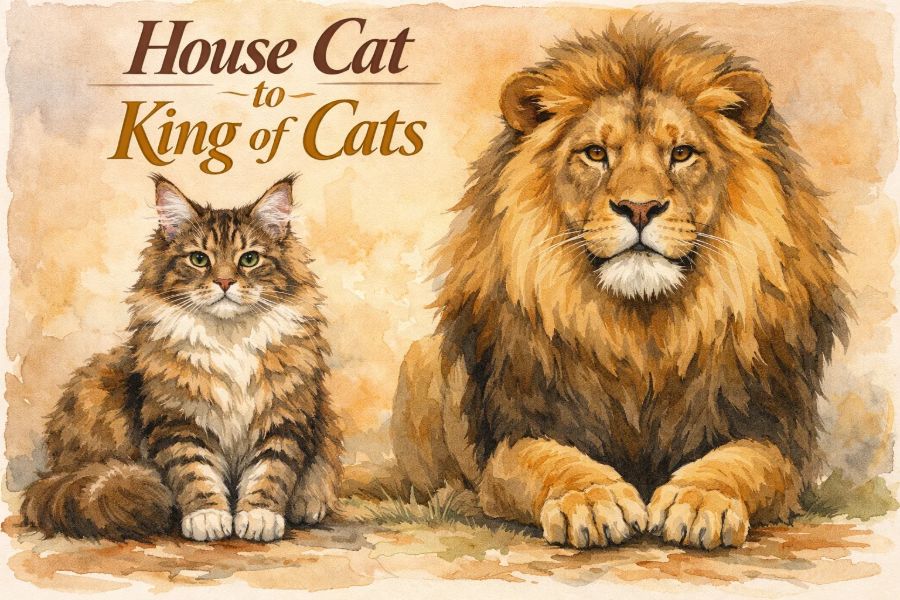
Lifestyle explains the size gap
The Maine Coon is a domestic breed shaped for life alongside humans. Breed organizations describe it as large, natural, muscular, and slow-maturing, but still fully within the ecological limits of a house cat. It hunts small prey, climbs, jumps, and coexists with people.
The lion, by contrast, is a social large predator built for cooperative or opportunistic hunting, territorial defense, and survival in wild ecosystems. Its size reflects that role. Big cats do not become enormous for amusement; they become enormous because large prey, intraspecific competition, and predator ecology reward body power. That ecological explanation is more important than the raw numbers alone.
So what is the fairest fun conclusion?
If the theme is “Maine Coon vs Lion — fun size comparison,” then the best zoological conclusion is:
The Maine Coon is a giant by domestic cat standards.
The lion is a giant by all cat standards.
Both reveal the same feline body plan, but at dramatically different scales.
A Maine Coon can feel lion-like on your couch because it is one of the biggest pet cats most people will ever see. But biologically, the lion is on another level entirely—closer to a predator-engineered machine than to an oversized house pet.
References
CFA. Maine Coon Cat breed page. Mature male weight commonly reaches or exceeds 20 lb.
TICA. Maine Coon breed page. Mature males average 13–18 lb and females 9–13 lb.
Britannica. Cat. Domestic cat overview and note that Maine Coon cats can weigh up to 22 lb (10 kg).
CFA. Maine Coon Cat Article. Broad-chested, long-bodied breed; males average 12–15 lb, some 20+ lb.
GCCF. Maine Coon. Long rectangular body, broad chest, males up to 18–20 lb.
Britannica. Lion. Taxonomy and general size/biology of Panthera leo.
Britannica. Feline and Panthera. Family-level and big-cat context.