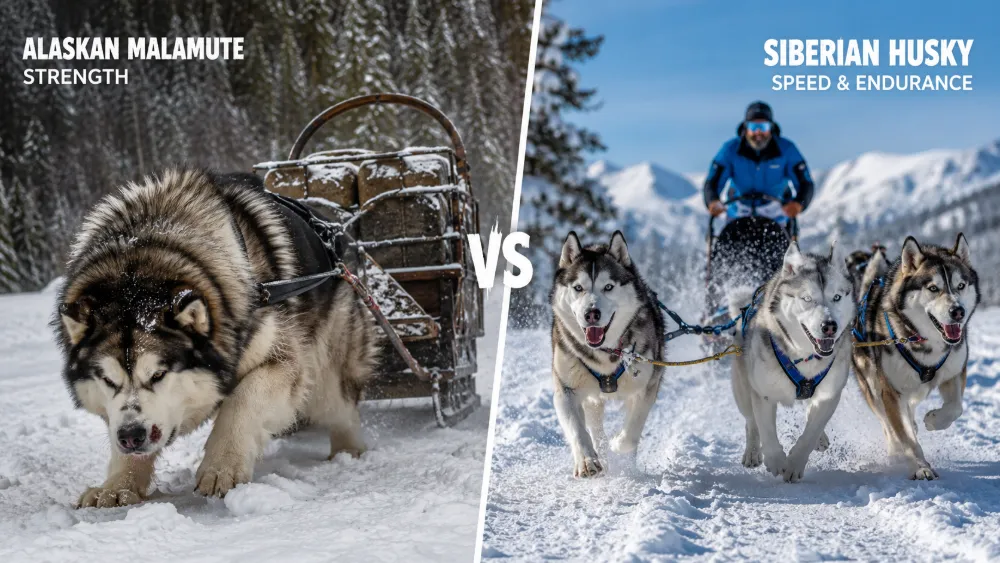
The main difference between an Alaskan Malamute and a Siberian Husky is size, build, and working style. Malamutes are usually larger, heavier-boned, and built for strength and hauling heavy loads. Huskies are usually lighter, faster, and more athletic, built for endurance and efficient long-distance travel. Both are northern sled dogs with thick coats and wolf-like looks, but they are different breeds and often feel very different in everyday life.
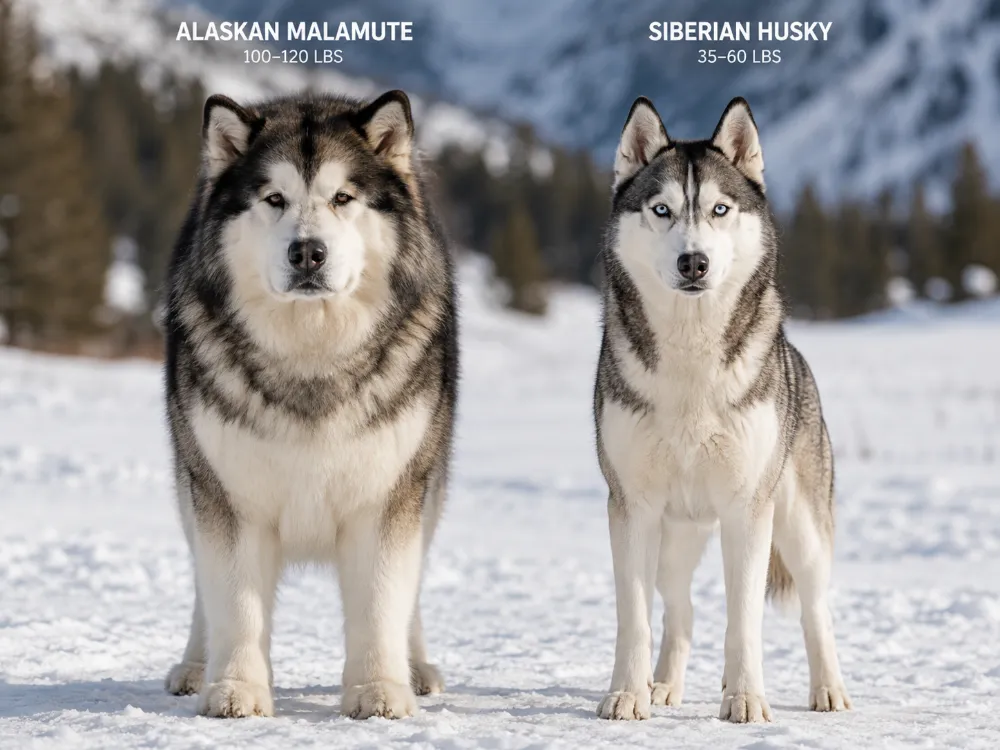
People mix up Alaskan Malamutes and Siberian Huskies all the time because both are spitz-type working dogs with upright ears, dense double coats, bushy tails, and a cold-weather background. In photos, especially without anything nearby for scale, they can look almost interchangeable.
In reality, they were developed for somewhat different jobs, and that shaped their bodies, movement, and personalities. One often looks like a powerful freight-pulling dog. The other often looks like a lighter, faster endurance runner.
In this guide, you will learn how Alaskan Malamutes and Huskies differ in appearance, energy level, temperament, work style, and family suitability, plus the quickest ways to tell them apart.
Quick comparison table
| Feature | Alaskan Malamute | Siberian Husky |
|---|---|---|
| Overall size | Larger and heavier | Smaller and lighter |
| Build | Broad, strong, heavy-boned | Lean, athletic, more moderate in frame |
| Main traditional job | Heavy hauling and freight pulling | Fast, efficient endurance sled work |
| Head shape | Broader head and fuller muzzle | Finer head and more refined outline |
| Eyes | Usually brown | Brown, blue, or one of each |
| Energy style | Strong, steady, powerful | Quick, busy, high-endurance |
| Everyday impression | More substantial and powerful | More agile and lively |
| Best quick clue | Bigger, bulkier, bear-like strength | Lighter, quicker, more streamlined sled-dog look |
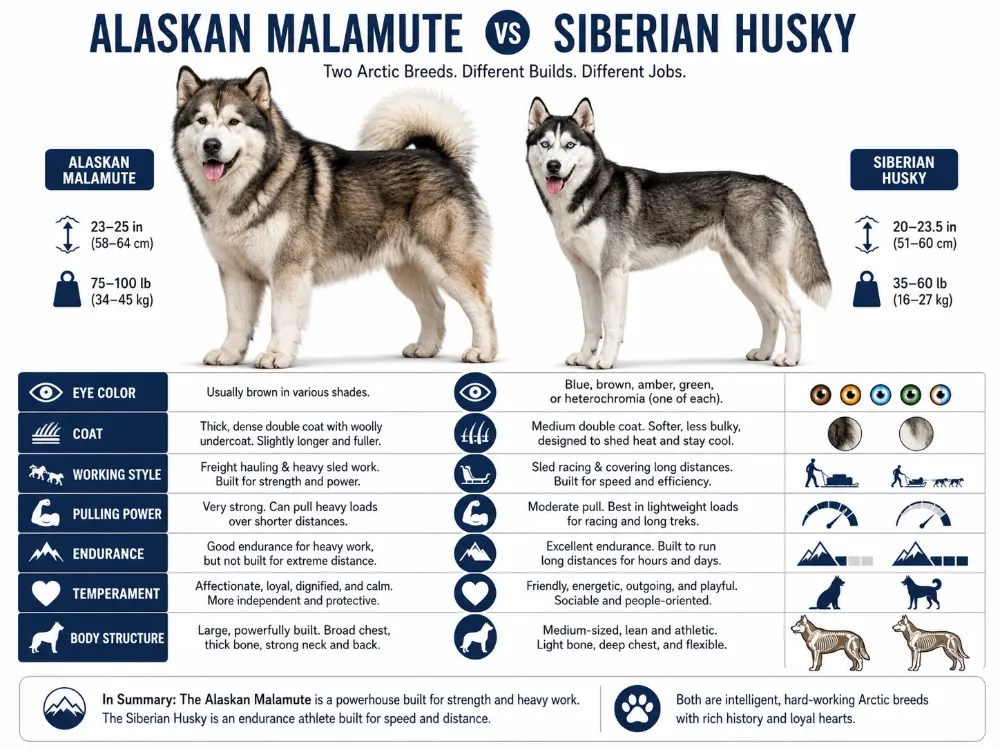
They are different breeds, not just big and small versions of one dog
The Alaskan Malamute and the Siberian Husky are separate breeds with different histories. Both are northern working dogs, but they were developed by different peoples in different regions and selected for somewhat different jobs. That matters because body shape, movement, and temperament were all influenced by those working roles.
The Malamute is strongly associated with power, pulling strength, and hauling heavy loads. The Husky is more strongly associated with covering long distances efficiently with lighter loads at a quicker pace. Those differences show up clearly in the dog’s structure.
So even though both are thick-coated sled dogs, a Malamute is not just a larger Husky, and a Husky is not just a smaller Malamute.
Malamutes are usually much bigger
One of the easiest differences to notice is size. Alaskan Malamutes are usually noticeably larger, heavier, and more substantial than Siberian Huskies. Their chest, neck, shoulders, and legs often look thicker and more powerful.
Siberian Huskies are more moderate in size. They still look strong and athletic, but they usually do not give the same heavy freight-dog impression as a Malamute. Their frame is lighter and more efficient-looking.
If the dog looks especially large and strong, Malamute becomes more likely. If it looks medium-sized, athletic, and lighter on its feet, Husky becomes more likely.
Malamutes are built for strength while Huskies are built for endurance
This is the core difference behind the entire comparison. Malamutes were shaped more for pulling heavy loads steadily. Their body reflects that purpose: heavier bone, broader chest, stronger overall mass, and a very powerful build.
Huskies were shaped more for traveling long distances efficiently. They often look like endurance athletes rather than draft animals. Their body is usually lighter, more economical, and more obviously built for sustained movement.
So the Malamute often feels like a power dog, while the Husky feels like a distance-running dog.
The head shape is different
Malamutes usually have a broader head with a fuller muzzle and a more substantial expression. Many people describe the head as stronger, heavier, and more powerful-looking.
Huskies usually have a finer, cleaner head shape. Their face often looks a bit narrower and more streamlined. This gives them a more agile and slightly sharper overall appearance.
When the two breeds stand side by side, the difference in head mass is often one of the quickest clues.
Eye color is a strong clue for beginners
Eye color can help a lot. Siberian Huskies are famous for blue eyes, brown eyes, or heterochromia, where one eye is blue and the other is brown. This trait is strongly tied to the Husky image in popular culture.
Alaskan Malamutes are usually associated with brown eyes. The classic blue-eyed look that many people expect from a northern dog is far more typical of the Husky than the Malamute.
If the dog has bright blue eyes, Husky becomes much more likely. If it has a heavier body and brown eyes, Malamute becomes more likely.
Malamutes often look bulkier through the coat
Both breeds have thick double coats, but Malamutes often look heavier and more plush overall because of their larger body and broader frame. They may give a more bear-like visual impression, especially in full winter coat.
Huskies also have a dense coat, but they often look more streamlined even when fluffy. Their outline usually stays more clearly athletic and less massive than that of a Malamute.
If the coat seems wrapped around a large, powerful frame, Malamute is the stronger guess. If the coat covers a lighter sled-runner outline, Husky is the stronger guess.
The tail carriage often feels heavier in Malamutes
Malamutes often carry the tail like a full plume over the back. The tail can look thick, waving, and visually heavy, which matches the rest of the breed’s powerful structure.
Huskies also have brushy tails, but the effect is often lighter and less massive. The tail usually fits the breed’s more agile, efficient silhouette.
This is not the first clue most people use, but it supports the broader difference between a heavier freight dog and a lighter endurance dog.
Huskies usually move with more speed and lightness
In motion, Siberian Huskies often look smooth, quick, and efficient. They were shaped for travel, so many move with an easy, floating quality that makes them seem almost tireless. Even standing still, they often look ready to launch into motion.
Malamutes can also move beautifully, but they usually give a more grounded impression. Their movement often feels more powerful than quick, more forceful than airy.
If the dog looks like it was built to travel far and fast, Husky becomes more likely. If it looks built to pull with steady force, Malamute becomes more likely.
Temperament is not exactly the same
Both breeds are intelligent, independent, and not especially eager to obey without reason. Neither should be mistaken for a naturally easy, highly handler-dependent breed. However, their style of personality often feels different.
Malamutes are often described as dignified, strong-willed, and steady. They may feel more serious and physically imposing. Huskies are often described as lively, mischievous, social, and constantly in motion. Many owners describe Huskies as more playful, more chaotic, and more dramatic in everyday behavior.
These are broad patterns rather than fixed rules, but many people notice the difference quickly.
Huskies often show more visible daily energy
Both breeds need real exercise and mental stimulation, but Siberian Huskies often show a more obvious day-to-day level of movement and restlessness. They may seem busy, curious, and ready to run almost all the time.
Malamutes also need activity, but their energy often feels heavier and steadier rather than constantly fast. A Malamute may still be demanding, but many do not project the same nonstop motion that Huskies often do.
This makes Huskies especially famous for boredom, escape behavior, and turning under-stimulation into mischief.
Both breeds can be difficult off-leash
Neither breed is known for easy off-leash reliability. Both can have strong independence and prey drive, and both may choose exploration over obedience if given the chance. Secure containment matters a great deal for each breed.
Huskies are especially famous for escaping fences, slipping out of doors, and running hard once free. Malamutes can also be escape artists, but the Husky often has the stronger reputation for speed, curiosity, and disappearing over the horizon.
For most owners, both breeds are safest with excellent fencing and realistic expectations.
Huskies are often more vocal
Both breeds can howl and make expressive sounds, but Huskies are especially famous for talking. Many Husky owners know the breed for whining, chatting, howling, and producing dramatic sounds that seem almost like conversation.
Malamutes can also vocalize and may produce deep “wooing” sounds, but they are often less famous for nonstop theatrical noise than Huskies are. The Husky usually carries the stronger reputation for being expressive and noisy.
If the dog seems to comment on everything loudly, many people will suspect Husky first.
Malamutes often feel more physically imposing
Because of their size, power, and heavy bone, Malamutes often feel more formidable in close contact. Even a friendly Malamute can be a lot of dog physically. Their strength matters in daily handling, leash work, and dog-to-dog management.
Huskies are easier to physically manage in many cases simply because they are smaller and lighter. That does not make them easy dogs overall, but it changes the kind of challenge they present.
The Malamute often challenges with power. The Husky often challenges with speed and mental mischief.
Neither breed is a simple guard dog
People sometimes assume that a wolf-like northern dog must make an excellent guard dog, but that is not always true. Huskies are often very social with strangers and may be poor guard dogs because they are too interested in greeting people.
Malamutes can look more intimidating because of size, but they are not automatically classic guard dogs either. Many are friendly or socially open rather than naturally suspicious in the way true protection breeds often are.
So neither breed should be chosen mainly for serious guarding.
Working style separates them clearly
If you reduce the whole comparison to one key idea, it is this: the Alaskan Malamute is the heavier freight puller, and the Siberian Husky is the lighter endurance traveler. That single distinction helps explain almost everything else.
Malamutes impress with strength, mass, and pulling force. Huskies impress with speed, efficiency, and travel endurance. Malamutes feel powerful. Huskies feel quick and tireless.
Once you understand that, the differences in body and temperament make much more sense.
Color can confuse beginners
Both breeds can appear in striking coat patterns and northern-dog masks, which is one reason people mix them up. A gray-and-white Malamute and a gray-and-white Husky can look very similar in photos if there is no clear sense of scale.
That is why color is not the best clue. Body mass, bone, head shape, eye color, and overall movement style matter much more than coat pattern alone.
The biggest mistake is focusing on face markings and ignoring the structure of the dog.
Which breed is easier for the average owner?
Neither breed is especially easy for an unprepared owner. Both shed heavily, both need exercise, both can be stubborn, and both may ignore commands if they do not see a reason to cooperate. However, they tend to be difficult in different ways.
Huskies often challenge owners with speed, noise, escape behavior, and constant activity. Malamutes often challenge owners with physical strength, independence, and the sheer force of a large working dog. The easier breed depends on what kind of challenge the owner is better prepared to handle.
So the real question is not which breed is easy, but which one fits the household’s reality better.
Which breed is better for families?
Both breeds can be affectionate family dogs in the right home, but both need structure, training, and realistic expectations. Huskies often bring a playful, social, energetic personality that many families enjoy, but they can also be noisy, destructive, and very hard to contain.
Malamutes often bring a calmer but stronger presence. They can be loving and loyal, but their size and power mean they need more physical management and supervision. Families with very young children may especially need to think carefully about size, exercise, and daily control.
For most homes, the better breed is the one whose energy and strength level truly match the family’s lifestyle.
Why people confuse them so often
People confuse Alaskan Malamutes and Huskies because both fit the same popular image: thick coat, upright ears, wolf-like face, snow-dog background, and striking markings. Without size reference, the breeds can look much more similar than they really are.
The confusion becomes even stronger because both breeds are common in photos, films, and social media, where scale and movement are often hidden. Once you focus on mass, eye color, and overall build, the difference becomes much easier to see.
The largest clue is not coat color. It is structure.
How to tell them apart quickly
If you need a fast identification guide, use these clues together:
Alaskan Malamute: larger size, heavier bone, broader head, brown eyes, thicker and more powerful overall frame
Siberian Husky: lighter size, finer frame, often blue or mixed eyes, quicker movement, more streamlined endurance-runner look
No single clue is perfect in every dog, but this combination is usually very reliable.
Final takeaway
The main difference between an Alaskan Malamute and a Husky is that the Malamute is usually larger, heavier, and built for powerful hauling, while the Husky is usually lighter, faster, and built for endurance and travel efficiency. Malamutes often feel stronger, steadier, and more physically imposing. Huskies often feel quicker, noisier, more mischievous, and more visibly energetic. They may look similar at first glance, but once you compare size, eyes, head shape, and movement style, they are much easier to tell apart.
FAQs
Is an Alaskan Malamute bigger than a Husky?
Yes. Alaskan Malamutes are usually larger and heavier than Siberian Huskies.
How can I tell an Alaskan Malamute from a Husky fast?
Look at size, head shape, and eyes. Malamutes are usually bulkier with brown eyes, while Huskies are lighter and often have blue or mixed eyes.
Which breed is more energetic, Alaskan Malamute or Husky?
Both are active, but Huskies often show more visible daily speed, restlessness, and endurance-driven energy.
Are Alaskan Malamutes and Huskies good family dogs?
They can be, but both need training, exercise, secure containment, and owners who understand strong independent working breeds.