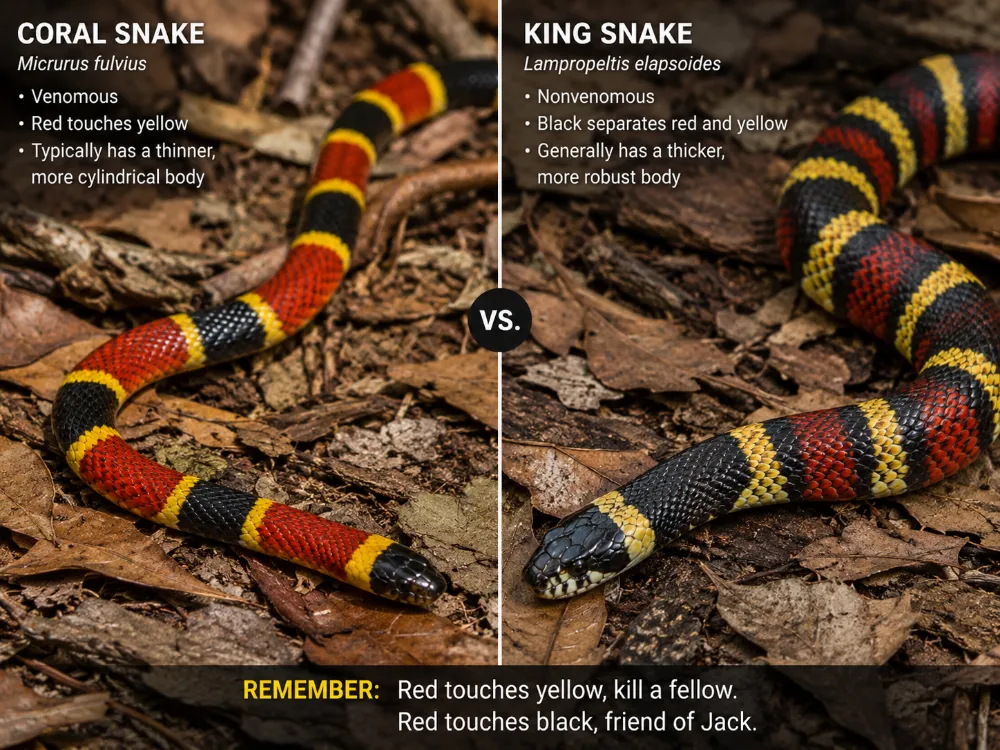
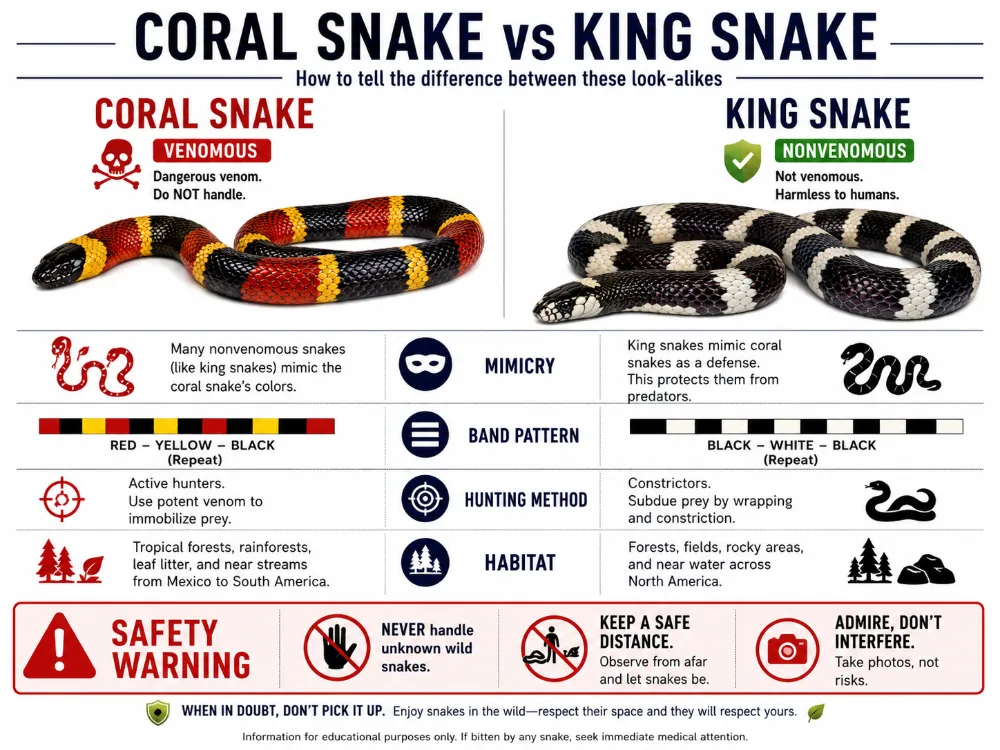
The short answer is that coral snakes are venomous elapid snakes, while king snakes are nonvenomous constrictors. They can look similar because some king snakes mimic coral snake warning colors, but coral snakes are true venomous species and king snakes are harmless to people in normal circumstances. The safest rule is never to rely on one color rhyme alone and never handle any banded snake unless a trained expert has identified it.
People often compare coral snakes and king snakes because both can show bright red, black, and yellow or cream bands. At a quick glance, that color pattern can be confusing, especially in places where mimic species occur. In reality, they belong to different snake groups, hunt differently, and pose very different risks to humans.
In this guide, you will learn how coral snakes and king snakes differ in venom, body shape, band pattern, behavior, habitat, mimicry, and identification, plus the safest way to think about the comparison in the wild.
Quick comparison table
| Feature | Coral Snake | King Snake |
|---|---|---|
| Main snake group | Venomous elapid | Nonvenomous colubrid |
| Danger to people | Medically significant venom | Usually harmless to humans |
| Color pattern | Often red, yellow, and black rings in a true warning pattern | Some species mimic coral snake colors, others do not |
| Main defense | Warning coloration, hiding, venom | Mimicry, musk, escape, biting if handled |
| Hunting style | Venom-assisted predator of small reptiles and other prey | Constriction and swallowing prey whole |
| Typical body look | Usually slender, smooth, glossy, small-headed | Often slightly sturdier, though variable by species |
| Behavior around people | Usually secretive and avoids contact | Usually secretive and defensive rather than dangerous |
| Best quick clue | Treat any similar banded snake as potentially venomous until expertly identified | Never assume harmlessness from color alone |
They are not the same kind of snake
Coral snakes and king snakes are not close lookalikes from the same branch of snake evolution. Coral snakes belong to the elapid family, the same broader venomous group that includes cobras, mambas, and sea snakes. King snakes belong to a different family group of nonvenomous snakes and kill prey mainly by constriction.
This means the difference is much deeper than color. One is a venomous snake with strong warning coloration. The other is a nonvenomous snake, and in some species that colorful pattern evolved partly because it resembles the warning colors of coral snakes.
So even if they look similar on the outside, biologically they are very different animals.
Coral snakes are venomous, king snakes are not
The most important difference is venom. Coral snakes are venomous and should be treated with serious caution. Their venom affects the nervous system, and although they are usually shy and not aggressive, a bite is a medical emergency.
King snakes are nonvenomous. They may bite in self-defense if handled, but they do not have medically significant venom the way coral snakes do. For people, the major risk from a king snake is usually only a defensive bite and stress from handling.
That is why this comparison is not just interesting natural history. It also matters for safety.
Some king snakes mimic coral snakes
One reason people confuse them so often is mimicry. Several nonvenomous snakes, including some king snakes and milk snakes, evolved bright red, black, and yellow or cream banding that resembles the warning colors of coral snakes. This may help discourage predators that have learned to avoid the real venomous species.
This kind of mimicry is one of the most famous examples of defensive resemblance in North American snakes. A predator that hesitates around coral snake colors may also hesitate around a harmless mimic.
So the king snake’s look can be deceptive on purpose, at least from an evolutionary perspective.
Color pattern can help, but it is not perfect
Many people learn a rhyme about red, yellow, and black bands, but the real world is more complicated than a single memory trick. Pattern rules may help in some regions and with some species, especially in parts of North America, but they are not universal and should never be trusted as the only identification method.
Different species, regional variants, faded individuals, juvenile patterns, lighting conditions, and imperfect human memory can all create mistakes. Some harmless snakes can look surprisingly close to coral snakes, and some coral snakes do not match people’s mental image perfectly.
So color can be useful, but it is not enough for safe field identification by non-experts.
Coral snakes usually have clean, bold warning rings
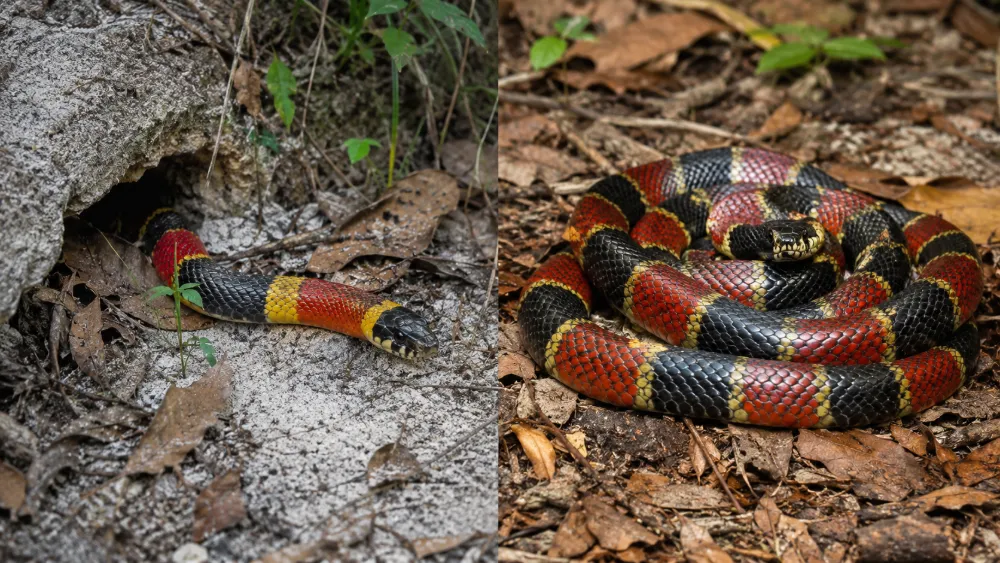
Many coral snakes have bright, sharply defined rings that wrap around the body. The pattern often looks smooth, glossy, and precise, which adds to the warning effect. Their coloration is not camouflage first. It is often a signal that says this is not a snake to attack casually.
King snakes that mimic coral snakes may show a similar ringed look, but the exact pattern can be more variable depending on species and region. Some are excellent mimics. Others are only roughly similar.
This is why skilled identification often depends on more than just “what colors touch.”
Head shape is not a reliable shortcut
People often look for a “venomous head shape,” but that shortcut is not reliable here. Coral snakes do not have the broad, triangular pit-viper head many people associate with venomous snakes. They are often slender snakes with a fairly small head that does not look dramatically wider than the neck.
King snakes can also have a smooth, narrow head. That means head shape does not help much in this comparison. A person who assumes a small head means harmless could make a dangerous mistake.
So with coral snakes and king snakes, body shape alone is not a safe rule.
Coral snakes are usually more secretive than people expect
Coral snakes are often shy, secretive animals that spend much of their time hidden under leaf litter, logs, debris, loose soil, or other cover. They are not usually snakes that chase people or deliberately seek confrontation.
This quiet lifestyle is one reason people may rarely see them even in places where they occur. Many sightings happen only when a snake is uncovered during yard work, after rain, or while crossing a path or road.
So although coral snakes are venomous, they are often less openly visible than their bright colors might suggest.
King snakes are also secretive, but often more familiar
King snakes are usually secretive too, but they are often better known to people because many species are common, widespread, and not dangerous. They may be found under boards, rocks, logs, trash piles, or in barns, fields, forests, and suburban edges depending on the species.
Because they are harmless and often beneficial predators of rodents and other snakes, king snakes are generally seen as useful snakes rather than dangerous ones. Some are even popular in reptile keeping because of their calm beauty and manageable temperament.
So the king snake often occupies a very different place in human perception from the coral snake.
They kill prey differently
Coral snakes use venom to subdue prey. Their diet often includes small reptiles, other snakes, lizards, and sometimes amphibians or other small animals depending on species and region. Their venom helps them overpower prey that might otherwise be difficult to control.
King snakes are constrictors. They seize prey and overpower it by coiling and squeezing rather than relying on venom. They are famous for eating rodents, lizards, birds, eggs, and even other snakes.
This makes king snakes ecologically important predators, especially in places where they help reduce pest populations or prey on other reptiles.
King snakes are famous snake-eaters
One of the most interesting facts about king snakes is that many species readily eat other snakes. This trait helps explain their name. They are powerful, adaptable predators within the snake world and often occupy a high place among smaller reptile hunters.
Some king snakes can even prey on venomous snakes under the right conditions. That does not make them immune superheroes in every situation, but it does make them unusually formidable nonvenomous snakes.
This snake-eating habit is one reason they are so respected by reptile enthusiasts and naturalists.
Coral snakes usually do not look bulky
Unlike some famous venomous snakes, coral snakes are usually slender rather than thick-bodied. Their body often looks smooth, glossy, and delicate compared with large rattlesnakes or heavy constrictors.
King snakes can also be smooth and attractive, but many have a slightly more substantial or obviously constrictor-like body depending on species. Even so, both can look sleek enough that beginners may underestimate how different they really are.
This is another reason the comparison is tricky for non-specialists.
Habitat overlap can make identification harder
In some parts of North America, coral snakes and their harmless mimics can live in broadly similar habitats. Woodlands, sandy soils, scrub, pine habitats, edges, debris piles, and moist sheltering places may all produce sightings of colorful banded snakes.
Because these animals can occur in the same general regions, people cannot safely assume that a bright snake in “the right habitat” must be harmless or dangerous. Habitat helps build context, but it does not remove the need for caution.
So the safest approach is always to treat uncertain identification as uncertain, not as harmless.
Regional rules are useful only in their proper place
Some regional identification rhymes were created for specific local coral snake and mimic species, especially in parts of the United States. They can be educational as part of local natural history, but they become risky when people apply them too broadly across other regions, countries, or species groups.
Outside the exact geographic context where the rhyme was designed, it may fail badly. Even inside that region, a frightened person may remember it incorrectly when it matters most.
So the better rule is this: if you are not a trained expert, do not try to prove a similar-looking banded snake is harmless by memory alone.
The safest identification rule is behavioral, not poetic
If you see a banded snake that could possibly be a coral snake, the correct action is distance. Do not pick it up, do not try to move it by hand, and do not crowd it for a closer photo. If the snake is in a place where people or pets are at risk, contact a trained wildlife or snake professional.
This matters because both venomous coral snakes and harmless king snakes are usually best left alone anyway. The harmless one does not need to be grabbed, and the venomous one definitely should not be.
So the best field wisdom is not “memorize one rhyme and touch snakes.” It is “respect uncertainty and keep space.”
Why coral snake mimicry works so well
Bright banding works because predators notice patterns. If enough predators have had bad experiences with venomous coral snakes, then harmless snakes with similar patterns may gain protection simply by resembling them. This is one of the clearest examples of warning-based mimicry in reptiles.
The mimic does not need to be identical in every detail. It only needs to be similar enough that a predator hesitates. That hesitation can mean survival.
So the confusion people feel when comparing coral snakes and king snakes is actually part of the evolutionary story.
Why people confuse them so often
People confuse coral snakes and king snakes because both may show vivid red, black, and yellow or cream bands, and most people do not see them often enough to become confident at identification. A quick sighting in leaf litter or grass can easily blur the details.
The confusion is even stronger because harmless mimics really are supposed to look similar. In a sense, evolution trained the king snake’s pattern to trigger uncertainty.
That means the confusion is understandable, but it should always lead to caution rather than guesswork.
How to tell them apart quickly
If you need a practical field rule, use this one: do not try to handle or closely inspect any small banded snake that resembles a coral snake. Assume uncertainty, keep your distance, and leave identification to a qualified local expert.
Coral snake: venomous, true warning coloration, secretive, should be treated as medically significant
King snake: nonvenomous constrictor, sometimes a mimic, usually harmless but not safe to identify carelessly by touch
For real safety, distance is more important than memorizing a single visual trick.
Which one is more dangerous?
Coral snakes are far more dangerous because they are venomous. Even though they are usually shy and bites are relatively uncommon compared with some other venomous snakes, the medical risk is real and serious.
King snakes are not dangerous in that way. They can bite if handled, but they are nonvenomous and not a medical threat like coral snakes. For this reason, confusing the two in the wrong direction is the dangerous mistake.
The safest response to any uncertainty is simple: do not touch the snake.
Final takeaway
The main difference between a coral snake and a king snake is that a coral snake is a venomous elapid, while a king snake is a nonvenomous constrictor. They can look similar because some king snakes mimic coral snake warning colors, but they are not the same kind of snake and they do not pose the same risk. Coral snakes should always be treated as medically significant, and any similar banded snake should be left alone unless identified by an expert.
FAQs
Is a coral snake venomous?
Yes. Coral snakes are venomous and should be treated as medically significant.
Is a king snake venomous?
No. King snakes are nonvenomous constrictors.
Why do king snakes sometimes look like coral snakes?
Some king snakes evolved color patterns that mimic coral snake warning colors, which may help discourage predators.
How can I safely tell a coral snake from a king snake?
The safest answer is not to rely on one memory trick. Keep your distance and let a qualified local expert identify it if necessary.