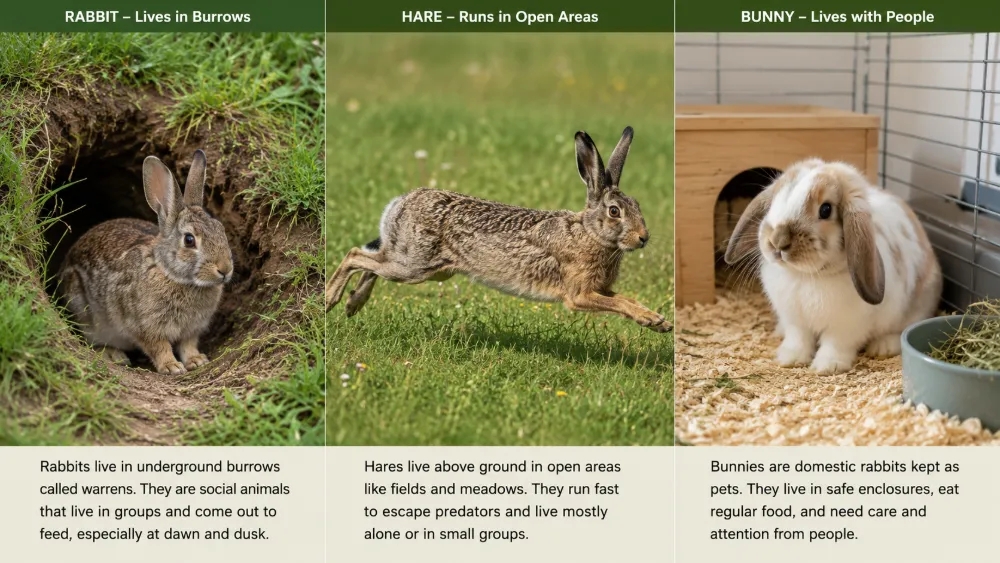
A bunny is not a separate animal species. It is an informal, affectionate word for a young or cute rabbit. A rabbit is a real group of small lagomorphs that are often social, burrow-living, and born helpless. A hare is a related but different type of lagomorph, usually larger, faster, longer-legged, and born fully furred with open eyes.
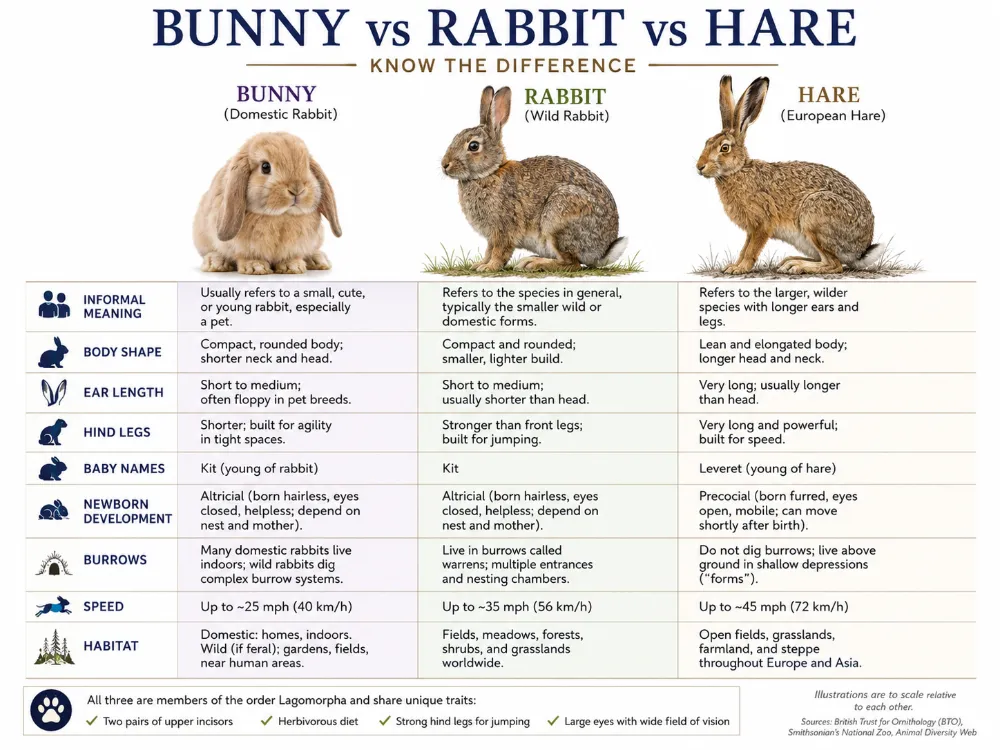
Bunny vs Rabbit vs Hare Summary Table
| Feature | Bunny | Rabbit | Hare |
|---|---|---|---|
| Scientific status | Informal word, not a scientific group | Real animal group within the order Lagomorpha | Real animal group within the order Lagomorpha |
| Common meaning | A cute rabbit, often a baby rabbit or pet rabbit | A small to medium lagomorph, often burrow-living | A larger, faster lagomorph adapted to open habitats |
| Typical body size | Usually refers to a small or young rabbit | Generally smaller and more compact than hares | Usually larger, longer-legged, and more athletic |
| Ears | Depends on the rabbit being described | Often shorter than hare ears, though varies by breed and species | Usually longer ears, often with dark tips in many species |
| Legs | Depends on the rabbit being described | Shorter hind legs compared with hares | Long powerful hind legs for high-speed running |
| Newborn young | Usually used for baby rabbits, though not a technical term | Born blind, hairless, helpless, and hidden in nests | Born fully furred, eyes open, and able to move soon after birth |
| Baby name | Informally “bunny” | Kit or kitten | Leveret |
| Habitat | Usually home, garden, farm, or pet context | Grasslands, forests, scrublands, farms, gardens, and burrows | Open fields, tundra, grasslands, deserts, and moorlands |
| Shelter | Depends on pet or wild rabbit context | Many species use burrows or underground warrens | Usually rests above ground in shallow depressions called forms |
| Social behavior | Usually refers to friendly or pet-like behavior | Many rabbits are social and may live in colonies | Often more solitary, though may gather during feeding or breeding |
| Defense strategy | Depends on the rabbit being described | Hiding, freezing, burrowing, and quick escape | Speed, long jumps, camouflage, and open-ground escape |
| Domestication | Common pet word | Domestic rabbits exist and are popular pets | Hares are wild animals and are not normally domesticated pets |
What Does Bunny Mean?
“Bunny” is a casual word, not a scientific name. People usually use it to describe a cute rabbit, a young rabbit, or a pet rabbit. For example, a child might call a small pet rabbit a bunny, even if the animal is fully grown.
In everyday English, “bunny” sounds softer, friendlier, and more affectionate than “rabbit.” It is common in children’s books, pet care language, Easter imagery, and casual conversation. However, a bunny is still a rabbit. There is no separate biological animal called a bunny.
From a zoological point of view, “bunny” is best understood as a nickname. If you need scientific accuracy, use “rabbit” for the animal and “kit” or “kitten” for a baby rabbit.
What Is a Rabbit?
A rabbit is a small to medium-sized lagomorph. Rabbits are not rodents, although many people mistakenly group them with mice, rats, or squirrels. Rabbits belong to the order Lagomorpha, along with hares and pikas.
Many rabbits have compact bodies, relatively short ears compared with hares, strong hind legs, and short tails. They are herbivores that eat grasses, leaves, herbs, bark, roots, and other plant material. Their teeth grow continuously, so chewing fibrous plants is essential for keeping the teeth worn down.
Rabbits are often associated with burrows. Some species dig complex underground tunnel systems called warrens. These burrows help protect them from predators, harsh weather, and temperature extremes. The European rabbit is the species from which domestic pet rabbits were developed.
What Is a Hare?
A hare is a close relative of the rabbit, but it is not the same animal. Hares are usually larger, longer-legged, faster, and more adapted to open landscapes. Many hares live in grasslands, tundra, deserts, moorlands, and other habitats where speed and camouflage are more important than burrowing.
Unlike many rabbits, hares usually do not live in deep underground warrens. Instead, they rest above ground in shallow depressions called forms. Their young, called leverets, are born with fur, open eyes, and the ability to move soon after birth. This is very different from baby rabbits, which are born helpless.
Common examples include the European hare, snowshoe hare, Arctic hare, and black-tailed jackrabbit. Despite the name “jackrabbit,” jackrabbits are actually hares, not true rabbits.
Are Bunnies and Rabbits the Same?
Yes, in normal everyday language, a bunny is a rabbit. The difference is mainly tone and usage. “Rabbit” is the more accurate and general word, while “bunny” is informal, cute, and often used for young or pet rabbits.
For example, “domestic rabbit” is more scientific than “pet bunny.” A veterinarian, zoologist, or wildlife biologist would usually say rabbit. A child, pet owner, or storybook writer may say bunny.
So the simple answer is: all bunnies are rabbits in common usage, but “bunny” is not a scientific category.
Are Rabbits and Hares the Same?
No. Rabbits and hares are related, but they are different animals. They both belong to the order Lagomorpha and share many features, including long ears, strong hind legs, and plant-based diets. However, they differ in body shape, newborn development, shelter, behavior, and lifestyle.
Rabbits are usually smaller and more compact. Many live in burrows and give birth to helpless young in hidden nests. Hares are usually larger and faster. They live more openly and give birth to well-developed young that can move quickly after birth.
The difference is not just a matter of age. A hare is not an adult rabbit, and a rabbit is not a young hare. They are separate types of lagomorphs.
Body Size and Shape
Rabbits usually have a compact body shape. Their legs are strong, but their overall build is often rounder and less stretched than that of hares. Domestic rabbits vary widely because humans have bred them into many sizes, from tiny dwarf breeds to giant breeds.
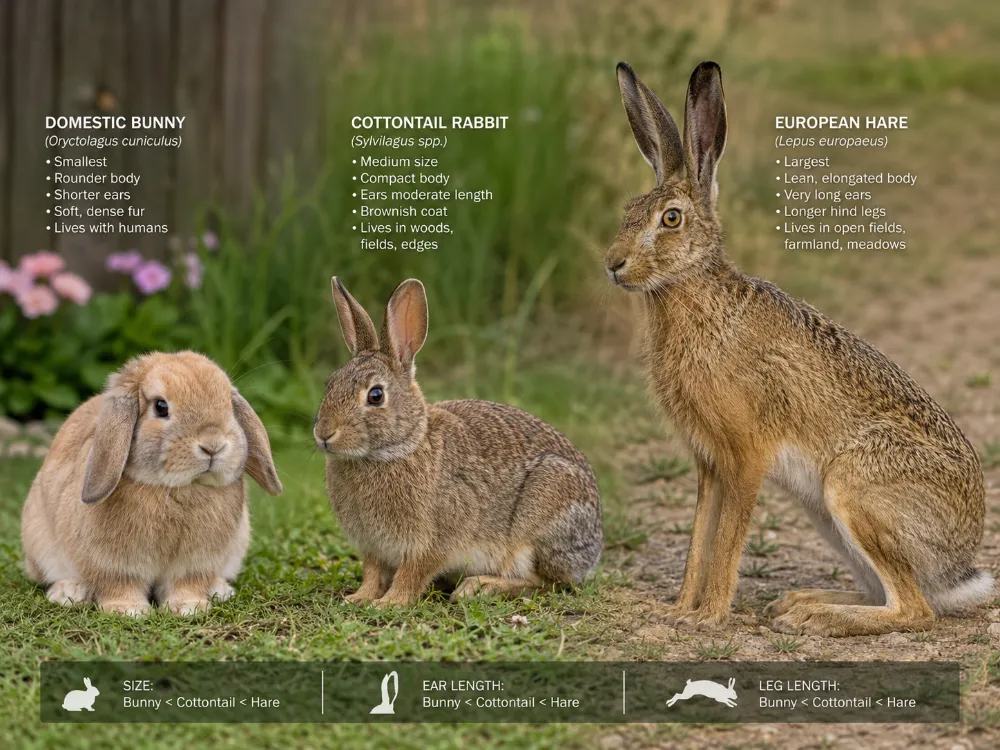
Hares are generally more athletic-looking. They have longer legs, longer ears, leaner bodies, and a more powerful running build. Their hind limbs are especially long and strong, allowing them to sprint, leap, and change direction quickly in open spaces.
If the animal looks compact and is staying close to cover or burrows, it is more likely a rabbit. If it looks tall, long-legged, and built for speed across open ground, it may be a hare.
Ear Differences
Both rabbits and hares have long ears, but hares often have longer ears in proportion to their body size. Many hare species also have dark markings or black tips on the ears, although this depends on the species.
Rabbit ears are usually shorter and more rounded in comparison. However, domestic rabbit breeds can be misleading. Some pet rabbits have very long ears, and lop-eared breeds have ears that hang down rather than stand upright.
Ear length is useful, but it should not be used alone. A better identification method is to combine ear shape with leg length, body size, habitat, and behavior.
Legs, Speed, and Movement
Hares are usually faster runners than rabbits. Their long hind legs help them escape predators in open habitats where there may be few places to hide. A hare may rely on explosive speed, zigzag running, and long leaps to avoid foxes, wolves, lynx, birds of prey, and other predators.
Rabbits can also run quickly, but many rely more on cover, burrows, dense vegetation, and sudden short-distance escape. A rabbit may freeze, dash into cover, or retreat underground when threatened.
In simple terms, rabbits are often better at hiding and burrowing, while hares are better at running in open spaces.
Baby Rabbits vs Baby Hares
One of the clearest biological differences is the condition of the young at birth. Baby rabbits are called kits or kittens. They are born blind, hairless, helpless, and dependent on the mother’s nest for warmth and protection.
Baby hares are called leverets. They are born fully furred, with open eyes, and can move soon after birth. This gives them a major advantage in open habitats where underground burrows are not the main shelter.
This difference reflects their lifestyles. Rabbits can hide vulnerable young in protected nests or burrows. Hares give birth to young that must be ready for life above ground almost immediately.
Burrows and Shelters
Many rabbits use burrows as shelter. The European rabbit is famous for building warrens, which are underground tunnel systems with multiple entrances, nesting chambers, and escape routes. These shelters help protect rabbits from predators and weather.
Hares usually do not dig complex warrens. Instead, they rest in shallow above-ground depressions called forms. A hare may crouch low in grass or snow, using camouflage to avoid detection. When danger comes too close, it escapes by running.
This is one of the most useful field differences: rabbits are often linked with underground shelter, while hares are more strongly linked with open-ground camouflage and speed.
Habitat Differences
Rabbits can live in grasslands, forests, scrublands, wetlands edges, farms, gardens, and semi-open landscapes. Many species prefer areas with cover, vegetation, or soil suitable for burrowing. Domestic rabbits live in homes, hutches, gardens, and managed enclosures.
Hares often prefer more open environments. Depending on the species, they may live in prairies, tundra, deserts, open fields, alpine meadows, moorlands, or snowy landscapes. Their body shape and behavior help them survive where hiding underground is less important than seeing danger early and running fast.
Habitat does not identify every species perfectly, but it gives a strong clue when combined with appearance and behavior.
Diet and Digestion
Rabbits and hares are both herbivores. They eat grasses, herbs, leaves, twigs, bark, buds, roots, and other plant material. Their exact diet depends on season and habitat. In winter, when fresh green plants are scarce, they may eat bark, woody stems, and dry vegetation.
Like other lagomorphs, rabbits and hares have specialized digestion. They produce soft nutrient-rich droppings called cecotropes, which they re-eat to absorb important nutrients. This behavior may seem strange to humans, but it is essential for extracting nutrition from fibrous plant food.
Because their teeth grow continuously, both rabbits and hares need tough plant material to help wear down their teeth naturally.
Social Behavior
Many rabbits are social animals. Some live in colonies or groups, especially species that use burrow systems. Social life can help with predator detection, reproduction, and shared use of safe shelter. Domestic rabbits are also social and often benefit from companionship when properly introduced and cared for.
Hares are often more solitary than rabbits. They may gather in feeding areas or during the breeding season, but they generally do not form the same kind of dense underground colonies as some rabbits. During breeding periods, hares may chase, leap, and box with one another.
The famous phrase “mad as a March hare” comes from the noticeable springtime behavior of European hares during the breeding season.
Reproduction and Lifespan
Rabbits are known for rapid reproduction. Many species can produce several litters in a breeding season, and domestic rabbits can breed quickly if not managed responsibly. This high reproductive rate helps compensate for heavy predation in the wild.
Hares also reproduce effectively, but their young are born more developed. Instead of hiding helpless newborns in a burrow, the mother hare leaves leverets in separate hiding places and returns to nurse them. This reduces the chance that a predator will find all the young at once.
Lifespan varies widely. Wild rabbits and hares often live shorter lives because of predators, disease, weather, and food shortage. Domestic rabbits can live much longer with proper care.
Domestication and Pets
Domestic rabbits are descended from the European rabbit. They have been bred into many forms, including dwarf rabbits, lop-eared rabbits, long-haired rabbits, and large meat or show breeds. These domestic rabbits are often called bunnies in pet contexts.
Hares are not normally domesticated pets. They are wild animals with strong flight responses, large space needs, and behavior suited to open habitats. Keeping a hare as if it were a domestic rabbit would not meet its natural needs.
If someone says they have a pet bunny, they almost certainly mean a domestic rabbit, not a hare.
Jackrabbits: Rabbits or Hares?
Jackrabbits are hares, not rabbits. The name is misleading. Jackrabbits have long ears, long legs, fast running ability, and young that are born furred and open-eyed. These are hare-like traits.
The black-tailed jackrabbit and white-tailed jackrabbit are good examples. They live in open habitats and escape predators by sprinting and leaping rather than diving into burrow systems like many rabbits.
So, despite the word “rabbit” in the name, a jackrabbit is biologically a hare.
Cottontails: Rabbits or Hares?
Cottontails are rabbits. They are common in many parts of North America and are named for the fluffy white underside of the tail, which looks like a small cotton ball when the animal runs away.
Cottontails usually do not build large underground warrens like European rabbits, but they still have rabbit-like traits. Their young are born helpless, blind, and mostly hairless. They also have a more compact body than hares.
This shows why burrowing alone is not the only difference. Some rabbits use simple nests rather than complex burrows, but their newborn development and body form still separate them from hares.
Wild Rabbit vs Pet Bunny
A wild rabbit is adapted to survival in nature. It has strong instincts for hiding, fleeing, detecting predators, and finding seasonal plant foods. Wild rabbits are not the same as domestic pet rabbits and should not be taken from the wild.
A pet bunny is usually a domestic rabbit that depends on humans for food, shelter, veterinary care, and protection. Domestic rabbits may look cute and gentle, but they still have natural needs: hay-based diets, chewing opportunities, exercise space, social interaction, and safe housing.
Wild rabbits belong in the wild. Domestic rabbits belong in responsible human care.
Common Misunderstandings
One common misunderstanding is that “bunny” means a baby rabbit. In casual speech it often does, but adults may also be called bunnies, especially pets. The accurate word for a baby rabbit is kit or kitten.
Another misunderstanding is that hares are just large rabbits. Hares are not simply oversized rabbits. They have different newborn development, body proportions, shelter habits, and survival strategies.
A third misunderstanding is that rabbits are rodents. Rabbits and hares are lagomorphs, not rodents. One key difference is that lagomorphs have an extra pair of small upper incisors behind the main front teeth.
How to Tell a Rabbit from a Hare Quickly
Look at the body: rabbits are usually compact; hares are usually longer-legged and leaner.
Look at the ears: hares often have longer ears, sometimes with dark tips.
Look at the habitat: rabbits often stay near cover or burrows; hares are often seen in open ground.
Look at the escape style: rabbits usually dash into cover; hares often run fast across open areas.
Look at the young: rabbit kits are born helpless; hare leverets are born furred and open-eyed.
Look at the name: jackrabbits are hares, while cottontails are rabbits.
Bunny vs Rabbit vs Hare: Final Comparison
The difference between bunny, rabbit, and hare is partly about language and partly about biology. “Bunny” is an informal word for a rabbit, usually a cute, young, or pet rabbit. “Rabbit” is the correct general term for many small lagomorphs, including domestic rabbits and wild species such as cottontails. “Hare” refers to a related but different kind of lagomorph, usually larger, faster, more solitary, and more adapted to open habitats.
If you are talking about a pet, “bunny” or “rabbit” is usually correct. If you are talking about a long-legged wild animal racing across an open field, it may be a hare. The easiest biological difference is the young: rabbits are born helpless, while hares are born ready to move.
FAQs About Bunny vs Rabbit vs Hare
Is a bunny the same as a rabbit?
Yes, in everyday English, a bunny is a rabbit. “Bunny” is an informal and affectionate word, while “rabbit” is the more accurate general term.
Is bunny a scientific name?
No. Bunny is not a scientific name or separate animal group. It is a nickname commonly used for young, cute, or pet rabbits.
What is a baby rabbit called?
A baby rabbit is called a kit or kitten. Many people casually call a baby rabbit a bunny, but kit is the more accurate term.
What is a baby hare called?
A baby hare is called a leveret. Leverets are born with fur, open eyes, and the ability to move soon after birth.
Are rabbits and hares the same animal?
No. Rabbits and hares are related lagomorphs, but they are different animals. Hares are usually larger, faster, longer-legged, and born more developed than rabbits.
Is a hare just an adult rabbit?
No. A hare is not an adult rabbit. Rabbits and hares are separate types of lagomorphs with different body shapes, behavior, and newborn development.
Are jackrabbits rabbits or hares?
Jackrabbits are hares. They have long legs, long ears, fast running ability, and young that are born furred and open-eyed.
Are cottontails rabbits or hares?
Cottontails are rabbits. They have rabbit-like body proportions and give birth to helpless young, even though they may not build large underground warrens like European rabbits.
Can hares be kept as pets?
Hares are wild animals and are not normally suitable as pets. Domestic rabbits, not hares, are the animals commonly kept as pet bunnies.
Are rabbits rodents?
No. Rabbits and hares are lagomorphs, not rodents. They belong to the order Lagomorpha, which also includes pikas.
Which is faster, a rabbit or a hare?
Hares are usually faster than rabbits. Their long legs and open-country lifestyle make them excellent runners and leapers.
Why are rabbits associated with Easter?
Rabbits are associated with spring, fertility, and new life because they reproduce quickly and are often visible in springtime. Over time, the “Easter bunny” became a popular cultural symbol.