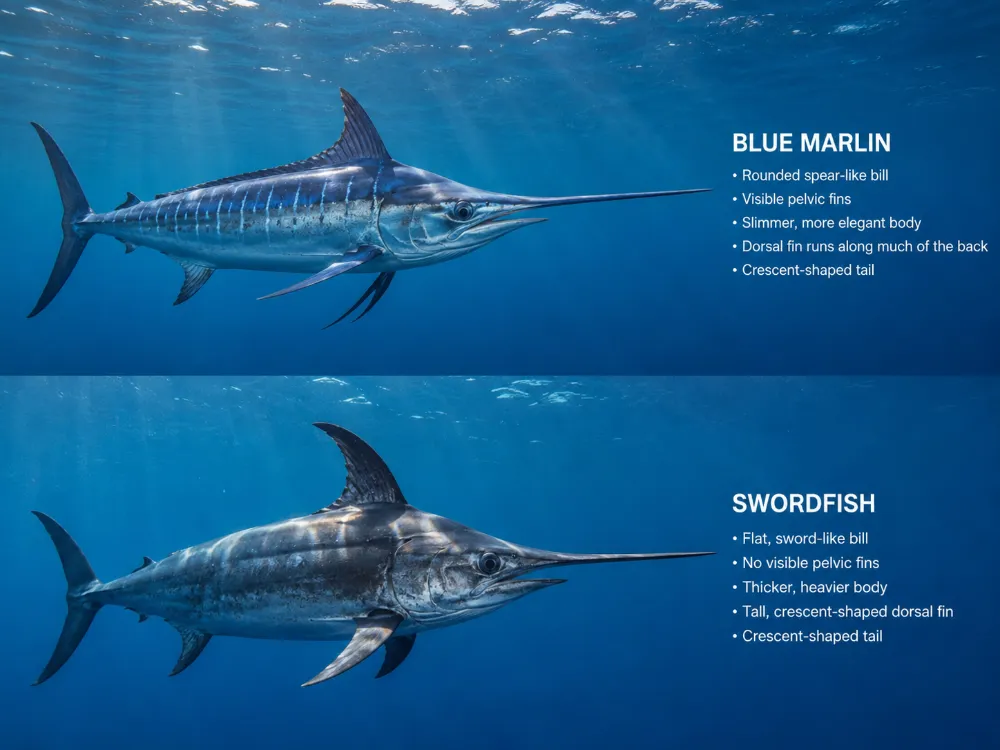
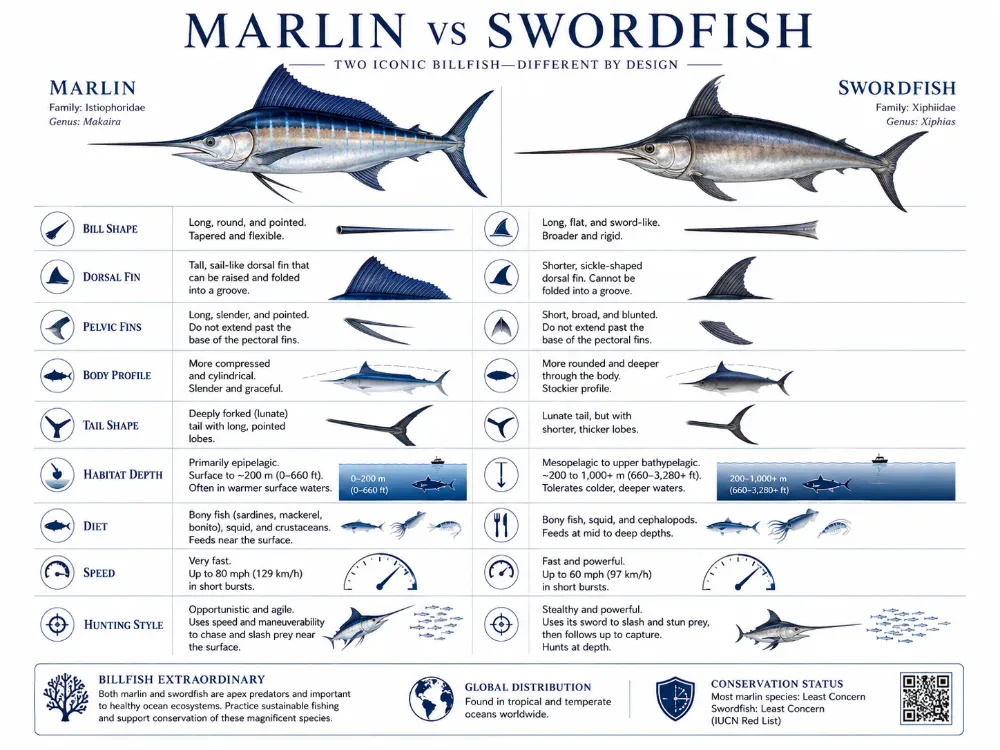
Marlins and swordfish are both fast, powerful billfish, but they are not the same animal. Marlins usually have a rounded spear-like bill, visible pelvic fins, and a more dramatic dorsal fin. Swordfish have a long, flat, sword-like bill, no pelvic fins as adults, and a deeper-diving lifestyle. Swordfish are the only living species in their family, while marlins include several species.
Marlin vs Swordfish Summary Table
| Feature | Marlin | Swordfish |
|---|---|---|
| Scientific group | Family Istiophoridae | Family Xiphiidae |
| Number of living species | Several species, including blue, black, striped, and white marlins | One living species: Xiphias gladius |
| Bill shape | Rounder, spear-like, and pointed | Long, broad, and flattened like a sword |
| Dorsal fin | Often tall, curved, or sail-like in appearance, depending on species | Adult swordfish have a shorter, more crescent-shaped dorsal fin |
| Pelvic fins | Present, though often small and slender | Absent in adults |
| Body shape | Long, muscular, streamlined, and often more laterally compressed | Thick-bodied, powerful, torpedo-shaped, and built for deep diving |
| Typical habitat | Warm open ocean, often near surface waters and productive offshore zones | Open ocean, including deeper and colder water layers |
| Depth behavior | Often hunts in upper ocean layers, though it can dive deeper | Famous for deep daily dives and broad temperature tolerance |
| Main diet | Fish, squid, and other fast-moving prey | Squid, fish, and deep-water prey |
| Hunting method | Uses speed and bill strikes to slash, stun, or injure prey | Uses its flat sword-like bill to slash and stun prey |
| Color | Often blue, black, silver, or striped depending on species | Usually dark brown to blackish above, lighter below |
| Best quick clue | Round spear-like bill plus visible pelvic fins | Flat sword-like bill plus no adult pelvic fins |
What Is a Marlin?
A marlin is a large, fast predatory fish in the billfish family Istiophoridae. Marlins are related to sailfish and spearfish. They are famous for their pointed bills, powerful bodies, long migrations, and dramatic fights when hooked by anglers.
There is not just one marlin species. Commonly recognized marlins include blue marlin, black marlin, striped marlin, and white marlin. These species differ in size, color, fin shape, range, and behavior, but they share the classic marlin body plan: a long streamlined body, a spear-like upper jaw, and a strong crescent-shaped tail.
Marlins are open-ocean predators. They hunt fish and squid in warm and tropical seas, often around productive waters where currents, temperature edges, reefs, seamounts, or baitfish schools concentrate prey.
What Is a Swordfish?
The swordfish is a large predatory fish with the scientific name Xiphias gladius. Unlike marlins, which include several species, the swordfish is the only living species in its family, Xiphiidae.
Swordfish are easily recognized by their long, flat, blade-like bill. This bill looks more like a broad sword than a round spear. Adult swordfish also lack pelvic fins, giving them a cleaner, more torpedo-like outline compared with marlins.
Swordfish are powerful open-ocean hunters. They are especially well adapted for diving into deep, cold water to hunt squid and fish. They have special heat-producing tissue associated with the eyes and brain, which helps them function in cold depths where many other large predatory fish are less efficient.
Bill Shape Differences
The bill is the easiest way to tell a marlin from a swordfish. A marlin’s bill is usually rounder in cross-section and more spear-like. It is pointed, narrow, and built for slashing through schools of prey.
A swordfish bill is flatter, wider, and more blade-like. It looks like a true sword, which explains the common name. From the side, it appears long and pointed; from above or below, it looks broad and flattened.
Simple rule: marlins have spear-like bills, while swordfish have sword-like bills.
Fin Differences
Fins are another strong clue. Marlins usually have pelvic fins, although they may be slender and not always obvious from a distance. Many marlins also have a high or curved first dorsal fin that can look dramatic when raised.
Adult swordfish do not have pelvic fins. Their dorsal fin is also different from that of most marlins. In adults, the first dorsal fin is usually shorter and more crescent-shaped rather than long and sail-like.
If the fish has a flat bill and no pelvic fins, it is almost certainly a swordfish. If it has a rounded bill and small pelvic fins, it is more likely a marlin or another close billfish relative.
Body Shape and Appearance
Marlins have long, muscular, streamlined bodies built for speed. Many species appear elegant and sharply tapered, with a high back, narrow body, and powerful tail. Blue marlins often show a deep blue upper body and silvery sides, while striped marlins have visible vertical stripes.
Swordfish have a thicker, more torpedo-shaped body. They often look heavier in the middle than marlins. Their body is dark above and lighter below, a pattern called countershading that helps conceal them from predators and prey in open water.
Both animals are built for speed, but the marlin often looks more like a surface-speed specialist, while the swordfish looks like a deep-diving ocean torpedo.
Size Differences
Both marlins and swordfish can grow very large. The largest marlins, especially blue marlins and black marlins, can exceed the size of most swordfish. Large female marlins are especially impressive and may reach several meters in length.
Swordfish are also large predators. Big adults can grow over 4 meters long, including the bill, and become very heavy. However, on average, the largest marlins are usually considered bigger than swordfish.
Size alone is not always the best identification clue because young marlins and young swordfish can overlap in size. Bill shape, fins, and body form are more reliable.
Habitat and Range
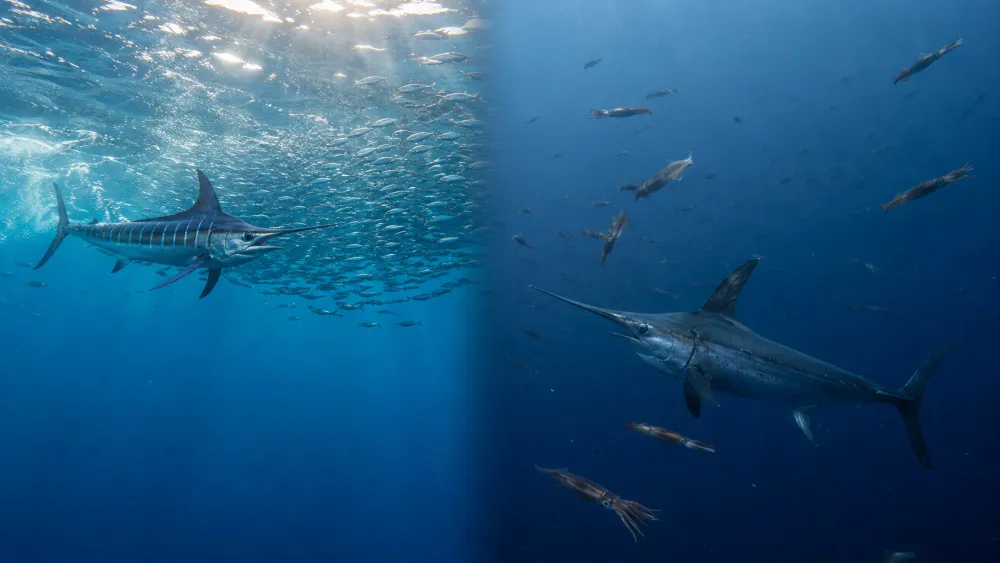
Marlins live mainly in warm and tropical open oceans. They are often associated with surface and upper-water habitats where prey fish gather. They may occur near continental slopes, oceanic islands, current lines, seamounts, and other productive offshore areas.
Swordfish have a broad oceanic range and are known for using deeper, colder water than many marlins. They may spend time near the surface at night and dive deep during the day to hunt squid and fish. This daily vertical movement is one of their most important behavioral traits.
In simple terms, marlins are more strongly associated with warm upper-ocean hunting, while swordfish are more famous for deep diving and cold-water tolerance.
Diet and Feeding Behavior
Marlins eat fish, squid, and other fast-moving marine animals. They may attack schools of tuna, mackerel, flying fish, and other prey. Their bill can be used to slash through groups of fish, stunning or injuring individuals before the marlin turns back to eat them.
Swordfish also eat fish and squid, but they are especially well known for hunting deeper-water prey. Squid are an important part of their diet in many regions. Their flat sword-like bill can slash prey, making it easier to capture fast or slippery animals.
Neither marlins nor swordfish use the bill like a stabbing spear in every attack. The bill is often used as a striking or slashing weapon to stun prey.
Speed and Swimming Ability
Marlins and swordfish are both fast swimmers, but exact speed claims are often exaggerated in popular sources. What is clear is that both have streamlined bodies, strong muscles, narrow tails, and efficient movement for high-speed hunting.
Marlins are famous for fast surface bursts, long runs, and spectacular leaps. Their speed and agility make them among the most athletic predators in the open ocean.
Swordfish are also powerful swimmers, but their specialty is not just speed. They are built for long-distance movement, deep diving, and hunting across a wide range of temperatures and depths.
Deep Diving Adaptations
Swordfish are better known for deep diving than marlins. They regularly move between warmer surface waters and colder deeper waters. This allows them to feed on prey that many surface-oriented predators cannot easily reach.
One of the swordfish’s most remarkable adaptations is its ability to warm the eyes and brain. This helps maintain visual performance in cold, dark water. For a predator that hunts squid and fish at depth, sharper vision can be a major advantage.
Marlins can also dive and move through different water layers, but swordfish are more specialized for deep, cold-water hunting.
Color and Markings
Marlins often show more striking colors and markings than swordfish. Blue marlins may have deep blue backs and silvery sides. Striped marlins have bold vertical stripes. Some marlins can flash brighter colors when excited, stressed, or actively hunting.
Swordfish are usually darker and less vividly patterned. They often have a dark brown, blackish, or bluish upper body and a lighter underside. Their appearance is more plain, but their flat bill and lack of pelvic fins make them easy to recognize.
If the fish has bright stripes or a strong blue-and-silver contrast, it may be a marlin. If it has a plain dark back, thick body, and flat sword-like bill, it is likely a swordfish.
Behavior and Migration
Marlins are wide-ranging ocean travelers. They may migrate long distances following warm water, prey movement, spawning areas, and oceanographic conditions. Some individuals travel across large parts of ocean basins.
Swordfish are also highly migratory. Their movements are often linked to temperature, prey, depth, and season. They may move vertically each day and horizontally across long distances over time.
Both animals show the restless lifestyle of open-ocean predators. They do not defend small territories like reef fish. Instead, they follow food, temperature, and reproductive opportunities across vast marine spaces.
Reproduction and Life Cycle
Marlins reproduce by releasing eggs and sperm into the water. Females can produce large numbers of tiny eggs, but only a small fraction survive to adulthood. Young marlins grow quickly and must avoid many predators during their early life.
Swordfish reproduce in a similar open-water manner. Females release many eggs, and larvae develop in the plankton before growing into juvenile fish. Young swordfish look very different from adults and gradually develop the long bill and adult body form.
Both animals grow fast compared with many large marine animals, but heavy fishing pressure can still affect their populations, especially when large breeding adults are removed.
Predators and Natural Threats
Adult marlins and swordfish have few natural predators because they are large, fast, and powerful. However, large sharks and killer whales may prey on them, especially younger or weakened individuals.
Juveniles are much more vulnerable. Young marlins and swordfish may be eaten by larger fish, sharks, seabirds, and other marine predators. In the open ocean, survival depends on rapid growth, camouflage, speed, and luck.
Humans are now one of the most important pressures on both groups through commercial fishing, sport fishing, and bycatch.
Are Marlin and Swordfish Related?
Yes, marlins and swordfish are related as billfish-like ocean predators, but they belong to different families. Marlins are members of the family Istiophoridae, along with sailfish and spearfish. Swordfish belong to the family Xiphiidae.
Their similar body shapes are partly the result of similar lifestyles. Both evolved as fast open-ocean hunters with long bills, streamlined bodies, and powerful tails. However, their anatomy shows clear differences, especially in the shape of the bill, the presence or absence of pelvic fins, and the structure of the dorsal fin.
Marlin vs Swordfish vs Sailfish
Marlin, swordfish, and sailfish are often confused because all have long bills and fast predatory lifestyles. Sailfish are usually easier to identify because they have an enormous sail-like dorsal fin that can be raised high above the body.
Marlins have a spear-like bill and a strong, streamlined body. Their dorsal fins vary by species, but they are generally not as exaggerated as the sailfish’s huge sail. Swordfish have the flattest bill and lack pelvic fins as adults.
A simple identification guide is: sailfish have the biggest sail, marlins have spear-like bills, and swordfish have flat sword-like bills.
Which Is More Dangerous?
Marlins and swordfish are not dangerous to swimmers in the way sharks are often imagined to be. They do not normally attack humans as prey. However, both are large, muscular wild fish with sharp bills and powerful bodies, so they can injure people if handled carelessly, especially during fishing or boating situations.
Swordfish have been known to use their bills defensively or aggressively when stressed, hooked, or threatened. Marlins can also be dangerous when brought near a boat because of their speed, strength, and sharp bill.
In natural open-water encounters, the risk to swimmers is extremely low. The main danger occurs when humans try to catch, restrain, or handle them.
Conservation and Human Impact
Marlins and swordfish are heavily valued by commercial and recreational fisheries. They are caught for food, sport, and trade. Because they are large migratory predators, they may cross many national and international waters, making management difficult.
Some marlin species have faced population pressure from overfishing, longline fisheries, and bycatch. Swordfish populations vary by region, and management success depends on careful monitoring, fishing limits, gear regulations, and protection of breeding adults.
As apex or near-apex predators, marlins and swordfish help maintain balance in open-ocean food webs. Protecting them also helps protect the health of pelagic marine ecosystems.
How to Tell a Marlin from a Swordfish Quickly
Look at the bill: marlins have a rounder spear-like bill; swordfish have a broad flat sword-like bill.
Look for pelvic fins: marlins have pelvic fins; adult swordfish do not.
Look at the dorsal fin: marlins often have a more dramatic dorsal fin; adult swordfish have a shorter crescent-shaped dorsal fin.
Look at the body: marlins are often more elegant and laterally compressed; swordfish are thicker and more torpedo-shaped.
Look at markings: marlins may show blue color or stripes; swordfish are usually plainer and darker above.
Look at behavior: marlins are famous for surface speed and leaps; swordfish are famous for deep diving.
Marlin vs Swordfish: Final Comparison
Marlins and swordfish are both extraordinary open-ocean predators, but their differences are clear once you know what to look for. A marlin has a rounded spear-like bill, visible pelvic fins, and usually belongs to one of several species in the family Istiophoridae. A swordfish has a flattened sword-like bill, no adult pelvic fins, and is the only living species in the family Xiphiidae.
If you see a sleek billfish with a round spear and dramatic fins, it is likely a marlin. If you see a thick-bodied fish with a flat blade-like bill and no pelvic fins, it is a swordfish. Both are fast, powerful hunters, but the marlin is more associated with warm upper-ocean speed, while the swordfish is more specialized for deep, cold-water hunting.
FAQs About Marlin vs Swordfish
Are marlin and swordfish the same fish?
No. Marlins and swordfish are different fish. Marlins belong to the family Istiophoridae, while swordfish belong to the family Xiphiidae. They look similar because both are fast open-ocean predators with long bills.
What is the easiest way to tell a marlin from a swordfish?
The easiest way is to look at the bill. A marlin has a rounder spear-like bill, while a swordfish has a flat, broad, sword-like bill. Adult swordfish also lack pelvic fins.
Is a swordfish a type of marlin?
No. A swordfish is not a type of marlin. It is the only living species in its own family, Xiphiidae. Marlins are in a different family and include several species.
Which is bigger, a marlin or a swordfish?
The largest marlins, especially blue and black marlins, can grow larger than most swordfish. However, both can become very large, and size varies by species, sex, age, and region.
Which is faster, marlin or swordfish?
Both are very fast swimmers, but exact speed claims are often exaggerated. Marlins are famous for fast surface bursts and leaps, while swordfish are powerful swimmers adapted for deep diving and long-distance movement.
Do marlins and swordfish use their bills as weapons?
Yes, but not always by stabbing. They often use their bills to slash, strike, stun, or injure prey. The bill can also be dangerous when the fish is stressed or handled during fishing.
Why is a swordfish called a swordfish?
It is called a swordfish because its upper jaw forms a long, flat, blade-like bill that resembles a sword. This shape is one of the main features that separates it from marlins.
Do swordfish have teeth?
Young swordfish have teeth, but adults generally lack obvious teeth. They rely more on speed, suction, and their sword-like bill to capture prey.
Do marlins have scales?
Yes, marlins have scales, although they may be small and embedded. Adult swordfish have a smoother appearance and lack the typical visible scales seen in many fish.
Do marlin and swordfish live in the same ocean areas?
They can overlap in some open-ocean regions, especially in warm and temperate seas. However, swordfish often use deeper and colder water layers more regularly than marlins.
Are marlin and swordfish dangerous to humans?
They do not normally attack humans as prey. However, they can injure people during fishing or handling because they are large, powerful fish with sharp bills.
Which is better adapted for deep water?
The swordfish is better known for deep-water hunting. It can dive into cold depths and has special adaptations that help keep the eyes and brain warm for hunting in low-light conditions.