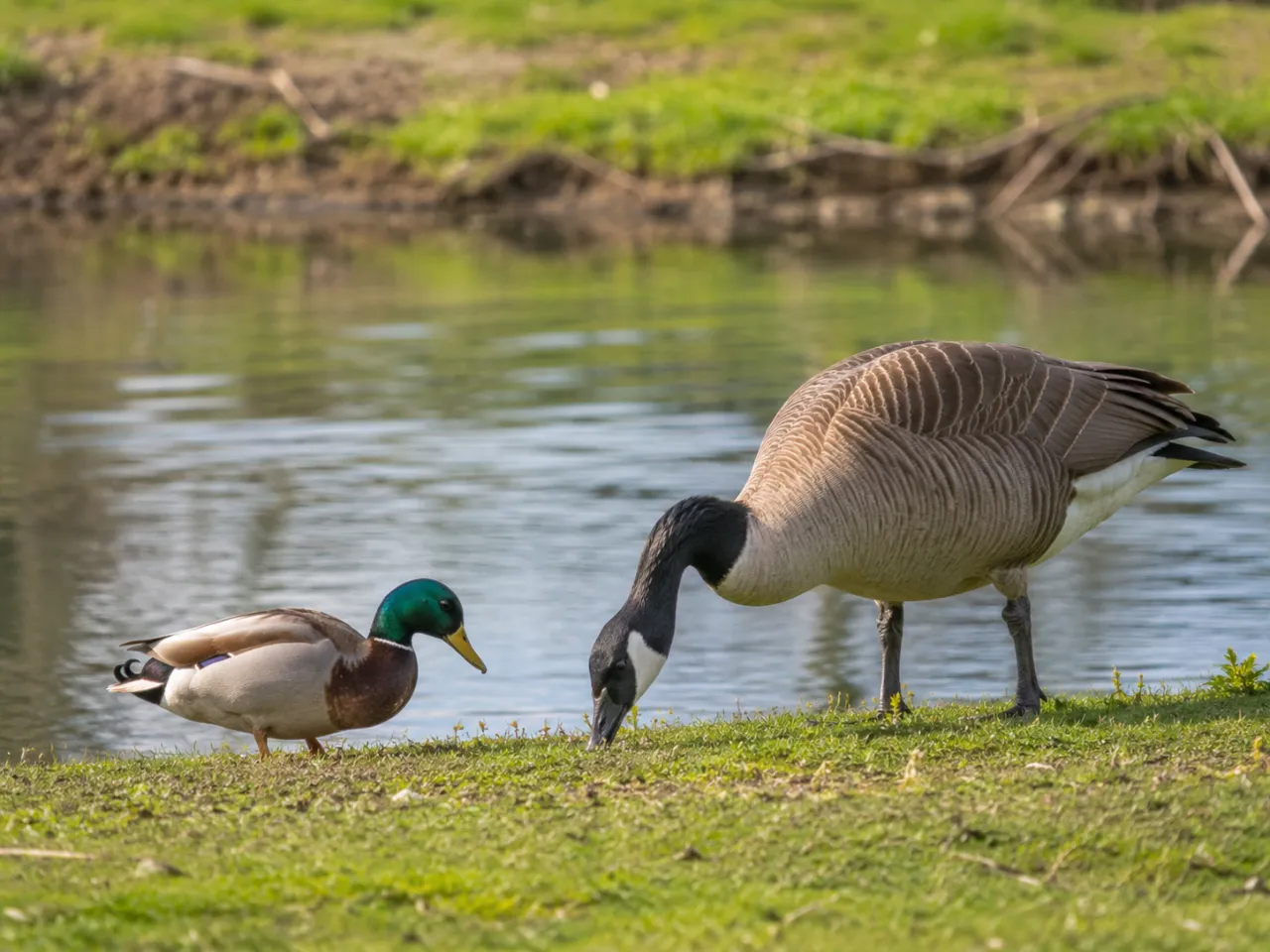
Ducks and geese are both waterfowl in the family Anatidae, but they are easy to tell apart once you know the main clues. Ducks are usually smaller, shorter-necked, rounder, and more varied in feeding style. Geese are usually larger, longer-necked, more terrestrial, louder, and more likely to graze on grass. A duck often looks compact and low on the water, while a goose looks taller, longer, and more upright.
Duck vs Goose Quick Answer
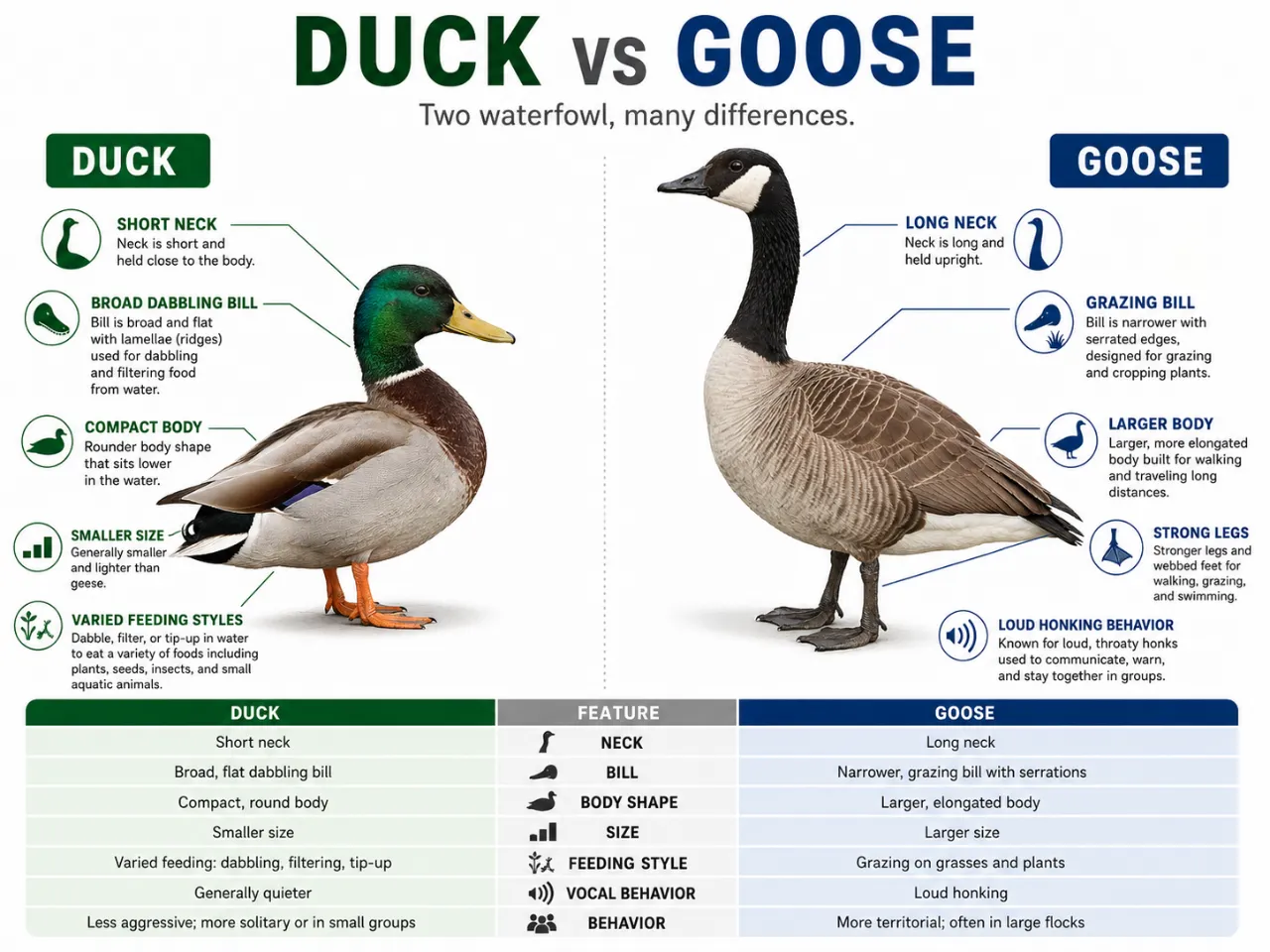
The easiest way to tell a duck from a goose is to look at the neck, body size, and behavior. Ducks usually have shorter necks, smaller bodies, and often feed by dabbling, diving, or filtering food from water. Geese have longer necks, larger bodies, stronger legs, and often feed by grazing on grass or aquatic plants. Geese also tend to be louder, more defensive, and more strongly bonded in pairs or family groups.
Duck vs Goose Summary Table
| Feature | Duck | Goose |
|---|---|---|
| Family | Anatidae | Anatidae |
| General size | Usually smaller | Usually larger |
| Neck | Shorter and more compact | Longer and more upright |
| Body shape | Rounder, lower, more compact | Longer, heavier, more upright |
| Bill shape | Often broad and flattened for dabbling or filtering | Usually stronger and more suited to grazing |
| Diet | Aquatic plants, seeds, insects, small fish, snails, crustaceans, algae | Mostly grasses, grains, aquatic plants, roots, shoots, and seeds |
| Feeding style | Dabbling, diving, filtering, grazing, or foraging depending on species | Mostly grazing and plant feeding, often on land |
| Common sound | Quacks, whistles, peeps, grunts, or soft calls | Honks, loud calls, hisses, and contact calls |
| Social behavior | Social, but pair bonds may be seasonal in many species | Often strong pair bonds and close family groups |
| Temperament | Usually less defensive, though some can be territorial | Often more defensive, especially near nests or goslings |
| Flight pattern | Fast wingbeats; many species fly in loose groups | Often strong migratory flight, commonly in V-shaped formations |
| Young | Ducklings | Goslings |
| Quick identification clue | Small, short-necked, compact waterfowl | Large, long-necked, loud, grazing waterfowl |
What Is a Duck?
A duck is a waterfowl in the family Anatidae. Ducks are a diverse group that includes dabbling ducks, diving ducks, sea ducks, perching ducks, whistling ducks, and domestic breeds. They are usually smaller than geese and swans, with compact bodies, short necks, webbed feet, and broad bills.
Ducks are highly adaptable. Some live on ponds and marshes, while others prefer rivers, lakes, coastal bays, open ocean, forest wetlands, rice fields, or urban parks. Their feeding styles vary widely. A mallard may tip forward in shallow water to reach plants, while a merganser may dive and chase fish underwater. This diversity is one reason ducks can look and behave very differently from one species to another.
What Is a Goose?
A goose is also a waterfowl in the family Anatidae, but geese are generally larger, longer-necked, and more land-oriented than ducks. Familiar examples include Canada geese, barnacle geese, greylag geese, snow geese, brant, and domestic geese.
Geese are often seen grazing on grass, walking in family groups, honking loudly, or flying in V-shaped migratory flocks. They usually have strong pair bonds and are famous for defending nests, mates, and goslings. Compared with ducks, geese often look more upright and powerful, with longer necks and heavier bodies.
Quick Visual Difference
For most common species, body size and neck length are the fastest clues. A duck usually looks small, compact, and short-necked. A goose usually looks bigger, longer-necked, and more upright.
Duck: smaller body, shorter neck, rounder shape, often sits lower on water.
Goose: larger body, longer neck, stronger legs, more upright posture.
Duck: often feeds by dabbling, diving, or filtering food from water.
Goose: often feeds by grazing on grass or walking on land.
Duck: calls may include quacks, whistles, peeps, or soft sounds.
Goose: calls are often loud honks or deep contact calls.
Size and Body Shape
Ducks are usually smaller than geese. Their bodies are often compact, rounded, and low to the ground. Many ducks have relatively short legs set farther back on the body, which helps with swimming but can make walking look slightly waddling.
Geese are generally larger and heavier. Their bodies are longer, their necks are more extended, and their legs often look stronger for walking and grazing on land. A goose usually appears more upright than a duck, especially when alert or standing in grass.
There is some overlap because large domestic ducks can look bulky and small goose species can be modest in size. Still, in most everyday situations, geese are noticeably bigger than ducks.
Neck Length: The Most Useful Clue
The neck is one of the best identification features. Ducks usually have short to medium-length necks. Even when they stretch upward, they rarely look as tall and elegant as geese.
Geese have longer necks, which help them graze, scan for danger, communicate with flock members, and maintain a more upright body posture. Their long necks are especially obvious when they are walking on land or flying in formation.
If the bird looks like a compact waterfowl with a short neck, it is likely a duck. If it looks like a larger waterfowl with a long neck and loud calls, it is likely a goose.
Bill Shape and Feeding Tools
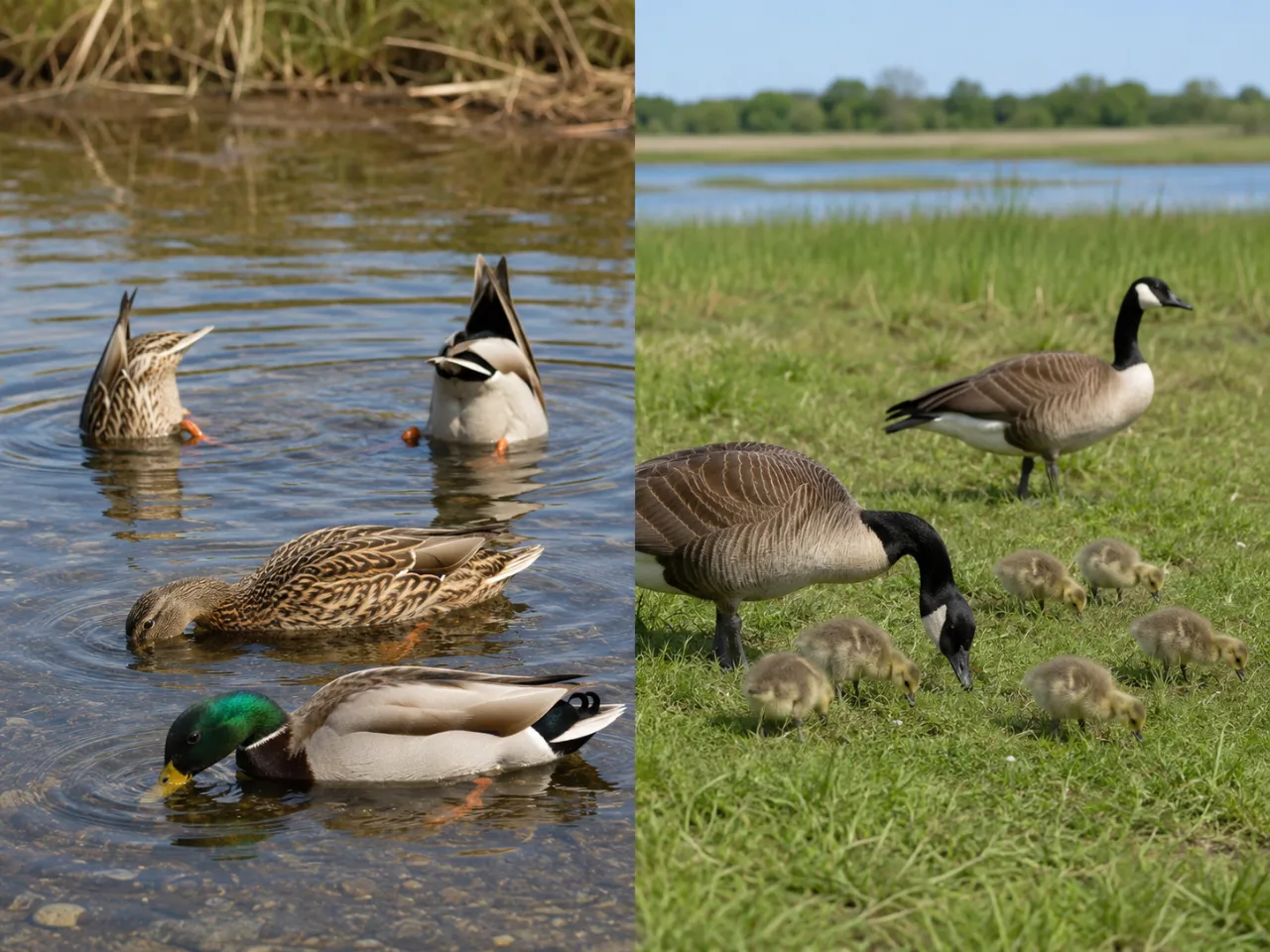
Ducks often have broad, flattened bills. Many species use comb-like structures called lamellae along the bill edges to filter food from water. Dabbling ducks use their bills to strain seeds, tiny animals, algae, and plant material from shallow water and mud.
Geese also have lamellae, but their bills are usually more strongly adapted for grazing. A goose can clip grass, pull vegetation, and feed efficiently on land. Many geese spend long periods walking and feeding in fields, lawns, wetlands, and agricultural areas.
In simple terms, a duck’s bill often works like a water filter, while a goose’s bill often works like a grazing tool.
Diet and Feeding Behavior
Ducks have highly varied diets. Many eat aquatic plants, seeds, algae, insects, snails, crustaceans, worms, tadpoles, small fish, and other small animals. Dabbling ducks feed near the water surface or tip forward with their tails up. Diving ducks dive underwater to catch prey or reach submerged plants.
Geese are more strongly herbivorous. They often eat grass, sedges, grains, shoots, roots, leaves, seeds, and aquatic vegetation. Some geese feed heavily in fields and lawns, which is why they are often seen in parks, golf courses, farms, and open grassy areas.
Ducks are usually more diverse in feeding style. Geese are usually more focused on grazing and plant eating.
Habitat Differences
Ducks are very flexible in habitat. Depending on the species, they may live in freshwater ponds, marshes, lakes, rivers, estuaries, coastal lagoons, mangroves, open ocean, flooded forests, or city parks. Some ducks spend much of their time diving, while others prefer shallow wetlands.
Geese also use wetlands, lakes, rivers, and coastal areas, but many species spend more time on land than ducks do. They often feed in fields, meadows, tundra, grasslands, and lawns. Geese need water for safety, resting, and raising young, but they may feed far from water if food is available.
If a bird is constantly diving or dabbling in water, it is probably a duck. If it is walking across grass and grazing in a group, it is more likely a goose.
Calls and Sounds
Ducks do not all simply “quack.” Female mallards are famous for a classic quack, but many duck species whistle, squeak, grunt, growl, or make soft contact calls. Male ducks are often quieter than females in many species.
Geese are usually louder and more carrying in sound. Many produce honks, barks, cackles, hisses, or deep contact calls. Goose calls help keep family groups and migrating flocks together. A flock of geese flying overhead can be heard from far away.
If the sound is a loud honk from a large flying group, it is probably geese. If the sound is a softer quack, whistle, or chatter near a pond, it may be ducks.
Flight and Migration
Ducks are strong fliers. Many species migrate long distances, often flying quickly with rapid wingbeats. Some ducks fly in loose groups, while others form lines or flocks depending on species and weather.
Geese are especially famous for migration in V-shaped formations. This formation can help conserve energy and keep the group organized during long-distance travel. Their large bodies, long necks, and loud calls make flying geese easy to recognize.
In flight, ducks often look smaller and faster-winged. Geese usually look larger, longer-necked, and more deliberate.
Social Behavior and Family Life
Ducks are social birds, especially outside the breeding season. They may gather in flocks for feeding, migration, and safety. In many duck species, pair bonds are seasonal, and males may not help much with raising the young.
Geese often form stronger pair bonds. Many geese mate for long periods and raise young together. Parents may lead goslings in a family group, defend them aggressively, and stay together through the early life stages.
This family behavior is one reason geese are often seen as more protective than ducks. A goose guarding goslings can become very defensive toward people, dogs, or other animals that come too close.
Ducklings vs Goslings
Baby ducks are called ducklings. They are usually small, fluffy, and able to walk and swim soon after hatching. Ducklings often follow their mother in a line and feed actively in shallow water or along the shore.
Baby geese are called goslings. Goslings are usually larger than ducklings and often graze on grass with their parents. Goose families may remain tightly organized, with both adults watching for danger.
A small fluffy bird following a compact short-necked mother is likely a duckling. A larger fluffy bird grazing with long-necked adults is likely a gosling.
Temperament: Are Geese More Aggressive Than Ducks?
Geese are often more defensive than ducks, especially during nesting season or when protecting goslings. A goose may hiss, stretch its neck, spread its wings, run forward, or bite if it feels threatened. This behavior is defensive, not “mean.” The goose is trying to protect its family or territory.
Ducks can also be territorial or pushy, especially males during breeding season, but they are usually less intimidating than geese because they are smaller and less forceful. Domestic drakes can sometimes become aggressive, especially if poorly managed or kept with too few females.
As a general rule, geese are more likely to stand their ground, while ducks are more likely to move away.
Domestic Ducks vs Domestic Geese
Domestic ducks are often kept for eggs, meat, pest control, ornamental ponds, or companionship. Common domestic duck breeds include Pekin, Khaki Campbell, Indian Runner, Rouen, Muscovy, and Call ducks. Domestic ducks usually need water access for bathing, safe shelter, predator protection, and appropriate feed.
Domestic geese are often kept for meat, eggs, guarding behavior, grazing, weed control, or farmyard companionship. Common domestic goose breeds include Embden, Toulouse, Chinese, African, Sebastopol, and Pilgrim geese. Geese can be excellent grazers, but they may be noisy and defensive.
Both domestic ducks and geese are social flock animals. They should not be kept alone without companionship and proper care.
Duck vs Goose as Pets
Ducks and geese can be rewarding animals for people with the right space, time, and setup, but neither is a simple indoor pet. They are outdoor birds that need secure housing, clean water, proper nutrition, predator protection, and social companionship.
Ducks may be better for people who want smaller, quieter, egg-producing flock birds, though some duck breeds are still loud and messy. Geese may be better for people with more land who want grazers and alert farm birds, but they can be louder, stronger, and more defensive.
Before keeping ducks or geese, owners should check local laws, noise rules, predator risks, veterinary availability, and long-term care needs.
Duck vs Goose Eggs
Duck eggs are usually larger than chicken eggs and often have rich yolks. Many domestic duck breeds are good layers. Duck eggs are popular in baking because of their size and richness.
Goose eggs are much larger than duck eggs, but geese usually lay fewer eggs per year than many domestic ducks. Goose eggs have thick shells, large yolks, and a rich texture. Because geese are often seasonal layers, goose eggs are less commonly available than duck eggs.
In general, ducks are better egg layers for regular production, while geese produce fewer but much larger eggs.
Duck vs Goose vs Swan
Swans are also waterfowl in the family Anatidae, and they are usually larger than both ducks and geese. Swans have very long necks, large bodies, and often a more graceful appearance on the water.
| Bird | Typical Size | Neck | Common Clue |
|---|---|---|---|
| Duck | Small to medium | Short | Compact body, dabbling or diving behavior |
| Goose | Medium to large | Longer | Grazing, honking, family groups |
| Swan | Large to very large | Very long | Elegant long neck, large white or dark body depending on species |
Common Misidentifications
Large ducks are sometimes mistaken for geese, especially domestic ducks such as Muscovy ducks or large Pekins. Muscovy ducks can look goose-like because they are large, heavy, and often walk on land, but they are still ducks.
Small geese can also be mistaken for ducks from a distance. Brant and some other small geese are compact compared with large Canada geese, but their longer necks, grazing behavior, and goose-like calls usually reveal their identity.
Another common mistake is assuming all white waterfowl are geese. White domestic ducks, white geese, and white swans can all appear in parks or farms. Neck length, body size, bill shape, and sound are better clues than color alone.
How to Identify One in a Photo
When looking at a photo, use several clues together:
Check the neck: short neck suggests duck; long neck suggests goose.
Check the body: compact and rounded suggests duck; larger and more upright suggests goose.
Check the setting: diving or dabbling in water suggests duck; grazing on grass suggests goose.
Check the bill: broad flat bill suggests duck; stronger grazing bill suggests goose.
Check the group: family group with large adults and goslings often suggests geese.
Check the flight: large V-shaped honking flock usually suggests geese.
Which Bird Is Smarter?
Both ducks and geese are more intelligent than many people assume. They can learn routines, recognize individuals, respond to social cues, remember feeding sites, and navigate migration routes.
Geese are especially known for strong social memory, pair bonds, and family defense. Ducks are highly adaptable and show complex feeding, migration, and social behaviors depending on species.
It is not accurate to say one is simply smarter than the other. Ducks and geese use intelligence in different ways shaped by their ecology.
Which Bird Is Better at Flying?
Both ducks and geese can be excellent fliers. Many wild ducks migrate long distances and fly quickly with rapid wingbeats. Some sea ducks and diving ducks are especially powerful flyers over water.
Geese are famous for long-distance migration, strong flock coordination, and V-shaped formations. Their larger bodies and loud calls make migration more visible to humans.
Ducks may look faster and more agile in flight, while geese often look more organized and powerful over long distances.
Conservation and Human Impact
Ducks and geese depend on healthy wetlands, rivers, lakes, grasslands, coastal habitats, and migration routes. Wetland loss, pollution, hunting pressure, climate change, invasive species, and disturbance can affect many waterfowl populations.
Some duck and goose species are common and adaptable, especially in urban parks and agricultural landscapes. Others are threatened or declining because they rely on specialized habitats. Conservation work often focuses on protecting wetlands, nesting grounds, stopover sites, and wintering areas.
Healthy waterfowl populations are signs of functioning wetland ecosystems. Protecting ducks and geese also protects fish, amphibians, insects, plants, and many other birds.
Final Comparison
Ducks and geese are closely related waterfowl, but they differ in size, shape, sound, diet, and behavior. Ducks are usually smaller, shorter-necked, more compact, and more varied in feeding style. Geese are usually larger, longer-necked, louder, more terrestrial, and more likely to graze in family groups.
If the bird is small, round, short-necked, and dabbling or diving, think duck. If it is large, long-necked, honking, walking on grass, or flying in a V-shaped flock, think goose.
Related Bird Comparisons
Goose vs Swan
Duck vs Swan
Mallard vs Duck
Male Duck vs Female Duck
Crane vs Heron
Egret vs Heron
FAQs About Duck vs Goose
Is a goose a duck?
No. Geese and ducks are both waterfowl in the family Anatidae, but they are different types of birds. Geese are usually larger, longer-necked, louder, and more land-oriented than ducks.
What is the easiest way to tell a duck from a goose?
Look at the neck and body size. Ducks are usually smaller with shorter necks and rounder bodies. Geese are usually larger with longer necks, stronger legs, and a more upright posture.
Are geese more aggressive than ducks?
Geese are often more defensive, especially during nesting season or when protecting goslings. Ducks can also be territorial, but geese are usually louder, larger, and more willing to stand their ground.
Do ducks and geese eat the same food?
They overlap, but their diets are not identical. Ducks often eat aquatic plants, seeds, insects, snails, small fish, and crustaceans. Geese are more strongly herbivorous and often graze on grasses, grains, and aquatic plants.
Can ducks and geese fly?
Yes. Many wild ducks and geese are strong fliers and long-distance migrants. Ducks often fly with fast wingbeats, while geese are famous for V-shaped migration flocks.
What are baby ducks and baby geese called?
Baby ducks are called ducklings. Baby geese are called goslings.
Can ducks and geese live together?
Domestic ducks and geese can sometimes live together if they have enough space, water, shelter, and careful management. However, geese can be dominant or defensive, so mixed flocks should be monitored.
Which is bigger, a duck or a goose?
Geese are usually bigger than ducks. Some large domestic ducks can be heavy, and some small geese are compact, but in most cases geese are larger and longer-necked.