An ox and a bull are both cattle, but they mean different things. A bull is an intact adult male bovine used mainly for breeding. An ox is usually a castrated male bovine trained to pull carts, plows, logs, or heavy loads. Bulls are often more muscular, hormonal, and aggressive, while oxen are usually calmer, more manageable, and trained for draft work.
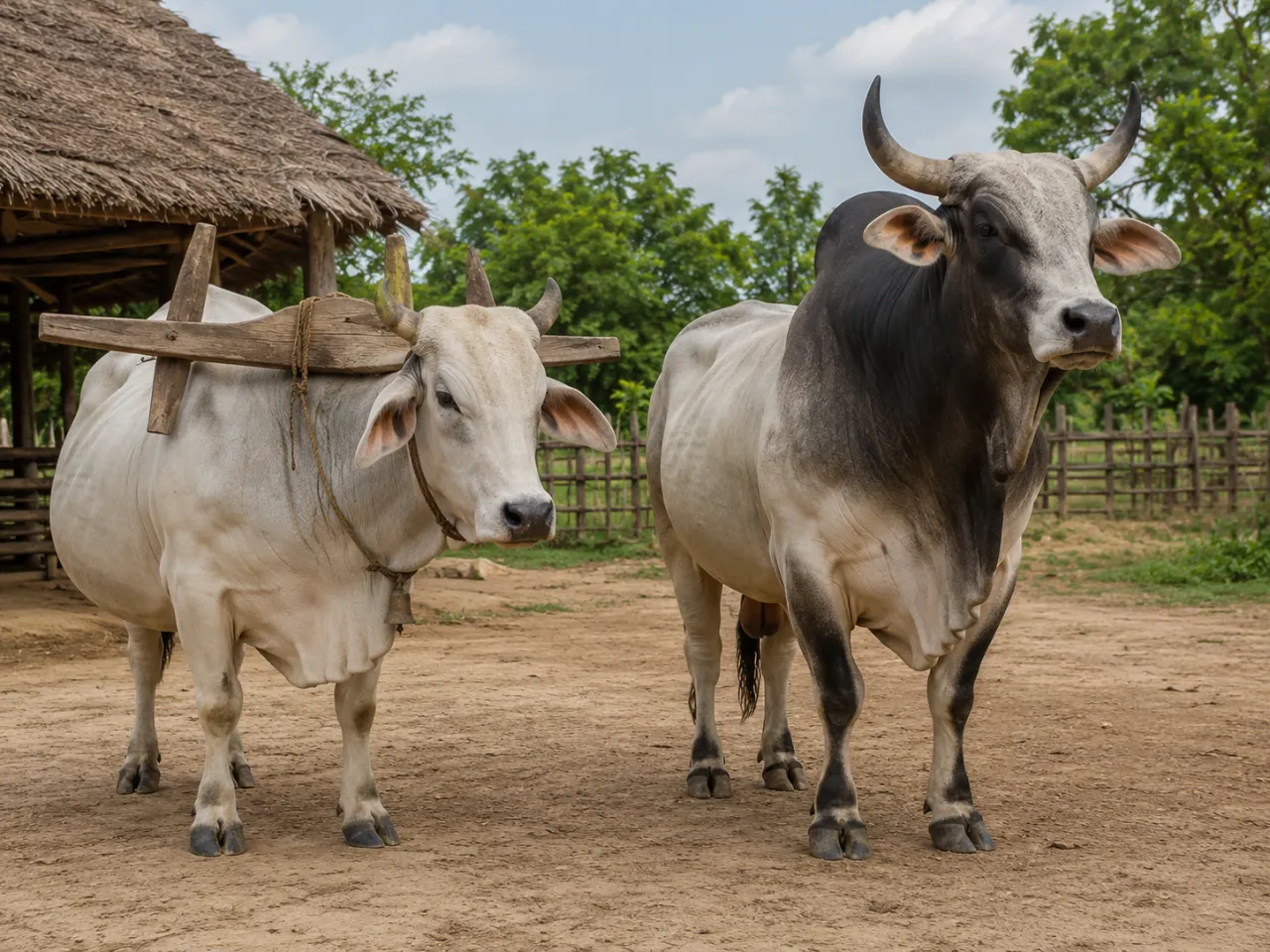
Ox vs Bull Quick Answer
The main difference between an ox and a bull is reproductive status and purpose. A bull is an uncastrated adult male cow-family animal, usually kept for breeding. An ox is usually a castrated male, often a steer, trained as a working animal. Bulls are selected for reproduction and genetics, while oxen are selected and trained for strength, patience, endurance, and obedience.
Ox vs Bull Summary Table
| Feature | Ox | Bull |
|---|---|---|
| Basic meaning | A trained draft bovine, usually a castrated male | An intact adult male bovine |
| Sex | Usually male, but castrated | Male, not castrated |
| Reproductive ability | Usually cannot reproduce | Can reproduce |
| Main purpose | Pulling, plowing, hauling, logging, transport, farm work | Breeding, herd genetics, sometimes meat production |
| Temperament | Usually calmer and more trainable | Often more territorial, dominant, and potentially aggressive |
| Training | Specifically trained to work with humans | Usually not trained for draft work |
| Strength | Strong, steady, and endurance-based | Very muscular and powerful, especially in neck and shoulders |
| Hormonal influence | Lower testosterone after castration | High testosterone compared with steers or oxen |
| Body shape | Large, steady, often broad and work-conditioned | Muscular, thick-necked, heavy-shouldered, more sexually developed |
| Horns | May have horns depending on breed and management | May have horns depending on breed and management |
| Common risk | Can be dangerous due to size, but usually more manageable | Can be very dangerous, especially during breeding season or territorial behavior |
| Quick identification clue | Calm working animal in yoke or harness | Intact adult male used for breeding, often more muscular and assertive |
What Is an Ox?
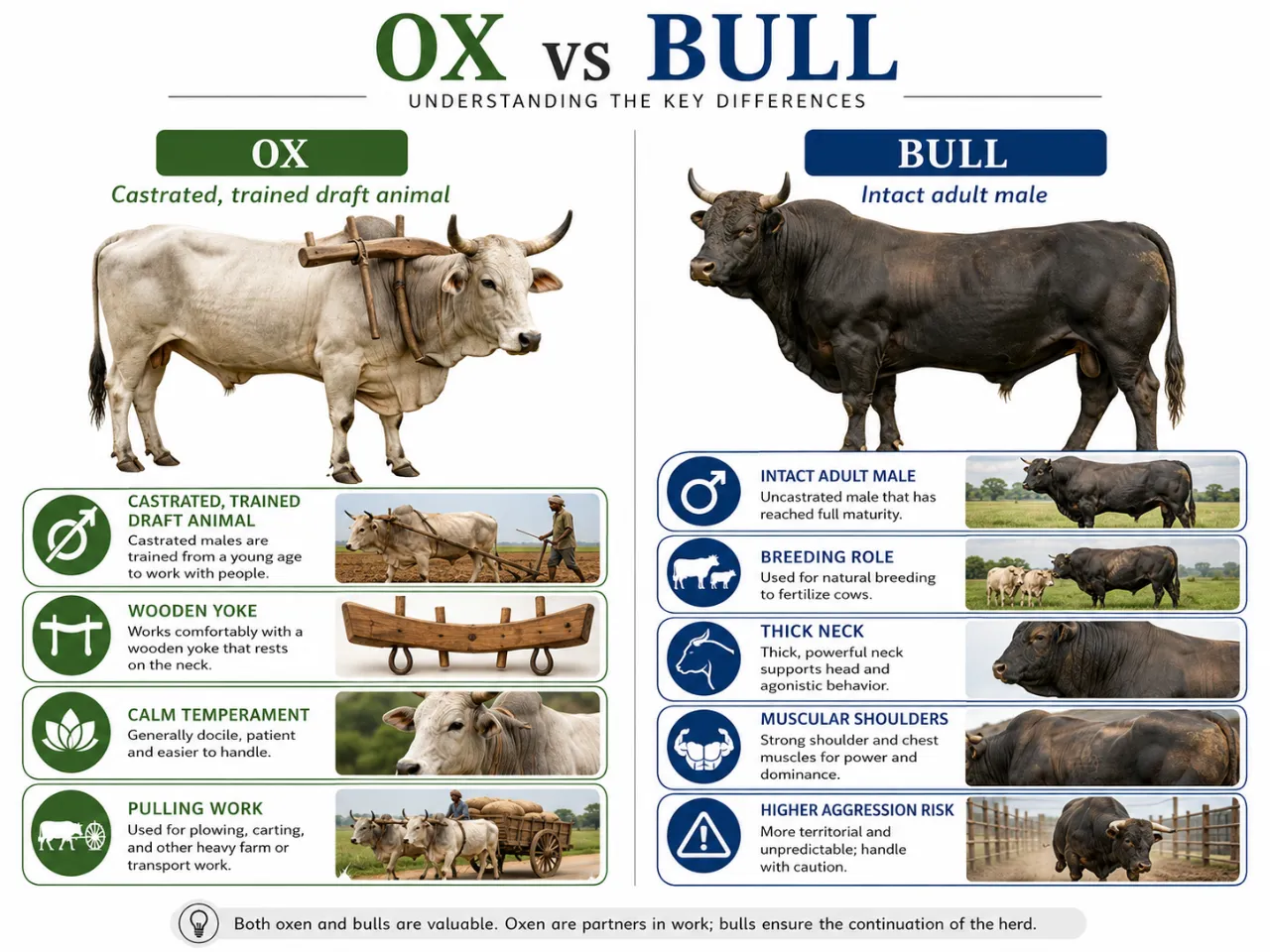
An ox is a bovine trained to work as a draft animal. In most cases, an ox is a castrated male cattle animal, often called a steer before or outside its working role. The word “ox” is mainly about function: it describes an animal trained to pull, haul, plow, or carry loads.
Oxen have been used by humans for thousands of years. Before tractors and modern machinery, oxen were essential for agriculture, transportation, logging, irrigation, and heavy labor. They could pull plows through fields, drag logs from forests, move carts, and transport goods over long distances.
An ox is not a separate species from cattle. It is usually domestic cattle trained for work. In some regions, related bovines such as water buffalo may also be used as draft animals, but in everyday English, “ox” usually refers to working cattle.
What Is a Bull?
A bull is an intact adult male bovine. “Intact” means the animal has not been castrated. Bulls are kept mainly for breeding because they can sire calves. Farmers and ranchers may choose bulls based on size, fertility, temperament, breed traits, milk-production genetics, meat quality, growth rate, or other herd goals.
Bulls are often powerful animals with thick necks, muscular shoulders, strong heads, and high levels of testosterone. They may show dominance behavior, territoriality, and aggression, especially around cows, rival males, or unfamiliar people.
A bull is not defined by horns. Some bulls have horns, and some are naturally hornless, called polled. The defining feature is that a bull is an uncastrated adult male.
Quick Visual Difference
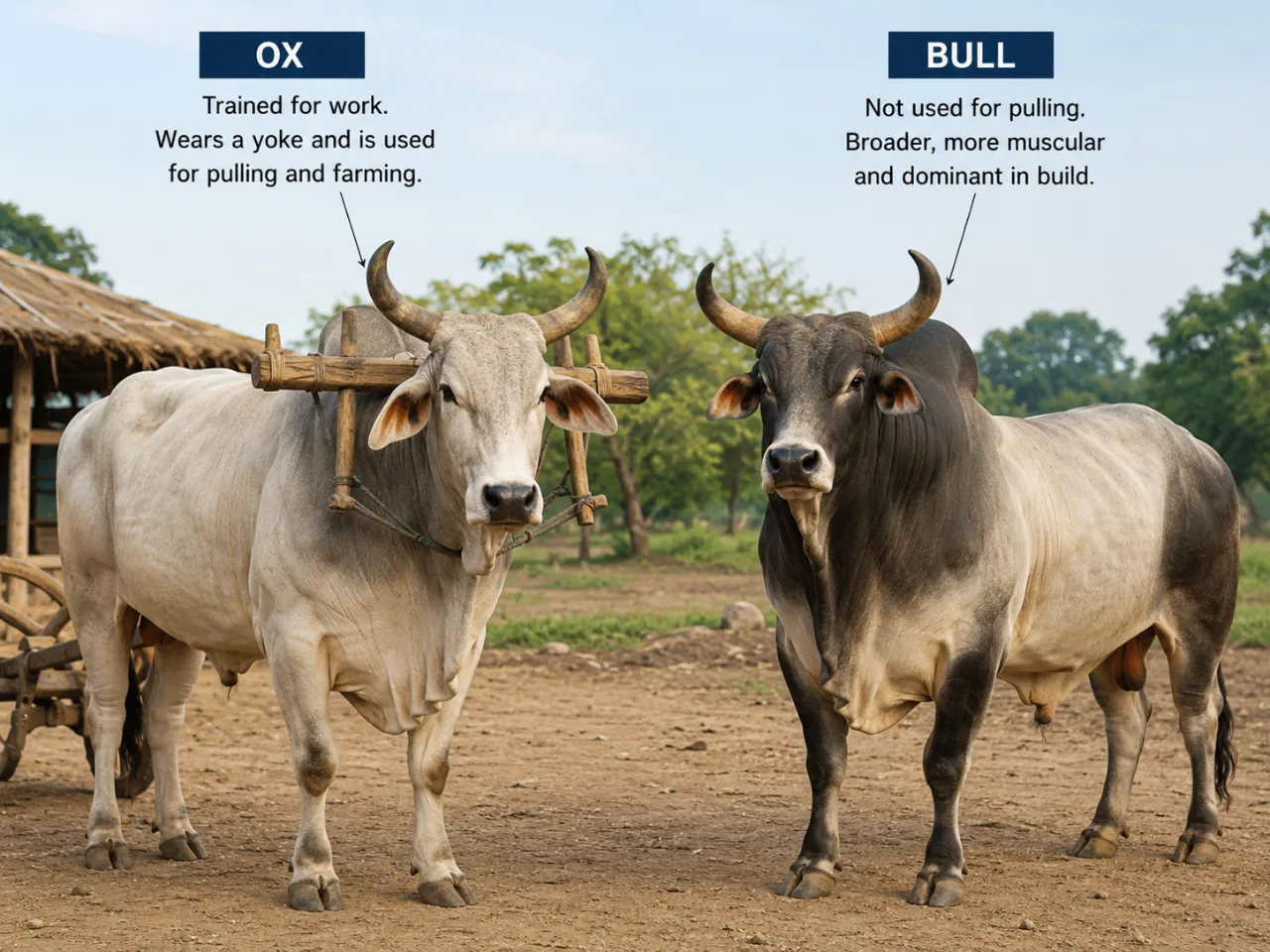
The easiest way to identify an ox is context. If the animal is wearing a yoke, pulling a cart, plowing a field, or working calmly with a handler, it is probably an ox. If the animal is kept with cows for breeding and shows a thick neck, muscular body, and dominant behavior, it is probably a bull.
Ox: usually castrated, trained, calmer, and used for work.
Bull: intact male, used for breeding, more hormonal, and often more aggressive.
Ox: identified more by job than by breed.
Bull: identified by sex and reproductive status.
The Biggest Difference: Job vs Sex
The word “bull” tells you the animal’s sex and reproductive status. A bull is an adult male that has not been castrated.
The word “ox” tells you the animal’s job. An ox is a trained working bovine. Most oxen are castrated males because castration usually makes them calmer and easier to manage, but the key idea is work, training, and draft use.
This is why the comparison can be confusing. A bull is a biological category. An ox is a working role.
Ox vs Bull vs Steer
To understand oxen and bulls, it helps to know the word “steer.” A steer is a castrated male bovine. Many oxen are steers that have been trained for work. However, not every steer is an ox. A steer raised only for beef is not usually called an ox.
| Term | Meaning | Common Role |
|---|---|---|
| Bull | Intact adult male bovine | Breeding |
| Steer | Castrated male bovine | Meat production or possible draft training |
| Ox | Trained draft bovine, usually a steer | Work, pulling, hauling, plowing |
| Cow | Adult female bovine that has usually had a calf | Milk, calves, breeding herd |
| Heifer | Young female bovine before first calf | Future breeding or dairy animal |
| Calf | Young bovine | Juvenile stage |
Are Oxen Always Male?
Oxen are usually castrated males, but the word can sometimes be used more broadly for cattle trained to work. In some traditions, cows may also be trained for draft work, especially where farms need animals that can both work and produce calves or milk.
However, in most classic agricultural usage, an ox is a castrated male trained for pulling. Castrated males are preferred because they are usually stronger than females, less aggressive than bulls, and easier to manage in teams.
Are Bulls Used as Oxen?
Bulls are usually not used as oxen. They can be strong enough to pull, but their behavior makes them less suitable for routine draft work. High testosterone can make bulls more aggressive, distracted, territorial, and difficult to control, especially around other cattle.
For heavy work, farmers historically preferred castrated males because they combined size and strength with steadier temperament. A calm, trained ox can work for hours beside people, other animals, carts, and tools. A mature bull is usually too risky for that kind of regular close handling.
Size and Strength
Both oxen and bulls can be extremely strong. A bull may be more muscular in a reproductive and dominance sense, with a thick neck, heavy shoulders, and powerful body. Bulls develop these traits under the influence of testosterone.
An ox may not have the same hormonal muscle pattern as a bull, but it can still be enormous and very strong. Oxen are conditioned for steady pulling, endurance, and obedience. Their strength is practical rather than explosive. A good ox team can pull heavy loads slowly and reliably over long distances or through difficult ground.
If the question is raw muscular aggression, the bull may have the advantage. If the question is controlled pulling power and work endurance, the ox is the better animal.
Temperament and Behavior
Oxen are usually calmer because they are castrated and trained. Their behavior is shaped by daily handling, voice commands, yoke training, and repeated work routines. A well-trained ox responds to commands, walks steadily, stops when asked, and works with another ox as a team.
Bulls are more unpredictable. Even a bull that seems calm can be dangerous because of its size, strength, and hormonal behavior. Bulls may paw the ground, lower the head, bellow, push, charge, or challenge people and other animals.
This does not mean every ox is safe or every bull is aggressive. Individual temperament varies. But as a general rule, oxen are selected for manageability, while bulls are selected for breeding value.
Training and Work
An ox is made through training. A young steer may be taught to accept a yoke, respond to voice commands, walk beside another animal, pull evenly, turn, stop, back up, and remain calm around equipment. Training usually begins when the animal is young and easier to handle.
Oxen may work alone, but they are often used in pairs or teams. A pair of oxen is commonly connected by a yoke across the neck or head, depending on regional tradition. The handler may use voice commands, body position, and gentle guidance.
Bulls are not usually trained for this purpose. Their role is reproduction, not draft labor.
Horns: Do Oxen and Bulls Both Have Horns?
Both oxen and bulls may have horns, depending on breed, genetics, and management. Some cattle breeds naturally grow horns. Others are naturally polled, meaning hornless. Some cattle are dehorned or disbudded when young for safety and management reasons.
Horns do not tell you whether an animal is an ox or a bull. A horned animal can be an ox, bull, cow, or steer. A hornless animal can also be any of those, depending on breed and reproductive status.
To identify an ox or bull, look at role, sex, body shape, and context rather than horns alone.
Body Shape Differences
Bulls often have a thicker neck, heavier head, stronger shoulders, and more muscular front end than steers or oxen. Their bodies reflect their role in competition, breeding, and dominance.
Oxen often look large, broad, and sturdy, but their bodies may be less thick-necked than bulls. Because they are trained for work, their muscles may develop through repeated pulling and movement. They often appear steady, solid, and conditioned rather than explosive.
In photos, a bull may look more intense and muscular around the neck and shoulders. An ox may look calmer and may be shown in a yoke or working position.
Diet and Care
Oxen and bulls both eat plant-based diets typical of cattle. They graze on grass and may also receive hay, silage, grains, minerals, and supplemental feed depending on management, workload, climate, and body condition.
Oxen used for heavy work need enough energy, protein, water, hoof care, rest, and proper equipment fit. A poorly fitted yoke or overwork can cause injury. Good handlers monitor body condition, lameness, heat stress, and fatigue.
Bulls need nutrition that supports fertility, body condition, and strength without making them dangerously overweight. Breeding bulls also need careful handling, safe fencing, and veterinary attention for reproductive health.
Are Oxen Stronger Than Horses?
Oxen and horses are strong in different ways. Oxen are usually slower than horses, but they can be excellent at steady pulling, especially with heavy loads, rough ground, or slow farm work. They are patient, sure-footed, and efficient on forage.
Horses are usually faster and better for riding, transport, and jobs requiring speed. Oxen were often favored where slow, steady power mattered more than speed. They were also valuable because they could work on simpler feed and were easier to maintain in some farming systems.
This is why oxen were historically important for plowing, hauling logs, and pulling heavy carts.
Which Is More Dangerous, an Ox or a Bull?
A bull is usually more dangerous than an ox because it is intact, hormonal, territorial, and extremely powerful. Bulls can injure or kill people, even when they have been handled before. Anyone working around bulls must understand cattle behavior and use safe facilities.
An ox can also be dangerous because of its size. A calm ox may still step on a person, swing its head, push, or panic. However, a well-trained ox is usually much more predictable and manageable than a mature bull.
The safest rule is to respect both animals. Never assume a large bovine is harmless.
Oxen in Human History
Oxen have played a major role in human civilization. They helped plow fields, move stones, pull carts, transport goods, power irrigation systems, and haul timber. In many regions, oxen made agriculture more productive before engines existed.
They were especially valuable because they could work slowly and steadily while eating grass, hay, crop residues, or other local feed. Their manure helped fertilize fields, and at the end of their working life, they could still provide meat or hide in traditional farming systems.
In many cultures, oxen symbolize patience, strength, labor, and endurance.
Bulls in Agriculture
Bulls are important because they contribute genetics to the herd. A single bull can sire many calves, so choosing the right bull can affect growth rate, milk production, body shape, temperament, fertility, and disease resistance in future generations.
In dairy systems, bulls from high-quality genetic lines may be used through artificial insemination rather than kept physically with cows. In beef systems, bulls may run with cows during breeding season. In both cases, bull selection is a major part of herd management.
A good bull is not just strong. He should be fertile, healthy, structurally sound, and suitable for the herd’s goals.
Ox vs Bull in Different Species
The words ox and bull are most often used for domestic cattle, but related terms can apply to other bovines. For example, people may speak of a water buffalo bull or yak bull. Draft animals from related species may sometimes be described as oxen in a broader sense if they are used for pulling or plowing.
In everyday English, though, the clearest comparison is domestic cattle: bull means intact adult male, and ox means trained working steer.
Common Misidentifications
One common mistake is thinking an ox is a separate species. It is not. An ox is usually a domestic cattle animal trained for work.
Another mistake is thinking horns make an animal a bull. Horns do not define sex. Cows, steers, oxen, and bulls may all have horns depending on breed and management.
A third mistake is assuming a bull and an ox are equally easy to handle because both are cattle. Bulls require much more caution because of their reproductive hormones and dominance behavior.
How to Identify One in a Photo
When looking at a photo, use several clues together:
Check the context: yoke, cart, plow, or logging work suggests ox.
Check the body: thick neck, heavy shoulders, and breeding posture may suggest bull.
Check the setting: working farm team suggests ox; breeding herd suggests bull.
Check behavior: calm trained pulling behavior suggests ox; dominant or territorial behavior suggests bull.
Do not rely on horns: both oxen and bulls may have horns.
Look for handlers and equipment: trained oxen are often shown beside handlers or in pairs.
Ox vs Bull vs Cow
Ox, bull, and cow are all cattle terms, but they describe different roles and sexes.
| Animal Term | Meaning | Main Role |
|---|---|---|
| Ox | Trained draft bovine, usually castrated male | Work and pulling |
| Bull | Intact adult male | Breeding |
| Cow | Adult female, usually one that has had a calf | Milk, calves, herd reproduction |
| Steer | Castrated male | Meat production or draft training |
| Heifer | Young female before first calf | Future breeding or dairy cow |
Which Animal Is Better for Farm Work?
For pulling, plowing, and hauling, an ox is better than a bull. Oxen are trained for work and are usually calmer, safer, and more reliable. They can work in pairs, respond to commands, and perform steady draft tasks.
A bull is better for breeding, not draft work. Although a bull may be strong, its temperament and reproductive behavior make it less practical and more dangerous for routine farm labor.
So the answer depends on the job: ox for work, bull for breeding.
Final Comparison
An ox and a bull are both cattle, but they represent different categories. A bull is an intact adult male used mainly for breeding. An ox is usually a castrated male trained as a draft animal. Bulls are powerful, hormonal, and potentially dangerous. Oxen are powerful too, but they are usually calmer, trained, and better suited to working closely with humans.
The simplest way to remember the difference is this: a bull is defined by sex and reproduction, while an ox is defined by training and work.
Related Animal Comparisons
Cow vs Bull
Steer vs Bull
Ox vs Cow
Bison vs Buffalo
Buffalo vs Bull
Yak vs Ox
FAQs About Ox vs Bull
Is an ox the same as a bull?
No. A bull is an intact adult male bovine used mainly for breeding. An ox is usually a castrated male bovine trained for pulling, plowing, hauling, or other work.
Can an ox reproduce?
Usually no. Most oxen are castrated males, so they cannot reproduce. Bulls are intact males and can sire calves.
Is an ox just a castrated bull?
Most oxen are castrated males, but not every castrated male is an ox. To be called an ox, the animal is usually trained and used for draft work.
Which is stronger, an ox or a bull?
A bull may have more raw muscular power and aggression because of testosterone. An ox is usually better at controlled pulling strength and endurance because it is trained for work.
Which is more dangerous, an ox or a bull?
A bull is usually more dangerous because it is intact, territorial, and more likely to show aggressive behavior. An ox can still be dangerous due to its size, but a trained ox is usually more manageable.
Do oxen have horns?
Some oxen have horns and some do not. Horns depend on breed, genetics, and management. Horns do not prove whether an animal is an ox or a bull.
Why are oxen castrated?
Castration usually makes male cattle calmer, easier to train, and safer to manage. This is why castrated males have traditionally been preferred for draft work.
Are oxen still used today?
Yes. Oxen are still used in some parts of the world for plowing, hauling, logging, and transport. They are also used in historical farming, cultural events, and traditional agriculture.