The short answer is that a donkey is a real animal species, while a mule is a hybrid. A donkey is the domesticated form of the African wild ass, but a mule is produced by crossing a male donkey with a female horse. Because of that, mules often look like a blend of both parents: they usually have donkey-like ears and toughness, but horse-like height, stride, and body shape. So the biggest difference is simple: donkey is a species, mule is a cross between species.
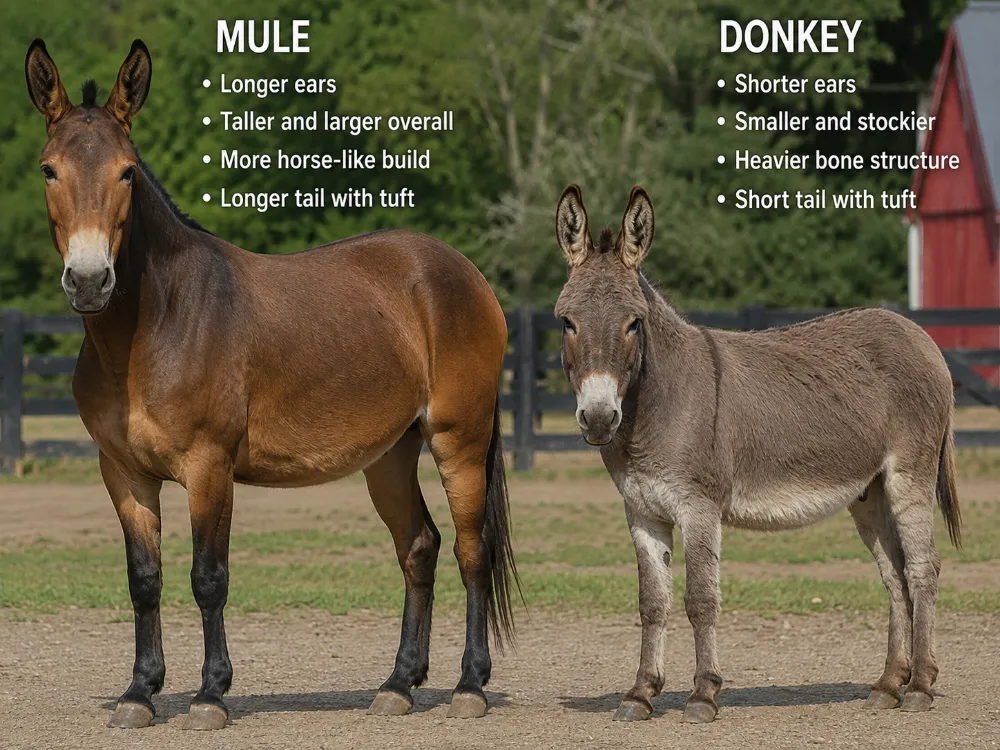
People often confuse mules and donkeys because both can have long ears, sturdy bodies, and a reputation for toughness, intelligence, and working ability. At a quick glance, especially in farm settings, a mule can look like a large donkey and a donkey can look like a smaller, rougher horse.
In reality, they are not the same animal. One is a true equine species in its own right, while the other is a hybrid created from two different equine parents. That difference affects body shape, behavior, fertility, and how people use them.
In this guide, you will learn how mules and donkeys differ in origin, appearance, voice, temperament, strength, and biology, plus the fastest ways to tell them apart.
Quick comparison table
| Feature | Mule | Donkey |
|---|---|---|
| What it is | A hybrid of a male donkey and a female horse | A true domesticated equine species |
| Scientific status | Hybrid animal | Domesticated form of the African wild ass |
| Parents | Donkey father, horse mother | Donkey parents |
| Body build | Often taller and more horse-like, but sturdy | Usually smaller, narrower, and more compact |
| Ears | Long, but often not as exaggerated as a donkey’s | Usually very long and obvious |
| Tail | Usually more horse-like with hair along more of the tail | Usually thinner with a tuft at the end |
| Voice | Often a mix of bray and whinny-like sounds | Classic bray |
| Fertility | Usually sterile | Normally fertile |
| Best quick clue | Looks like a horse-donkey blend | Looks fully donkey, especially in head, ears, and tail |
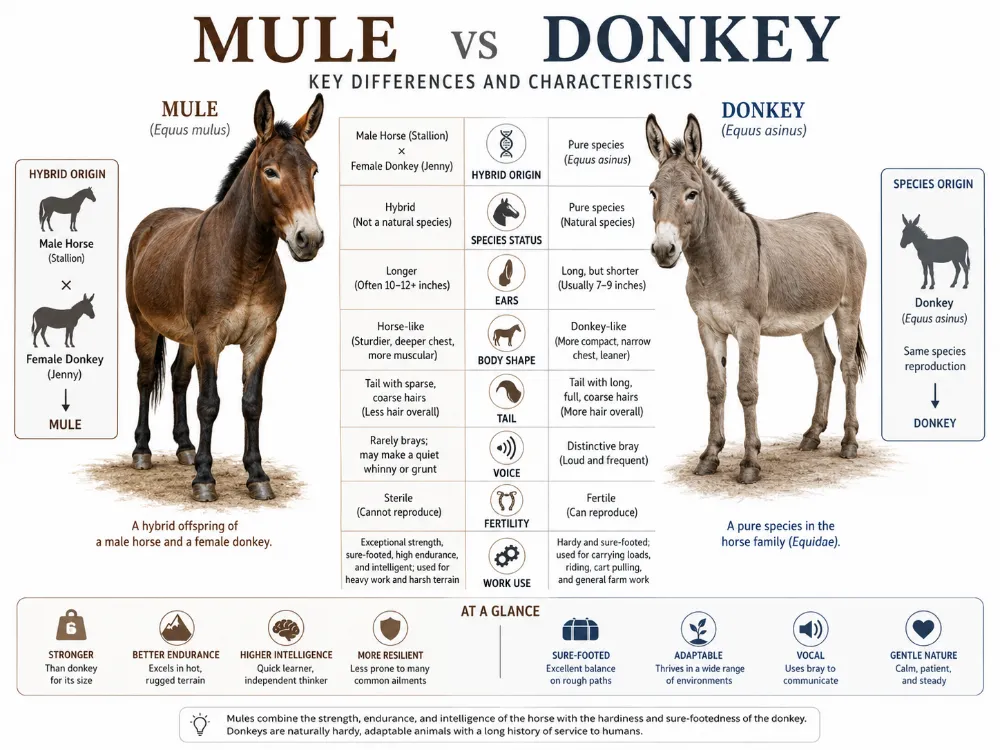
A donkey is a species, but a mule is a hybrid
This is the most important difference in the entire comparison. A donkey is a real domesticated equine animal with its own evolutionary history. A mule is not a separate species in the same way. A mule is the offspring of a male donkey, often called a jack, and a female horse, called a mare.
Because the mule comes from two different parental lines, it often combines traits from both. That is why mules can look so distinctive. They are not simply “better donkeys” or “odd horses.” They are hybrids with a body and temperament shaped by both sides of the family.
So if you want the simplest scientific answer, it is this: donkey is a species, mule is a cross.
A mule is not the same as a hinny
This is a useful point because people often mix up mule and hinny. A mule comes from a male donkey and a female horse. A hinny comes from a male horse and a female donkey.
These two hybrids are not exactly the same in appearance or frequency. Mules are far more common and usually the animal people mean in everyday discussion. Hinnies exist, but they are less often seen.
So when people compare mule vs donkey, they are usually talking about the common donkey-horse hybrid, not the reverse cross.
Mules are usually larger than donkeys
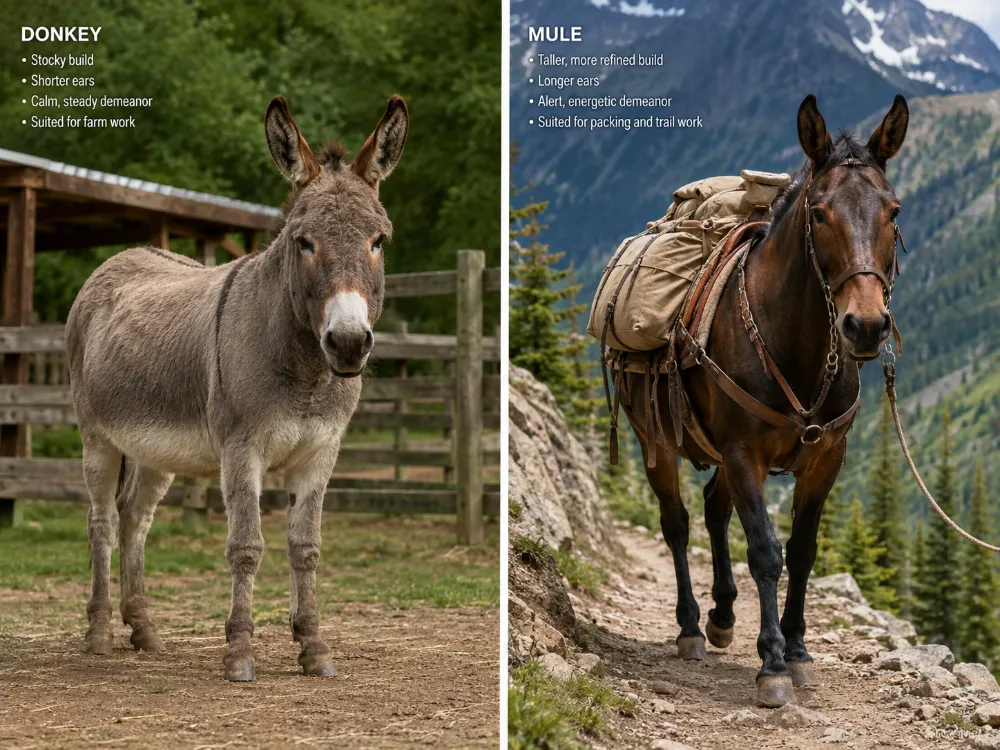
One of the clearest visual differences is size. Mules are often taller and longer-legged than donkeys because their mother is a horse. They often carry more height, longer stride, and a more stretched body outline.
Donkeys are usually smaller and more compact. Even large donkeys often look shorter-bodied and less elevated than a typical mule. Their proportions tend to feel more naturally donkey-shaped, with a simpler and more compact working-animal outline.
If the animal looks especially tall and horse-like in frame but still has long ears, mule becomes more likely.
Mules often look like a blend of horse and donkey
This blended appearance is one of the best clues. Many mules have a horse-like body, a stronger shoulder and hindquarter, and a more fluid stride than a donkey. At the same time, they often keep donkey-like ears, a tougher expression, and a hardy overall look.
Donkeys usually look more uniform in type. Their shape is not a blend. It is distinctly donkey, with a straighter, simpler outline and less of the horse-like elegance or lift that many mules show.
If the animal seems caught halfway between horse and donkey in appearance, it is probably a mule.
Donkeys usually have more obviously donkey-like heads
A donkey usually has a very recognizable head: long ears, a relatively narrow face, a straight or slightly convex profile, and a distinctly donkey expression. The whole head tends to look built for the species, not mixed from two parents.
Mules often have a head that reflects both lineages. The ears are often long, but the face may look somewhat more refined or horse-influenced. The muzzle and forehead can show a mixed look that makes the animal seem neither fully horse nor fully donkey.
If the head looks purely donkey in every feature, donkey becomes more likely.
Donkey ears are usually more exaggerated
Both mules and donkeys can have long ears, which is why beginners confuse them so easily. However, donkey ears are usually more obviously large in proportion to the head and are one of the classic features of the species.
Mules often inherit long ears from the donkey father, but the ears may not always look as exaggerated as those of a full donkey. On some mules, the ears are clearly long but still feel slightly more balanced against the rest of the head.
So if the ears seem especially large and unmistakably donkey-like, the animal may well be a donkey rather than a mule.
The tail is often one of the best clues
Tail shape is a very useful feature. Donkeys usually have a thinner tail with a tuft of hair at the end, more like the tail pattern seen in wild asses. The tail does not usually look like a horse’s full flowing tail.
Mules more often have a tail that is more horse-like, with fuller hair along a greater part of its length. Even when the tail is not as dramatic as a horse’s, it often looks less purely donkey-like than the tail of a true donkey.
If the tail looks horse-influenced rather than tuft-ended and simple, mule becomes more likely.
Mules often move more like horses
One of the most striking differences can be seen in motion. Mules often have a longer, smoother, more horse-like stride than donkeys. They may look more athletic, more elevated, and more fluid when walking or working under saddle or pack.
Donkeys usually have a more compact and practical way of moving. Their gait can look efficient, careful, and sturdy rather than extended or elegant. This fits their long history as hardy working animals in difficult terrain.
If the animal’s movement seems especially horse-like while the head still suggests donkey ancestry, mule is a strong possibility.
Mules are usually stronger for their size
Mules are famous for strength, endurance, and efficiency. Because they combine horse and donkey ancestry, they often show what people call hybrid vigor. In practical terms, that can mean toughness, stamina, strong feet, and excellent work capacity.
Donkeys are also very hardy and strong for their size, but mules often stand out especially in pack work, farm work, and riding because they combine greater size with notable durability.
This is one reason mules have been so valued in agriculture, transport, and mountain travel around the world.
Donkeys are famous for caution, not stubbornness
Donkeys have a reputation for being stubborn, but that reputation is often unfair. In reality, donkeys are usually thoughtful, cautious animals that do not blindly rush into danger. When uncertain, they may stop, assess, and refuse to move until they feel safe.
Mules often inherit some of this careful donkey-like judgment, which is one reason experienced handlers value them. A mule may think before reacting, and that can make it feel very different from a more impulsive horse.
So both animals are often better understood as intelligent and cautious rather than simply stubborn.
Mules often combine donkey caution with horse energy
This is one of the reasons mules are so distinctive. Many mules seem to combine the steady judgment of a donkey with some of the energy, movement, and athletic ability of a horse. That combination makes them excellent working animals in many environments.
Donkeys, by contrast, usually feel more consistently donkey-like in temperament. They are often steady, observant, and conservative in their reactions, but they do not usually show the same horse-influenced athletic blend that a mule can show.
So if the animal seems more dynamic than a donkey but still more self-protective than a horse, it may well be a mule.
Donkeys bray, mules often sound mixed
Voice can be another clue. Donkeys are famous for their bray, a loud and distinctive call that is one of the classic sounds of the species.
Mules often produce sounds that seem mixed. Their vocalization may include elements of the donkey bray and horse-like whinnying or other hybrid-sounding calls. The result can sound unusual to people who know the parent species well.
If the voice sounds unmistakably donkey-like, that supports donkey. If it sounds blended or harder to classify, mule becomes more likely.
Fertility is a major biological difference
This is one of the most important scientific differences. Donkeys are normally fertile and reproduce with other donkeys in the normal way.
Mules are usually sterile because they are hybrids of two different equine lines with mismatched chromosome patterns. Rare exceptions have occurred, especially involving female mules, but the general biological rule is that mules do not reproduce normally.
So if the question is which one can form a normal breeding population on its own, the answer is donkey, not mule.
Donkeys come in standard, miniature, and large forms
One reason mule versus donkey can look confusing is that donkeys vary in size. Some are miniature, some are standard-sized, and some large donkeys can be quite substantial. That means not every donkey is tiny or obviously different from a mule at first glance.
Even so, the donkey still keeps the core species features: donkey head, donkey tail, donkey voice, and a more purely donkey body plan. The mule still tends to look like a hybrid, especially in motion and overall proportion.
So size alone is useful, but structure matters more.
Mules are often preferred for difficult work and terrain
Mules have long been valued for pack travel, mountain work, farm labor, and riding in harsh conditions. Their hardiness, sure-footedness, and efficient movement make them especially respected in environments where a horse may be less practical.
Donkeys are also highly valued working animals, especially in dry regions, small-scale transport, guarding livestock in some settings, and carrying loads. They are resilient, economical, and extremely useful animals in their own right.
The difference is often not that one is useful and the other is not. It is that the mule is often chosen when a larger hybrid work animal is desired, while the donkey is the true species adapted for its own long partnership with people.
Why people confuse them so often
People confuse mules and donkeys because both can have long ears, short manes, sturdy legs, and working-animal body language. At a quick glance, a mule can seem like a big donkey, especially if the observer is not also comparing horses regularly.
The confusion becomes stronger because many people know the word mule from history, farming, or idioms, but do not always know its exact biological meaning. Once you learn that a mule is a horse-donkey hybrid, many of the visible differences suddenly make sense.
The biggest mistake is assuming that long ears automatically mean donkey.
How to tell them apart quickly
If you need a fast identification guide, use these clues together:
Mule: taller body, more horse-like proportions, long ears but mixed appearance, more horse-like tail, hybrid look
Donkey: fully donkey-shaped head, very long ears, tufted tail, more compact body, classic bray, true species
No single clue is perfect every time, but the combination of tail, head, and body proportions usually works very well.
Which one is better?
There is no universal winner, because they are not meant for exactly the same role. A mule is often the stronger choice when people want a tough, capable hybrid for riding, packing, or hard labor with greater size and hybrid vigor.
A donkey is often the better answer when people want the true species itself, with its own endurance, caution, efficiency, and lower-maintenance working style. Donkeys also have their own social and practical value beyond comparison with hybrids.
So the better animal depends on the purpose, not on the idea that one has replaced the other.
Final takeaway
The main difference between a mule and a donkey is that a donkey is a true equine species, while a mule is a hybrid produced by crossing a male donkey with a female horse. Mules often look like a blend of both parents, with donkey-like ears but more horse-like size, body shape, and movement. Donkeys usually look more uniformly donkey-like in the head, tail, voice, and structure. Once you understand that one is a species and the other is a hybrid, the whole comparison becomes much easier.
FAQs
Is a mule a donkey?
No. A mule is a hybrid made from a male donkey and a female horse.
What is the main difference between a mule and a donkey?
The main difference is that a donkey is a true species, while a mule is a horse-donkey hybrid.
How can I tell a mule from a donkey fast?
Look at the tail, body shape, and overall proportions. A mule often looks more horse-like, while a donkey looks fully donkey-shaped.
Can mules have babies?
Mules are usually sterile, although very rare exceptions have been recorded, especially in females.