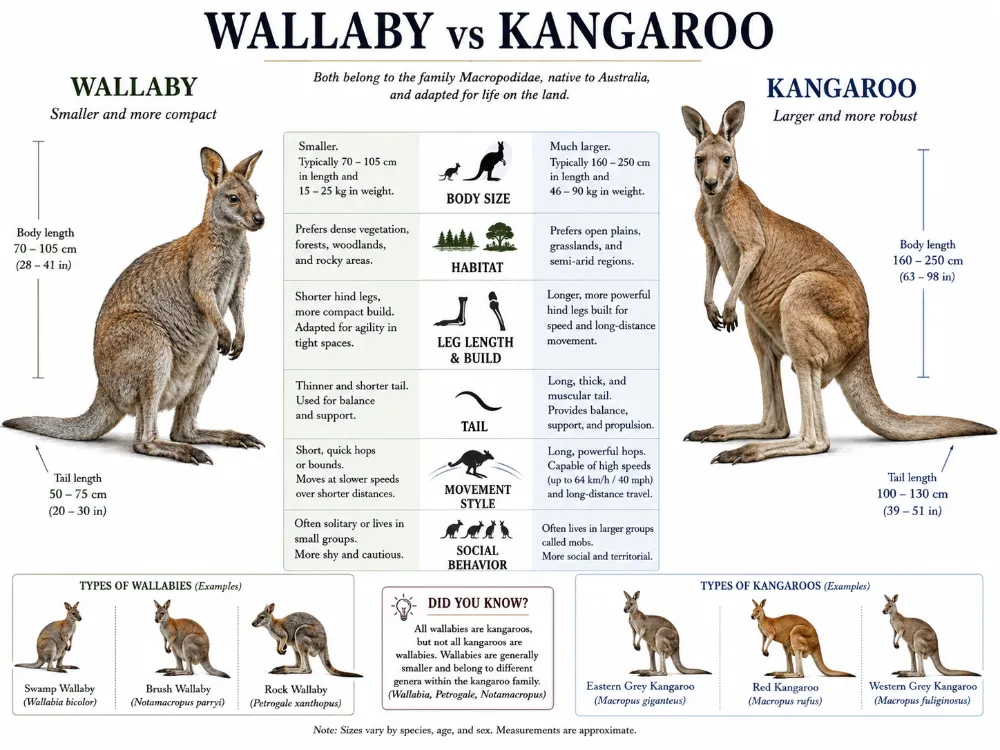
The short answer is that wallabies are usually smaller, stockier macropods, while kangaroos are usually larger, longer-legged, and built for covering open ground efficiently. Both belong to the same broader marsupial family, and the line between them is partly based on size, body form, and common naming rather than one perfectly simple rule. In everyday use, though, a kangaroo is the larger open-country hopper, while a wallaby is the smaller, more compact relative.
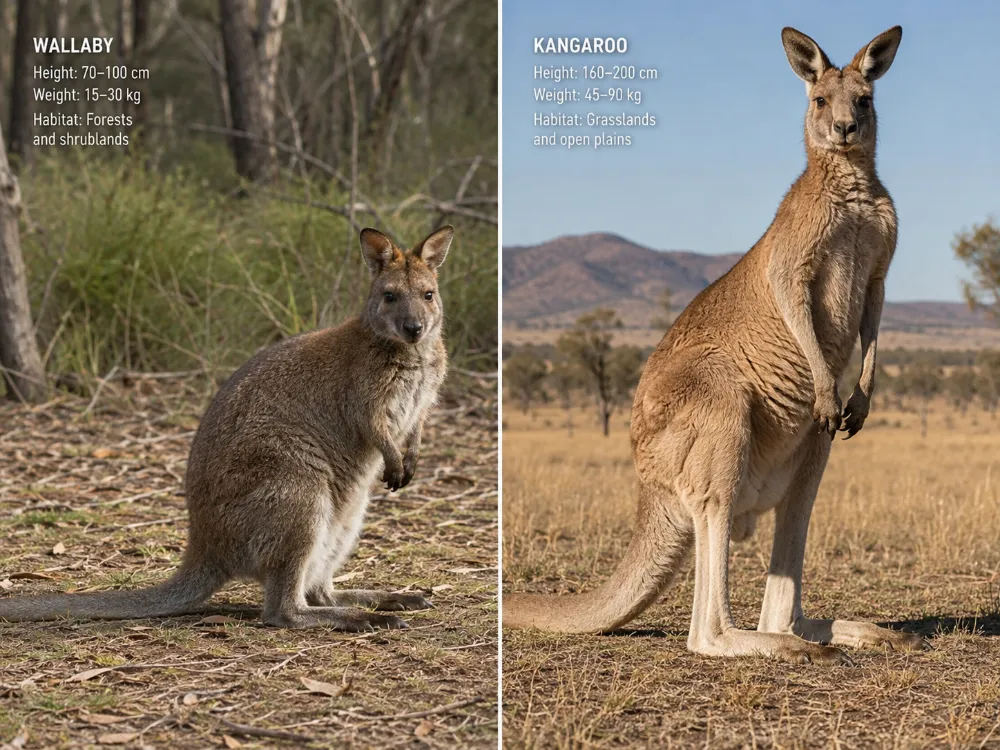
People often confuse wallabies and kangaroos because both are Australian marsupials with powerful hind legs, long tails, and forward-hopping movement. At a glance, they can seem like large and small versions of the same animal, and in many ways they are close relatives.
In this guide, you will learn how wallabies and kangaroos differ in size, body shape, habitat, movement, behavior, and ecology, plus the fastest ways to tell them apart correctly.
Quick comparison table
| Feature | Wallaby | Kangaroo |
|---|---|---|
| Overall size | Usually smaller and more compact | Usually larger and taller |
| Body build | Stockier, shorter-limbed, often more compact | Longer-legged, leaner, more built for distance hopping |
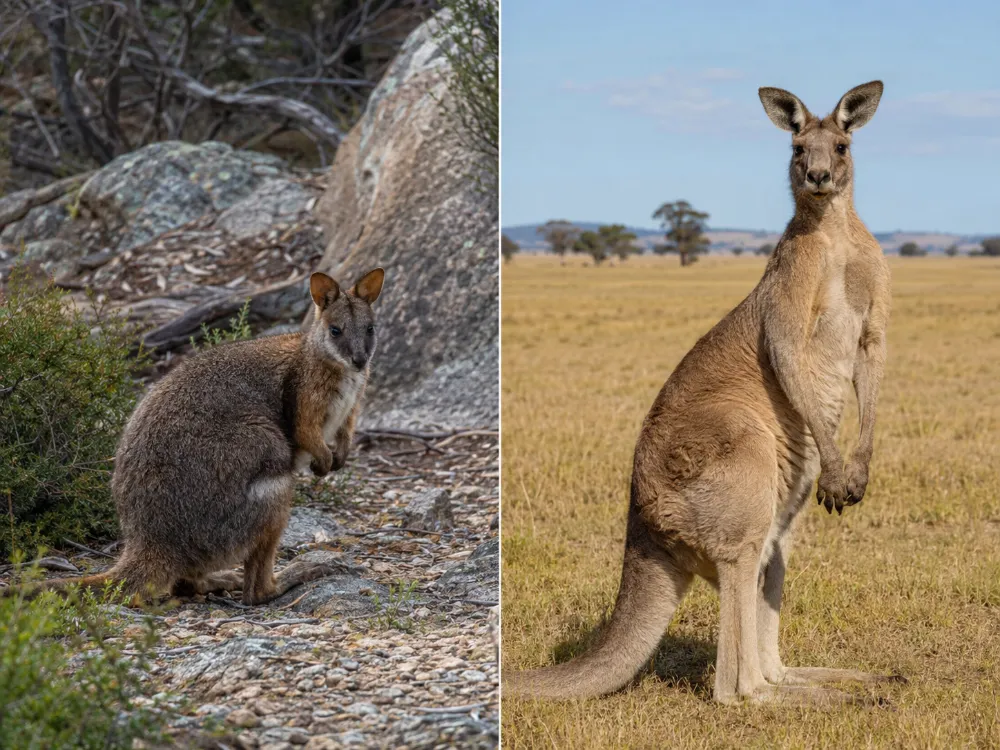
| Main habitat image | Woodland, scrub, rocky country, forest edges | Open grassland, plains, open woodland |
| Movement style | Agile in tighter spaces, shorter-range bounding | Efficient long-distance hopping across open ground |
| Tail and proportions | Often shorter-looking relative to body and more compact overall | Long, heavy balancing tail and taller silhouette |
| Face shape | Often shorter-faced and softer-looking | Often longer-faced and more elongated |
| Common use of name | Usually smaller macropods | Usually the largest macropods, especially red and gray kangaroos |
| Best quick clue | Smaller, sturdier, more bush or rocky-country feel | Larger, taller, open-country powerful hopper |
They are close relatives, not completely separate kinds of mammals
Wallabies and kangaroos both belong to the macropod group, a branch of marsupials famous for large hind feet, powerful hind legs, and pouch-carrying reproduction. This is why they look so similar. They share the same broad body plan: long tail, short front limbs, strong back legs, and hopping locomotion.
However, they are not just two random names for the same animal. In everyday biological use, kangaroo usually refers to the larger forms, while wallaby usually refers to the smaller and often more compact forms. The difference is real, but it is not always a perfectly sharp taxonomic line.
So the comparison is useful, even though the naming is partly based on size and traditional usage.
The biggest difference is size
One of the easiest differences to notice is size. Kangaroos are usually much larger than wallabies. A kangaroo often looks tall, long-legged, and impressive in open country, especially when standing upright or moving across a field.
Wallabies are usually smaller and lower to the ground. They often look like a more compact version of the same basic body design. Even when a wallaby is well built, it usually does not create the same towering impression as a kangaroo.
If the animal looks very large and powerful, kangaroo becomes more likely. If it looks noticeably smaller and more compact, wallaby becomes more likely.
Kangaroos usually have longer legs
Kangaroos are generally built for efficient movement across open terrain. Their hind legs often look especially long and powerful, and their whole body seems shaped for distance hopping. This long-legged design helps them travel efficiently across grassland or open woodland.
Wallabies usually look shorter-legged and stockier. They are still excellent jumpers, but their body often seems better suited to maneuvering in more cluttered habitats such as scrub, rocky slopes, or woodland cover.
If the animal looks tall, stretched, and built like a long-distance runner, kangaroo is the better guess.
Wallabies usually look more compact
Wallabies often have a rounder, more compact appearance than kangaroos. Their body can look shorter and sturdier, with proportions that feel better suited to quick movement through uneven or covered habitat.
Kangaroos usually look more elongated. The body, legs, neck, and tail often create a taller and more extended profile. This gives them the classic silhouette many people picture when they imagine a kangaroo on an open plain.
If the animal feels compact and bush-country adapted, wallaby becomes more likely.
Habitat often gives a strong clue
Kangaroos are often associated with open country. They are especially well suited to grasslands, plains, and open woodland where their long-distance hopping ability becomes a major advantage. In these places, they can move efficiently, detect danger at a distance, and graze in more open settings.
Wallabies are often associated with denser or more broken habitat such as forest edges, scrub, rocky areas, and thicker cover. Their smaller size and compact build often suit these more enclosed landscapes.
This is not a perfect rule for every species, but habitat is often one of the most useful real-world clues.
Kangaroos are built for long-distance travel
Kangaroos are among the most efficient large hoppers in the mammal world. Their movement is especially impressive over open ground, where they can cover large distances with powerful, economical bounds. The long legs, elastic tendons, and balancing tail all work together to make this possible.
Wallabies also hop well, of course, but they usually give the impression of shorter-range agility rather than large-scale open-country travel. Their movement often fits environments where quick directional changes matter more than pure distance efficiency.
So if the animal seems built for open-country speed and range, kangaroo is more likely.
Wallabies are often better suited to tighter terrain
Because wallabies are smaller and more compact, they often appear better adapted to moving through thick vegetation, rocky ground, or uneven cover. They may seem more agile in close spaces where a giant open-country body would be less efficient.
This is one reason wallabies are commonly associated with bushland and rocky areas. Their body form feels practical in habitats where flexibility and maneuverability matter as much as raw speed.
So while both groups hop, the wallaby often feels like the more agile bush specialist.
Face and head shape can differ
Kangaroos often have a longer face and a more elongated head shape. This fits their taller overall silhouette and can make them look more sharply profiled when standing upright.
Wallabies often have a shorter, softer-looking face. Their head may seem rounder or less stretched than that of a kangaroo, which adds to the overall compact impression.
This is a subtle clue, but when combined with size and habitat it helps a lot.
The tail often looks more massive in kangaroos
Both wallabies and kangaroos use the tail for balance and support, but in kangaroos the tail often looks especially long, heavy, and visually important. It is part of the whole large-body system that supports powerful hopping and upright posture.
Wallabies also have strong tails, but because the body is smaller and more compact, the tail often feels slightly less dramatic in overall effect. It still matters greatly for movement, but it may not dominate the silhouette as strongly as in a big kangaroo.
If the animal has an especially long, heavy tail supporting a tall body, kangaroo becomes more likely.
Diet overlaps, but habitat shapes how they feed
Both wallabies and kangaroos are mainly herbivorous. They feed on grasses, leaves, shoots, and other plant material depending on species and habitat. In that broad sense, they share a very similar feeding lifestyle.
The difference is often where and how they feed. Kangaroos are more strongly associated with grazing in open areas, while wallabies may browse or feed in more sheltered, shrubby, or mixed habitats depending on the species.
So the menu can overlap, but the setting often does not.
Social behavior can differ too
Kangaroos are often seen in more open and visible groups, especially in species that use grassland or open woodland. Seeing several kangaroos together in a field is a familiar image because their habitat makes that group living easy to notice.
Wallabies can also occur in groups or loose associations, but many feel less openly social simply because they live in denser cover or in more scattered conditions. Their smaller size and habitat use often make them seem more private.
So if you see a large, obvious mob in open country, kangaroo is often the stronger guess.
The names are useful, but not perfectly strict
This is an important biological point. The terms wallaby and kangaroo are useful, but they do not always divide the macropod world with perfect neatness. Common names developed over time, and nature does not always fit human categories as cleanly as we would like.
In practice, though, the pattern is still very helpful: kangaroo usually means the larger open-country forms, and wallaby usually means the smaller, more compact forms. For most everyday animal writing, that distinction works well.
So the names are practical and meaningful, even if the boundary is not absolute in every species discussion.
Wallaroos add another layer of confusion
People sometimes hear about wallaroos and become even more confused. A wallaroo is another macropod that can look intermediate in some ways, which shows again that the group does not divide into only two perfectly separate body plans.
That does not make wallaby versus kangaroo useless. It simply means the macropod family is diverse and the common names reflect a spectrum rather than a single strict break.
For most readers, the key idea remains the same: wallabies are generally smaller and stockier, while kangaroos are generally larger and more open-country built.
Both are marsupials with pouches
Like other macropods, both wallabies and kangaroos are marsupials. Females carry their young in a pouch, and the tiny undeveloped newborn continues growing there after birth. This is one of the defining features of the whole broader group.
So while they differ in size and habitat, they share the same remarkable marsupial reproductive strategy. In both cases, the pouch is a central part of the life cycle.
This shared biology is another reminder that they are close relatives, not distant look-alikes.
Why people confuse them so often
People confuse wallabies and kangaroos because both have the same instantly recognizable macropod body plan. To someone who is not used to Australian mammals, the first impression may simply be “large hopping pouch animal.”
The confusion is strongest in photos without scale. A small kangaroo can look like a wallaby, and a large wallaby can look like a small kangaroo if there is nothing nearby for size reference.
Once you look at body proportions, habitat, and overall size, the difference becomes much easier to understand.
How to tell them apart quickly
If you need a fast identification guide, use these clues together:
Wallaby: smaller, stockier, shorter-legged, often in bush, scrub, or rocky habitat
Kangaroo: larger, taller, longer-legged, often in open country with a more stretched silhouette
No single clue is perfect every time, but this combination usually works very well in practice.
Which one is bigger?
In ordinary usage, kangaroos are bigger than wallabies. That is one of the most basic rules behind the naming. Kangaroos usually represent the larger forms, especially the famous red and gray kangaroos.
Wallabies are typically the smaller side of the comparison. Even when robust, they usually do not match the height, long-legged reach, and open-country presence of a true kangaroo.
So if the question is simply size, kangaroo usually wins clearly.
Final takeaway
The main difference between a wallaby and a kangaroo is that wallabies are usually smaller, more compact macropods often associated with scrub, rocky, or wooded habitats, while kangaroos are usually larger, taller, longer-legged macropods built for efficient travel across open country. They are close relatives in the same broader marsupial family, but once you compare size, proportions, and habitat, the distinction becomes much clearer.
FAQs
Is a wallaby a kangaroo?
Not exactly. Wallabies and kangaroos are close relatives in the same broader macropod group, but wallaby usually refers to the smaller forms and kangaroo to the larger ones.
How can I tell a wallaby from a kangaroo fast?
Look at size and build. Wallabies are usually smaller and stockier, while kangaroos are usually larger, taller, and longer-legged.
Which is bigger, a wallaby or a kangaroo?
A kangaroo is usually bigger than a wallaby.
Do wallabies and kangaroos live in the same habitats?
They can overlap in some regions, but wallabies are often more associated with scrub, woodland, or rocky cover, while kangaroos are often more associated with open country.