Quick answer
Manatees and dugongs are both slow-moving, plant-eating aquatic mammals in the order Sirenia. They are related, but they belong to different families and have several clear differences. Manatees are in the family Trichechidae, while the modern dugong is in the family Dugongidae.
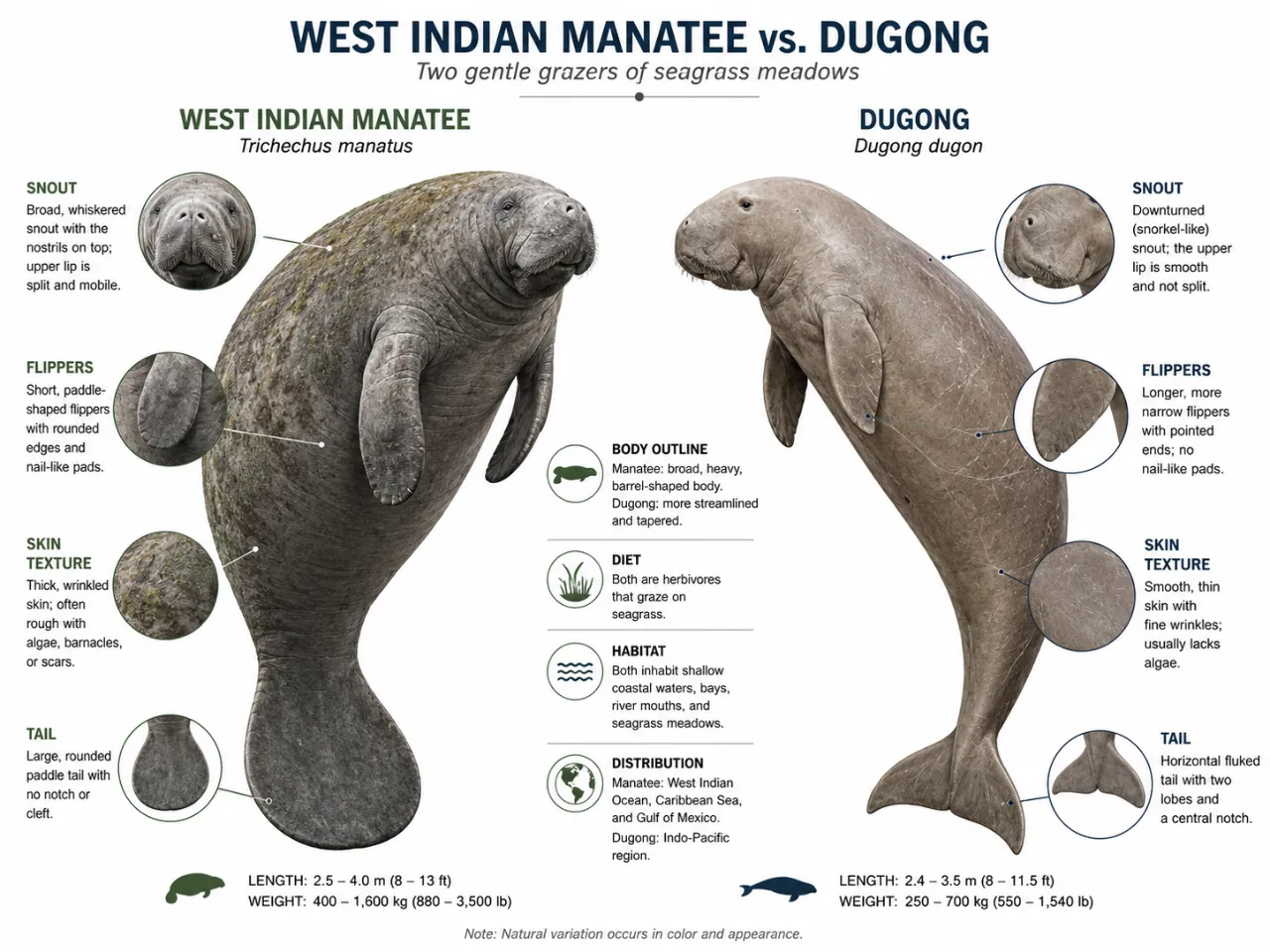
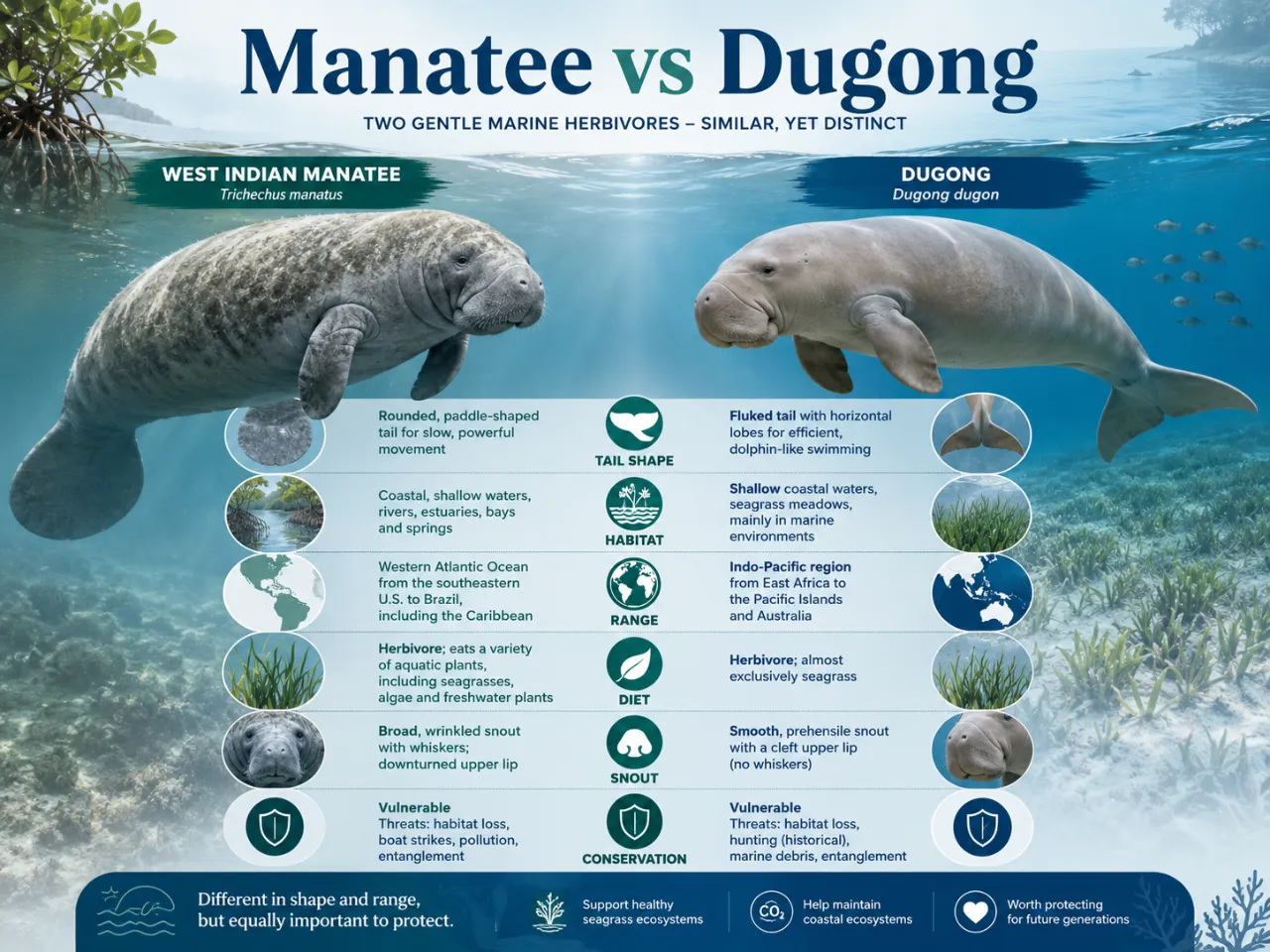
The fastest way to tell them apart is by the tail. A manatee has a wide, rounded, paddle-like tail. A dugong has a two-lobed fluked tail, more like a dolphin or small whale. Their snouts also differ: manatees have a more flexible upper lip, while dugongs have a downward-facing muzzle adapted for feeding on seagrass from the seafloor.
Summary table
| Feature | Manatee | Dugong |
|---|---|---|
| Scientific group | Family Trichechidae | Family Dugongidae |
| Living species | Several species, including West Indian, Amazonian, and West African manatees | One living species, the dugong |
| Tail shape | Rounded, paddle-shaped tail | Fluked, whale-like tail |
| Snout shape | Rounded face with flexible split upper lip | Downturned muzzle for grazing on seagrass |
| Habitat | Freshwater rivers, estuaries, coastal waters, and warm shallow seas | Mostly shallow marine seagrass habitats |
| Range | Americas, Caribbean, Amazon Basin, and West Africa depending on species | Indo-Pacific region, from East Africa to Australia and nearby areas |
| Diet | Aquatic plants, seagrasses, freshwater vegetation, and algae | Mainly seagrass, with some variation by habitat |
| Teeth and tusks | No obvious tusks; teeth are replaced continuously from the back | Adult males often develop visible tusks |
| General appearance | Rounder, heavier-looking body with a broad tail | More streamlined body with a fluked tail and downturned face |
How manatee and dugong bodies differ
Manatees and dugongs both have large, torpedo-shaped bodies, small eyes, no hind limbs, and front flippers. Their bodies are adapted for slow, steady movement through shallow water rather than fast swimming. They look similar at first glance because they share a sirenian body plan.
However, their body shape is not identical. Manatees generally look rounder and bulkier, with a broad paddle-shaped tail that moves up and down as they swim. Dugongs tend to look slightly more streamlined, and their fluked tail gives them a more whale-like outline.
The head is another important clue. Manatees have a rounded face and a flexible, divided upper lip that helps them grasp vegetation. Dugongs have a more downturned snout, which is well suited for grazing on seagrass growing along the seabed.
How manatees and dugongs feed
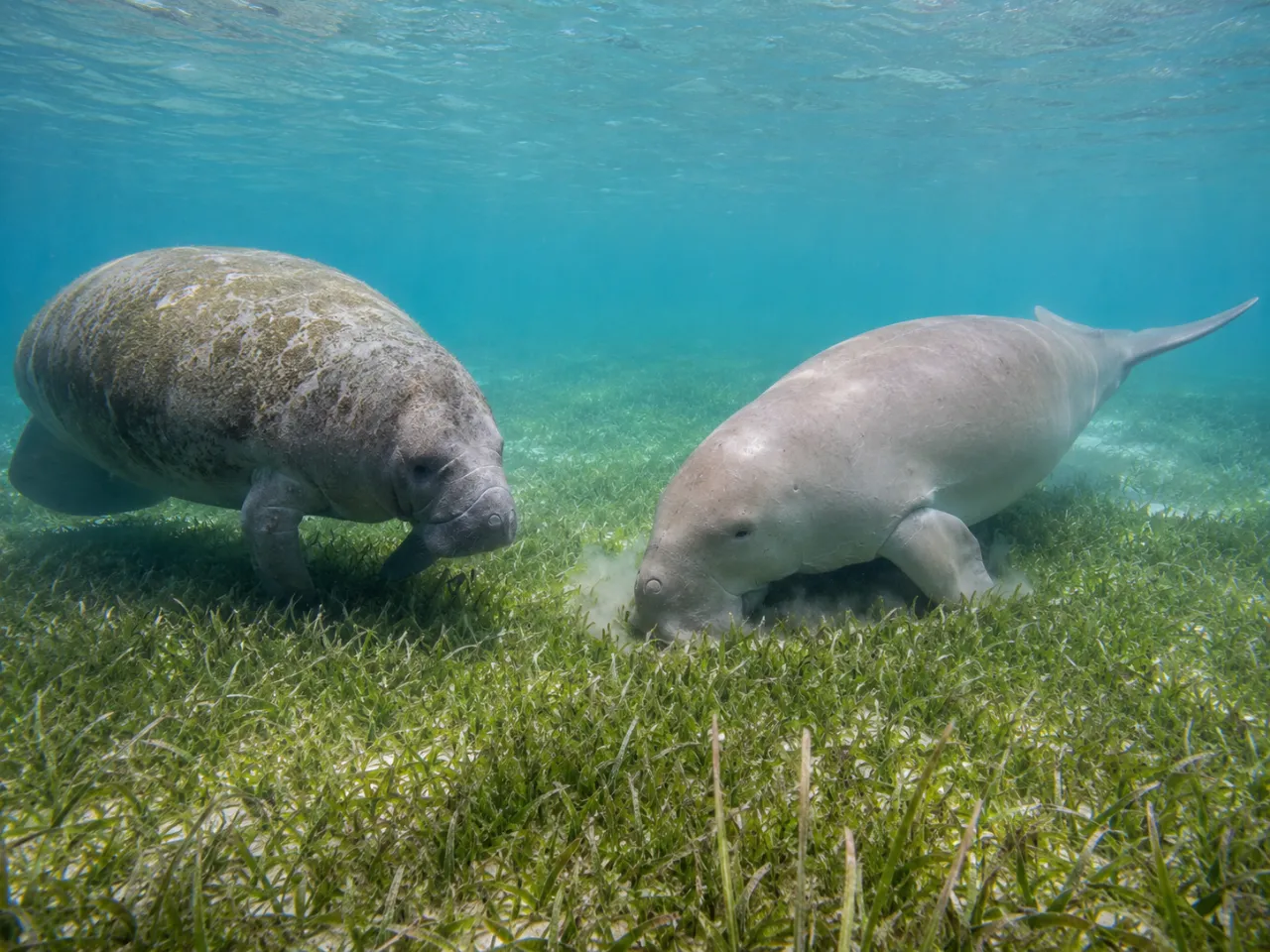
Both animals are mostly herbivorous, but they do not feed in exactly the same way. Manatees eat a wide variety of aquatic vegetation. Depending on the species and habitat, this may include seagrass, freshwater plants, floating vegetation, shoreline plants, algae, and other soft aquatic plant material.
Dugongs are more specialized seagrass grazers. Their downturned muzzle allows them to feed efficiently from the seafloor. As they graze, they may leave visible feeding trails through seagrass beds. In many areas, dugongs depend strongly on healthy seagrass meadows.
Because both animals need large amounts of plant food, they can spend many hours a day feeding. Their slow metabolism and large digestive systems help them process fibrous vegetation. In this sense, the nickname “sea cow” is understandable, although they are not closely related to cattle.
How their habitats and ranges differ
Manatees are generally more flexible in habitat use. Some live in coastal seas, estuaries, lagoons, rivers, and freshwater systems. The Amazonian manatee lives in freshwater habitats, while the West Indian manatee can move between marine, brackish, and freshwater environments.
Dugongs are mainly marine animals. They are usually found in warm, shallow coastal waters where seagrass beds are available. Their range extends across parts of the Indo-Pacific, including coastal areas of East Africa, the Red Sea, the Indian Ocean, Southeast Asia, northern Australia, and some Pacific islands.
This difference matters because dugongs are especially vulnerable when seagrass meadows are damaged. Manatees also depend on healthy aquatic habitats, but some species can use a broader range of freshwater and coastal feeding areas.
Which animal is larger
Manatees are often heavier and bulkier than dugongs, although size varies by species, age, sex, and individual condition. Many adult manatees are around 3 meters long, and large individuals may exceed that. Their weight can be several hundred kilograms, with some individuals becoming very heavy.
Dugongs are also large mammals, but they are generally somewhat more streamlined. Many adults are around 2.4 to 3 meters long, with body mass commonly in the several-hundred-kilogram range. Large dugongs can be impressive, but they usually do not look as round and heavy as large manatees.
Size alone is not the best identification feature. A young manatee may be smaller than an adult dugong. Tail shape, snout shape, location, and habitat are more reliable clues.
Do all manatees and dugongs live the same way
No. Manatees include more than one living species, and each has its own range and habitat pattern. The West Indian manatee is associated with the Caribbean, Florida, and nearby warm waters. The Amazonian manatee lives in freshwater river systems. The West African manatee lives in parts of western and central Africa, using rivers, estuaries, lagoons, and coastal areas.
The dugong has one living species, but dugong populations do not all experience the same conditions. A dugong in northern Australia may live in different seagrass landscapes from one in the Red Sea or Southeast Asia. Local food availability, water clarity, boat traffic, fishing pressure, and coastal development can all shape behavior and survival.
Because their environments vary, it is safest to describe their behavior with words such as “generally,” “often,” and “in many populations.” These animals share a basic biology, but local ecology can strongly influence their lives.
Behavior and social life
Manatees are generally calm, slow-moving animals. They may be seen alone, in pairs, or in loose groups, especially around warm-water areas, feeding sites, or mating activity. They are not strongly territorial in the way many land mammals are.
Dugongs are also usually peaceful and slow-moving. They may be solitary, occur in pairs, or form small groups, although larger gatherings can occur where food is abundant. In many places, dugongs are shy and difficult to observe because they spend much of their time underwater and may avoid disturbance.
Both animals communicate with sounds, body contact, and behavior. Mothers and calves are especially important social units. Calves depend on their mothers for milk, protection, and learning during early life.
Reproduction and life cycle
Manatees and dugongs reproduce slowly. Females usually give birth to a single calf after a long pregnancy. Calves nurse for an extended period and stay close to their mothers. This slow reproductive rate means populations may recover only gradually after major declines.
Manatee calves are born in water and can swim soon after birth. They remain dependent on their mothers and learn where to feed, rest, and find safe areas. Dugong calves follow a similar pattern, staying with the mother while nursing and learning to use seagrass habitats.
Because they mature slowly and produce few young, both animals are vulnerable to human-caused mortality. Boat strikes, entanglement, habitat loss, hunting, and pollution can have long-lasting effects on local populations.
Why these sea cows matter in ecosystems
Manatees and dugongs help shape aquatic plant communities. By grazing on aquatic vegetation, they can influence plant growth, nutrient cycling, and the structure of shallow-water habitats. Dugongs, in particular, are closely linked to seagrass meadows, where their grazing can help maintain productive seagrass systems under natural conditions.
Healthy seagrass beds are important ecosystems. They provide nursery habitat for fish, help stabilize sediments, store carbon, and support many marine animals. When dugongs decline, it can be a sign that seagrass habitats are under pressure.
Manatees can also act as indicators of freshwater and coastal ecosystem health. If manatees are struggling, it may suggest problems such as habitat degradation, cold stress, pollution, food loss, or increasing human disturbance.
Conservation and threats
Both manatees and dugongs face serious conservation challenges. Boat strikes are a major threat for some manatee populations, especially in areas with heavy vessel traffic. Cold stress, habitat loss, fishing gear entanglement, pollution, and loss of aquatic vegetation can also be harmful.
Dugongs are strongly affected by seagrass loss, coastal development, accidental capture in fishing gear, boat traffic, and hunting in some regions. Because dugongs depend heavily on shallow seagrass habitats, damage to those areas can quickly reduce food availability.
Protecting these animals usually requires more than protecting the animals themselves. It also means protecting warm-water refuges, seagrass meadows, river systems, coastal zones, and safe travel corridors. Reducing boat speed in key habitats and managing fishing gear can make a major difference.
Final takeaway
Manatees and dugongs are both gentle, plant-eating sirenians, but they are not the same animal. The clearest visual difference is the tail: manatees have a rounded paddle tail, while dugongs have a fluked tail. Their faces, ranges, habitats, and diets also differ.
Manatees are generally more flexible in habitat use and may live in freshwater, brackish water, or coastal seas. Dugongs are mostly marine animals closely tied to seagrass meadows. Both are slow-reproducing mammals that depend on healthy aquatic ecosystems, and both need careful protection from human pressure.
FAQs
Are manatees and dugongs the same animal?
No. Manatees and dugongs are related sirenian mammals, but they belong to different families. Manatees are in Trichechidae, while dugongs are in Dugongidae. They look similar because both are large, aquatic, plant-eating mammals.
What is the easiest way to tell a manatee from a dugong?
The tail is the easiest clue. A manatee has a broad, rounded paddle-shaped tail. A dugong has a fluked tail with two lobes, somewhat like the tail of a dolphin or whale.
Do manatees and dugongs eat the same food?
They both eat aquatic plants, but dugongs are generally more specialized for seagrass grazing. Manatees often eat a wider variety of aquatic vegetation, including seagrasses, freshwater plants, floating plants, and algae depending on species and habitat.