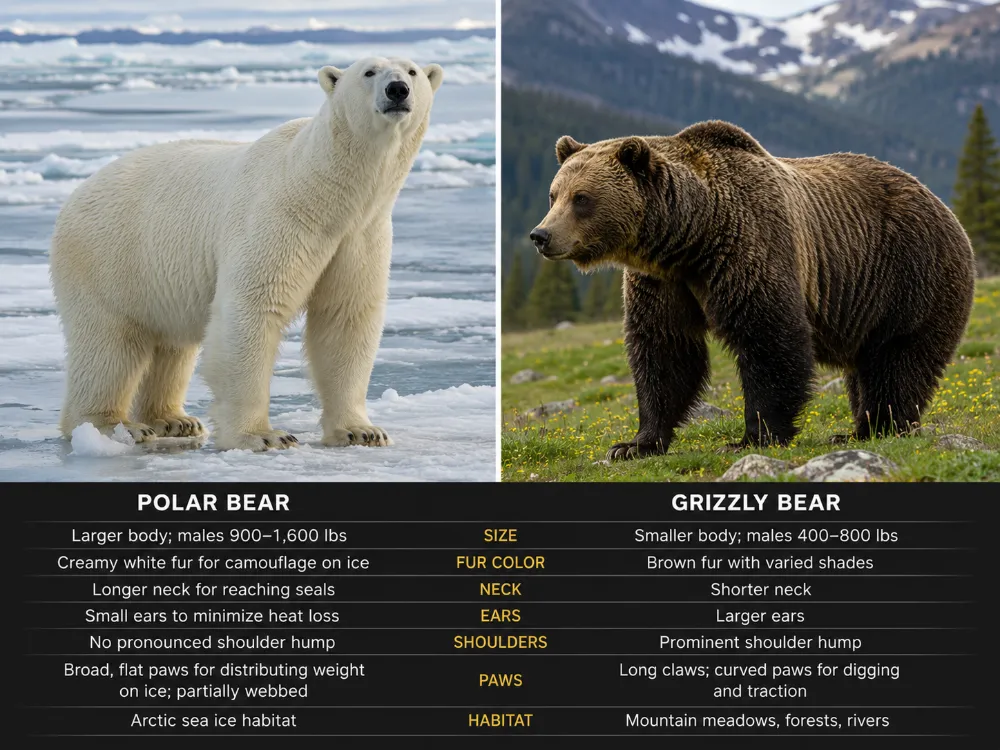
Polar bears and grizzly bears are closely related, but they are adapted to very different worlds. Polar bears are larger, more marine, and specialized for hunting seals on Arctic sea ice. Grizzly bears are more flexible land-based omnivores, feeding on plants, insects, fish, and mammals. A polar bear is usually better built for swimming and cold, while a grizzly is better suited to forests, mountains, rivers, and open inland landscapes.
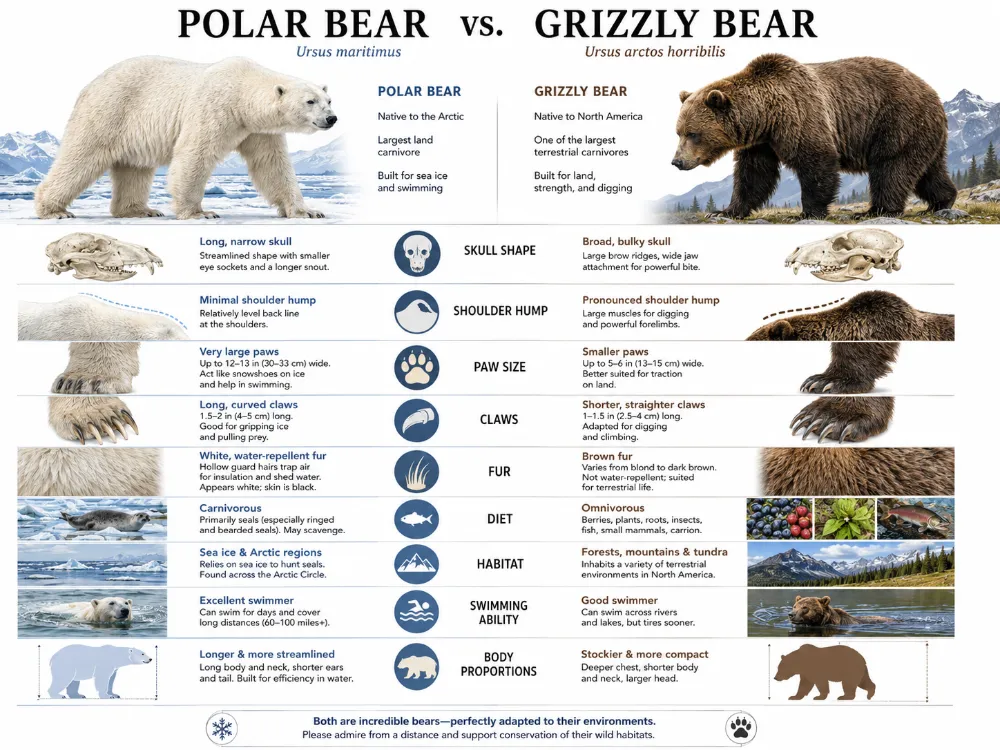
Polar Bear vs Grizzly Bear Summary Table
| Feature | Polar Bear | Grizzly Bear |
|---|---|---|
| Scientific name | Ursus maritimus | Ursus arctos horribilis |
| Bear type | A highly specialized Arctic bear | A North American subspecies of brown bear |
| Main habitat | Arctic sea ice, coasts, tundra, and cold marine environments | Forests, mountains, meadows, river valleys, tundra edges, and inland wilderness |
| Average male weight | About 350–700 kg, sometimes more | Often about 180–360 kg inland; some populations can be larger |
| Average female weight | About 150–250 kg | Often about 90–180 kg, depending on region and food supply |
| Body shape | Long body, long neck, small ears, large paws | Heavy shoulder hump, shorter neck, strong digging muscles |
| Fur color | White to yellowish-white | Brown, blond, cinnamon, dark brown, or grizzled |
| Main diet | Mostly seals, especially ringed and bearded seals | Omnivorous: roots, berries, insects, fish, carrion, mammals, and grasses |
| Swimming ability | Excellent long-distance swimmer | Can swim well, but less specialized for marine life |
| Claws | Shorter, powerful claws suited for gripping ice and prey | Longer claws, excellent for digging roots, dens, and small animals |
| Typical hunting style | Ambushes seals at breathing holes or on ice | Forages widely; hunts opportunistically and scavenges often |
| Best adapted for | Cold, ice, swimming, and marine hunting | Digging, climbing terrain, seasonal feeding, and varied land habitats |
What Is a Polar Bear?
The polar bear is the largest living bear species by average body size and one of the most specialized carnivores on Earth. Its scientific name, Ursus maritimus, means “sea bear,” which fits its lifestyle well. Although polar bears walk on land and give birth in snow dens, their survival is strongly tied to sea ice and marine prey.
Polar bears mainly live around the Arctic, including areas associated with Canada, Alaska, Greenland, Norway, and Russia. They use sea ice as a hunting platform, especially for seals. Their long body, powerful limbs, large feet, dense fur, and thick fat layer help them survive in extreme cold and move across ice, snow, and water.
What Is a Grizzly Bear?
The grizzly bear is a North American subspecies of brown bear. Its scientific name is Ursus arctos horribilis. Grizzlies are powerful land bears found in parts of Alaska, western Canada, and the northwestern United States. They are closely related to other brown bears, but the word “grizzly” usually refers to inland North American brown bears rather than large coastal brown bears or Kodiak bears.
Grizzlies are famous for their shoulder hump, long claws, broad head, and adaptable diet. Unlike polar bears, grizzlies are true omnivores. They may eat berries, roots, grasses, insects, fish, small mammals, carrion, elk calves, moose calves, and many other foods depending on season and location.
Size and Weight Differences
Polar bears are usually larger than grizzly bears, especially when comparing adult males. A large male polar bear can weigh several hundred kilograms more than an average inland male grizzly. Polar bears also tend to have a longer, more stretched body shape, while grizzlies look more compact and muscular around the shoulders.
However, bear size varies greatly by region, sex, age, season, and food availability. A well-fed grizzly from a rich salmon area may be much larger than an inland grizzly from a drier mountain region. Likewise, a polar bear’s weight can change dramatically between hunting seasons and fasting periods.
In simple terms: polar bears are generally longer and heavier, while grizzlies are stockier, more muscular in the shoulders, and better built for digging and moving across rugged land.
Body Shape and Physical Adaptations
The easiest way to tell a polar bear from a grizzly bear is by body shape. Polar bears have a long neck, narrow head, small ears, and large paws. Their body is streamlined for swimming, and their feet work almost like snowshoes on ice and snow.
Grizzly bears have a very different outline. They have a prominent shoulder hump, a dish-shaped face, shorter rounded ears, and long front claws. The shoulder hump is made of powerful muscles that help the bear dig into soil, tear apart logs, excavate roots, and build dens.
Polar bears are built for ice and water. Grizzlies are built for land, digging, and seasonal foraging.
Fur, Skin, and Cold Protection
Polar bears are famous for their white appearance, but their fur is not actually pure white in the same way as paint or snow. The hairs reflect visible light and help the bear blend into icy surroundings. Under the fur, polar bears have black skin, which may help absorb heat from sunlight. They also have a thick layer of fat that provides insulation and energy storage.
Grizzly bears have brown, dark brown, blond, cinnamon, or grayish-brown coats. The name “grizzly” comes from the pale or silver-tipped hairs that can give the fur a grizzled appearance. Their fur protects them from cold mountain weather, but they are not as specialized for Arctic marine conditions as polar bears.
Habitat and Range
Polar bears are strongly associated with Arctic sea ice. They depend on ice to reach seals, which are their most important prey. They may also walk along coastlines, rest on land, or den in snowbanks, but sea ice remains central to their hunting success.
Grizzly bears live in a much wider variety of land habitats. They may occupy forests, alpine meadows, river valleys, tundra edges, mountain slopes, and coastal areas. Their habitat needs are tied to food, cover, denning sites, and space. Because they eat so many different foods, grizzlies can survive in places where a seal-hunting specialist like the polar bear could not.
Diet and Feeding Strategy
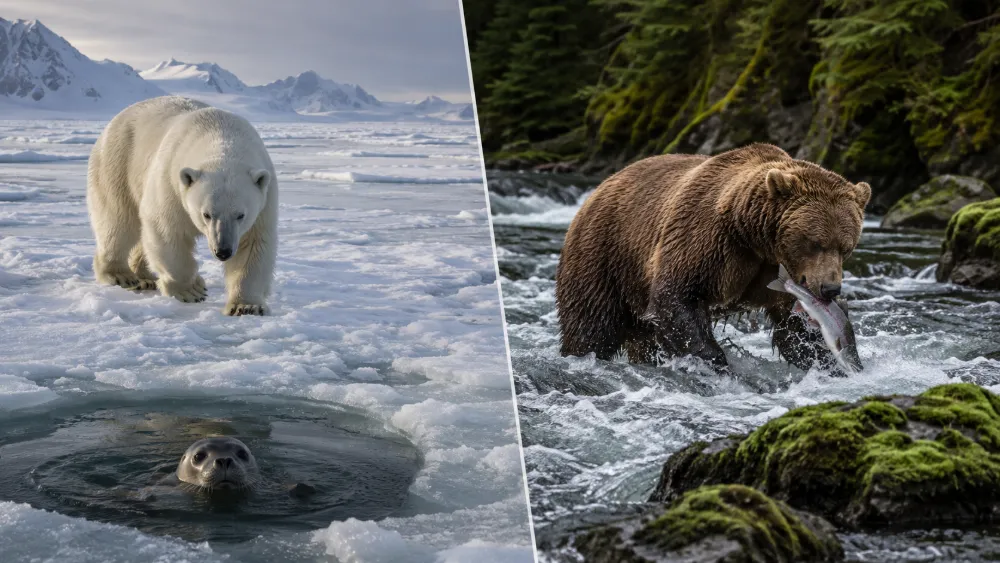
The polar bear is the more carnivorous of the two. Its main prey is seals, especially ringed seals and bearded seals. Polar bears often wait near breathing holes in the ice, stalk seals resting on ice, or break into snow lairs where seal pups are hidden. Seal fat is extremely important because it provides the high-energy food polar bears need to survive Arctic conditions.
Grizzly bears are much more flexible. In spring, they may eat fresh vegetation, roots, carrion, and young animals. In summer, they may feed on berries, insects, grasses, and fish. In autumn, they focus heavily on high-calorie foods to build fat before winter. A grizzly can be a predator, scavenger, grazer, fisher, and digger all in the same year.
This is one of the biggest differences between the two bears: polar bears are specialized hunters, while grizzlies are adaptable omnivores.
Hunting Behavior
Polar bears are patient hunters. Their most famous technique is still-hunting, where the bear waits silently near a seal breathing hole. When a seal surfaces to breathe, the bear strikes quickly with its powerful forelimbs. Polar bears may also stalk seals across ice, using their pale coat as camouflage.
Grizzly bears hunt differently. They are opportunistic rather than specialized. A grizzly may catch salmon, dig up ground squirrels, scavenge carcasses, or prey on elk and moose calves. In many areas, plant foods make up a large portion of the grizzly diet, even though the animal is fully capable of killing large prey.
Strength and Fighting Ability
Both polar bears and grizzly bears are extremely powerful animals, but their strength is shaped by different lifestyles. Polar bears have enormous body mass, strong forelimbs, and the ability to overpower seals on ice. Their size alone gives them a major physical advantage in many comparisons.
Grizzlies are also very strong, especially in the shoulders, neck, and forelimbs. Their long claws and digging muscles make them highly effective at tearing into soil, logs, dens, and carcasses. Grizzlies may be more explosive and maneuverable on rough land, while polar bears are better suited to ice, snow, and swimming.
In a direct size comparison, a large male polar bear is usually heavier than a large male grizzly. But in nature, animals do not exist as “combat rankings.” Age, sex, health, hunger, location, and motivation matter greatly.
Claws and Paws
Polar bear paws are large, broad, and partly adapted for walking on snow and swimming. Their paw pads have small bumps that improve traction on ice. Their claws are strong and curved enough to grip slippery surfaces and hold struggling prey.
Grizzly bear claws are usually longer and more visibly curved. They are excellent digging tools. Grizzlies use them to dig roots, excavate dens, rip apart rotting wood, turn over rocks, and uncover burrowing animals. These claws are one reason grizzlies are so effective at exploiting a wide range of land-based foods.
Swimming and Movement
Polar bears are the better swimmers. They can travel long distances through cold Arctic water, using their large front paws like paddles. Their thick fat layer helps with buoyancy and insulation. Swimming is an essential part of their life in a changing ice environment.
Grizzlies can also swim, and many individuals cross rivers or lakes with ease. However, they are not marine specialists. They spend most of their active life walking, climbing slopes, digging, fishing in rivers, and foraging across large home ranges.
Behavior and Temperament
Polar bears are often more solitary and predatory in their daily behavior. Since they rely heavily on meat and fat, they may travel great distances in search of seals. Adult males can have very large ranges and may show strong aggression around food, mates, or competing bears.
Grizzly bears are also usually solitary, except for mothers with cubs, mating pairs, or groups feeding near concentrated food sources such as salmon streams. Their behavior changes strongly with the season. A grizzly may spend months gaining weight before winter, then enter a den during the coldest part of the year.
Hibernation and Denning
Grizzly bears are well known for winter denning. They enter a state of dormancy during winter, living off stored body fat. Pregnant females give birth in the den, and cubs remain there during their earliest and most vulnerable stage of life.
Polar bear denning is different. Pregnant female polar bears dig maternity dens, often in snowdrifts, and give birth there. However, many adult male polar bears and non-pregnant females do not hibernate in the same way grizzlies do. They may remain active during winter if hunting conditions are favorable.
Cubs and Reproduction
Both species give birth to tiny, helpless cubs that depend heavily on their mothers. Polar bear cubs are usually born in winter dens and emerge months later when they are stronger. The mother then leads them onto sea ice, where she must hunt while also protecting them.
Grizzly cubs are also born during the denning period. They stay with their mother for a long time, often more than two years. During this period, they learn where to find seasonal foods, how to avoid danger, and how to survive in a complex landscape.
Can Polar Bears and Grizzly Bears Meet?
Yes, polar bears and grizzly bears can meet in parts of the Arctic where their ranges overlap. As warming conditions alter sea ice and northern habitats, interactions between the two species may become more noticeable in some regions.
Polar bears and grizzly bears are closely related enough to produce hybrids. These hybrids are sometimes called “pizzly bears” or “grolar bears.” They are rare, but they show how closely related the two species are. Even so, polar bears and grizzlies remain distinct animals with different ecological roles.
Evolutionary Relationship
Polar bears evolved from brown bear ancestors and became specialized for Arctic marine life. Compared with grizzlies, polar bears show adaptations for cold, swimming, and hunting seals. Their long necks, reduced ear size, large feet, pale coats, and heavy fat reserves all reflect life on sea ice.
Grizzlies represent a more generalized brown bear form. They retain the flexible diet and strong land-based foraging abilities that allow brown bears to live in many environments. This helps explain why grizzlies can survive on roots, berries, fish, carrion, insects, and mammals, while polar bears depend much more heavily on marine prey.
Which Bear Is More Dangerous?
Both species can be dangerous, but danger depends on the situation. Polar bears are more likely to view humans as potential prey than most other bear species because they are highly carnivorous predators. In remote Arctic settings, a hungry polar bear can be extremely dangerous.
Grizzly bears are also dangerous, especially mothers with cubs, bears surprised at close range, or bears defending food. Many grizzly attacks are defensive rather than predatory. A grizzly may react aggressively if it feels threatened, startled, cornered, or forced to defend cubs or a carcass.
From a zoological perspective, neither species should be treated as “more aggressive” in a simple way. Their behavior is shaped by ecology, hunger, experience, season, and human behavior.
Conservation Differences
Polar bears are especially vulnerable to the loss of sea ice because their main hunting method depends on frozen marine habitat. Less stable sea ice can reduce hunting time, increase fasting periods, and force bears to travel farther for food.
Grizzly bear conservation issues are more connected to habitat loss, human conflict, road expansion, livestock conflict, food conditioning, and fragmented populations. Some grizzly populations are stable or recovering, while others remain small and vulnerable.
Both bears need large, connected habitats and careful management. Their conservation challenges are different, but both show how strongly large predators depend on healthy ecosystems.
Key Differences Between Polar Bears and Grizzly Bears
Polar bears are usually larger, especially adult males.
Polar bears are more carnivorous and depend heavily on seals.
Grizzlies are more omnivorous and eat a wider variety of foods.
Polar bears are better swimmers and are adapted to Arctic marine life.
Grizzlies are better diggers and have longer claws for land-based foraging.
Polar bears have long necks and large paws, while grizzlies have shoulder humps and powerful digging muscles.
Polar bears rely on sea ice, while grizzlies use forests, mountains, meadows, rivers, and tundra edges.
Polar Bear vs Grizzly Bear: Final Comparison
The polar bear and the grizzly bear are close relatives, but they represent two very different survival strategies. The polar bear is a specialist: a large, ice-adapted marine hunter built for cold, swimming, and catching seals. The grizzly bear is a generalist: a powerful land omnivore built for digging, foraging, fishing, scavenging, and adapting to seasonal food changes.
If the question is which bear is bigger, the answer is usually the polar bear. If the question is which bear is more adaptable, the answer is usually the grizzly bear. Both are remarkable examples of bear evolution, and both deserve respect as top predators in their own environments.
FAQs About Polar Bears vs Grizzly Bears
Is a polar bear bigger than a grizzly bear?
Yes, polar bears are usually bigger than grizzly bears, especially when comparing adult males. A large male polar bear may weigh far more than a typical inland male grizzly. However, size varies by region, age, sex, and food supply.
Are polar bears and grizzly bears related?
Yes. Polar bears and grizzly bears are close relatives within the bear family. Polar bears evolved from brown bear ancestors and became highly specialized for Arctic marine life.
Can polar bears and grizzly bears breed?
Yes, they can produce hybrids in rare cases. These hybrids are often called pizzly bears or grolar bears. They are uncommon but possible because polar bears and grizzlies are genetically close.
Which bear is stronger, a polar bear or a grizzly bear?
A large polar bear usually has the advantage in size and mass, while a grizzly has powerful shoulder muscles, long claws, and strong land-based fighting ability. Strength depends on the individual animal, not just the species.
Do polar bears eat grizzly bears?
Polar bears do not normally hunt grizzly bears. They mainly hunt seals. In rare encounters, bears may compete, fight, or avoid each other, but grizzlies are not a normal prey item for polar bears.
Do grizzly bears eat polar bears?
Grizzly bears do not normally eat polar bears. Grizzlies are opportunistic omnivores and may scavenge many things, but polar bears are not a regular part of their diet.
Which bear is more carnivorous?
The polar bear is much more carnivorous. Its diet is based mainly on seals and seal fat. Grizzly bears are omnivores and may eat large amounts of plants, berries, insects, roots, fish, and carrion.
Which bear is better at swimming?
The polar bear is the better swimmer. It has large paws, a streamlined body, thick fat, and strong endurance in cold water. Grizzlies can swim, but they are not specialized marine bears.
Where do polar bears and grizzly bears overlap?
Their ranges can overlap in parts of the Arctic and subarctic, especially where grizzlies move into northern coastal or tundra regions. Such overlap is still limited compared with their broader habitat differences.
What is the easiest way to tell them apart?
Look at the body shape. A polar bear is white or yellowish-white, with a long neck, narrow head, and large paws. A grizzly is brown or grizzled, with a shoulder hump, dish-shaped face, and long digging claws.