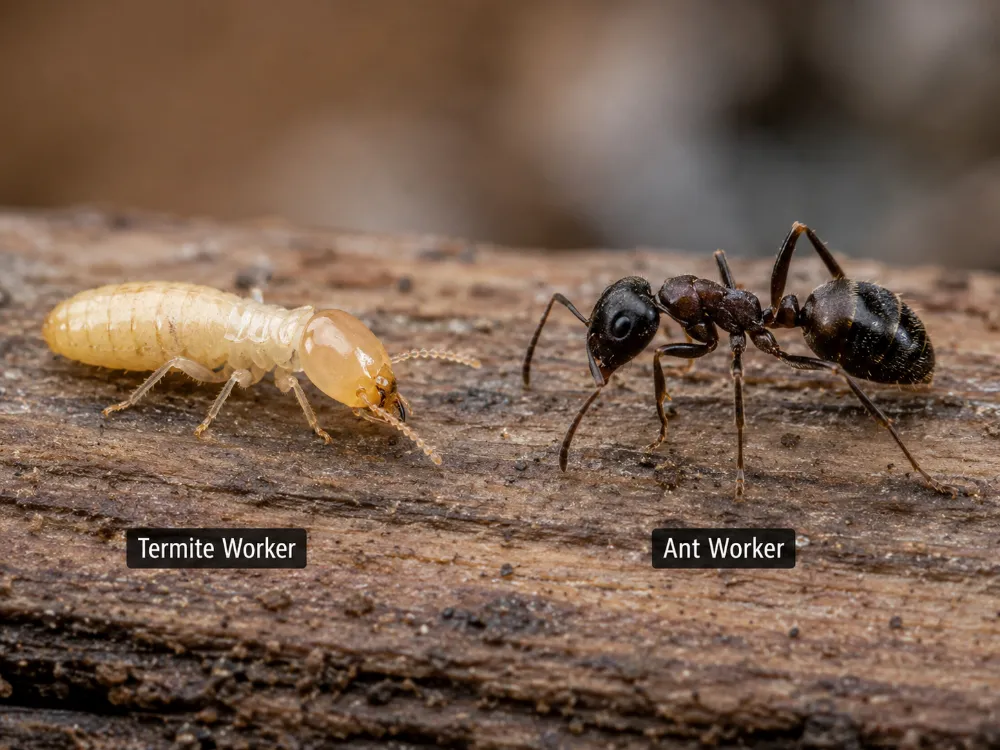
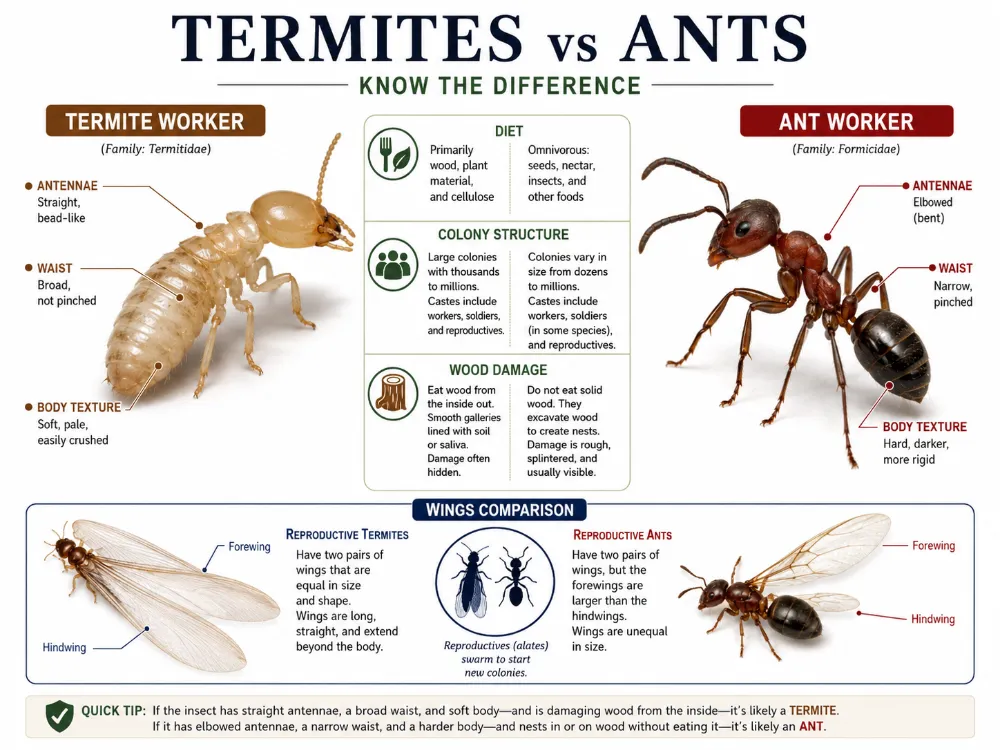
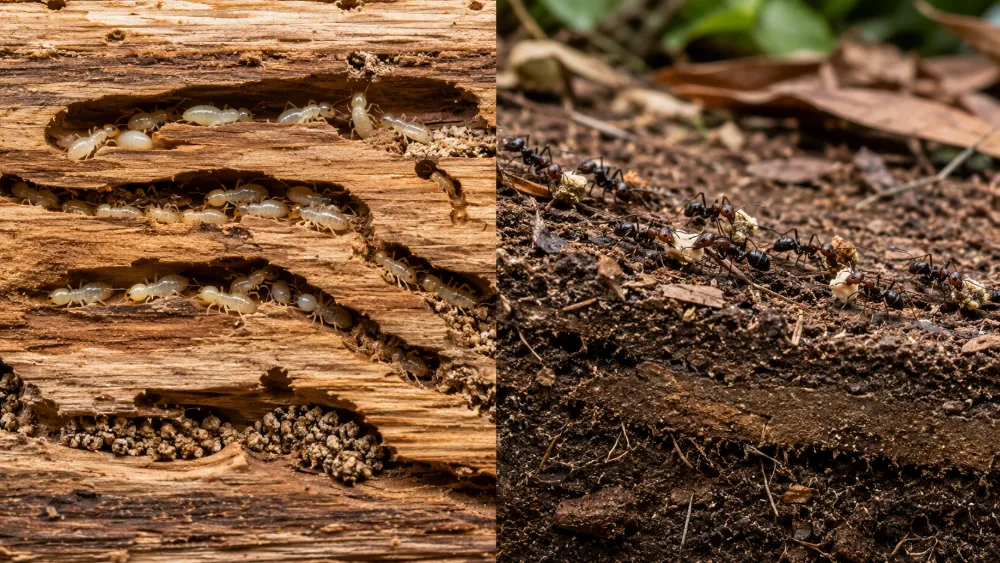
Termites and ants may look similar at first, but they are very different insects. Termites have straight antennae, thick waists, equal-sized wings, and soft bodies, while ants have bent antennae, narrow waists, unequal wings, and harder bodies. Termites mainly feed on cellulose-rich material such as wood and plant matter, while ants have a much wider diet that may include insects, seeds, nectar, honeydew, and household food.
Termites vs Ants Summary Table
| Feature | Termites | Ants |
|---|---|---|
| Scientific group | Order Blattodea, infraorder Isoptera | Order Hymenoptera, family Formicidae |
| Closest relatives | Cockroaches | Wasps and bees |
| Body shape | Soft, broad body with no narrow waist | Clearly segmented body with a narrow pinched waist |
| Antennae | Straight or bead-like antennae | Elbowed or bent antennae |
| Wings on swarmers | Two pairs of wings about the same size | Front wings larger than hind wings |
| Color | Often pale, cream, white, tan, or light brown | Often black, brown, red, yellow, or mixed colors |
| Waist | Thick waist, body looks more uniform | Thin waist between thorax and abdomen |
| Main food | Cellulose from wood, dead plants, leaf litter, soil organic matter, or dung | Insects, nectar, seeds, honeydew, fungi, meat, sweets, and many other foods |
| Metamorphosis | Incomplete metamorphosis: eggs, nymphs, adults | Complete metamorphosis: eggs, larvae, pupae, adults |
| Colony members | King, queen, workers, soldiers, and winged reproductives | Queen, workers, males, and winged reproductives; some species have soldiers |
| Common home concern | Can seriously damage wooden structures | Often invade kitchens, walls, gardens, or stored food; some damage wood indirectly |
| Ecological role | Major decomposers that recycle dead plant material | Predators, scavengers, seed dispersers, soil engineers, and ecosystem cleaners |
What Are Termites?
Termites are social insects best known for eating wood and other cellulose-rich materials. Although they are often called “white ants,” termites are not ants. They are more closely related to cockroaches. Modern classification places termites within the order Blattodea, the same broad order that includes cockroaches.
Most termites live in colonies with specialized castes. A colony may include a queen, a king, workers, soldiers, and winged reproductive individuals called alates or swarmers. Workers collect food, care for young, build tunnels, and maintain the nest. Soldiers defend the colony, often with enlarged heads and strong jaws or chemical defenses.
Termites are extremely important in nature because they break down dead wood, fallen leaves, grass, and other plant material. In forests, savannas, and tropical ecosystems, they help recycle nutrients back into the soil. The problem begins when some termite species feed on wood inside buildings, fences, furniture, or other human structures.
What Are Ants?
Ants are social insects in the family Formicidae. They are related to wasps and bees and are among the most successful insects on Earth. Ants live in organized colonies that may contain a few dozen individuals or millions of workers, depending on the species.
Most ant colonies include one or more queens, many workers, and reproductive males and females during breeding periods. Worker ants forage for food, care for larvae, defend the nest, and build tunnels or chambers. Some species also have soldier ants with enlarged heads and strong mandibles.
Ants have highly varied diets. Some hunt other insects, some collect seeds, some farm fungi, some drink nectar, and many feed on honeydew produced by aphids or scale insects. In homes, ants are often attracted to sugar, grease, meat, crumbs, pet food, and moisture.
Body Shape Differences
The body shape is one of the easiest ways to tell termites and ants apart. Termites have a broad, almost tube-like body. Their thorax and abdomen are not separated by a narrow waist, so the insect looks more uniform from head to tail.
Ants have a more clearly divided body with three obvious sections: head, thorax, and abdomen. The most important feature is the narrow waist, called the petiole, between the thorax and abdomen. In many ants, this waist looks like one or two small nodes.
If the insect has a thick waist and soft, pale body, it may be a termite. If it has a narrow pinched waist and a harder, darker body, it is more likely an ant.
Antennae Differences
Antennae are another reliable clue. Termite antennae are usually straight or gently curved and look like a string of small beads. They do not have a sharp elbow.
Ant antennae are elbowed. Each antenna has a long first segment that bends clearly into the rest of the antenna. This bent shape is one of the quickest field marks for identifying ants.
When comparing termites vs ants, remember this simple rule: termites have straight antennae, while ants have bent antennae.
Wing Differences in Swarmers
Both termites and ants can produce winged reproductive insects. These winged individuals are often seen during swarming events, when young queens and males leave the colony to mate and start new colonies. Because swarmers can look similar, wings are very useful for identification.
Termite swarmers have two pairs of wings that are roughly equal in size and shape. Their wings are usually long, delicate, and extend beyond the body. Termite wings also break off easily, so piles of shed wings near windowsills, doors, or floors can be a warning sign.
Winged ants have front wings that are larger than the hind wings. Their wings do not usually appear as equal and uniform as termite wings. Winged ants also keep the same narrow waist and elbowed antennae seen in worker ants.
Color and Texture Differences
Termites are often pale, cream, white, tan, or light brown, especially workers. Their bodies are soft and moist-looking because many termites avoid sunlight and live inside soil, wood, tunnels, or protected nests.
Ants are often darker and harder-bodied. Many species are black, brown, red, yellow, or reddish-brown. Their outer skeleton is usually more rigid and polished than that of termites. However, color alone is not enough for identification because both groups include many species with different colors.
Use color together with body shape, antennae, wings, and behavior for a more accurate comparison.
Diet and Feeding Behavior
Termites are famous for feeding on cellulose. Cellulose is a tough plant material found in wood, grass, leaves, bark, paper, cardboard, and many forms of dead vegetation. Termites rely on microbes in their gut or in their colony system to help break down this difficult material.
Not all termites eat buildings. Many species feed on dead wood, soil organic matter, grass, leaf litter, or dung. In natural ecosystems, this makes them important decomposers. However, subterranean termites, drywood termites, and some other groups can become serious structural pests when they enter homes.
Ants have a much broader diet. Some species are predators, some are scavengers, some collect seeds, and some prefer sugary liquids. Many household ants are attracted to human food, especially sugar, grease, meat, fruit, and crumbs. Carpenter ants may tunnel through wood, but they do not eat wood as termites do. Instead, they excavate it to create nesting space.
Colony Structure and Social Life
Both termites and ants are social insects, but their societies are organized in different ways. Termite colonies often have both a king and a queen. The king may remain with the queen and continue mating with her over time. A termite queen can become greatly enlarged in some species and may lay large numbers of eggs.
Ant colonies usually have one or more queens, but adult males are generally short-lived and mainly exist for mating. Worker ants are usually sterile females. They perform most colony tasks, including foraging, nursing larvae, cleaning, nest construction, and defense.
Termite workers may be male or female, while ant workers are female. This is an important biological difference between the two groups.
Life Cycle Differences
Termites go through incomplete metamorphosis. Their young hatch from eggs as nymphs, which look somewhat like smaller, less developed adults. These nymphs gradually molt and develop into workers, soldiers, or reproductive termites depending on the colony’s needs and species biology.
Ants go through complete metamorphosis. Their life stages are egg, larva, pupa, and adult. Ant larvae look like small, soft, legless grubs and must be fed by workers. After the pupal stage, they emerge as adult ants.
This difference is important because termite young often look more similar to adults, while ant young look completely different from adult ants.
Nesting Habits
Termite nests vary widely. Some termites build underground colonies, some live inside dry wood, some build mounds, and some create carton-like nests from chewed plant material, soil, and saliva. Subterranean termites often build mud tubes to travel safely between soil and wood while avoiding dry air and predators.
Ant nests are also diverse. They may be built in soil, under rocks, inside logs, within hollow stems, in wall voids, or even in living trees. Some species create large mounds, while others make small hidden nests. Ants are more likely to be seen actively walking in trails across open surfaces.
In homes, termite activity is often hidden inside wood or behind walls. Ant activity is often more visible because workers forage openly for food.
Damage to Homes and Wood
Termites are usually more dangerous to wooden structures because many species actually consume wood. They can hollow out beams, flooring, trim, door frames, furniture, and other cellulose-based materials. Since they often work inside wood or underground, termite damage may remain unnoticed for a long time.
Ants can also be a problem in homes, but their damage is usually different. Carpenter ants tunnel into wood to build nests, but they do not digest wood as food. They often prefer damp, decaying, or softened wood. Other ants may invade kitchens, contaminate food, protect honeydew-producing pests in gardens, or create nuisance trails indoors.
If wood looks hollowed out, contains mud tubes, or has piles of shed wings nearby, termites may be involved. If there are sawdust-like wood shavings and large black or reddish ants, carpenter ants may be the issue.
Behavior and Movement
Termites usually avoid open air and bright light. Workers often remain hidden inside soil, wood, or mud tubes. They need moisture and protection from drying out, especially subterranean termites. This hidden behavior is one reason termites can damage structures before people notice them.
Ants are usually more active in visible trails. Many species leave chemical scent trails that guide nestmates to food. You may see ants moving across floors, walls, counters, garden paths, tree trunks, or outdoor pavement.
In general, termites are more secretive, while ants are more visible foragers.
Ecological Importance
Although termites are often disliked because of home damage, they are ecologically valuable. They break down dead plant material, improve soil structure, recycle nutrients, and provide food for birds, reptiles, amphibians, mammals, spiders, and other insects. In some tropical and savanna ecosystems, termites are among the most important decomposers.
Ants are also vital to ecosystems. They aerate soil, disperse seeds, prey on pests, clean up dead insects, and serve as food for many animals. Some ants protect plants, while others farm fungi or tend aphids for honeydew. Their ecological roles are extremely diverse.
Both termites and ants can be pests in human spaces, but in nature they are essential members of healthy ecosystems.
How to Tell Termites and Ants Apart Quickly
Look at the waist: termites have a thick waist; ants have a narrow pinched waist.
Look at the antennae: termites have straight antennae; ants have elbowed antennae.
Look at the wings: termite wings are equal in size; ant front wings are larger than hind wings.
Look at the body: termites are often soft and pale; ants are usually harder and darker.
Look at the behavior: termites often stay hidden; ants often forage in visible trails.
Look at the damage: termites eat cellulose; carpenter ants excavate wood but do not eat it.
Termite Swarmers vs Flying Ants
Swarmers are one of the most confusing stages because both termites and ants can appear with wings. A sudden group of flying insects near windows, lights, doors, or walls may be either termite swarmers or flying ants.
To identify them, focus on three features. First, termite swarmers have a broad waist, while flying ants have a narrow waist. Second, termite swarmers have straight antennae, while flying ants have elbowed antennae. Third, termite swarmers have two pairs of equal-sized wings, while flying ants have larger front wings and smaller hind wings.
If many shed wings are found indoors, especially near wood, windowsills, or baseboards, termites should be considered a serious possibility.
Are Termites Just White Ants?
No, termites are not white ants. The phrase “white ants” is a common nickname, but it is scientifically incorrect. Termites and ants belong to different insect groups and have different evolutionary histories.
Termites are closer to cockroaches, while ants are closer to wasps and bees. Their similar social lifestyles evolved separately. This is a good example of convergent evolution, where unrelated or distantly related animals develop similar traits because they face similar ecological challenges.
Which Insect Is More Harmful?
For buildings, termites are usually more harmful because they can directly consume wood and other cellulose materials. A large termite colony can cause serious structural damage if it remains undetected.
Ants are usually more of a nuisance indoors, but some species can still cause problems. Carpenter ants can weaken wood by tunneling through it, fire ants can sting painfully, and some invasive ants can disrupt native ecosystems. The level of harm depends on the species, location, colony size, and behavior.
Termites vs Ants: Final Comparison
Termites and ants are both social insects, but they are not the same animal. Termites are soft-bodied cellulose feeders with straight antennae, thick waists, and equal-sized wings. Ants are harder-bodied insects with elbowed antennae, narrow waists, and front wings larger than hind wings.
Their roles in nature are also different. Termites are major decomposers that recycle dead plant material. Ants are flexible foragers, predators, scavengers, seed dispersers, and soil engineers. In homes, termites are more closely linked to hidden wood damage, while ants are more often seen as visible foraging pests.
FAQs About Termites vs Ants
Are termites ants?
No. Termites are not ants. Termites are more closely related to cockroaches, while ants are related to wasps and bees. They both live in colonies, but they belong to different insect groups.
Why are termites called white ants?
Termites are sometimes called white ants because many termite workers are pale and live in colonies like ants. However, the name is misleading because termites are not true ants.
What is the easiest way to tell termites from ants?
The easiest way is to check the waist and antennae. Termites have thick waists and straight antennae. Ants have narrow waists and elbowed antennae.
Do termites and ants both have wings?
Only reproductive termites and ants have wings during swarming periods. Termite swarmers have four wings of about equal size. Flying ants have front wings that are larger than their hind wings.
Do ants eat wood like termites?
Most ants do not eat wood. Carpenter ants tunnel through wood to make nests, but they do not digest wood as food. Termites actually feed on cellulose found in wood and plant material.
Which is worse in a house, termites or ants?
Termites are usually worse for structural damage because they can eat wood from the inside. Ants can be annoying or damaging in some cases, but most household ants do not cause the same type of hidden wood destruction as termites.
Why do termites lose their wings?
After termite swarmers mate and find a place to start a new colony, they shed their wings. Piles of discarded wings near windows, doors, or wooden areas can be a sign of termite activity.
Do termites bite humans?
Termites are not usually a biting threat to humans. Soldier termites can bite if handled, but they are not aggressive toward people in the way some ants can be.
Do ants attack termites?
Yes. Many ants prey on termites. Termites are soft-bodied and nutritious, so they are important food for some ant species. Termite soldiers help defend the colony against ant attacks.
Can termites and ants live near each other?
Yes, they can live in the same general environment, especially in soil, wood, forests, and gardens. However, ants may attack termite colonies, and termites often stay hidden to avoid predators.