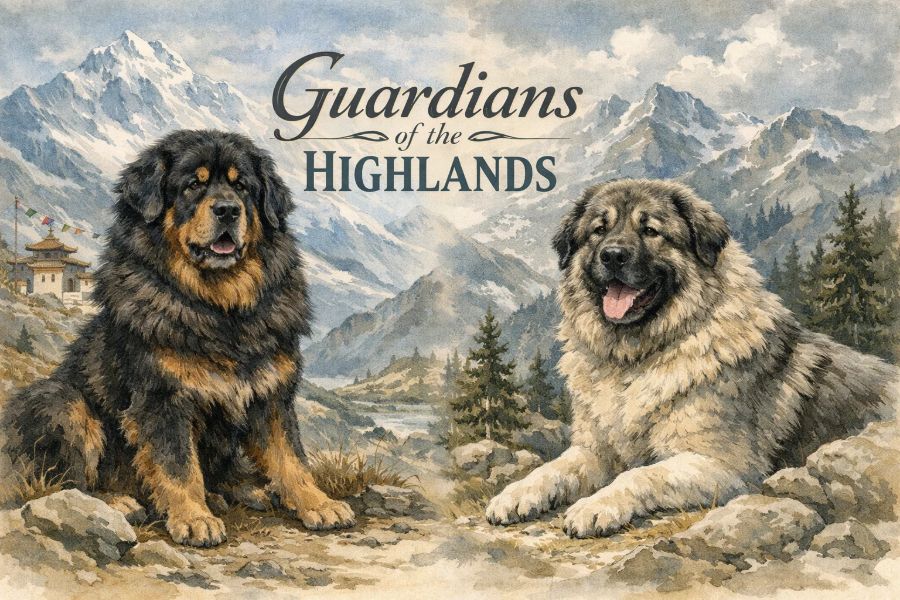
At a zoological and working-dog level, Tibetan Mastiffs and Caucasian Shepherd Dogs are not simply “two giant fluffy guard dogs.” They are both livestock-and-property guardians, but they come from different mountain systems, were shaped by different human cultures, and tend to express protection in different styles. The Tibetan Mastiff developed in the Himalayas as a guardian of camps, flocks, and monasteries, while the Caucasian Shepherd Dog developed across the Caucasus as a large, heavily built flock and property guardian for severe climates and serious predator pressure.
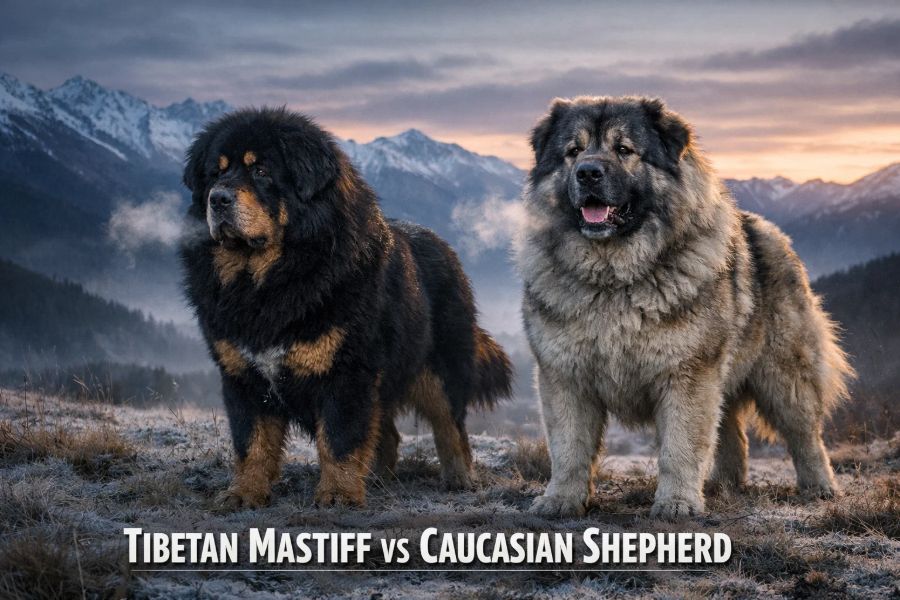
The short scientific summary is this: the Tibetan Mastiff is usually the more reserved, aloof, and selectively responsive guardian, while the Caucasian Shepherd is usually the more overtly forceful, territorial, and confrontation-ready guardian. Neither breed is “better” in every context. The better fit depends on whether you value watchful restraint and independence or bold, immediate territorial confidence.
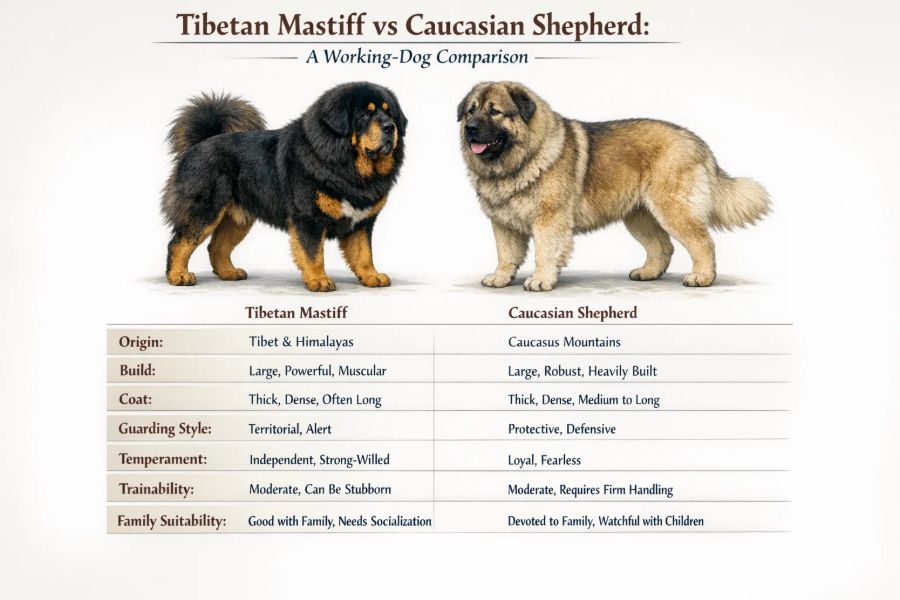
Quick comparison table
| Category | Tibetan Mastiff | Caucasian Shepherd Dog | Practical takeaway |
|---|---|---|---|
| Origin | Himalayas / Tibet | Caucasus region | Both are mountain guardians from harsh climates |
| Historical role | Camp, monastery, flock, and estate guardian | Livestock and property guardian | Similar jobs, different regional selection pressures |
| Overall build | Large, substantial, athletic, “not a giant” in AKC wording | Large, powerful, plenty of bone and strong musculature | Caucasian is usually the heavier, more massive type |
| Temperament | Watchful, aloof, imposing, territorial with strangers | Bold, fearless, self-confident, fierce when threat is present | Tibetan often guards with reserve; Caucasian often guards with more directness |
| Trainability | Intelligent, learns quickly, but dislikes repetitive obedience | Intelligent but highly independent; obedience can be difficult | Neither is ideal for novice owners |
| Family style | Devoted to family, restrained with outsiders | Soft with family, serious with strangers | Both bond strongly, but require careful management |
| Climate adaptation | Excellent cold-weather coat, mountain heritage | Bred for severe climates of the Caucasus | Both tolerate cold well |
| Best fit | Experienced owner wanting a dignified, self-directed guardian | Experienced owner needing a very serious territorial guardian | Both require expert handling |
The breed-role and temperament summaries above come directly from AKC and FCI breed materials.
Origins and working background
The Tibetan Mastiff is described by the FCI as an ancient working breed of the nomad herders of the Himalaya and a traditional guardian of Tibetan monasteries. The AKC breed standard likewise frames it as a large, athletic, substantial guardian rather than an exaggerated giant. This history helps explain the breed’s famous combination of vigilance, reserve, and independence.
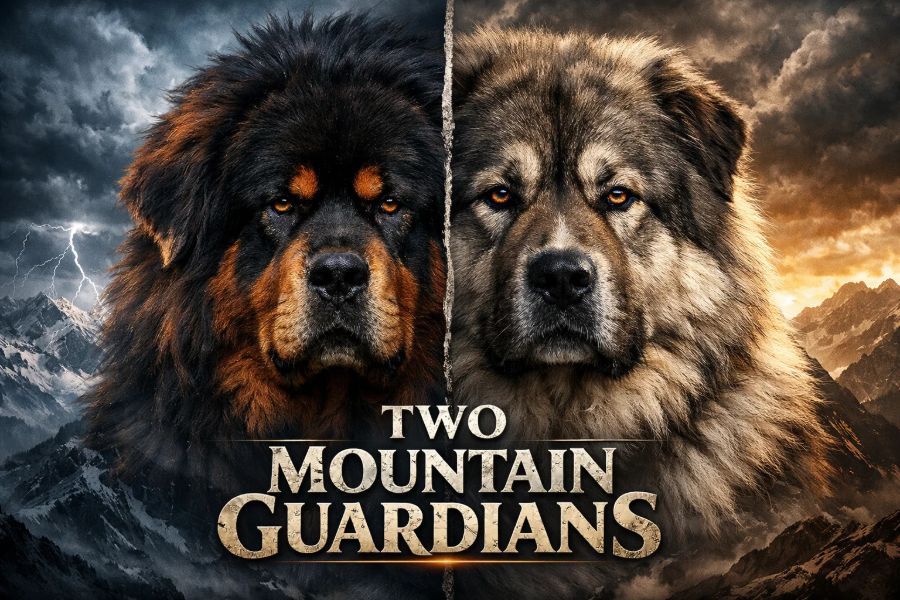
The Caucasian Shepherd Dog, by contrast, is described by the FCI as a large, strong dog with plenty of bone and powerful musculature, historically used across the Caucasus in all kinds of climatic conditions, including very severe ones. The breed’s background is tied closely to flock and property protection against real threats in rough terrain, which matches its reputation for seriousness and territorial confidence.
So although both breeds are guardians, their histories suggest slightly different emphases: the Tibetan Mastiff as a watchful, dignified sentinel, and the Caucasian Shepherd as a heavier, more forceful territorial defender. That distinction is an inference from the official standards and temperament descriptions.
Size, bone, and physical impression
The AKC standard for Tibetan Mastiffs describes them as “large, but not a giant breed,” athletic and substantial, with a broad head and strong bone. That wording matters: the breed is meant to be impressive, but still functional and agile enough for guardian work in mountain environments.
The FCI standard for the Caucasian Shepherd emphasizes “large, strong,” with “plenty of bone” and a “powerful muscular system.” In practical terms, this usually means the Caucasian Shepherd presents a heavier, more massive visual and physical presence than the Tibetan Mastiff.
So if the comparison is purely about bulk and bodily force, the Caucasian Shepherd usually has the edge. If the comparison is about athletic substantiality without excessive mass, the Tibetan Mastiff often fits that description better.
Coat and climate adaptation
Both breeds are strongly adapted to cold climates, but their coats express that adaptation differently. Tibetan Mastiffs are described by AKC as densely coated giants, and breed standards emphasize a strong mane-like appearance, especially in males. This gives the breed its famous lion-like silhouette.
The Caucasian Shepherd was selected across severe climatic conditions in the Caucasus, and the standard reflects a dog built for exposure, harsh weather, and outdoor guarding. Its coat is also heavy and protective, but its overall impression is often more rugged and fortress-like than ceremonial or lion-maned.
Both breeds are excellent in cold environments, but neither is naturally optimized for hot, humid climates without careful management. That conclusion follows directly from their standards and mountain origins.
Temperament: reserve vs directness
This is where the comparison becomes most interesting.
The AKC describes the Tibetan Mastiff as watchful, aloof, imposing, and intimidating, mellow and calm around the house, devoted to family, and aloof and territorial with strangers. That suggests a dog that often prefers to assess first and react second.
The AKC describes the Caucasian Shepherd as bold, fearless, self-confident, and fierce when a threat is present, while still being soft and devoted with family. That wording points to a dog that is more likely to move from assessment to confrontation quickly when it decides something is wrong.
So, behaviorally, the Tibetan Mastiff often appears more like a silent judge, while the Caucasian Shepherd often appears more like an active enforcer. That is not a scientific ranking, but it is a fair interpretation of the official breed language.
Guarding style
Because of those temperament differences, the two breeds often guard in different ways.
A Tibetan Mastiff often excels at boundary awareness, night vigilance, and selective response. Owners and breed clubs frequently note that the breed can be especially alert after dark, which fits its historical role as a camp and monastery guardian. The dog may not constantly seek interaction, but it is usually highly aware of what belongs and what does not.
A Caucasian Shepherd often excels at territorial certainty and direct intervention. The AKC explicitly warns that this is a serious guardian breed and should not be taken lightly. That wording reflects a dog that is not merely suspicious, but fully prepared to act on that suspicion.
If you want a guardian that feels more contained and reserved, the Tibetan Mastiff may fit that image better. If you want one that feels more physically and psychologically forceful, the Caucasian Shepherd usually fits better.
Trainability and intelligence
Neither breed should be judged by “obedience competition” standards alone. Guardian dogs were bred to think independently, often at a distance from humans and in situations where waiting for instructions could be a liability.
The AKC notes that Tibetan Mastiffs are highly intelligent and learn quickly, but do not respond well to repetitive obedience drills and often see no reason to repeat what they already understand. That is not low intelligence; it is low handler-dependence.
The AKC says the Caucasian Shepherd is extremely independent and intelligent, but can be difficult to train for obedience. Again, that points to a dog whose cognition is shaped for autonomous judgment, not eager compliance.
So if “smart” means easily trained to obey fast, repeated commands, neither breed is ideal. If “smart” means able to evaluate territory, strangers, and threat on its own, both are highly intelligent working breeds.
Family life and stranger tolerance
Both breeds can be deeply loyal to family, but both require careful socialization and experienced management.
The Tibetan Mastiff is described by AKC as sweetly devoted to family and aloof with strangers. That makes it better understood as selectively affectionate and selectively social, not universally welcoming.
The Caucasian Shepherd is described as kind and endearing with family, including other family pets, but fierce when it perceives a threat. That combination can be excellent in the right hands, but risky in inexperienced homes or poorly controlled environments.
In both breeds, poor socialization does not create “extra protection”; it usually creates poor judgment. That point follows from the temperament goals of both standards.
Which breed is more suitable for ordinary pet homes?
For most average households, neither is an easy choice.
The Tibetan Mastiff may be somewhat easier for owners who appreciate a more reserved dog and can provide secure boundaries, calm structure, and respect for the breed’s independence. But it is still a powerful guardian with strong territorial instincts.
The Caucasian Shepherd is even more clearly a breed that requires serious experience. The AKC’s warning that it “should never be taken lightly” is unusually blunt and should be read exactly as written.
So for novice owners, dense urban settings, or homes that want a highly social, biddable dog, neither breed is a natural match.
Health and function
Because both breeds are giant or near-giant working dogs, structural soundness matters more than visual drama. The standards emphasize functional build rather than exaggeration. That is especially important in modern breeding, where over-massing, poor movement, or excessive coat can undermine the original guardian function.
The more functional interpretation is this: Tibetan Mastiffs should remain substantial but athletic, and Caucasian Shepherds should remain powerful but sound and balanced.
Final verdict
A zoologist’s comparison would end like this:
Choose the Tibetan Mastiff if you want a more aloof, dignified, selectively responsive guardian with strong boundary awareness and a calmer outward style.
Choose the Caucasian Shepherd if you want a more massive, forceful, openly assertive territorial guardian that projects confidence and intervention readiness.
Neither breed is “better” in absolute terms. They are two different answers to the same ancient human problem: how to live safely with animals, property, and predators in hard mountain landscapes.
References
AKC. Tibetan Mastiff breed page.
AKC. Caucasian Shepherd Dog breed page.
FCI. Tibetan Mastiff Standard No. 230.
FCI. Caucasian Shepherd Dog Standard No. 328.
AKC. Official Standard of the Tibetan Mastiff.