From a zoological and canine-behavior perspective, “Pitbull vs Dogo Argentino” should not be treated as a fight question. A more responsible and scientifically useful comparison looks at origin, body structure, working purpose, temperament, trainability, management, and welfare risk. That matters especially because “pit bull” is not one universally fixed breed name: in many jurisdictions it is an umbrella term, while the American Pit Bull Terrier is recognized by the United Kennel Club, and the AKC instead recognizes related breeds such as the American Staffordshire Terrier.
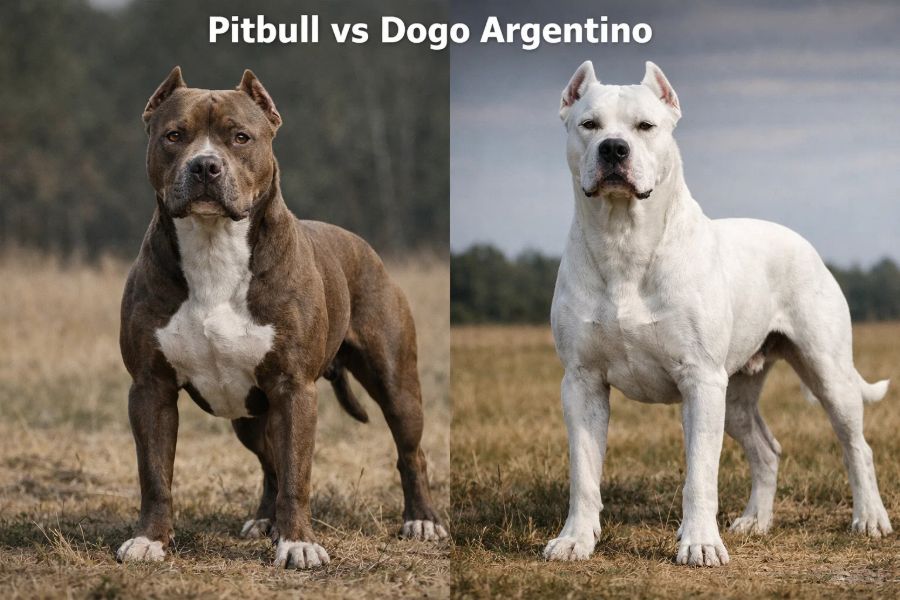
The short answer is this: the Dogo Argentino is usually the larger, taller, and more purpose-bred big-game catch dog, while pit bull–type dogs are generally more compact, more agile in short bursts, and more variable because “pit bull” covers multiple lineages and mixes in public use. In behavior, neither dog should be judged by myths alone. For both, owner handling, early socialization, humane training, and environment matter more than breed label by itself. The AVMA explicitly notes that breed is a poor sole predictor of aggression, and AVSAB warns that confrontational training can worsen aggression rather than fix it.
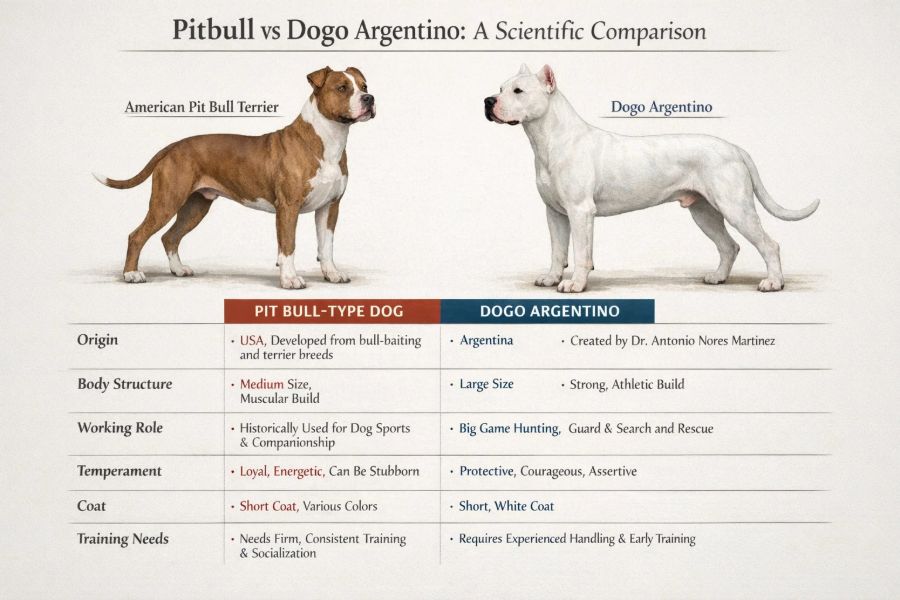
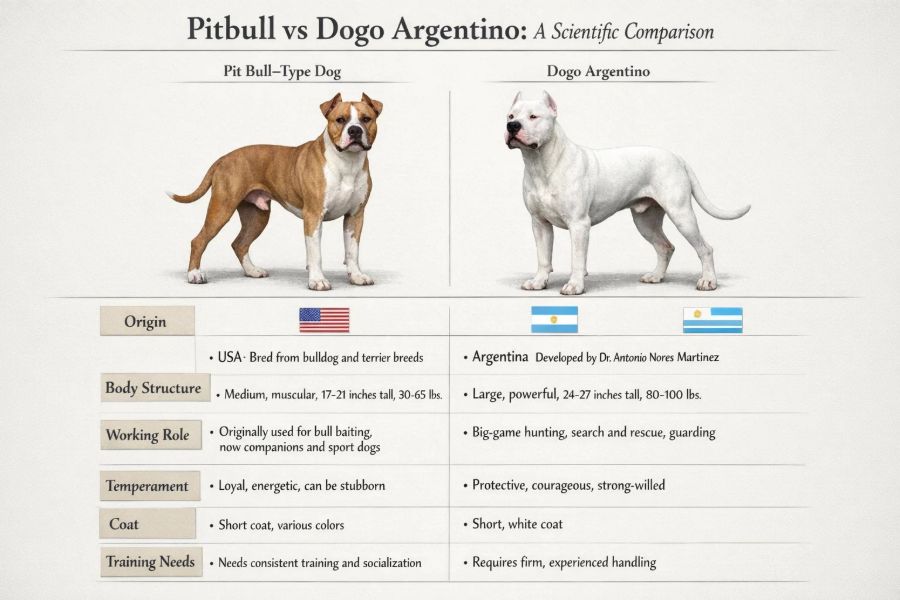
Quick comparison table
| Category | Pit bull–type dog / American Pit Bull Terrier | Dogo Argentino | Practical takeaway |
|---|---|---|---|
| Recognition | “Pit bull” is often a broad label; APBT recognized by UKC, not AKC | Recognized breed with formal standards | Dogo is more standardized; pit bull label is broader |
| Historical role | Bull-baiting ancestry, later farm dog and catch-dog roles in some lines | Developed in Argentina for big-game hunting | Dogo was more explicitly designed for large quarry work |
| General build | Medium-sized, muscular, compact, athletic | Large, powerful, athletic molosser-type hunter | Dogo is usually bigger and rangier |
| Typical coat | Short, sleek | Short, smooth, all white in standard | Both are short-coated working dogs |
| Temperament in standards | Confident, athletic, eager, strong | Courageous, balanced, strong-willed, should not be human-aggressive in standard | Both require experienced handling |
| Trainability | Often highly trainable, but varies by line and label | Trainable but strong-willed and powerful | Both need structure; Dogo often needs more physical-management margin |
| Best fit | Experienced owner wanting a medium, athletic power breed | Very experienced owner wanting a large working guardian/hunting breed | Neither is ideal for novices |
This table simplifies a complex topic because the “pit bull” side is less taxonomically tidy than the Dogo side.
First, what does “pitbull” actually mean?
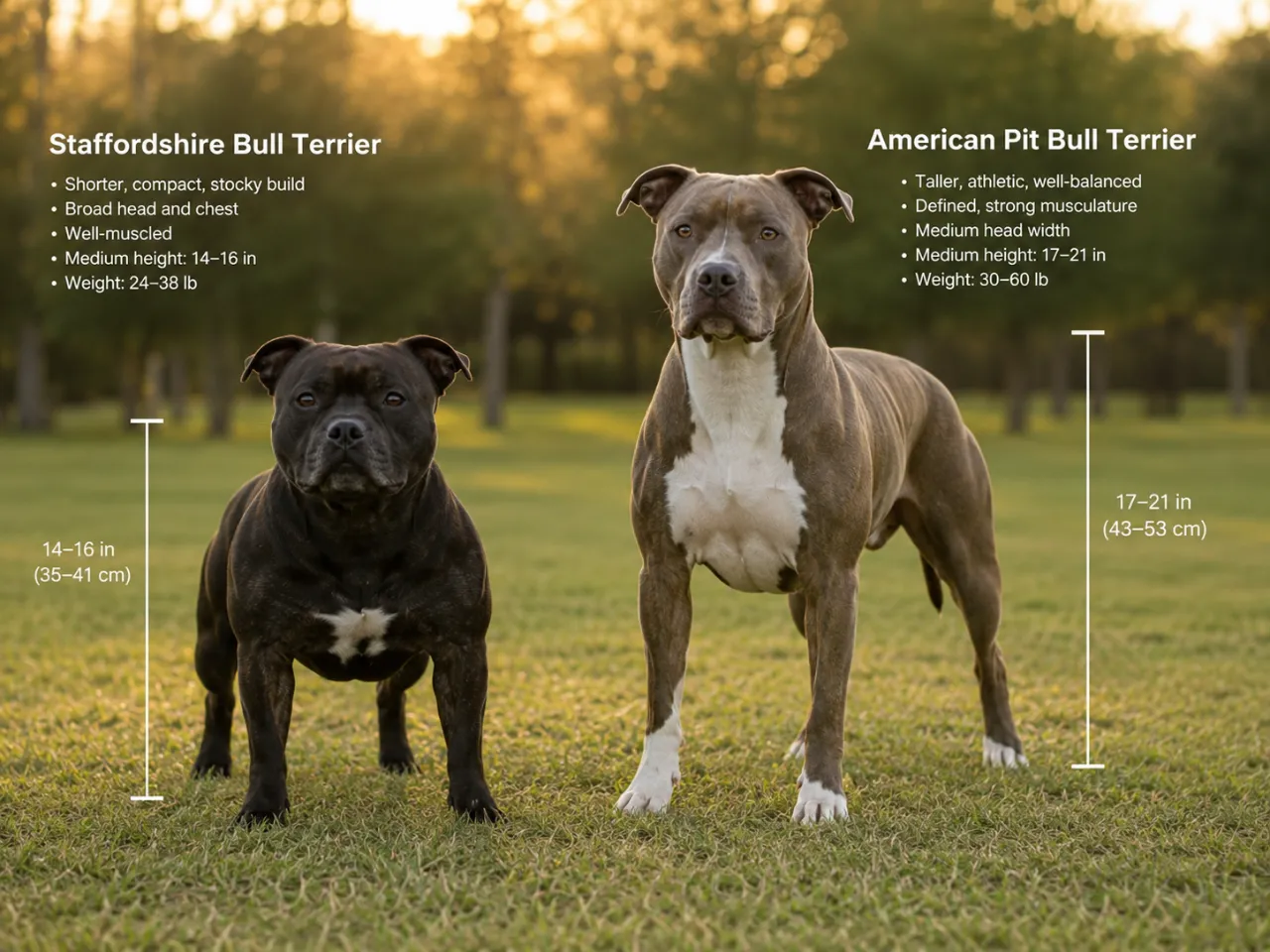
Scientifically and cynologically, this is the first problem with the comparison. The AKC states that “pit bull” is not a specific AKC-recognized breed, while many policies use the term broadly for dogs thought to resemble the American Pit Bull Terrier, American Staffordshire Terrier, Staffordshire Bull Terrier, Bull Terrier, or mixes of those types. The UKC, however, does recognize the American Pit Bull Terrier as a breed and describes it as a medium-sized, solidly built, short-coated, powerful and athletic dog.
That means any honest comparison must admit uncertainty: if someone says “pitbull,” they may mean a UKC American Pit Bull Terrier, an AKC American Staffordshire Terrier, or a broad visual type rather than a pedigree-defined breed. By contrast, the Dogo Argentino is a more standardized reference point in breed standards.
The Dogo Argentino: a purpose-bred big-game dog
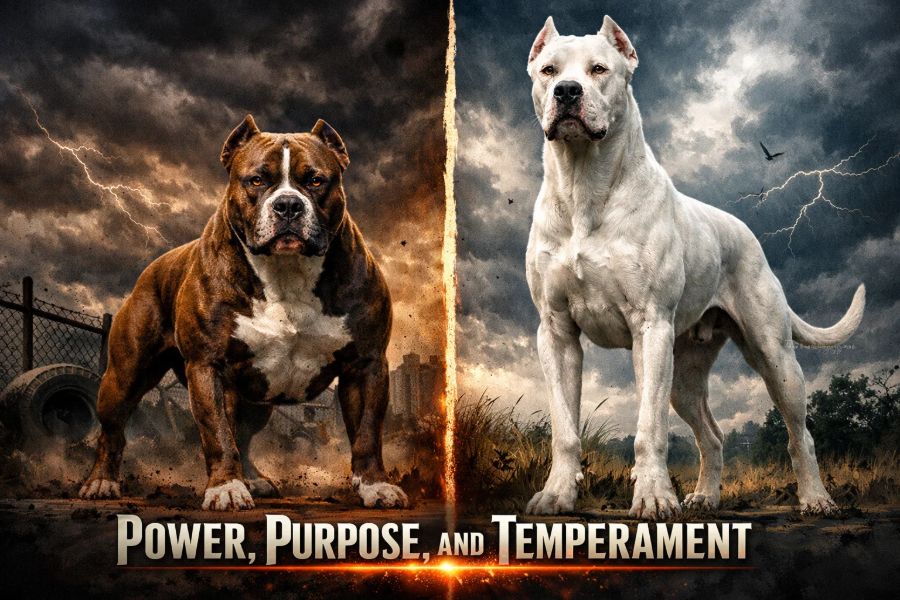
The FCI standard identifies the Dogo Argentino as originating in Argentina and explicitly describes its use as a “dog for big game hunting.” That working purpose is central to understanding the breed. This was not meant to be just a companion or generic guard dog; it was shaped to locate, pursue, and physically hold dangerous quarry in cooperation with hunters.
That background helps explain the Dogo’s physical style: a large, white, muscular, athletic dog built for endurance, power, and confident forward movement. Compared with most pit bull–type dogs, the Dogo Argentino is usually the more rangy, taller, heavier platform. That does not automatically make it “better,” but it does make it a different tool.
Body structure: compact athlete vs larger catch dog
The UKC describes the American Pit Bull Terrier as medium-sized, solidly built, powerful, and athletic. In practical terms, that means a dog that often combines strength with compactness and quick movement. Many pit bull–type dogs look spring-loaded rather than oversized.
The Dogo Argentino standard, by contrast, describes a dog developed for big-game hunting, which naturally favors a larger frame, more reach, and a body plan suited to grappling with larger quarry under field conditions. So if the comparison is about mass and reach, the Dogo usually comes out ahead. If it is about compact acceleration and lower-profile athleticism, many pit bull–type dogs look more specialized in that direction.
Temperament: confidence in both, but different expression
Breed standards are not perfect behavior predictors, but they do tell us what a breed was selected to be. The APBT standard emphasizes a dog that is powerful, athletic, and functionally built. The Dogo Argentino standard emphasizes a serious big-game dog and a confident working temperament. Neither standard supports the cartoon idea that these dogs are mindless aggression machines.
A more useful way to say it is this: pit bull–type dogs often present as intense, people-oriented, highly physical dogs with strong drive, while Dogo Argentinos often present as larger, more imposing working dogs with serious field purpose and more overall physical management demand. Because the “pit bull” label is broad, though, there is more variation on that side.
Trainability and working intelligence
Neither side should be judged by internet mythology. Dogs like these are not “smart” merely because they are strong, and they are not “dangerous” merely because they look powerful. Modern behavior science stresses that working success depends on the interaction of genetics, early development, environment, handling, and training method.
Both types can be very trainable, but they are best understood as high-consequence dogs: when they are well bred, well socialized, and well managed, they can be capable working or companion animals; when they are poorly managed, the consequences can be more serious than with smaller or less powerful breeds. AVSAB’s humane training statement is especially important here: training that focuses on punishment and confrontation is not recommended, especially where fear or aggression is involved.
Why breed alone does not explain risk
This is one of the most important scientific points. The AVMA states that breed is a poor sole predictor of aggressiveness, and its background document on dog bite prevention cautions against simplistic breed-based assumptions. Its public materials also argue that breed-specific legislation is not a complete answer to dog-bite prevention.
That does not mean breed is irrelevant. Structure, original function, and inherited behavioral tendencies still matter. But from a scientific and public-safety perspective, risk comes from a combination of dog management, socialization, owner behavior, reproductive status, chaining or confinement practices, training method, and the specific individual dog. Breed label alone is too crude to explain everything.
Strength, bite, and the limits of internet numbers
Online discussions about these breeds often obsess over “bite force” numbers. Most of those numbers are weakly sourced, inconsistent, or speculative. For domestic dogs, bite performance depends on body size, skull geometry, motivation, bite position, and measurement method, and internet rankings are often not reliable. It is safer and more scientifically honest to say that both are strong-jawed, muscular dogs, with the Dogo usually having the larger body platform and the pit bull–type dog usually having the more compact build.
So if your question is really “which one is stronger,” the only careful answer is: the Dogo Argentino is usually larger and more heavily advantaged in overall size and leverage, while pit bull–type dogs are typically more compact and athletic relative to body size. But that is a structural comparison, not a responsible invitation to test them against each other.
Lifestyle fit: which is harder to own?
For most households, the Dogo Argentino is usually the more demanding dog physically, simply because it is a larger, more standardized big-game breed with substantial power and management needs. It needs space, handling skill, controlled exposure, and strong preventive management.
Pit bull–type dogs are often smaller and more common, but that does not make them easy. Because the label covers many lineages and mixes, outcomes vary widely. A well-bred, stable, properly managed APBT-type dog can be a very different animal from an impulsively bred, poorly socialized “pit bull” mix. That variation is exactly why broad generalizations are so unreliable.
Welfare and ethics matter more than “who wins”
A zoologist or animal-behavior professional would not reduce this comparison to a fight outcome. These are both dogs shaped by humans for difficult working roles. The ethical question is not which dog would defeat the other, but which homes can meet their needs safely and humanely. Humane training bodies such as AVSAB recommend reinforcement-based training and specifically warn that dominance-based or confrontational methods can increase aggressive responses.
That is especially important with powerful breeds. The stronger the dog, the higher the responsibility. Good breeding, early socialization, appropriate containment, and humane behavior work matter far more than internet folklore about “toughness.”
Final verdict
A scientific comparison would summarize it this way:
The Dogo Argentino is usually the larger, more standardized, purpose-bred big-game catch dog.
Pit bull–type dogs are usually the more compact, athletic, and label-variable group, with greater uncertainty because “pit bull” is often used as a visual category rather than one exact breed.
In practice, neither should be judged by myths, and neither should be framed as an animal-fighting comparison. The scientifically useful comparison is about form, function, management, and welfare, not a staged contest.
References
AKC. Policy Analysis: Breed-Specific Legislation and Dangerous Dog Laws; includes note that the American Pit Bull Terrier is not AKC-recognized and that “pit bull” is often broadly defined.
AKC. Why breed-specific legislation is not the answer.
UKC. American Pit Bull Terrier breed standard.
FCI. Dogo Argentino Standard No. 292; identifies the breed’s use as a big-game hunting dog.
AVMA. The Role of Breed in Dog Bite Risk and Prevention.
AVSAB. Position Statement on Humane Dog Training.
AVSAB. Position Statement on the Use of Dominance Theory in Behavior Modification.