Beavers build dams to raise water levels and create deeper, safer ponds where they can live, travel, and store food. By slowing the flow of a stream, a dam helps keep the entrances to a beaver lodge or bank den underwater, making the home harder for land predators to reach. Deeper water also allows beavers to swim more easily and can prevent important underwater entrances from freezing shut in winter. Although beavers build dams primarily to improve their own habitat, the resulting ponds and wetlands can benefit many other species.
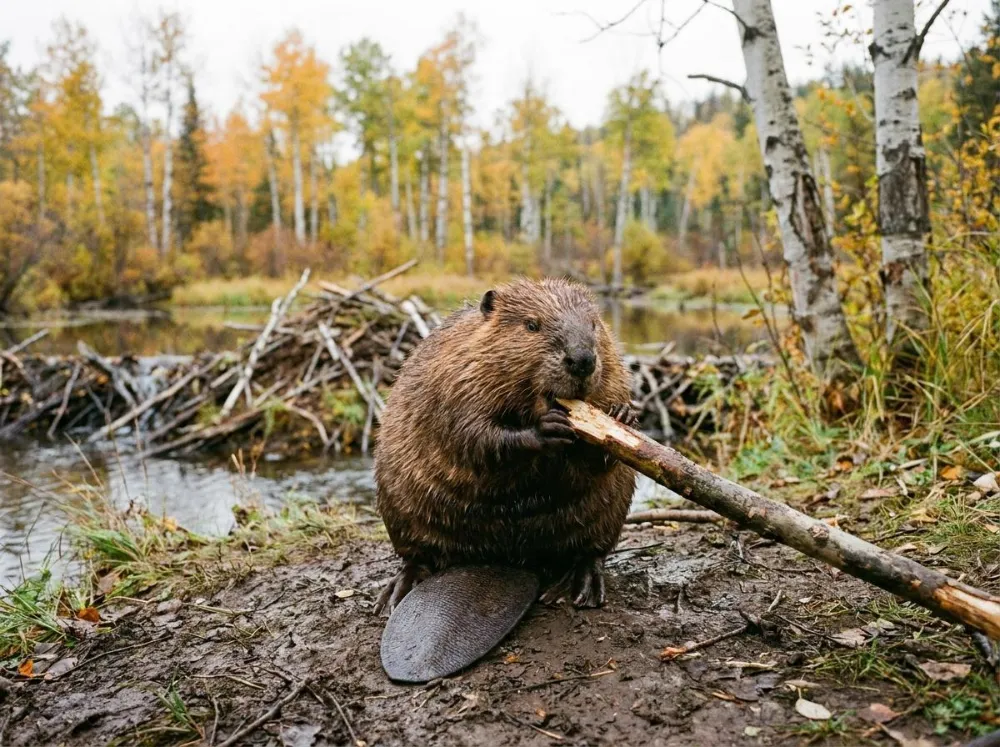
Beavers build dams from natural materials to deepen shallow waterways and create safer aquatic habitat.
Why Do Beavers Build Dams?
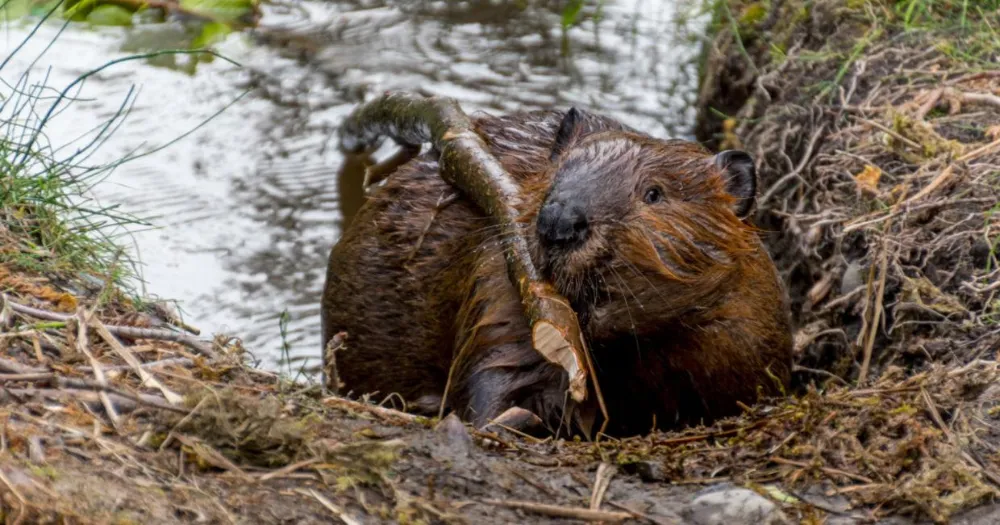
Beavers are large semiaquatic rodents known for their remarkable ability to change the environment around them.
Both North American beavers (Castor canadensis) and Eurasian beavers (Castor fiber) can construct dams when local conditions make them useful.
The main purpose of a dam is to control water depth.
In a shallow stream, a beaver may not have enough water to travel safely or maintain a protected underwater entrance to its home.
By placing branches, logs, mud, and other materials across the stream, it slows the flow and causes water to collect upstream.
This creates a pond or enlarges an existing one.
The resulting habitat provides several advantages:
Protection from predators: Underwater entrances make homes harder to approach from land.
Safer travel: Beavers can swim between feeding sites instead of moving across exposed ground.
Food access: Waterways help them transport branches and reach vegetation.
Winter survival: Deep water can keep access routes and food stores available beneath ice.
Shelter: Stable water levels support lodges and bank dens.
Beavers are therefore not simply trying to block rivers.
They are modifying the landscape to meet their biological needs.
How Do Beaver Dams Work?
A beaver dam is a structure that slows the movement of water through a stream or other flowing channel.
When water encounters the dam, some of it is held back.
As the water level rises upstream, a deeper pool or pond develops.
Water may continue flowing through gaps, over the top, or around parts of the structure.
Unlike a completely sealed concrete wall, a natural beaver dam is often porous.
Its structure changes over time as the beavers add materials and as water rearranges sediment and debris.
The US National Park Service explains that beaver dams are designed to slow and retain water rather than stop every drop from passing downstream.
This distinction matters because flowing water and changing water levels are still part of a functioning beaver wetland.
Do Beavers Live Inside Their Dams?
No. A beaver dam is not the same thing as a beaver home.
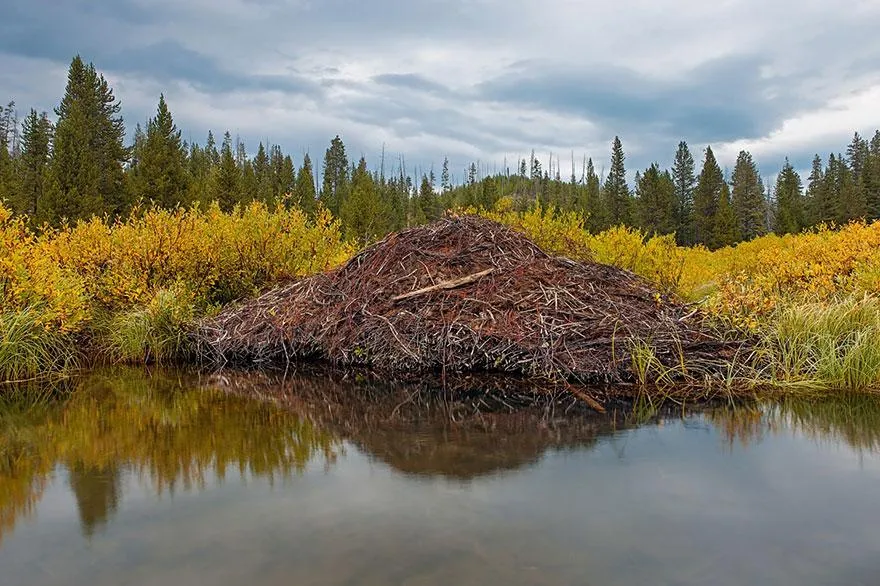
Beavers usually live in a lodge or a bank den.
A dam controls water levels.
A lodge provides a protected chamber where beavers can rest, raise young, and shelter from dangerous conditions.
Some lodges are large structures made from branches, sticks, and mud.
Others are built against streambanks or islands.
Bank dens are excavated into the banks of suitable waterways.
The entrances to these shelters are usually underwater.
A dam may help maintain the depth of water needed to keep those entrances submerged.
Confusing dams and lodges is one of the most common misconceptions about beavers.
What Is the Difference Between a Beaver Dam and a Beaver Lodge?
| Feature | Beaver Dam | Beaver Lodge |
|---|---|---|
| Main purpose | Control water depth | Provide shelter and living space |
| Typical location | Across a flowing channel | In a pond, against a bank, or near the water |
| Construction materials | Branches, logs, mud, stones, vegetation | Branches, sticks, mud, and other natural materials |
| Living chamber | Generally absent | Present |
| Underwater entrance | Not a defining feature | Common |
| Direct role | Creates or maintains suitable habitat | Protects resting and breeding animals |
A beaver family may use both structures in the same territory.
However, a beaver can also live in a bank den where a separate dam is unnecessary.
Why Do Beavers Need Deep Water?
Beavers are strong swimmers but move less efficiently on land.
Their broad, webbed hind feet help propel them through water.
On land, they may be more vulnerable to predators such as coyotes and large carnivores.
Deep water allows a beaver to escape by diving and moving through submerged routes.
It also helps conceal the entrance to a lodge.
For beavers living in cold climates, sufficient depth is particularly important during winter.
If a shallow pond freezes to the bottom, underwater travel and food storage become difficult or impossible.
The National Park Service identifies these protections as major benefits of dam building.
How Do Beavers Build Dams?
Beavers use their powerful incisors to cut branches, saplings, and sometimes substantial trees.
They transport the material to a suitable section of stream.
Construction generally involves several activities:
Collecting branches and woody material from nearby vegetation.
Placing larger sticks or logs to form part of the structure.
Adding smaller branches and plant material between the larger pieces.
Using mud, sediment, and sometimes stones to help reduce water flow.
Continuing to repair or modify the dam as water conditions change.
The exact building sequence varies according to the shape of the stream, available materials, and existing structures.
A beaver does not need to construct an entirely new dam every time the water level changes.
It may reinforce, raise, widen, or repair a structure already in place.
What Materials Do Beavers Use to Build Dams?
Beavers use materials available in their local environment.
These commonly include:
Tree branches
Small logs and woody stems
Mud and sediment
Leaves and other plant material
Stones or gravel where available
Branches and logs provide structure.
Smaller material helps fill gaps.
Mud and sediment can reduce the amount of water passing directly through parts of the dam.
However, the design is not identical in every stream.
Some beavers use naturally fallen trees or existing debris as the foundation for their construction.
Others may create a relatively low dam across a narrow channel.
Why Do Beavers Cut Down Trees?
Beavers cut trees for food and building materials.
Their large front teeth are specialized for gnawing through bark and wood.
They may consume bark, leaves, buds, and the living cambium layer beneath the bark.
They also use branches and trunks in dams, lodges, and winter food caches.
However, beavers do not obtain their nutrition primarily by digesting the hard structural wood of large tree trunks.
The National Park Service notes that beavers are particularly interested in the softer, nutrient-containing tissue beneath the bark.
Aspen and willow are important foods in many habitats.
Other tree species may also be used depending on local availability.
How Can Beavers Cut Trees With Their Teeth?
Beavers have large incisors that grow continuously.
Like other rodents, they use these teeth for gnawing.
The enamel and underlying tooth material wear differently, helping maintain an effective cutting edge.
The teeth are strong enough to remove wood from trees and branches.
Repeated gnawing produces the distinctive tapered or cone-shaped stumps often associated with beaver activity.
The ability to cut wood allows beavers to collect construction material without relying only on branches that have already fallen.
However, not every tree in a beaver territory is cut down.
Tree selection depends on species, size, distance from water, and local conditions.
Do Beavers Build Dams With Their Tails?
Beavers do not use their tails as construction tools in the way humans use shovels or hammers.
The broad, flattened tail has several other functions.
It can assist with balance on land and help the animal control its position in water.
Beavers also slap the water surface with their tails as a warning response to perceived danger.
They mainly transport and position building materials using their mouths and forefeet.
The idea that a beaver repeatedly pounds its dam into place using its tail is a misleading cartoon image.
Do All Beavers Build Dams?
No. Beavers do not need to build dams in every habitat.
If a river, lake, or pond already provides deep, stable water, the animals may have no reason to create an additional impoundment.
Beavers can occupy bank dens along waterways where existing conditions provide sufficient safety and access.
On large rivers, for example, constructing a dam across the entire channel may be impractical.
The National Park Service explicitly notes that beavers do not construct dams across every large stream or river they inhabit.
Dam construction is therefore a flexible response to local habitat conditions rather than an activity that every beaver performs continuously.
Do Beavers Build Dams Alone or Together?
Beavers often live in family groups that can include a breeding pair and offspring of different ages.
Multiple family members may participate in maintaining structures and using the territory.
However, individuals can also perform building and repair activities independently.
A single beaver does not necessarily need an entire group to place branches or repair a small section of dam.
Family members may contribute to a dam over an extended period.
Some structures are maintained or expanded by successive generations of beavers.
This means the size of a dam does not tell us exactly how many animals built it at any one time.
How Long Does It Take Beavers to Build a Dam?
There is no universal construction time.
A small dam built in a narrow channel may develop quickly when suitable materials are readily available.
Larger or more complex structures can require extended work and repeated repairs.
Construction depends on:
Stream width
Water flow and seasonal changes
Available branches and mud
Terrain and streambed conditions
Number of active beavers
Whether an existing structure is being repaired
Because beavers continue maintaining structures after the initial construction, the idea of a dam being permanently finished can be misleading.
A functioning dam is often a changing feature of the landscape.
How Big Can Beaver Dams Get?
Beaver dams range from relatively short barriers across small streams to exceptionally large structures.
The size depends on the terrain, available water, vegetation, and how long the site has been occupied.
Some extensive dam systems are created and maintained over many years.
However, the largest structures are unusual and should not be treated as typical examples.
Most beavers do not build giant dams visible from satellites.
Even relatively small dams can substantially change local water depth and create important habitat.
How Do Beaver Dams Change Rivers and Streams?
Beaver dams alter the movement and storage of water.
By slowing flow, they can increase upstream water depth and expand the area covered by water.
They can also change how water interacts with surrounding soil and floodplains.
These effects influence sediment deposition, channel shape, vegetation, and aquatic habitat.
A 2022 global review examined the ecological and hydrological consequences of beaver dams across different environments.
The review found consistent evidence for reduced local water velocity and increased water retention near many dams.
However, the effects on downstream discharge were more variable.
This means the claim that beaver dams always increase downstream water supply is too broad.
The outcome depends on location, season, evaporation, groundwater interactions, and the amount of water moving through the system.
What Did the 2025 USGS Study Discover?
In 2025, the US Geological Survey published research examining the effects of beaver dams and ponds on urban streams in Oregon's Tualatin River Basin.
The researchers used streamflow and hydraulic modeling to compare reaches with and without beaver-related structures.
They found that beaver dams increased the diversity of local hydraulic conditions.
Compared with undammed scenarios, affected reaches generally had:
More inundated area
Greater water depth
Lower water velocities
A wider variety of aquatic flow conditions
However, the differences became less pronounced during larger flows when water spread over the channel banks and connected with the floodplain.
The study demonstrated that beaver dams can change stream hydraulics substantially, but the benefits and effects depend on flow magnitude and surrounding terrain.
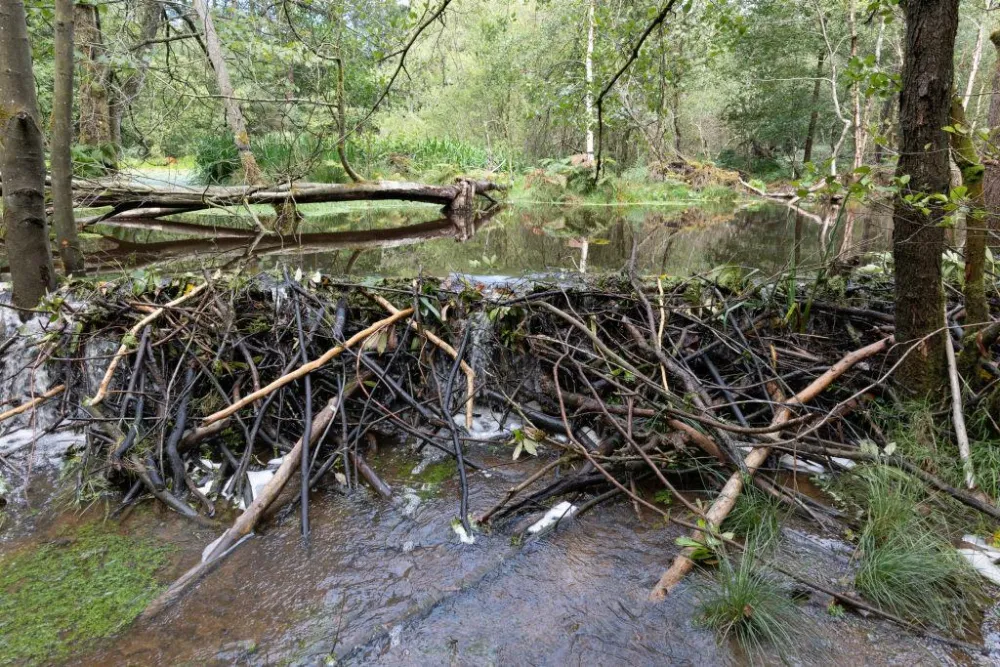
A beaver dam slows a stream and raises upstream water levels, creating a pond and changing the surrounding wetland habitat.
Do Beaver Dams Prevent Flooding?
Beaver dams can reduce the speed of floodwater movement and delay peak flows under some conditions.
However, they do not eliminate flood risk.
A multi-site study published in 2021 examined beaver-influenced streams in England.
Researchers monitored more than 1,000 storm events across four sites.
They found an overall pattern of reduced peak flows and longer delays between rainfall and peak discharge after beaver activity.
These results support the idea that sequences of beaver dams can moderate some stormflow responses.
However, the effect varies with local conditions.
During very large floods, water may flow over or around dams, and some structures may be damaged.
It would therefore be incorrect to claim that beaver dams prevent all flooding.
Can Beaver Dams Help During Droughts?
Beaver-created ponds and wetlands can store water in the landscape.
Under suitable conditions, this stored water may help maintain moisture in surrounding soils and provide aquatic habitat during dry periods.
Some research indicates that beaver dams can influence groundwater movement and increase local water residence times.
However, the effect on downstream water availability is not always positive or identical.
Evaporation from newly created ponds can also influence the water balance.
The 2022 global review emphasized that the net effects depend on climate, terrain, and hydrological conditions.
Beaver dams can contribute to drought resilience in some environments, but they are not a universal solution to water shortages.
Do Beaver Dams Improve Water Quality?
Beaver ponds can trap sediment and change how nutrients and organic matter move through streams.
Slower water often allows suspended particles to settle.
Wetland vegetation and microbial processes may also influence nutrient cycling.
However, the outcomes are not always uniformly beneficial.
Changes in temperature, oxygen, sediment chemistry, and nutrient availability can affect different species in different ways.
Some downstream conditions may improve, while other changes may be undesirable for certain organisms.
Scientists therefore evaluate beaver impacts using measurements rather than assuming every dam improves every aspect of water quality.
Why Are Beavers Called Ecosystem Engineers?
An ecosystem engineer is an organism that substantially changes the physical environment in ways that affect other species.
Beavers are among the best-known examples.
By building dams, digging channels, cutting vegetation, and maintaining ponds, they alter the distribution of water and plant communities.
These physical changes can create new habitats for organisms that were previously uncommon in the area.
A stream valley dominated by flowing water may develop ponds, wet meadows, and marshy areas after sustained beaver activity.
Over time, abandoned dams and drained ponds may also create different habitats.
Scientists use these changing mosaics to understand the ecological importance of beavers.
How Do Beaver Dams Help Other Animals?
Beaver ponds and associated wetlands can provide habitat for many organisms.
Depending on local conditions, these may include:
Amphibians that reproduce in ponds
Waterfowl and other wetland birds
Fish that use slow-water habitats
Aquatic insects and other invertebrates
Wetland mammals
Plants adapted to saturated soils
Different species benefit from different features of the habitat.
Some depend on shallow margins, while others use deeper water or newly established vegetation.
However, species that require fast-flowing water may respond differently to the creation of a pond.
Not every aquatic organism benefits equally from dam building.
Are Beaver Dams Good for Fish?
Beaver dams can create slow-water habitat that benefits some fish species and life stages.
Ponds may provide cover, feeding areas, and shelter from certain high-flow conditions.
However, dams can also alter stream connectivity and create obstacles to movement.
The effect depends on fish species, water temperature, oxygen conditions, dam structure, and seasonal flow.
Some fish can pass through or around certain beaver dams, particularly during higher flows.
Other situations may create more substantial barriers.
Therefore, it is inaccurate to describe every beaver dam as either universally beneficial or universally harmful to fish.
Can Beaver Dams Create Problems?
Yes. Beaver activity can create conflicts with human land use.
Potential problems include:
Flooding roads, trails, or agricultural land
Blocking drainage culverts
Changing water levels on private property
Damaging valued trees through gnawing
Altering habitat conditions for certain sensitive species
These conflicts do not mean beavers lack ecological value.
They show that the consequences of ecosystem engineering depend on where it occurs.
Wildlife agencies and land managers sometimes use water-level control devices, tree protection, or other nonlethal approaches to reduce conflicts.
Management should follow local wildlife regulations and consider the risks of disturbing structures that affect water flow.
What Happens if a Beaver Dam Breaks?
Beaver dams can be damaged by storms, changing water levels, ice, or natural deterioration.
When part of a dam fails, stored water may escape more rapidly.
This can change downstream flow and expose previously flooded areas.
Beavers may repair damaged structures if the site remains suitable.
However, some abandoned or failed dams are not rebuilt.
The resulting changes in vegetation, sediment, and water level can create a new stage of habitat development.
Because a dam may hold substantial water, deliberately breaching one can create safety and environmental risks.
Such work should be handled by qualified local authorities or professionals where necessary.
Do Beavers Build Dams in Winter?
Beavers remain active during winter, although their activity patterns change with temperature, ice, and food availability.
In cold climates, they may rely on submerged food caches prepared before freeze-up.
Maintaining sufficient water depth is important for protecting access routes beneath ice.
Construction and repair are often easier when waterways are not completely frozen.
However, the timing of dam maintenance varies by climate and location.
Beavers do not necessarily stop all activity simply because winter arrives.
Are Beaver Dams Permanent?
Not always.
Some dams persist for many years, especially when beavers maintain them and local conditions remain favorable.
Others are temporary structures affected by floods, erosion, or changes in animal occupancy.
A beaver family may abandon a location if food becomes scarce or water conditions become unsuitable.
After abandonment, a dam may deteriorate and the pond may drain partially or completely.
Vegetation can then colonize the exposed sediments.
These changes are part of the natural dynamics of beaver-influenced landscapes.
Are Beavers the Only Animals That Build Dams?
Beavers are exceptionally specialized for constructing woody dams across flowing water.
Other animals modify waterways or create structures that influence water movement, but these activities are not necessarily equivalent to classic beaver dams.
Humans, of course, build engineered dams for purposes such as water storage, flood control, and electricity generation.
Beavers build natural structures through behavior adapted to their own survival and habitat needs.
The physical principles of water impoundment may be similar, but the construction materials, scales, and biological motivations differ.
Frequently Asked Questions
Why do beavers build dams?
Beavers build dams to raise water levels, create safer ponds, protect underwater entrances to their homes, and improve access to food.
Do beavers live inside their dams?
No. They typically live in lodges or bank dens. Dams are structures that help control water levels.
How do beavers build dams?
They collect branches, logs, mud, and other natural materials and place them across flowing water to slow the current.
Why do beavers cut down trees?
They cut trees to obtain food and construction materials for dams, lodges, and winter food stores.
Do all beavers build dams?
No. Beavers may live in existing deep water or bank dens without needing to construct a dam.
How long does it take a beaver to build a dam?
There is no fixed construction time. It depends on stream size, available materials, local conditions, and whether the dam is new or being repaired.
Can beaver dams stop a river?
They usually slow and redirect water rather than stopping all flow. Water may pass through, over, or around the structure.
Do beaver dams prevent floods?
Some dam systems reduce peak flows and delay stormwater movement, but they do not eliminate flood risk.
Are beaver dams good for the environment?
They can create wetlands and provide habitat for many organisms, although their effects are not equally beneficial in every location.
Do beaver dams help fish?
They can create useful habitat for some fish, but may also affect movement, water temperature, and stream connectivity.
Do beavers use their tails to build dams?
No. Their teeth, mouths, and forefeet are used to cut, move, and position materials. Their tails serve other functions, including balance and signaling.
Why are beavers called ecosystem engineers?
They physically modify waterways and surrounding habitats, influencing water, vegetation, and many other species.
The Bottom Line
Beavers build dams primarily to create deeper, safer water where they can travel, reach food, and protect the entrances to their homes.
They do not normally live inside the dams themselves. Instead, the dams maintain suitable conditions for lodges and bank dens.
By changing water flow and creating ponds, beavers also transform their surroundings into wetlands that support many different organisms.
These effects can benefit ecosystems and sometimes reduce flood peaks, although they can also create local conflicts or unsuitable conditions for certain species.
Beaver dam building is therefore both an extraordinary animal survival strategy and one of nature's most influential examples of ecosystem engineering.
Sources & Further Reading
The following government sources and peer-reviewed studies explain beaver dam construction, habitat requirements, stream hydrology, and ecological effects.
US National Park Service — Build a Beaver Dam. Explains why beavers build dams, how they construct them, and the difference between dams and lodges.
US National Park Service — Beavers: Katahdin Woods and Waters National Monument. Describes lodge entrances, deep-water requirements, diet, and seasonal behavior.
US National Park Service — Beaver Natural History Narrative. Explains beaver anatomy, swimming, food selection, and circumstances in which dams are unnecessary.
A Global Review of Beaver Dam Impacts: Stream Conservation Implications Across Biomes (2022). Review of beaver effects on water depth, flow velocity, retention, and stream ecosystems.
Beaver Dams Attenuate Flow: A Multi-Site Study (2021). Field research documenting flood-flow changes associated with beaver dam systems.
US Geological Survey (2025) — Effects of Beaver Dams and Ponds on Hydrologic and Hydraulic Responses of Storm Flows. Research on changes in stream depth, velocity, flooded area, and stormflow conditions.
Beaver: Nature's Ecosystem Engineers (2021). Scientific review discussing how beaver activity affects water storage, wetlands, and ecological processes.