Meerkats stand on their hind legs mainly to watch for predators, although they also stand upright to survey their surroundings and sometimes to warm themselves in the sun. When a meerkat acts as a sentinel, it often climbs onto a mound, rock, or other elevated position and scans the landscape while group members search for food. Sentinels use different calls to communicate changes in danger. Their upright posture provides a wider view, but not every meerkat standing up is necessarily on guard.
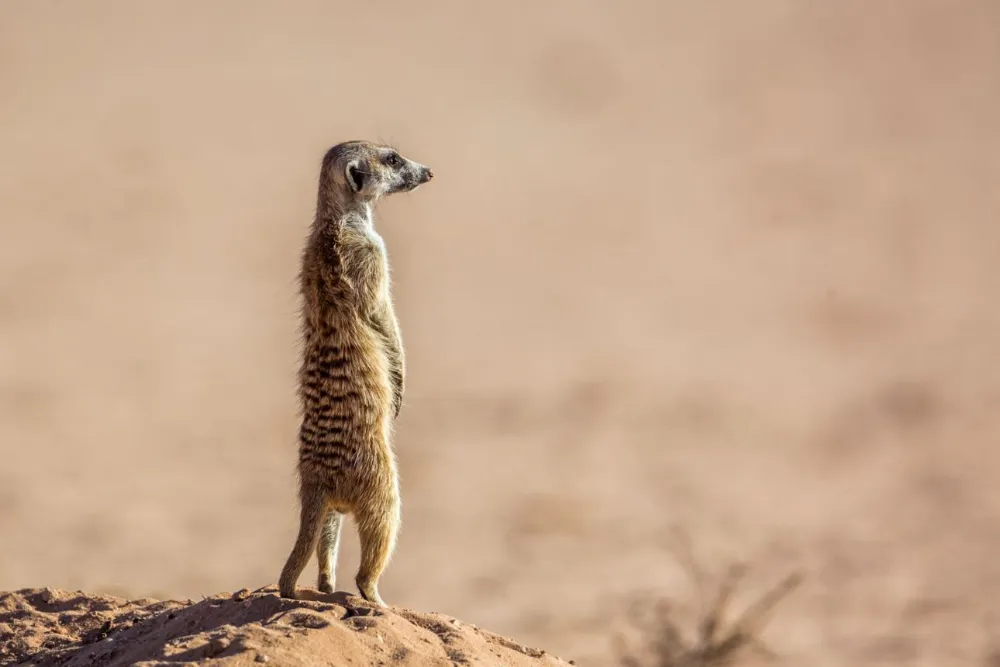
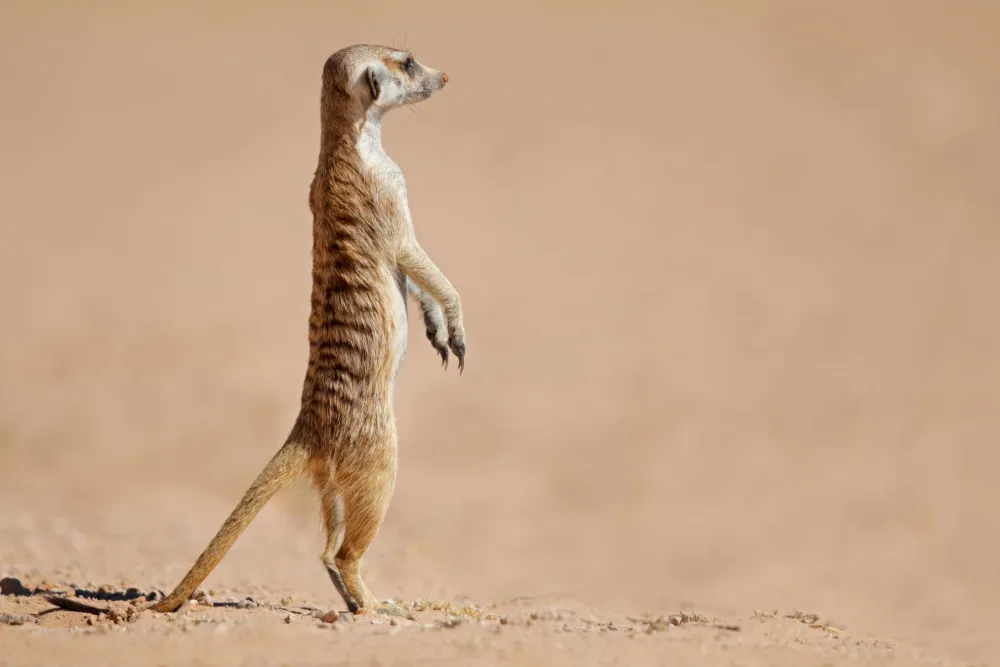
A meerkat standing upright can scan the surrounding landscape for possible danger.
Why Do Meerkats Stand Up?
Meerkats (Suricata suricatta) are small, highly social mammals native to southern Africa.
They belong to the mongoose family and live in groups that cooperate in several activities, including raising young and responding to predators.
Standing upright is one of their most recognizable behaviors.
There are three important reasons for this posture:
Sentinel behavior: Watching for predators while other group members forage.
Environmental inspection: Looking over vegetation or uneven ground.
Thermoregulation: Exposing the body to sunlight while warming up.
These functions can look similar in photographs.
To understand what a meerkat is doing, scientists examine its surroundings, body position, calls, and the activities of other group members.
What Is a Meerkat Sentinel?
A sentinel is an individual that temporarily watches for potential danger while other members of its group engage in activities such as foraging.
In meerkats, sentinels often use elevated positions, including termite mounds, stones, branches, and low shrubs.
From these positions, they can monitor a wider area than an animal whose head is close to the ground.
During sentinel duty, the meerkat may scan the landscape and produce vocal signals.
Other group members can use those signals to adjust their own behavior.
However, standing guard is not a permanent occupation assigned to a particular animal for life.
Individuals can alternate between watching, feeding, and other activities.
Why Do Meerkats Need Lookouts?
Meerkats often forage by digging into soil to locate insects and other small animals.
While a meerkat's head is lowered, it cannot continuously monitor every direction for approaching predators.
This creates a trade-off between feeding and vigilance.
Spending more time searching for danger can mean spending less time finding food.
A sentinel can provide information that helps nearby animals manage this trade-off.
When the sentinel produces reassuring calls, group members may spend more time feeding and less time looking around.
When the vocalizations indicate increased danger, the group may become more vigilant or move toward shelter.
This is an example of coordinated vigilance.
What Predators Are Meerkats Watching For?
Wild meerkats face threats from several types of predators.
Potential dangers include:
Birds of prey, including eagles and hawks
Jackals and other terrestrial carnivores
Some snakes
Other predators capable of catching small mammals
The type of predator matters because different threats require different responses.
An approaching bird of prey may pose a different danger from a predator moving across the ground.
Meerkats can use alarm calls and rapid movement toward underground shelters to reduce exposure.
However, sentinel behavior cannot guarantee protection against every attack.
How Does Standing Upright Help a Meerkat See Predators?
A meerkat standing upright raises its head above much of the surrounding vegetation.
That higher viewpoint can make it easier to detect movement across open ground or in the sky.
The animal can turn its head and scan different directions.
Meerkats also have dark markings around their eyes, which are characteristic features of the species.
However, those markings should not be treated as proof of a precise measured improvement in predator detection under all lighting conditions.
The primary benefit of standing on an elevated lookout point is improved access to visual information.
The meerkat can then combine what it sees and hears with information from other group members.
Why Do Meerkats Use Their Tails While Standing?
Meerkats can balance on their hind legs while keeping their front paws off the ground.
The tail may contact the ground and provide additional stability.
This creates a posture resembling a tripod, with the hind feet and tail helping support the body.
The arrangement allows the head to remain elevated during observation.
However, the exact position of the tail changes with the animal's posture and the surface on which it stands.
A meerkat may also sit upright or rest against a support rather than standing fully extended.
Do Meerkats Take Turns Standing Guard?
Yes. Different individuals can perform sentinel duties at different times.
However, scientific research shows that meerkat guarding is not governed by a strict, evenly distributed schedule.
A 1999 study published in Science investigated why individual meerkats become sentinels.
Researchers found that animals typically guarded from relatively safe locations.
Individuals rarely performed consecutive guarding bouts, but there was no regular rotation system.
Food provision increased the animals' contributions to guarding.
This result suggested that an individual which had recently eaten might be more willing to spend time watching while other animals continued feeding.
The finding challenged the simple idea that every sentinel deliberately sacrifices itself for the group.
Are Meerkat Sentinels Being Selfless?
Sentinel behavior can benefit other group members, but that does not necessarily mean it evolved solely through self-sacrifice.
In behavioral ecology, scientists distinguish between a behavior's effects on other individuals and the benefits or costs experienced by the animal performing it.
A meerkat that has already eaten may gain a personal advantage by watching from a safe position.
It can monitor the environment while other group members continue foraging.
If it detects a predator early, the sentinel itself may be able to escape quickly.
The 1999 research demonstrated that personal benefits and group benefits can coexist.
It would therefore be misleading to describe meerkat sentinel behavior as either perfectly altruistic or entirely selfish in every circumstance.
What Are Meerkat Sentinel Calls?
Sentinel calls are vocal signals made by meerkats performing lookout behavior.
Some calls indicate that the sentinel currently perceives relatively little danger.
Other calls are associated with increased risk.
A 2017 study published in Scientific Reports identified six types of sentinel calls and investigated how they affect foraging group members.
The researchers used playback experiments to test responses to different vocalizations.
Short, common calls tended to support continued feeding and lower individual vigilance.
Longer, less common calls were associated with increased warning behavior.
These findings show that meerkat sentinel communication conveys more than the simple presence or absence of a lookout.
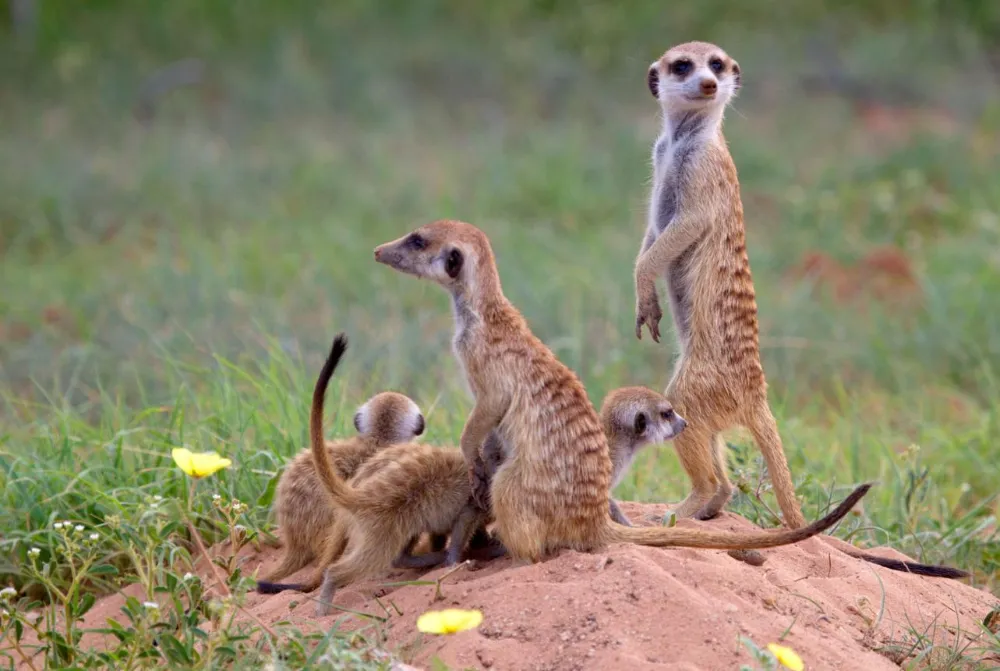
While a sentinel surveys the surroundings, other group members can devote more attention to digging and feeding.
How Do Meerkat Warning Calls Work?
Meerkat vocal communication provides information that can influence the behavior of listeners.
Different calls may reflect changes in the apparent level of danger.
A sentinel giving frequent reassuring calls can indicate that it is present and continuing to monitor the surroundings.
When perceived risk increases, the pattern of calls may change.
Other meerkats can respond by interrupting foraging, looking around, or seeking shelter.
However, not every call means that a predator has already been visually identified.
Some calls convey graded information about the sentinel's assessment of risk.
Scientists separate these routine sentinel calls from more urgent alarm calls associated with particular threats.
Can Meerkats Recognize Different Sentinels by Voice?
Research indicates that meerkats can use information about which individual is producing a sentinel call.
A 2018 study in Scientific Reports examined how foraging meerkats responded to calls from different sentinels.
The researchers found that group members adjusted their vigilance according to the identity and experience of the caller.
Calls from more experienced sentinels were associated with different behavioral responses from calls produced by less experienced individuals.
This suggests that meerkats do not simply react to every sentinel call in exactly the same way.
They can incorporate information about the sender into their decisions.
However, this does not mean meerkats consciously assign human-style job rankings to their companions.
The result demonstrates sophisticated social information use.
What Are Super Sentinels?
Some meerkats perform lookout duties more frequently than others.
Researchers sometimes call these individuals super sentinels.
The term describes their relatively high contribution to guarding behavior, not a separate biological caste.
A 2021 study of captive meerkats found that certain individuals consistently performed more sentinel bouts than other group members.
Similar variation has been observed in wild groups.
The researchers also investigated how experience and responses to predator calls affected sentinel behavior.
They concluded that guarding behavior likely reflects a combination of inherited behavioral tendencies and individual experience.
Therefore, differences among sentinels do not necessarily mean that a single individual has been formally appointed as the group's permanent leader.
Do Baby Meerkats Stand Guard?
Very young meerkat pups depend on older group members for protection and care.
As they grow, they develop the movement, sensory skills, and behavioral responses required for more independent activities.
A 2021 study in Animal Behaviour investigated the development of sentinel calling in wild meerkats.
The researchers found that individuals began performing sentinel bouts at an average age of approximately 202 days.
The timing varied, especially with group size.
Young meerkats in smaller groups tended to begin acting as sentinels earlier.
Interestingly, all six identified sentinel call types were already present when the behavior first appeared.
The rates of particular calls changed as individuals gained experience.
These findings indicate that important elements of the sentinel system develop relatively early, while experience influences how the behavior is expressed.
Do Meerkats Learn to Be Sentinels?
Experience appears to influence meerkat guarding and communication.
However, the available evidence does not support a simple explanation in which sentinels learn every call exclusively by copying adults.
The 2021 developmental study found that young sentinels already possessed the main repertoire of sentinel call types when they began guarding.
Some calling patterns nevertheless changed with experience.
Research on captive groups also found evidence that earlier encounters with predator sounds affected responses.
These observations suggest an interaction between early-developing behavioral tendencies and learning.
The specific contribution of each factor is still being investigated.
Why Do Meerkats Stand Upright in the Sun?
Not every upright meerkat is guarding against predators.
Meerkats also adopt upright postures while warming themselves in sunlight.
They are active during the day and often emerge from burrows after relatively cool nights.
Morning sunlight can help them gain heat before becoming fully active.
San Diego Zoo Wildlife Alliance explains that meerkats may bask while sitting upright, resting on their haunches, or using their tails for stability.

Their relatively thin fur and dark abdominal skin contribute to their thermal biology.
Because a meerkat may look alert while basking, posture alone does not establish sentinel behavior.
How Can You Tell if a Meerkat Is Guarding or Sunbathing?
Both behaviors can involve an upright posture, but the context provides important clues.
| Feature | Sentinel Behavior | Sunbathing |
|---|---|---|
| Main function | Monitoring potential danger | Gaining heat from sunlight |
| Typical surroundings | Group members foraging nearby | Sunny resting area |
| Head activity | Frequent environmental scanning | May be relaxed or less actively scanning |
| Vocalizations | Sentinel calls may occur | Different calling context; often quiet |
| Posture | Often elevated and upright | Can be upright or reclined |
These differences are useful general clues rather than infallible rules.
Recent research has found subtle differences in vocalizations and physiological arousal between sentinel and sunning contexts.
This reinforces the need to consider both behavior and context.
What Did the 2026 Meerkat Call Study Find?
A 2026 study published in Physiology & Behavior compared short vocalizations produced during sentinel behavior and sunbathing.
The researchers examined both call characteristics and changes in heart rate.
They found higher heart rates and call rates during sentinel behavior.
Acoustic features also differed subtly between the two contexts.
The findings suggested that differences in physiological arousal can affect the structure of apparently similar vocalizations.
However, the study does not mean that every individual call can be perfectly classified from sound alone in all circumstances.
It provides evidence that vocal communication can carry contextual information beyond broad call categories.
How Do Meerkats React When a Sentinel Spots a Predator?
When a sentinel detects a serious threat, it may produce alarm calls.
Group members can respond by becoming alert, moving together, or running toward nearby burrow entrances.
Meerkat territories often contain a network of tunnels and emergency refuge holes.
These allow animals to seek underground shelter when danger approaches.
The appropriate response depends on the type and location of the predator.
For example, an aerial predator and a terrestrial predator may require different escape tactics.
However, the presence of an alarm call does not ensure that every meerkat reacts identically.
Individual position, age, experience, and available escape routes influence the response.
Where Do Meerkats Stand Guard?
Meerkat sentinels often choose elevated places that provide a broad view of their surroundings.
Possible lookout sites include:
Termite mounds
Small rocks
Raised soil near burrow entrances
Low branches or fallen wood
Other stable natural elevations
Using an elevated position can make it easier to detect movement above vegetation or across uneven ground.
Researchers studying wild meerkats found that sentinels often select relatively safe positions.
However, no single type of lookout point is required for every sentinel bout.
Do Meerkats Have a Leader?
Meerkat groups have a social hierarchy, and breeding is often concentrated among a dominant male and female.
Dominant females can play especially important roles in group social organization.
However, the existence of dominant breeders does not mean that sentinel behavior is controlled through a rigid command system.
Different individuals can perform lookout duties.
The frequency of guarding depends on several factors, including individual condition and experience.
Researchers therefore distinguish between social dominance and a temporary functional role such as sentinel duty.
Do Meerkats Live in Families?
Meerkats live in social groups that often include related individuals.
Group members can cooperate in raising young, guarding, and maintaining access to their territory.
However, social groups may also contain unrelated individuals.
Meerkat social systems are characterized by both cooperation and competition.
Members may help care for pups but can also compete for reproductive opportunities.
Sentinel behavior is one example of cooperation that can support group functioning while also providing potential benefits to the individual sentinel.
Are Meerkats Naturally Brave?
Meerkats often appear fearless when standing upright and watching their surroundings.
However, bravery is a human description that does not directly explain animal behavior.
A meerkat acting as a sentinel may be choosing a relatively safe elevated position from which to monitor danger.
Its behavior can be influenced by hunger, prior experience, group size, and the presence of other sentinels.
Research on sentinel behavior emphasizes that individuals are not necessarily accepting extraordinary danger for the benefit of others.
Their apparent confidence should be interpreted in terms of risk assessment and evolved behavioral adaptations.
Why Do Meerkats Live in Groups?
Group living can provide several advantages in the challenging environments inhabited by meerkats.
Cooperative activities can include:
Shared vigilance
Helping care for young
Responses to predators
Social learning and information use
Coordinated use of territory and shelter
However, group living also creates competition for food, reproductive opportunities, and social status.
The benefits and costs depend on group size, ecological conditions, and individual relationships.
Sentinel behavior helps illustrate how group members can benefit from coordinating their activities without every action being equally costly or equally beneficial to every individual.
Do Other Animals Use Sentinels?
Yes. Coordinated vigilance occurs in several other social animal groups.
Researchers have documented lookout behavior in some birds and mammals.
Examples include certain cooperatively breeding birds and social mongooses.
However, the organization of sentinel systems differs.
Some species produce regular reassuring calls, while others rely more heavily on visual observation or alarm signals.
Not every animal that pauses to look around is performing an established sentinel role.
The behavior is most clearly identified when one individual's vigilance is coordinated with the activities of others.
Is Standing Guard Dangerous for Meerkats?
Sentinel behavior involves exposure to the surrounding environment, but the level of danger is not necessarily greater than that faced by foraging individuals.
An elevated sentinel may be able to detect an approaching predator before group members whose attention is focused on the ground.
In the 1999 research, sentinels generally occupied relatively safe positions.
The study also found that solitary individuals sometimes guarded, demonstrating that lookout behavior can have personal benefits even without companions to protect.
Nevertheless, wild meerkats face real predation risks.
No observation point provides complete protection.
Frequently Asked Questions
Why do meerkats stand on two legs?
Meerkats stand upright to look for predators, survey their surroundings, and sometimes warm themselves in the sun.
Why do meerkats stand guard?
Sentinel behavior provides information about danger while other group members forage or engage in different activities.
Do meerkats take turns being sentinels?
Different individuals perform sentinel duties, but research has not found a fixed rotation schedule.
How do meerkats warn each other?
They use vocal signals, including sentinel calls and alarm calls, that help group members respond to different levels and types of danger.
Do meerkat sentinels make sounds when there is no danger?
Yes. Common reassuring calls can indicate that the lookout remains present and perceives relatively little risk.
Do all meerkats stand guard?
Many individuals can perform sentinel duties, but participation varies with age, condition, experience, and group circumstances.
When do baby meerkats start standing guard?
A 2021 study found that young meerkats began sentinel bouts at an average age of approximately 202 days, with substantial variation.
Do meerkats stand up to get warm?
Yes. They may adopt an upright or seated posture while basking in sunlight, particularly after cool nights.
Do meerkats recognize the voices of other meerkats?
Research indicates that they can distinguish individually characteristic sentinel calls and respond differently depending on the caller.
Why do meerkats use their tails when standing?
The tail can provide additional support and stability when the animal adopts an upright posture.
What animals eat meerkats?
Potential predators include birds of prey, jackals, snakes, and other carnivores capable of capturing small mammals.
Are meerkats related to cats?
Meerkats belong to the mongoose family, Herpestidae. Despite the name, they are not true cats.
The Bottom Line
Meerkats frequently stand on their hind legs because raising the head helps them observe their surroundings.
When one animal acts as a sentinel, it can monitor predators while others concentrate on finding food.
Scientific research demonstrates that this system involves multiple call types, differences among individual sentinels, and flexible responses by group members.
However, not all upright meerkats are on guard. Some are simply surveying the environment or warming themselves in sunlight.
The familiar meerkat lookout posture is therefore part of a sophisticated combination of sensory behavior, social cooperation, and individual survival strategies.
Sources & Further Reading
The following zoological resources and peer-reviewed studies support the explanations of meerkat sentinel behavior, communication, social information, development, and sunbathing.
Clutton-Brock et al. (1999) — Selfish Sentinels in Cooperative Mammals. Science study examining the individual benefits, feeding state, and non-rotational nature of meerkat guarding.
Rauber and Manser (2017) — Discrete Call Types Referring to Predation Risk Enhance the Efficiency of the Meerkat Sentinel System. Experimental evidence for different sentinel call types and their effects on foraging behavior.
Rauber and Manser (2018) — Experience of the Signaller Explains the Use of Social Versus Personal Information in the Context of Sentinel Behaviour in Meerkats. Research on how individuals evaluate calls from different sentinels.
Effect of Group Size and Experience on the Ontogeny of Sentinel Calling Behaviour in Meerkats (2021). Research on when young meerkats begin guarding and how experience influences calling.
Sentinel Behavior in Captive Meerkats (2021). Study of individual guarding differences and responses to predator calls.
Context-Dependent Variation in Meerkat Short Note Calls Reflects Emotional Arousal (2026). Investigates acoustic and physiological differences between sentinel and sunning behavior.
San Diego Zoo Wildlife Alliance — Meerkat. Species information covering sentinels, predators, group behavior, and sunbathing.