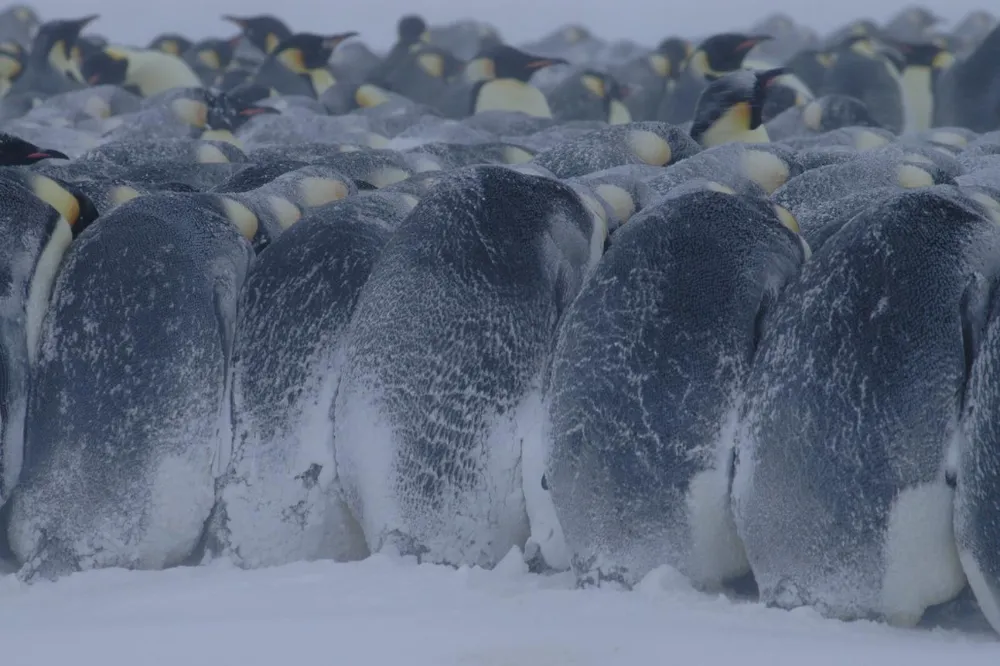
Emperor penguins huddle together to conserve body heat and reduce the energy they need to survive the extreme Antarctic winter. By standing shoulder to shoulder, they reduce the amount of body surface exposed to freezing air and strong winds. Temperatures within a tight huddle can be much warmer than the surrounding environment. Remarkably, emperor penguins do not simply remain motionless: they make small coordinated movements that gradually reorganize the group, allowing different individuals to spend time in more sheltered positions.
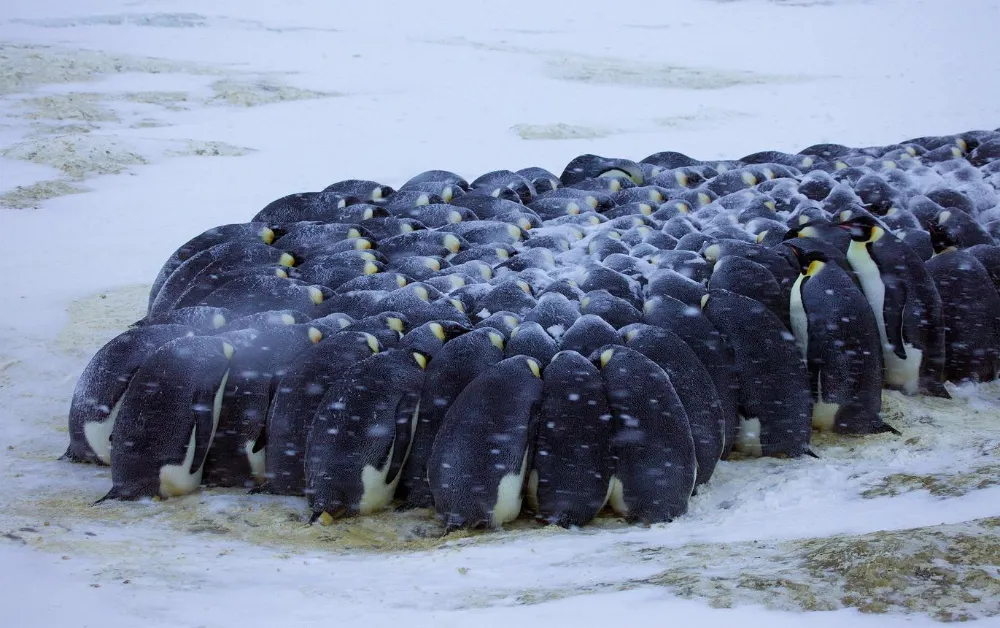
Emperor penguins form tightly packed huddles to reduce heat loss during Antarctica's severe winter.
Why Do Penguins Huddle Together?
Huddling is an important survival behavior in emperor penguins (Aptenodytes forsteri).
These birds breed during the Antarctic winter, when they may experience extremely low temperatures, strong winds, and prolonged darkness.
Instead of facing these conditions entirely as isolated individuals, emperor penguins can gather into dense groups.
Each bird provides some physical shelter for its neighbors.
As more penguins stand close together, a smaller proportion of their combined body surface is directly exposed to cold air.
This reduces the energy required to maintain a stable body temperature.
Huddling is particularly important for males incubating eggs while fasting during winter.
Scientists call this form of group-based heat conservation social thermoregulation.
How Does Huddling Keep Emperor Penguins Warm?
Penguin huddling provides several related thermal benefits.
The most important mechanisms include:
Reduced exposed surface area: Neighboring birds shield parts of one another's bodies from the cold.
Protection from wind: Birds inside the group experience less direct exposure to moving air.
A warmer microclimate: The air among closely packed bodies becomes warmer than the surrounding atmosphere.
Lower energy expenditure: Reduced heat loss allows birds to spend less metabolic energy maintaining body temperature.
These effects work together.
However, the largest benefit is not simply that penguins warm the air around them.
Research indicates that reducing the body surfaces exposed to severe cold is an especially important part of the energy-saving process.
How Warm Does It Get Inside a Penguin Huddle?
The temperature inside a tightly packed emperor penguin huddle can become surprisingly high.
Researchers have recorded local temperatures approaching the birds' body temperature.
A study published in Physiology & Behavior reported ambient temperatures within huddles reaching approximately 37.5°C (99.5°F) under certain conditions.
That is dramatically warmer than the freezing air outside the group.
However, this does not mean every part of every huddle remains at that temperature.
The conditions inside a group vary with density, position, wind, weather, and movement.
Some areas are much warmer than others.
The reported temperature also describes the local environment around the birds, not an increase in the penguins' core body temperature to an abnormal level.
Why Is Huddling Important During the Antarctic Winter?
Emperor penguins breed during one of the coldest seasons on Earth.
Male emperor penguins take responsibility for incubating the egg after it is transferred by the female.
The female travels to the ocean to feed while the male remains at the breeding colony.
During the incubation period, males may go for extended periods without food.
They must therefore rely heavily on stored body reserves.
Maintaining body temperature in extreme cold requires energy.
By reducing heat loss, huddling helps males conserve those limited energy reserves.
Saving energy improves the bird's ability to remain with the egg until the breeding cycle progresses.
Huddling is consequently closely connected with reproductive success, not merely temporary comfort.
How Much Energy Do Emperor Penguins Save by Huddling?
Scientific research has shown that huddling can substantially reduce the metabolic cost of surviving Antarctic winter conditions.
A review published in the Journal of Experimental Biology examined experimental and observational evidence on emperor penguin energy conservation.
In the studies reviewed, small groups of penguins had metabolic rates approximately 39 percent lower than isolated individuals under the measured conditions.
Freely moving penguins capable of forming natural huddles showed an additional average reduction of approximately 21 percent compared with loosely grouped birds.
These comparisons demonstrate that both proximity and the ability to form dense huddles can provide energetic advantages.
However, the percentages apply to specific research conditions.
They should not be interpreted as a fixed amount of energy saved by every penguin every day.
The benefits depend on group structure, temperature, wind, and individual circumstances.
Do Penguins Take Turns Standing in the Middle?
Emperor penguins can change positions within a huddle over time.
Individuals do not necessarily remain permanently at the exposed outer edge or in the sheltered interior.
Observational studies show that tightly packed groups undergo repeated collective movements.
These movements gradually change the arrangement of individuals.
As the huddle reorganizes, birds can gain access to different positions.
However, the popular description of penguins taking turns should not imply that they follow a fixed queue or consciously assign equal shifts.
The group changes through local movements and responses to environmental conditions.
There is no evidence that emperor penguins use a human-like schedule in which each bird is promised an exact amount of time in the middle.
How Do Penguins Move Inside a Huddle?
In very dense emperor penguin huddles, individual birds may have little room to move independently.
Nevertheless, the group can reorganize through tiny coordinated steps.
A 2011 study published in PLOS ONE documented a remarkable pattern.
At approximately 30- to 60-second intervals during the observed conditions, penguins made small steps that traveled through the group as a coordinated wave.
The movements were only a few centimeters long.
Yet the cumulative effect of repeated steps was substantial.
Over time, birds shifted their relative positions while the overall huddle remained compact.
This mechanism helps explain how a densely packed aggregation can stay together without becoming permanently immobilized.
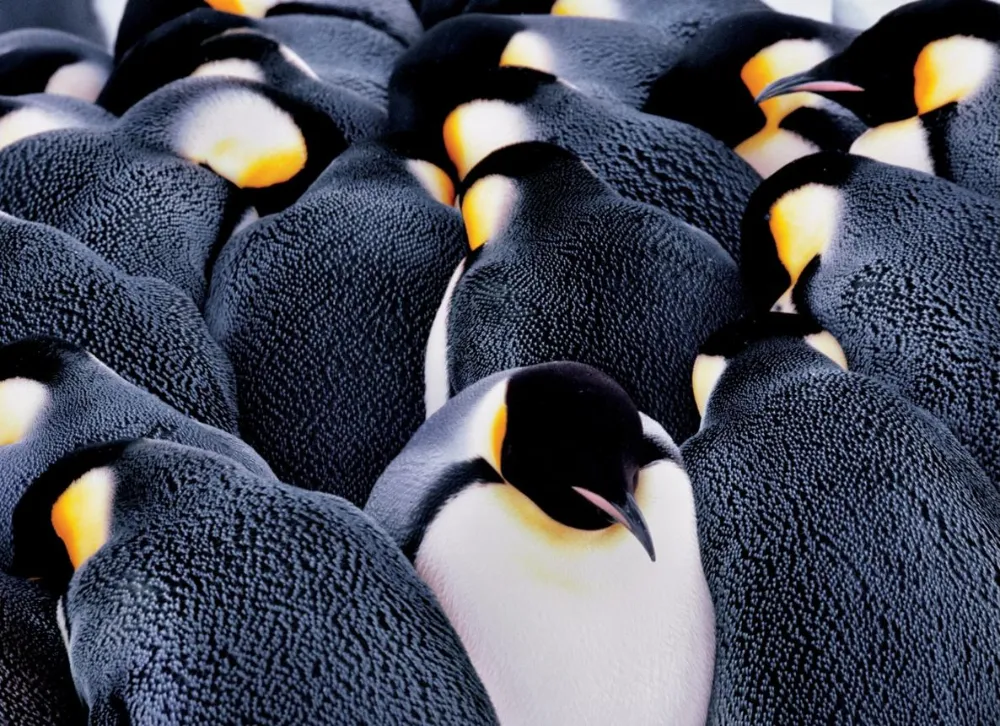
Small coordinated steps allow tightly packed emperor penguins to change positions while maintaining the warmth of the group.
What Did the 2011 Penguin Huddle Study Discover?
Researchers Daniel Zitterbart, Barbara Wienecke, James Butler, and Ben Fabry used time-lapse photographs to investigate the movement of emperor penguins near Germany's Neumayer Antarctic Research Station.
The team observed a colony of approximately 2,000 birds.
During the recorded period, air temperatures ranged from approximately -33°C to -43°C.
Most birds in the observed huddles were males incubating eggs.
Researchers found that the birds' movements were not random independent steps.
Instead, the movements propagated as waves through the tightly packed group.
The small steps were typically around 5–10 centimeters in the observed events.
Repeated waves gradually altered the internal arrangement of the huddle.
The researchers compared the group dynamics with certain behaviors of densely packed physical materials.
However, the similarity is a mathematical and mechanical analogy, not a claim that penguins behave exactly like nonliving particles.
Why Don't Penguin Huddles Become Completely Stuck?
A tightly packed group creates a mechanical problem.
If the birds stand too far apart, much of the thermal benefit is lost.
If they become too tightly packed, individual movement becomes difficult.
The small collective movements observed in emperor penguin huddles help resolve this conflict.
Rather than requiring a bird to push through many neighbors, nearby individuals move together in small increments.
These increments are transmitted through the group.
After a movement wave passes, the birds can settle into another stable configuration.
Over repeated cycles, the huddle changes its internal arrangement.
This allows a combination of high packing density and gradual mobility.
Do Penguins Rotate From the Outside to the Inside?
Penguin huddles are dynamic, and birds can move between more exposed and more sheltered positions.
However, the term rotation is a simplification.
The birds do not necessarily move in an orderly circle from the edge to the center.
Researchers have observed collective steps, changes in huddle shape, and individuals joining or leaving aggregations.
These movements can alter which birds experience the most favorable microclimates.
A mathematical study published in 2012 showed that a huddle composed of individuals responding to local heat loss can develop patterns that give birds access to sheltered positions over time.
However, this was a mathematical model.
Its predictions should not be presented as proof that every natural penguin huddle distributes warmth with perfect equality.
How Does Wind Affect a Penguin Huddle?
Wind increases the rate at which exposed surfaces lose heat.
For birds standing at the edge of a huddle, direct exposure to strong wind can be especially costly.
By packing close together, penguins reduce the amount of body surface exposed to moving air.
Individuals in more sheltered positions experience different thermal conditions from those on the windward edge.
Wind can also influence where huddles form and how they change shape.
Research published in Animal Behaviour identified wind, environmental temperature, and solar radiation as important factors associated with changes in emperor penguin group structure.
The response is therefore not controlled by temperature alone.
Do Penguins Huddle All the Time?
No. Emperor penguin huddling is not a permanent state.
The birds may move between loose gatherings and tightly packed groups.
Environmental conditions change throughout the day and across the breeding season.
When the environment becomes more demanding, tighter aggregation can help reduce heat loss.
When birds need to dissipate heat or move, the huddle may loosen or break apart.
Different sections of a colony can also have different levels of crowding at the same time.
This creates a changing pattern of dense and loose aggregations.
Researchers describe these changes as part of a flexible system of social thermoregulation.
Can Emperor Penguins Get Too Hot in a Huddle?
Yes. The inside of a tight huddle can become warm enough that continued close contact is no longer beneficial for every individual.
A bird that becomes too warm can benefit from moving toward a less crowded area.
Observational studies suggest that huddles form and disperse as birds respond to their thermal environment.
This behavior helps maintain body temperature within suitable limits.
Huddling therefore involves balancing two opposing risks:
Losing too much heat when exposed to extreme cold
Retaining excessive heat when surrounded by many warm bodies
The movement of birds into and out of dense aggregations contributes to this balance.
A huddle is not simply a structure that should always become as dense as possible.
What Is Social Thermoregulation?
Social thermoregulation occurs when animals use contact or proximity with other individuals to influence their thermal conditions.
It is found in several animal groups.
Emperor penguins provide one of the most dramatic examples because they gather in large numbers during severe Antarctic winters.
Social thermoregulation can reduce heat loss and the energy needed to maintain body temperature.
The behavior may also change according to weather, social circumstances, and the animal's physiological condition.
In emperor penguins, group structure is closely linked with breeding ecology and prolonged fasting.
However, not every form of animal aggregation is primarily a thermoregulatory behavior.
Some species group together for feeding, mating, predator avoidance, or other reasons.
Do All Penguins Huddle Together?
Penguins are a diverse group of birds, and they do not all use the same huddling strategy.
Emperor penguins are especially famous for large, dense winter huddles.
Other penguin species may gather closely under certain conditions, but the size, density, and function of these aggregations vary.
For example, some penguins breed in milder environments where extreme winter huddling is not necessary.
Others may gather in groups for social or reproductive reasons.
Therefore, descriptions of the emperor penguin's tightly coordinated Antarctic huddles should not automatically be applied to every species.
Why Do Male Emperor Penguins Huddle During Incubation?
Male emperor penguins face an extraordinary challenge during the breeding season.
After receiving an egg from the female, a male balances it on his feet beneath a specialized brood pouch.
He must keep the egg protected and warm during Antarctic winter conditions.
At the same time, he is fasting while the female travels to feeding areas.
This means the male cannot easily replace energy lost through thermoregulation.
Huddling reduces energy expenditure during this demanding period.
The behavior helps males preserve enough body reserves to survive and continue incubating their eggs.
However, a huddle is not a substitute for the individual male's careful egg protection.
Each incubating bird remains responsible for supporting its own egg.
Do Emperor Penguins Keep Their Eggs Warm in the Huddle?
Yes. Huddling helps incubating males conserve the energy needed to maintain suitable conditions for their eggs.
The egg itself is held on the male's feet beneath the brood pouch.
This arrangement provides direct protection from freezing conditions.
The surrounding huddle reduces the energy cost of maintaining the adult's body temperature.
However, emperor penguins do not typically place all their eggs together in a shared central nest.
Each male holds and protects his own egg.
It is also incorrect to imagine the eggs lying exposed on the Antarctic ice inside the huddle.
Do Penguin Chicks Huddle Together?
Emperor penguin chicks can gather into groups after reaching stages when they spend increasing amounts of time outside continuous parental brooding.
These groups are often called crèches.
Chick aggregations may provide social and protective benefits, including effects associated with environmental exposure.
However, the organization and purpose of a chick crèche should not be treated as identical to the dense male incubation huddles studied during winter.
Adult incubation huddles and chick aggregations occur at different stages of the breeding cycle.
The animals involved also differ in size, insulation, and behavior.
How Do Penguin Feathers Help Them Survive the Cold?
Huddling works together with the physical insulation of the emperor penguin's body.
Penguins possess dense plumage that helps reduce heat loss.
The structure of their feathers helps retain insulating air near the body.
They also have a layer of subcutaneous fat that provides additional insulation and stored energy.
These adaptations are important both in water and on land, although the thermal challenges differ between the two environments.
Huddling does not replace these individual adaptations.
It provides an additional way to reduce exposure when birds are gathered on Antarctic sea ice.
How Do Penguins Keep Their Feet Warm?
Penguins have circulatory adaptations that help manage heat exchange through their limbs.
Countercurrent heat exchange allows warm arterial blood and cooler returning venous blood to exchange heat in closely associated vessels.
This can reduce unnecessary heat loss through exposed appendages.
However, the temperature of the feet is not necessarily the same as the temperature of the body core.
Penguins can maintain a warm core while their feet remain much cooler.
These individual physiological mechanisms complement the heat-conserving effects of huddling.
What Happens When a Penguin Huddle Breaks Apart?
A huddle may break apart as environmental or behavioral conditions change.
Researchers have documented cases in which movements beginning in a small region spread through a larger aggregation.
These disturbances can cause a dense group to loosen or disperse.
Individuals may then enter less crowded parts of the colony.
Some birds may later join another huddle.
Such changes allow birds to move between warmer and cooler conditions.
Therefore, the formation and dissolution of huddles are not necessarily signs of a problem.
They can be part of the normal process of regulating thermal conditions.
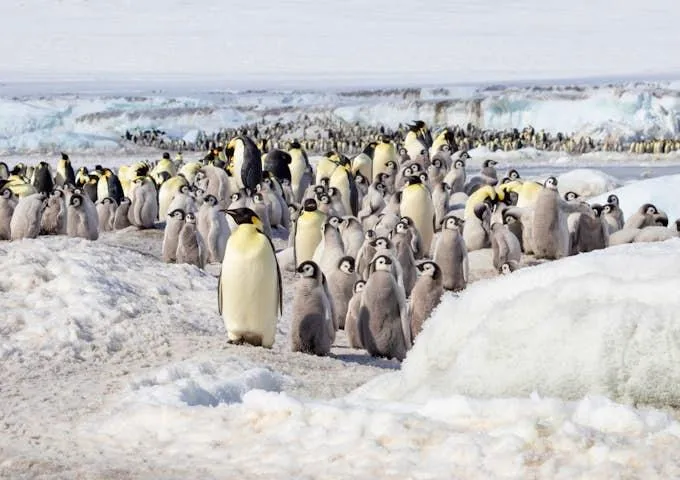
Emperor penguin colonies contain both dense huddles and more loosely spaced birds, with group structure changing over time.
Can Penguin Huddling Be Explained by Physics?
Scientists have used mathematical models to examine how local movements produce large-scale huddle patterns.
Some models treat each penguin as an individual responding to surrounding conditions.
As birds adjust their positions, the combined effect produces a changing group shape.
Researchers have compared these collective dynamics with certain physical systems that become tightly packed or transition between more mobile and more rigid states.
A 2018 study described the changes in emperor penguin group density using a phase-transition framework.
This comparison helps researchers understand how changes in environmental conditions may lead to rapid changes in aggregation.
However, living penguins do not literally change between solid and liquid states.
The models are tools for understanding group behavior, not claims that the birds are passive particles without sensory or behavioral control.
How Does Climate Change Affect Emperor Penguin Huddling?
Emperor penguins depend on Antarctic sea ice for important stages of their reproductive cycle.
Changes in sea-ice conditions can affect the availability and stability of breeding habitat.
Huddling helps birds manage severe cold, but it cannot replace suitable breeding surfaces or eliminate every environmental threat.
Unstable ice can disrupt colonies regardless of how effectively adults conserve heat.
Changes in ocean conditions may also affect food availability and the journeys required for feeding.
Therefore, the ability to survive extreme cold does not mean emperor penguins are protected from broader environmental change.
Penguin Huddling vs. Other Cold-Weather Adaptations
| Adaptation | Main Function | How It Helps |
|---|---|---|
| Dense feathers | Individual insulation | Reduce heat transfer from the body |
| Body fat | Insulation and energy reserve | Helps protect the core and supports fasting |
| Countercurrent heat exchange | Circulatory heat conservation | Limits heat loss through appendages |
| Huddling | Social thermoregulation | Reduces exposed body surfaces and wind effects |
| Coordinated huddle movement | Group reorganization | Allows movement despite dense packing |
| Brood pouch | Egg protection | Keeps the egg off the ice and close to the parent's body |
Frequently Asked Questions
Why do penguins huddle together?
Emperor penguins form dense huddles to reduce heat loss and conserve energy during the Antarctic winter.
How do penguins keep warm in a huddle?
Standing close together reduces exposed body surface area, provides wind protection, and creates a warmer local environment.
Do penguins take turns in the middle of the huddle?
Penguins change positions through collective movement, but there is no evidence that they follow a fixed turn-taking schedule.
How often do penguins move in a huddle?
A 2011 study observed small coordinated movements occurring about every 30–60 seconds under the recorded conditions. The timing is not necessarily identical in every colony.
How hot can a penguin huddle get?
Scientists have reported temperatures within tight emperor penguin huddles reaching approximately 37.5°C under certain circumstances.
Do all penguin species huddle?
Not in the same way. Dense winter huddling is especially associated with emperor penguins, while aggregation behavior varies among other species.
Do baby penguins huddle together?
Emperor penguin chicks can form groups called crèches, although these are not identical to the dense incubation huddles of adult males.
Can penguins get too warm in a huddle?
Yes. Dense groups may become very warm, and birds can benefit from moving into less crowded conditions.
Why do emperor penguins huddle while incubating eggs?
Incubating males must conserve energy while fasting in severe cold. Huddling reduces their thermoregulatory demands.
Do penguins huddle to protect themselves from predators?
Animal aggregations can have different functions, but the best-documented explanation for dense emperor penguin winter huddles is heat and energy conservation.
How do emperor penguins survive freezing temperatures?
They combine insulating feathers, body fat, circulatory heat conservation, and social huddling with other physiological adaptations.
Do penguin huddles stay together all night?
Not necessarily. Huddles can form, move, loosen, and break apart as conditions change.
The Bottom Line
Emperor penguins huddle together because close contact reduces heat loss and helps conserve energy during the Antarctic winter.
The behavior is particularly important for males incubating eggs while fasting.
Scientific studies show that penguin huddles are not motionless groups. Small coordinated movements allow birds to change positions while remaining closely packed, and larger changes in group structure help them respond to environmental conditions.
Huddling is therefore a remarkable example of social thermoregulation: individual animals adjusting their behavior in ways that create a collective survival advantage.
Sources & Further Reading
The following peer-reviewed studies provide evidence for energy conservation, coordinated movement, changing huddle structure, and the physics of emperor penguin aggregation.
Ancel et al. (2008) — Energy Saving Processes in Huddling Emperor Penguins: From Experiments to Theory. Reviews measured metabolic benefits and the relative contributions of wind protection, reduced exposed surface area, and local microclimate.
Zitterbart et al. (2011) — Coordinated Movements Prevent Jamming in an Emperor Penguin Huddle. Observational study documenting collective movement waves approximately every 30–60 seconds.
Waters et al. (2012) — Modeling Huddling Penguins. Mathematical model of how local heat-loss responses can reorganize group structure.
Gilbert et al. (2015) — New Insights Into the Huddling Dynamics of Emperor Penguins. Examines how weather and individual movement affect the formation and breakup of huddles.
Phase Transitions in Huddling Emperor Penguins (2018). Investigates changing aggregation density in relation to weather using time-lapse observations and physical modeling.
Huddling Behavior in Emperor Penguins: Dynamics of Huddling (2006). Examines changing huddle conditions and reports local temperatures reaching approximately 37.5°C.