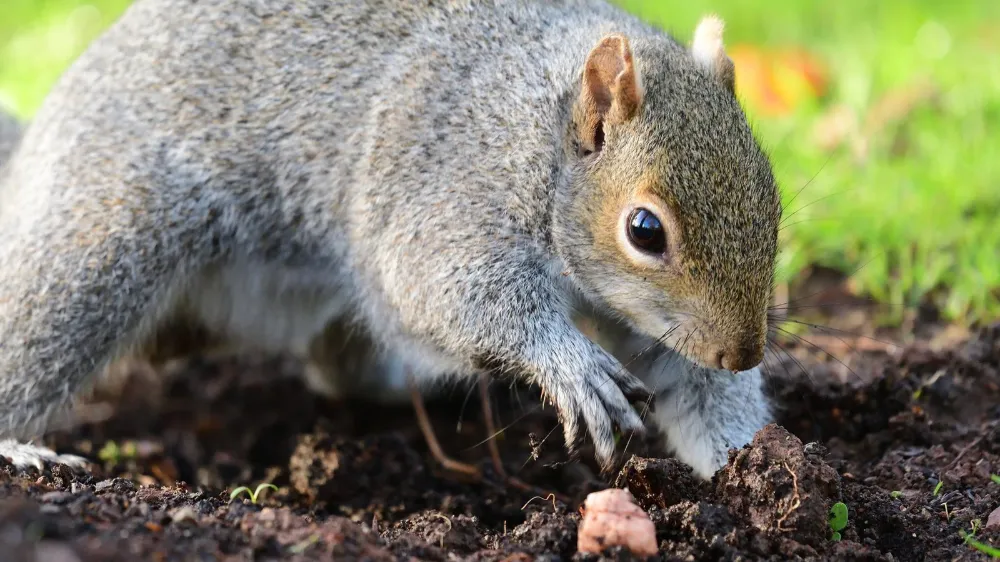
Squirrels bury nuts to save food for later, especially during periods when fresh food becomes harder to find. This behavior is called food caching. Many tree squirrels hide individual nuts and seeds in separate places, then use spatial memory and environmental clues to recover them. They may also use their sense of smell when searching for buried food. Squirrels do not retrieve every nut they bury, and some forgotten or abandoned seeds eventually germinate into new plants and trees.
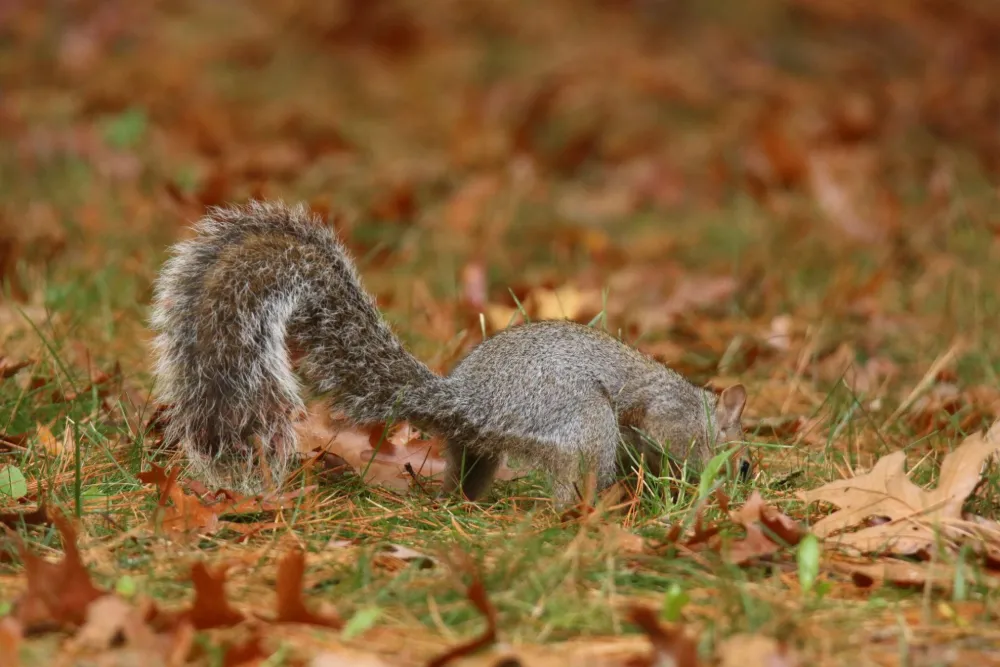
Many tree squirrels bury individual nuts in scattered locations, creating food reserves for later use.
Why Do Squirrels Bury Nuts?
Squirrels bury nuts as a way of storing energy-rich food for the future.
In temperate regions, the availability of acorns, walnuts, hickory nuts, and other tree seeds changes throughout the year.
Autumn often brings abundant nuts, while winter may offer fewer fresh food sources.
By storing food during periods of abundance, squirrels can improve their chances of finding something to eat later.
Many squirrels do not simply gather all their food into one large pile.
Instead, they distribute nuts across multiple hiding places.
This strategy can reduce the risk of losing an entire food supply to a single competitor or disturbance.
Researchers call the behavior scatter-hoarding.
The exact strategy differs among squirrel species and depends on food availability, habitat, and competition.
What Is Scatter-Hoarding?
Scatter-hoarding is the practice of storing individual food items in numerous separate locations.
Each storage location is called a cache.
A squirrel may dig a small hole, place a nut inside, and cover it with soil, leaves, or other material.
It may then travel to another place and repeat the process.
Over time, an individual can establish a large collection of caches throughout its home range.
This approach differs from larder-hoarding, in which an animal concentrates stored food in one or a few central locations.
Scatter-hoarding has several advantages:
Risk reduction: Losing one cache does not eliminate the entire food supply.
Flexible retrieval: Food can be recovered from different areas.
Reduced competition: Scattered caches may be harder for another animal to discover all at once.
Seasonal preparation: Food collected during abundant periods remains available later.
However, scattering food also creates a demanding memory problem: the squirrel must relocate many separate hiding places.
Do Squirrels Bury Nuts for Winter?
Yes. Preparing for periods of food scarcity is one of the main benefits of caching.
In autumn, many tree squirrels encounter large numbers of nuts produced by oaks, hickories, walnuts, and other trees.
These foods contain nutrients and stored chemical energy useful during colder months.
Squirrels can collect and hide some of this seasonal supply rather than consuming everything immediately.
During winter, they may recover cached nuts when other food is less available.
However, the behavior is not limited to autumn.
Some squirrels cache food at other times of year depending on local conditions.
Research on fox squirrels has shown that food scarcity, nut quality, and competition can influence how much effort they invest in caching.
Do Squirrels Hibernate During Winter?
Most familiar tree squirrels, including eastern gray squirrels and fox squirrels, do not undergo prolonged winter hibernation.
They remain capable of activity during cold weather, although they may spend more time sheltered during severe conditions.
Stored nuts provide an important food reserve during this period.
Some ground squirrels, however, do hibernate.
Therefore, the statement that squirrels never hibernate is incorrect when applied to the entire squirrel family.
Food caching and hibernation are different survival strategies, and their importance varies among species.
How Do Squirrels Remember Where They Bury Nuts?
Squirrels use spatial memory to remember the locations of food caches.
Spatial memory allows an animal to retain information about places and their relationships to surrounding features.
A squirrel may use the positions of trees, roots, rocks, buildings, and other landmarks to locate a buried nut.
This information helps it return to places where food was previously stored.
Researchers have experimentally demonstrated cache-location memory in eastern gray squirrels.
In a 1991 study published in Animal Behaviour, individual squirrels buried hazelnuts in an outdoor enclosure.
After delays of two, four, or twelve days, the animals were tested on their ability to recover their own caches.
The squirrels recovered significantly more nuts from their own hiding locations than from locations previously used by other squirrels.
This finding demonstrated that they could remember particular cache locations rather than depending exclusively on smell.
Do Squirrels Use Smell to Find Buried Nuts?
Yes. Squirrels can use odor cues to locate food, including nuts hidden in soil.
Smell can be useful when a squirrel is close to a cache and needs to pinpoint its exact position.
However, experimental evidence shows that smell is not the only mechanism involved.
Spatial memory helps squirrels return to previously used areas.
Local sensory cues may then assist with locating the buried item.
Several conditions can influence the usefulness of smell:
Soil moisture
Burial depth
Food condition
Wind and temperature
Presence of leaves or other ground cover
Different species and situations may involve different combinations of memory and odor information.
It is inaccurate to claim that squirrels recover every cache entirely by smell or entirely by memory.
How Many Nuts Can a Squirrel Remember?
Some tree squirrels bury very large numbers of food items, potentially numbering in the thousands over extended periods.
However, this does not mean that every individual remembers the exact location of every item it has ever cached.
The number of caches varies with species, food availability, and season.
Research on fox squirrels has shown that their caching behavior can involve thousands of nuts, but direct memory tests usually examine smaller numbers under controlled conditions.
Scientists therefore distinguish between the total number of stored items and the number of cache locations demonstrated to be remembered accurately.
Experimental studies support impressive spatial memory, but a single universal memory capacity cannot be assigned to all squirrels.
What Did Scientists Discover About Squirrel Memory in 2017?
A 2017 study published in Royal Society Open Science investigated how eastern fox squirrels (Sciurus niger) organize stored food.
Researchers Mikel Delgado and Lucia Jacobs studied 45 free-ranging squirrels on the University of California, Berkeley campus.
The animals were offered different nuts, including almonds, hazelnuts, pecans, and walnuts.
Scientists recorded where the squirrels buried the nuts and whether different conditions changed the organization of their caches.
When squirrels repeatedly collected nuts from one central location, they sometimes organized caches by nut type.
For example, nuts of one species tended to be stored in a spatial cluster separate from another type.
This organization resembles a memory strategy called spatial chunking.
Chunking involves organizing information into groups that may make it easier to manage.
However, the squirrels did not use the same spatial organization in every experimental condition.
When food was obtained from multiple locations, they tended instead to avoid places where they had already made caches.
The study demonstrated flexible storage strategies rather than a rigid rule followed by every squirrel.
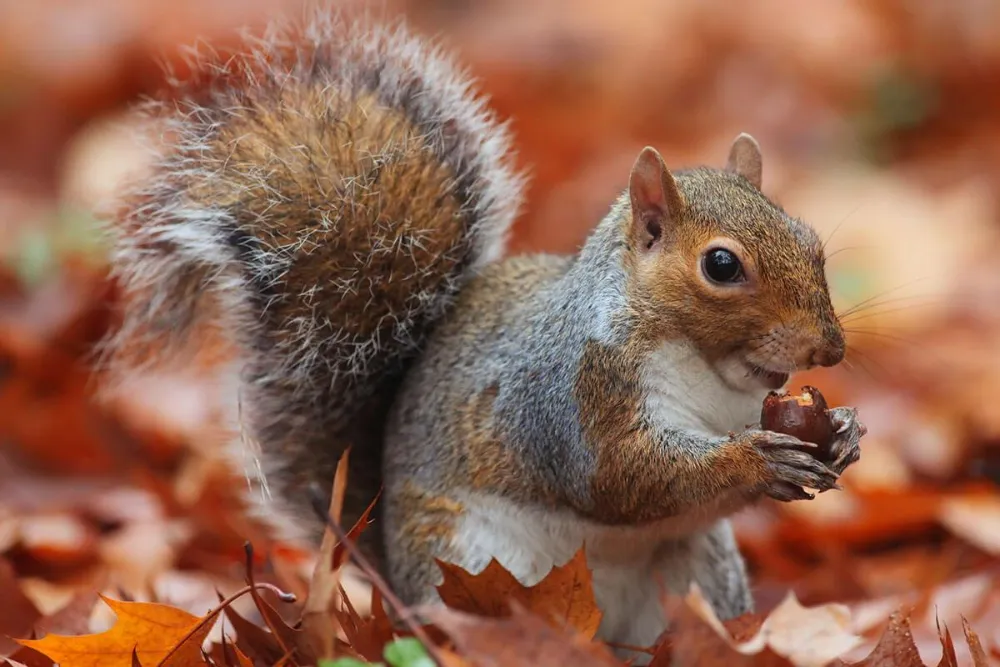
Fox squirrels assess food items and can organize caches using spatial strategies influenced by where they obtain their food.
Do Squirrels Sort Their Nuts by Type?
Some squirrels do, under certain conditions.
The 2017 Berkeley study provided evidence that fox squirrels sometimes group stored nuts spatially according to species.
This suggests that the animals may organize food-related information in a structured way.
However, the behavior was conditional.
It occurred particularly when squirrels repeatedly received nuts at one central location.
When collecting food from many different places, squirrels showed other patterns of cache distribution.
The study therefore does not establish that every squirrel sorts all its nuts into fixed categories.
Instead, it suggests that food storage strategies can change according to circumstances.
How Do Squirrels Decide Which Nuts to Bury?
Squirrels do not necessarily bury every nut they find.
They may eat some immediately and cache others.
Research indicates that these choices can be influenced by food quality, availability, competition, and the risk of losing the item.
A 2014 study published in PLOS ONE examined how fox squirrels evaluate food under different conditions.
Researchers found that squirrels changed their food-handling and caching investment according to the value and scarcity of available items.
They also observed characteristic movements, including head flicks and manipulation of nuts with the paws.
These behaviors were associated with aspects of food assessment and caching decisions.
However, scientists cannot infer a squirrel's precise thoughts from these movements alone.
The findings show that observable behavior reflects flexible decisions about food storage.
Why Do Squirrels Shake or Flick Nuts?
Fox squirrels sometimes move their heads rapidly while holding a nut in their mouths.
This movement is often called a head flick.
Experimental research has found associations between head flicking, food characteristics, and the decision to cache a nut.
It may contribute to evaluating aspects such as weight or other physical properties.
However, the exact sensory information involved is not completely understood.
Head flicking should not be interpreted as proof that a squirrel consciously calculates the nutritional value of each item.
It is better described as part of a measurable food-assessment behavior associated with storage decisions.
Do Squirrels Pretend to Bury Nuts?
Yes. Researchers have documented a behavior called deceptive caching in eastern gray squirrels.
During deceptive caching, a squirrel performs movements that resemble burying a food item but leaves the hiding place empty.
This can include digging or covering an apparently normal cache location without actually depositing the nut.
A 2008 study published in Animal Behaviour found that deceptive caching occurred more frequently when other squirrels were nearby.
The researchers also found that such behavior reduced the likelihood of cache discovery by human observers acting as surrogate thieves.
These findings suggest that deceptive caching can help protect food from competitors.
However, the study does not establish that squirrels possess human-like intentions or understand deception in the same way people do.
It demonstrates a behavioral strategy that can misdirect potential competitors.
Why Do Squirrels Hide Nuts From Other Squirrels?
Stored food can be stolen by other animals, including members of the same squirrel species.
This is called cache pilferage.
A squirrel that loses a cache also loses the time and energy invested in collecting, transporting, and burying the food.
For this reason, squirrels may adjust where and how they hide valuable nuts.
Research has documented several protective behaviors:
Moving away from nearby competitors before caching
Selecting more concealed sites
Using multiple separate caches
Changing caching behavior when watched
Creating empty, deceptive hiding places
These behaviors are not necessarily used equally by all squirrel species.
They illustrate how competition can influence food-storage decisions.
Do Squirrels Steal Each Other's Nuts?
Yes. Squirrels may locate and take food buried by other squirrels.
Cached nuts are potential resources for any animal capable of finding and accessing them.
This creates an ongoing conflict between animals that store food and those that discover it.
Some individuals may retrieve their own caches, while others obtain food stored by neighbors.
Researchers study this process as part of the ecology of food hoarding.
Competition influences how far a squirrel carries a nut, where it buries the item, and whether it changes its behavior in the presence of observers.
However, squirrels do not necessarily recognize the original owner of every cache they encounter.
Do Squirrels Forget Where They Bury Nuts?
Some buried nuts are never recovered by the squirrel that stored them.
However, an unrecovered nut does not necessarily prove that the squirrel forgot its location.
There are several possible explanations:
The squirrel may fail to remember the location.
Another animal may steal the nut.
The original squirrel may die or move away.
The squirrel may have sufficient food elsewhere.
Environmental changes may make the cache difficult to access.
The nut may decay, germinate, or become unsuitable to eat.
Therefore, it is misleading to assign a single precise percentage of forgotten nuts to all squirrels.
Research demonstrates that squirrels have effective spatial memory, but cache recovery is never guaranteed.
What Happens to Nuts That Squirrels Don't Recover?
Some unrecovered nuts remain in the soil long enough to germinate.
If the seed is viable and environmental conditions are suitable, it may develop into a seedling.
This is one reason squirrels can contribute to seed dispersal.
For example, when a squirrel carries an acorn away from a parent oak tree, it may deposit the seed in a new location.
If the acorn survives and germinates, the resulting seedling grows away from its parent tree.
However, many buried seeds never become mature trees.
They may be eaten by other animals, destroyed by insects, damaged by fungi, or die from unsuitable growing conditions.
Seed dispersal is therefore a potential ecological benefit of caching, not a guarantee that every forgotten nut becomes a tree.
Do Squirrels Help Plant Trees?
Yes. Scatter-hoarding squirrels can act as seed dispersers for trees and other plants.
By carrying and burying viable seeds, they move plant reproductive material away from the original source.
University of New Hampshire Extension identifies squirrels and blue jays as animals involved in moving and burying acorns.
When suitable seeds are buried in favorable soil conditions and escape later consumption, they may germinate.
This can contribute to forest regeneration and changes in the distribution of trees.
However, the net ecological effects of squirrel caching vary among plant species, habitats, and local conditions.
A squirrel may consume many seeds while dispersing others.
Both processes influence plant reproduction.
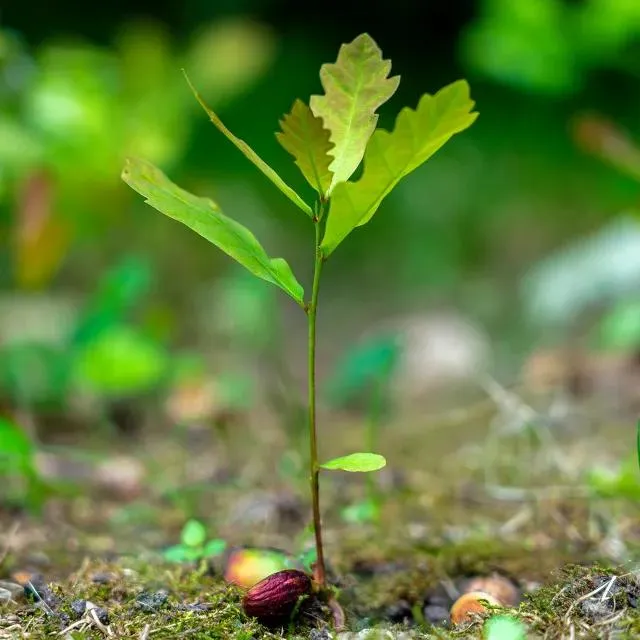
Some acorns that remain buried can germinate and develop into oak seedlings, linking squirrel food storage with forest regeneration.
Do Squirrels Know Which Acorns Will Grow?
Squirrels can evaluate food characteristics and may treat different types of acorns differently.
However, there is no basis for claiming that squirrels consciously know the future germination outcome of each buried seed.
Their caching decisions may reflect food value, perishability, seed condition, and other ecological factors.
Some oak species produce acorns that germinate relatively soon after falling, while others undergo a period of dormancy.
These differences can influence whether an acorn remains suitable for storage.
Researchers have studied how squirrels handle acorns from different oak groups.
In some cases, squirrels alter seeds in ways that reduce germination while preserving their value as stored food.
Such behavior illustrates the complex relationship between animals that consume seeds and plants that depend on seed survival.
Do Squirrels Bury Only Acorns?
No. Depending on species and habitat, squirrels may cache several types of nuts and seeds.
These include:
Acorns
Walnuts
Hickory nuts
Hazelnuts
Pecans
Other suitable tree seeds
Not every squirrel species eats or stores all these foods.
Regional availability and individual food preferences influence caching behavior.
Some squirrels also store other foods, although hard-shelled nuts are particularly suitable for long-term caching in many temperate tree squirrels.
Do All Squirrels Bury Their Food?
No. Food-storage behavior varies among squirrel species.
Eastern gray squirrels and fox squirrels are well-known scatter-hoarders.
Other squirrel species may store food in tree cavities, nests, or concentrated food piles.
Some ground squirrels rely heavily on other seasonal strategies, including hibernation.
In tropical environments, food availability and ecological conditions can produce different patterns of storage and feeding.
The squirrel family is diverse, so one familiar backyard behavior should not be treated as universal.
What Is the Difference Between Scatter-Hoarding and Larder-Hoarding?
| Feature | Scatter-Hoarding | Larder-Hoarding |
|---|---|---|
| Storage pattern | Many separate locations | One or a few concentrated stores |
| Typical food placement | Individual nuts buried across an area | Food collected together in a central place |
| Main advantage | Distributes risk of loss | Food concentrated for retrieval |
| Main challenge | Remembering many locations | Protecting a concentrated supply |
| Example | Many gray and fox squirrels | Some other squirrel species and food-storing rodents |
Some animals show flexibility in storage behavior, and categories may not capture every detail of natural foraging.
How Deep Do Squirrels Bury Nuts?
Many tree squirrels create relatively shallow caches rather than digging deep burrows for individual nuts.
The exact depth depends on soil conditions, seed size, species, and local circumstances.
Shallow burial allows a squirrel to hide food relatively quickly and recover it later.
However, shallow caches may also be accessible to other animals.
Loose soil, fallen leaves, and other ground cover can help conceal a buried nut.
There is no single burial depth that applies to every squirrel or every cache.
Why Do Squirrels Bury Nuts in Lawns and Gardens?
Lawns, gardens, parks, and other landscaped areas can provide suitable places for squirrels to hide food.
If squirrels live near nut-bearing trees, they may transport seeds into nearby soft soil.
Loose ground is relatively easy to dig and can provide a convenient place for making a cache.
Some squirrels may use gardens repeatedly because these areas fall within their normal home ranges.
Buried acorns may later sprout, producing unexpected oak seedlings.
This behavior is a normal part of squirrel foraging and food-storage ecology.
Do Squirrels Bury Nuts in Summer?
Yes. Squirrels may cache food outside autumn when suitable items are available.
Seasonal patterns nevertheless vary.
Autumn often produces abundant tree nuts in temperate forests, making it an important period for caching.
Research on fox squirrels has examined food-storage decisions during both summer and autumn.
One study found that squirrels adjusted food assessment and caching investment according to seasonal scarcity and item value.
This demonstrates that caching is not limited to a single season.
Are Squirrels Intelligent Because They Bury Nuts?
Squirrel caching behavior demonstrates sophisticated abilities involving spatial memory, food assessment, and responses to competition.
Scientific studies have documented memory for cache locations, flexible spatial organization, and protective behaviors directed at potential pilferers.
However, intelligence is difficult to summarize with a single ranking across animal species.
Squirrels are particularly adapted to solving the problems associated with locating, storing, and recovering food.
Their caching abilities should be understood as specialized cognitive adaptations rather than proof that they think exactly like humans.
Frequently Asked Questions
Why do squirrels bury nuts instead of eating them?
They store food for later use, particularly when suitable nuts are abundant but future food supplies may become limited.
How do squirrels find the nuts they bury?
Squirrels use spatial memory to return to cache locations and may also use their sense of smell to locate buried food.
Do squirrels remember every nut they bury?
No evidence shows that squirrels remember every cache. They have strong spatial memory, but not all stored nuts are recovered.
Do squirrels forget where they hide their acorns?
Some caches remain unrecovered, but forgetting is only one possible explanation. Theft, environmental changes, and other factors also contribute.
Do squirrels bury nuts to grow trees?
No. Squirrels bury nuts primarily as food reserves. Tree growth can be an unintended ecological consequence when viable seeds remain in the soil.
Why do squirrels bury nuts in the fall?
Autumn often provides abundant acorns and other tree nuts, allowing squirrels to store food before winter scarcity.
Do squirrels steal buried nuts?
Yes. Squirrels may locate and consume caches made by other individuals.
Do squirrels fake burying nuts?
Yes. Researchers have documented deceptive caching in eastern gray squirrels, including the covering of empty hiding places.
Can squirrels smell acorns underground?
Squirrels can use odor cues to find buried food, although experiments show that spatial memory is also important.
How many nuts does a squirrel bury?
The number varies greatly with species, food availability, season, and individual behavior. Some squirrels may store thousands of nuts over extended periods.
Do squirrels bury nuts in summer?
Yes. Squirrels can cache food in different seasons when suitable items are available.
Do buried acorns grow into oak trees?
Some viable acorns germinate after burial if they are not eaten or damaged and environmental conditions are suitable.
The Bottom Line
Squirrels bury nuts to create food reserves that help them survive periods when fresh food is harder to find.
Many species use scatter-hoarding, hiding individual nuts in numerous places rather than storing everything together.
Research shows that squirrels can remember cache locations, use flexible organization strategies, and even create deceptive hiding places when facing competition.
Some stored seeds remain unrecovered and may eventually germinate, making squirrel caching an important link between animal behavior and forest ecology.
Sources & Further Reading
The following university publications and peer-reviewed scientific studies support the explanations of squirrel food caching, spatial memory, protective behavior, and seed dispersal.
Jacobs and Liman (1991) — Grey Squirrels Remember the Locations of Buried Nuts. Experimental evidence demonstrating memory for individual cache locations.
Delgado and Jacobs (2017) — Caching for Where and What: Evidence for a Mnemonic Strategy in a Scatter-Hoarder. Peer-reviewed study of spatial chunking in fox squirrels.
University of California, Berkeley — Fox Squirrels Use Chunking to Organize Their Favorite Nuts. University explanation of the 2017 caching and memory research.
Steele et al. (2008) — Cache Protection Strategies of a Scatter-Hoarding Rodent: Do Tree Squirrels Engage in Behavioural Deception?. Experimental evidence for deceptive caching in gray squirrels.
Delgado et al. (2014) — Fox Squirrels Match Food Assessment and Cache Effort to Value and Scarcity. Research on food assessment and flexible caching decisions.
University of New Hampshire Extension — Northern Red Oak Regeneration: Biology and Silviculture. Discusses acorn dispersal by squirrels and other animals as part of oak regeneration.