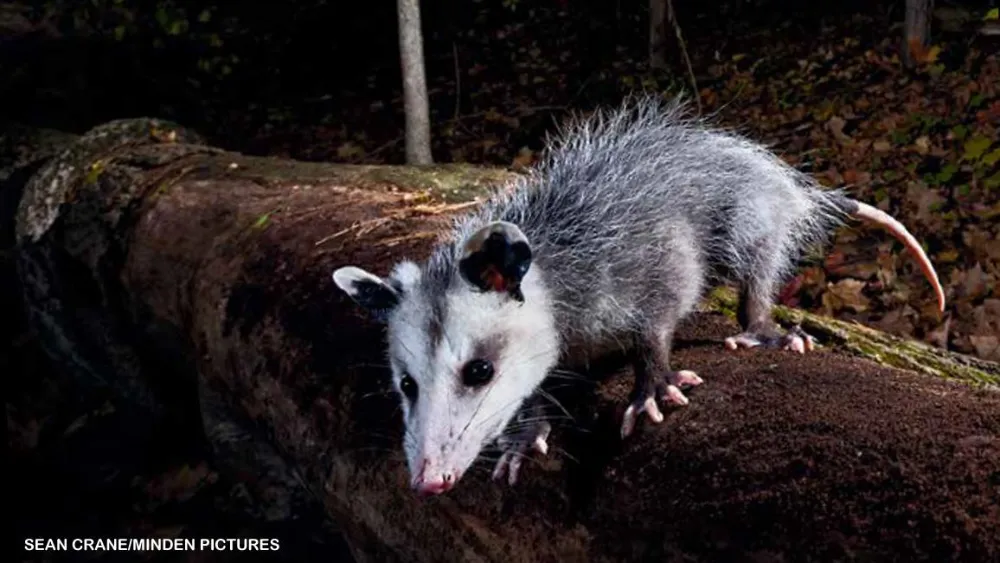
Opossums play dead as an unusual defensive response to extreme danger. When a Virginia opossum feels severely threatened and escape seems impossible, it may enter a state called tonic immobility, also known as thanatosis or death-feigning. The animal becomes motionless and may lie on its side with its mouth open and tongue exposed. Its breathing and heart rate can slow, and it may release strong-smelling secretions. This is generally an involuntary physiological reaction rather than a performance the opossum can simply choose to begin or end.
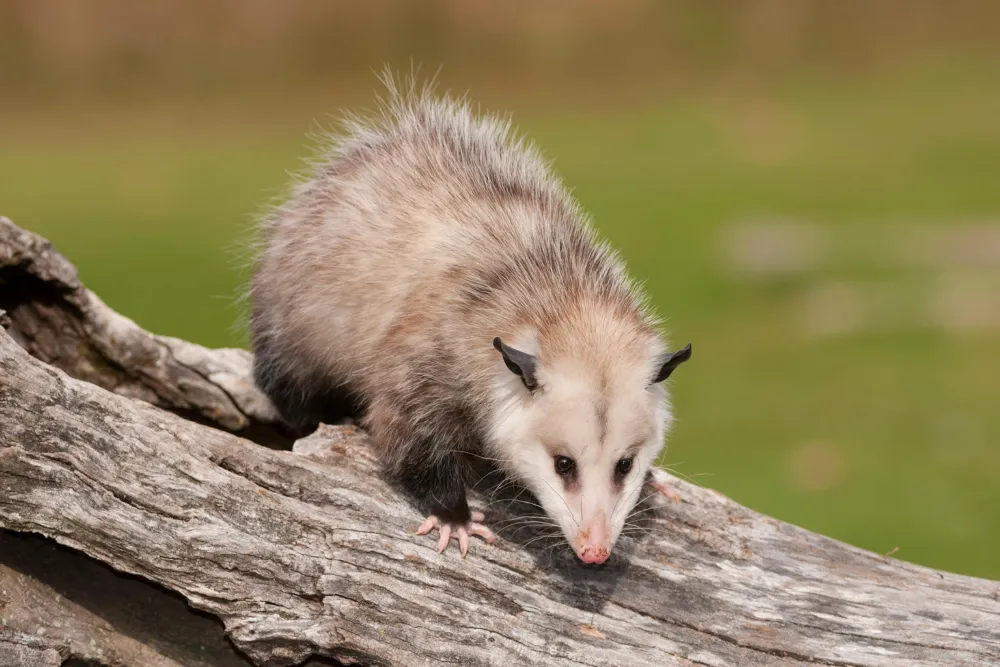
The Virginia opossum is famous for an extreme defensive state commonly called playing possum.
Why Do Opossums Play Dead?
Opossums may enter a death-feigning state when they experience an intense, apparently inescapable threat.
The behavior is especially well known in the Virginia opossum (Didelphis virginiana), the only marsupial species native to much of the United States and Canada.
When threatened, an opossum does not always immediately become motionless.
It may first attempt to escape, climb away, hiss, show its teeth, or adopt a defensive posture.
If the threat escalates, some individuals enter a prolonged state of immobility.
The resulting appearance can resemble a dead animal.
Researchers have proposed that this response may interfere with certain stages of a predator's attack.
However, its effectiveness is not guaranteed and varies with the predator and circumstances.
The most important scientific distinction is that the behavior involves profound changes in motor control and physiology, not merely an animal deciding to lie still.
What Does Playing Possum Mean?
The expression playing possum comes from the Virginia opossum's well-known death-feigning behavior.
In everyday English, it means pretending to be asleep, unconscious, unaware, or dead.
For the animal itself, however, the expression can be misleading.
A Virginia opossum does not necessarily choose the response deliberately.
Instead, an intense threat can trigger a state characterized by reduced movement and responsiveness.
In scientific discussions, this type of response is often called tonic immobility.
The broader term thanatosis refers to behavior resembling death and occurs in several unrelated animal groups.
Researchers sometimes distinguish between basic immobility and the additional physical changes that make certain animals appear dead.
Do Opossums Play Dead on Purpose?
Opossums are generally not thought to enter the full death-feigning state as a freely controlled act.
Wildlife specialists and researchers commonly describe it as an involuntary response to extreme fear or threat.
University of Florida IFAS Extension explains that the familiar behavior is not a conscious performance.
Once an opossum enters the state, it may remain immobile despite continued external stimulation.
This differs from deliberately lying down while remaining ready to stand up immediately.
However, scientists continue to investigate the neural mechanisms involved, including the relationship between awareness and the suppression of movement.
The fact that a response is involuntary does not automatically establish that the animal is unconscious.
What Is Tonic Immobility?
Tonic immobility is a state of pronounced motor inhibition that can occur when an animal encounters an intense threat, sometimes after direct physical contact or restraint.
During tonic immobility, the animal becomes unusually still and shows reduced responsiveness.
The state can continue for a period even after the immediate physical contact has ended.
A 2018 review published in Behavioral Ecology and Sociobiology examined tonic immobility across many animal groups.
The researchers described it as a widespread but incompletely understood response associated with dangerous encounters.
It is not identical to ordinary rest, sleep, or voluntary hiding.
The term death-feigning is sometimes used interchangeably with tonic immobility, although some researchers reserve it for displays that include additional corpse-like features.
What Happens to an Opossum When It Plays Dead?
In a characteristic death-feigning episode, a Virginia opossum may show several physical changes.
Immobility: The body remains unusually still.
Altered posture: The animal may lie on its side in a collapsed position.
Open mouth: The jaws may remain open, sometimes exposing the tongue.
Reduced responsiveness: The animal may show little visible reaction to ordinary touch.
Slower heart rate: Circulatory activity can decrease.
Slower breathing: Respiratory frequency can fall.
Secretions: Salivation, urination, defecation, or strong-smelling glandular secretions may occur.
Not every episode includes every sign to the same degree.
The intensity and duration of the response vary among individuals and circumstances.
These physical changes explain why an opossum in this state may appear much more convincingly dead than an animal that merely stops moving.
What Did the 1985 Opossum Experiment Discover?
A physiological study published in 1985 examined death-feigning in American opossums.
The researchers induced the response under controlled experimental conditions and measured changes in circulation, respiration, and body temperature.
During the observed episodes, average heart rate decreased from approximately 222 to 120 beats per minute.
Respiratory rate decreased from approximately 27 to 19 breaths per minute.
Body temperature also fell slightly.
The researchers observed pronounced immobility and reduced behavioral responses to stimulation.
Importantly, the opossums still showed physiological responses when a dog approached again.
This indicated that the animals continued to process information about the surrounding threat.
The study provided evidence that death-feigning involves substantial physiological changes rather than simple voluntary stillness.
However, the measured averages should not be treated as exact values that occur in every wild opossum.
Are Opossums Conscious When Playing Dead?
Research suggests that opossums can retain awareness or responsiveness to environmental information during tonic immobility.
The 1985 physiological study found changes in heart rate associated with a renewed approach by a dog, even while the animals remained behaviorally immobile.
Earlier electroencephalographic research also examined brain activity during tonic immobility.
These findings indicate that death-feigning should not automatically be equated with unconsciousness.
However, scientists distinguish between measurable neural responsiveness and subjective conscious experience.
It is difficult to determine precisely what an animal experiences internally during such an event.
The strongest conclusion is that visible immobility does not prove that the brain has stopped monitoring the environment.
Is Playing Dead the Same as Fainting?
No. Tonic immobility should not simply be described as ordinary fainting.
Fainting in humans generally involves a temporary reduction in cerebral blood flow and a loss of consciousness.
Opossum death-feigning is a different physiological state involving motor inhibition and changes in autonomic activity.
Experimental evidence indicates that at least some environmental information can still influence the animal's physiological responses.
Likewise, the behavior is not normal sleep.
Although all three conditions can involve reduced movement, their causes and underlying mechanisms differ.
How Long Do Opossums Play Dead?
The duration of an opossum's death-feigning episode varies.
Episodes may last several minutes, and reports describe longer periods under some circumstances.
However, there is no scientifically established fixed duration that applies to every opossum.
The response depends on the individual, the intensity of the threat, and other physiological conditions.
Researchers reviewing tonic immobility across animals note that duration can range widely.
Descriptions of an exact number of minutes should therefore be treated as examples, not universal rules.
Once the animal recovers from the state, it may resume movement and attempt to reach safety.
Can Opossums Wake Up Whenever They Want?
Opossums do not appear to control the full tonic immobility response in the same way a person can decide to stand up or sit down.
Recovery is associated with the animal's physiological state and the threatening circumstances.
The absence of movement does not mean an opossum has chosen to remain inactive.
Likewise, a motionless animal should not be prodded or handled in an attempt to make it recover.
Physical interference may increase stress or put both the animal and the person at risk.
The safest general approach to a wild opossum is to avoid unnecessary contact and leave it undisturbed.
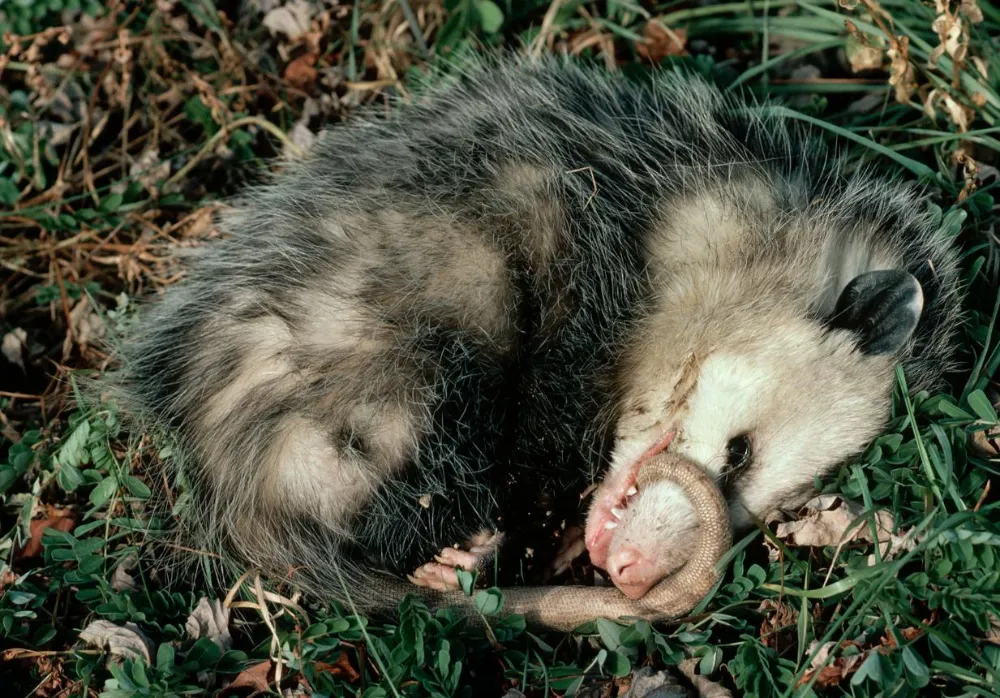
During death-feigning, an opossum can become motionless and adopt a posture that resembles a dead animal.
Why Do Opossums Smell Bad When Playing Dead?
Virginia opossums can release strong-smelling glandular secretions during defensive encounters.
The odor is sometimes described as resembling decomposition.
Additional responses such as urination and defecation may contribute to the unpleasant smell.
These features can reinforce the corpse-like appearance of a motionless opossum.
However, scientists should distinguish between the presence of the odor and proof that it reliably discourages predators.
Some studies have questioned whether the additional death-feigning displays prevent attacks as effectively as commonly believed.
Therefore, it is more accurate to describe the odor as part of the defensive response than to claim that every predator immediately retreats when it smells the animal.
Does an Opossum Actually Produce the Smell of a Dead Animal?
The odor can resemble the smell associated with decay, but the opossum is not undergoing decomposition.
It remains alive.
The unpleasant scent comes from normal physiological secretions produced during the defensive response.
The animal may also salivate and release urine or feces.
These substances can make the display more conspicuous.
However, there is no need to assume that the animal intentionally manufactures an exact imitation of a decomposing corpse.
The response can be explained as a coordinated physiological reaction triggered by extreme threat.
Do Opossums Stop Breathing When Playing Dead?
No. Opossums do not ordinarily stop breathing completely during tonic immobility.
Instead, their breathing can become slower and less conspicuous.
The 1985 physiological study documented an average respiratory-rate reduction of approximately 30 percent during death-feigning.
This means the animals continued exchanging gases while appearing largely motionless.
Because the respiratory movements may be subtle, casual observers can mistake a living opossum for a dead one.
However, breathing changes vary among episodes and should not be used alone to determine whether an animal is alive or dead.
Does Playing Dead Protect Opossums From Predators?
Death-feigning is widely discussed as a potential last-resort defensive strategy.
Some predators may be less likely to continue attacking an animal that stops moving.
Immobility might also interfere with prey-handling behavior or alter the sequence of an attack.
However, the actual benefits are difficult to measure.
A 2025 scientific review emphasized that some popular explanations of opossum death-feigning are stronger than the experimental evidence currently supports.
Earlier studies involving dogs did not demonstrate that all the corpse-like features reliably prevented continued attack.
This does not mean the behavior has no defensive value.
It means that researchers must separate plausible evolutionary benefits from outcomes directly demonstrated by experiments.
Playing dead is not a guarantee of survival.
Why Don't Opossums Just Run Away?
Opossums often do try to escape when they encounter danger.
They can walk, run, climb, and use shelter to avoid threats.
If a predator or other danger comes close, an opossum may turn toward it, hiss, bare its teeth, or adopt a defensive posture.
The death-feigning response is associated with more intense or inescapable situations.
Researchers often describe tonic immobility as occurring late in a sequence of defensive responses.
The behavior therefore does not replace all other forms of escape or defense.
It is one possible response within a broader repertoire of survival behaviors.
Do Opossums Have Sharp Teeth?
Yes. Virginia opossums have numerous sharp teeth.
Adults typically possess 50 teeth, more than any other native North American land mammal.
When threatened, they may open their mouths and show these teeth.
This display can make an opossum look dangerous even when it is attempting to avoid confrontation.
However, displaying teeth and entering tonic immobility are different behaviors.
An opossum showing its teeth is not necessarily about to play dead.
It may be warning a perceived threat to stay away.
Do Opossums Bite People?
Opossums can bite when frightened, trapped, or handled, as is possible with many wild mammals.
However, they generally try to avoid unnecessary confrontation.
An opossum that hisses or opens its mouth may be displaying defensive behavior.
People should avoid touching, cornering, or attempting to handle an unfamiliar wild opossum.
If an animal appears injured or unable to move, contact an appropriately licensed wildlife rehabilitator or local animal-control service rather than attempting to provoke a response.
Can Baby Opossums Play Dead?
Young opossums develop a range of defensive responses as their nervous systems and bodies mature.
However, the exact timing and reliability of tonic immobility in developing Virginia opossums are not established by the same body of evidence available for adults.
Small juveniles are particularly vulnerable to injury, temperature stress, and predation.
They should not be deliberately frightened or physically restrained to test their behavior.
Scientific descriptions of adult death-feigning cannot automatically be applied to every developmental stage.
Do All Opossums Play Dead?
Death-feigning is especially well documented in the Virginia opossum, but not every individual necessarily responds to danger in this way.
Different circumstances may produce escape, defensive displays, immobility, or other responses.
The broader opossum family includes many species living in Central and South America.
Behavioral responses differ among species, and detailed experimental evidence is not equally available for all of them.
Therefore, it is inaccurate to say that every opossum always plays dead when frightened.
Are Opossums and Possums the Same Animal?
Not exactly.
The Virginia opossum belongs to the American marsupial family Didelphidae.
In everyday North American English, the word "possum" is often used informally for the Virginia opossum.
However, in Australia and nearby regions, possums refers to several different marsupial groups.
Australian possums are not simply another name for the Virginia opossum.
The expression "playing possum" is strongly associated with the American opossum's famous defensive behavior.
The behavior should not automatically be attributed to every species commonly called a possum.
What Other Animals Play Dead?
Thanatosis or tonic immobility has been documented in multiple animal groups.
Examples include certain snakes, insects, fish, and other vertebrates.
One striking example is the eastern hognose snake (Heterodon platirhinos).
When severely threatened, it may roll onto its back, remain motionless, and show other dramatic defensive responses.
Some beetles also remain motionless when disturbed.
However, death-feigning behaviors are not identical across species.
Different animals may differ in posture, physiology, duration, and the circumstances that trigger immobility.
| Animal | Reported Response | Important Difference |
|---|---|---|
| Virginia opossum | Prolonged immobility with physiological changes | May include salivation and glandular secretions |
| Eastern hognose snake | Dramatic defensive display and immobility | May roll onto its back and expose its tongue |
| Some beetles | Motionless posture after disturbance | Different nervous-system organization |
| Certain fish | Tonic immobility after intense stimulation | Triggers and duration vary by species |
Is Playing Dead an Intelligent Trick?
Death-feigning can look like a clever trick because the resulting posture resembles a dead animal.
However, the appearance of deception does not prove that the animal understands a predator's beliefs or consciously chooses to mislead it.
In Virginia opossums, the response is generally understood as a strongly physiological and largely involuntary state.
Scientists distinguish between behavior that has an effect resembling deception and evidence that an animal has a human-like intention to deceive.
A 2025 review of tonic immobility and animal consciousness discussed these distinctions in detail.
It also emphasized the importance of interpreting behavioral displays in the context of the animal's nervous system and defensive responses.
What Is the Difference Between Freezing and Playing Dead?
Freezing is a defensive response in which an animal temporarily remains still, often to avoid detection.
An animal that freezes may remain capable of rapidly escaping if circumstances change.
Tonic immobility is a more profound reduction in motor activity.
It may continue even when the immediate source of restraint is removed.
The two behaviors can occur at different points in a defensive sequence.
They should not be treated as identical simply because both involve reduced movement.
Playing dead may also include additional physiological signs that are absent during ordinary freezing.
Playing Dead vs. Freezing vs. Sleeping
| Feature | Playing Dead | Freezing | Normal Sleep |
|---|---|---|---|
| Typical trigger | Intense threat | Perceived danger | Normal biological sleep regulation |
| Movement | Strongly inhibited | Temporarily suppressed | Reduced, depending on sleep stage |
| Immediate escape | May be limited | Often remains possible | Requires arousal |
| Physiological changes | Can be pronounced | Variable | Sleep-related changes |
| Same as unconsciousness | No | No | No; sleep has distinct neural states |
What Should You Do if You Find an Opossum Playing Dead?
If you encounter a motionless opossum, do not assume that it is dead.
Some opossums remain unusually still during a defensive episode.
Avoid touching, shaking, lifting, or deliberately frightening the animal.
Keep pets and people at a safe distance and allow it to remain undisturbed.
If the opossum is in immediate danger from traffic or appears seriously injured, contact a licensed wildlife rehabilitator or appropriate local wildlife authority for guidance.
Do not try to test whether it is playing dead by applying pain or force.
A living wild animal can be injured by unnecessary handling and may also bite when frightened or recovering.
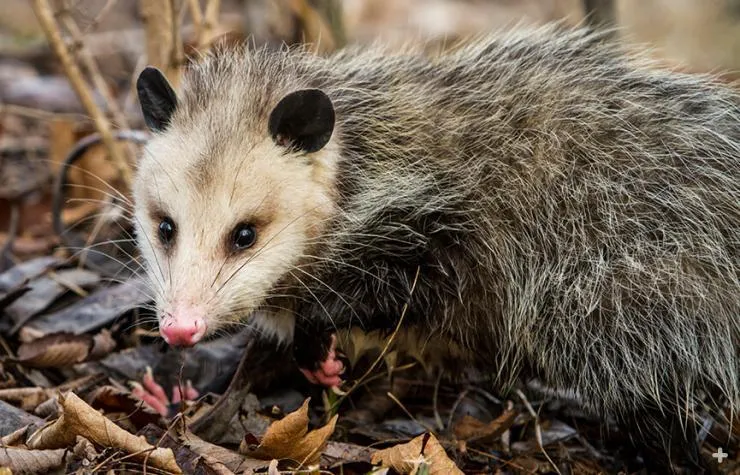
Opossums normally escape, climb, and forage; death-feigning is only one possible response to extreme danger.
Why Are Opossums Important to Ecosystems?
Virginia opossums are opportunistic omnivores that consume a broad range of foods.
Their diets may include insects, other invertebrates, fruits, seeds, carrion, and small animals.
They also function as prey for larger predators.
By feeding, scavenging, and moving through different habitats, opossums participate in local food webs.
They are adaptable mammals found in woodlands, agricultural areas, suburbs, and some urban environments.
However, ecological claims should be evaluated carefully.
For example, popular statements that opossums invariably consume huge numbers of ticks are not reliable universal descriptions of their diets.
Their actual ecological roles depend on local food resources, habitat, and behavior.
Frequently Asked Questions
Why do opossums pretend to be dead?
Opossums may enter tonic immobility when severely threatened. The resulting motionless posture resembles death, but the response is generally involuntary rather than a deliberate performance.
How long do opossums play dead?
The duration varies. Episodes may last several minutes or longer, but there is no universal time limit for every individual.
Are opossums conscious when playing dead?
Physiological research indicates that opossums can continue responding to environmental threats while appearing motionless. Their precise subjective experience remains uncertain.
Can opossums play dead whenever they want?
No evidence establishes that the full tonic immobility response can be started and stopped freely. It is generally associated with extreme fear and involuntary physiological changes.
Do opossums stop breathing when they play dead?
No. Their breathing may become slower, but experimental measurements demonstrate continued respiration.
Why do opossums smell like they are dead?
Defensive episodes can involve strong-smelling glandular secretions, together with salivation, urination, or defecation.
Do opossums play dead to avoid predators?
Death-feigning is considered a potential defensive response, but scientific studies have not established that it reliably prevents attacks by every predator.
Do baby opossums play dead?
Young opossums develop defensive behaviors, but the exact developmental pattern of tonic immobility is not as well documented as the adult response.
Do all possums play dead?
No. The behavior is especially famous in Virginia opossums and should not be assumed to occur identically in every animal called a possum.
Is an opossum playing dead actually asleep?
No. Tonic immobility and normal sleep are different physiological states.
Can an opossum bite after playing dead?
Yes. A wild opossum may bite if frightened or handled, including after recovering from an immobile state.
What animals besides opossums play dead?
Death-feigning or tonic immobility occurs in some snakes, insects, fish, and other animals, although the mechanisms and appearances vary.
The Bottom Line
Virginia opossums play dead because extreme threats can trigger a powerful defensive state called tonic immobility.
During this response, an opossum may become motionless, show reduced breathing and heart rate, and release unpleasant-smelling secretions.
Although these features create the appearance of death, the behavior is not simply a voluntary trick. Research indicates that the animal can continue processing information about its surroundings while movement is strongly inhibited.
Scientists are still investigating how reliably this response protects opossums from predators and the precise neural mechanisms involved.
The familiar phrase "playing possum" therefore describes a remarkable biological response that is more complex than merely pretending to be dead.
Sources & Further Reading
The following university, peer-reviewed, and scientific review sources explain death-feigning behavior, tonic immobility, physiology, and the limits of current evidence.
University of Florida IFAS Extension (2025) — Nuanced Wildlife: Opossum. Describes the Virginia opossum's defensive behavior and involuntary death-feigning response.
Gabrielsen and Smith (1985) — Physiological Responses Associated with Feigned Death in the American Opossum. Experimental research measuring changes in heart rate, breathing, and body temperature.
Barratt (1965) — EEG Correlates of Tonic Immobility in the Opossum. Early investigation of brain electrical activity during tonic immobility.
Humphreys and Ruxton (2018) — A Review of Thanatosis (Death Feigning) as an Anti-Predator Behaviour. Broad scientific review of tonic immobility across animal groups.
Tonic Immobility and Phenomenal Consciousness in Animals: A Review (2025). Discusses interpretations of death-feigning, awareness, and uncertainty about predator-deterrence benefits.