Crows gather in large groups at night to sleep in communal roosts, especially during winter. These gatherings may provide several benefits, including protection from predators, access to favorable sleeping locations, and opportunities to obtain information about food. American crows can form roosts containing hundreds, thousands, or even more birds. However, scientists have not identified one explanation that accounts for every crow roost. The reasons may change with the season, environment, and individual birds involved.
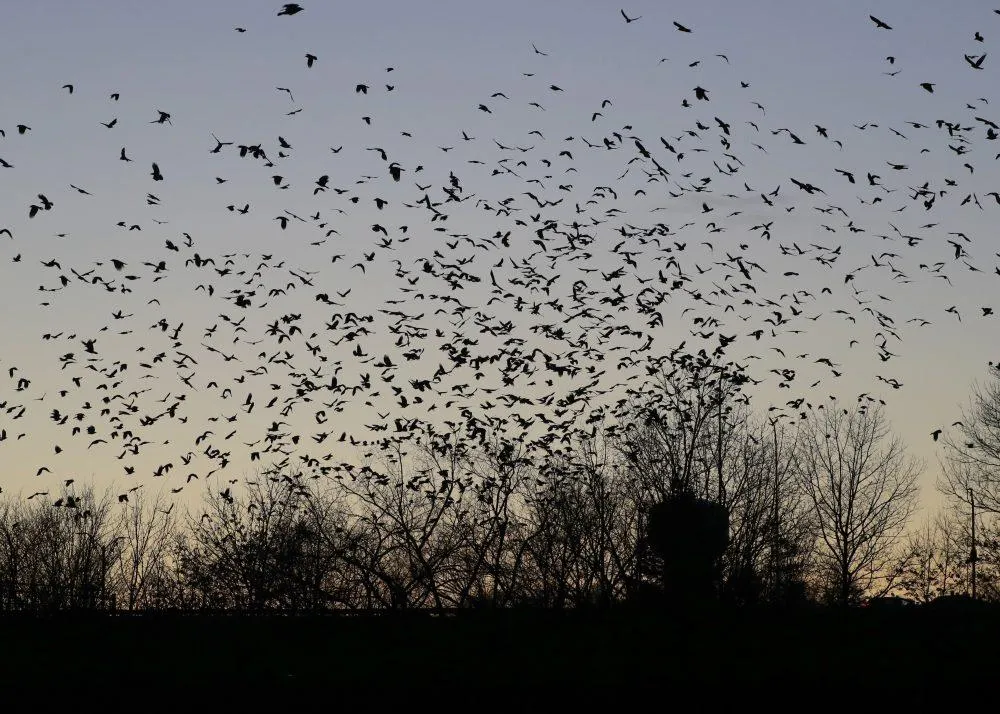
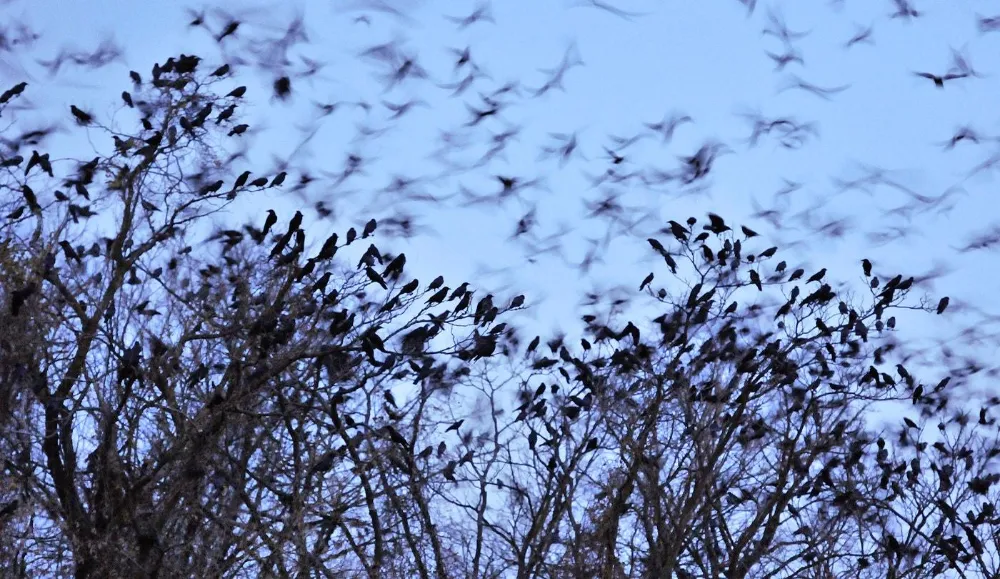
American crows often gather in large communal roosts during winter evenings, with many birds returning to the same general area.
Why Do Crows Gather in Large Groups at Night?
Crows are highly social birds, and many populations regularly gather in groups.
During the breeding season, some American crows spend much of their time within family territories.
Outside the breeding season, larger groups may form around feeding areas and overnight roosts.
A communal roost is a location where multiple birds gather to spend the night.
Some crow roosts contain hundreds of individuals. Others can attract many thousands.
Researchers have proposed several possible benefits of these gatherings:
Predator protection: More birds may help detect or respond to threats.
Information about food: Individuals may gain useful cues by observing other birds.
Suitable sleeping locations: Certain trees and urban environments may provide favorable shelter.
Social opportunities: Grouping can bring different individuals into contact.
Environmental benefits: Some roost sites may offer protection from wind or other unfavorable conditions.
These explanations are not mutually exclusive.
A crow may benefit from several features of a communal roost at the same time.
What Is a Crow Communal Roost?
A crow communal roost is a shared overnight resting area used by many crows.
The birds often gather near the roost before sunset, sometimes forming conspicuous flocks in nearby trees or open areas.
As daylight fades, additional crows arrive from different directions.
The birds eventually settle into trees or other elevated resting locations.
At dawn, they disperse toward feeding areas, family territories, or other daytime locations.
Some communal roosts are used repeatedly across a winter season.
Others change location or size in response to disturbance, habitat conditions, and seasonal changes.
The Cornell Lab of Ornithology describes American crow roosts that have existed in the same general region for many decades.
However, remaining in one geographic region does not mean that every bird sleeps on the exact same branch every night.
Why Do Crows Gather at Dusk?
Dusk is an important transition between daytime activity and nighttime rest.
American crows are primarily active during daylight.
They spend much of the day searching for food, moving around their territories, and interacting with other birds.
As evening approaches, individuals begin traveling toward overnight roosting areas.
The approach of darkness can provide a predictable environmental cue for this daily movement.
Birds arriving from different feeding locations may converge near the roost.
This can create the appearance of a sudden gathering, even though the birds have been moving toward the area for some time.
In some places, large numbers of crows gather at preliminary locations before settling at the final night roost.
These staging gatherings can involve loud calls and repeated short flights.
Do Crows Sleep Together for Protection?
Protection from predators is one of the major explanations proposed for communal crow roosting.
Crows can be vulnerable to predators, including large owls.
A single bird sleeping alone may have fewer opportunities to benefit from the presence of alert neighbors.
In a large group, more individuals may detect an approaching threat.
Birds may also respond collectively through alarm calls or movement.
Another possible advantage is risk dilution: when many potential prey animals are together, the probability that a particular individual will be targeted may decrease under certain circumstances.
However, large groups may also attract attention.
The precise balance between predator protection and predator attraction depends on the environment and predator involved.
Scientists therefore regard safety in numbers as a plausible and important hypothesis, not a guaranteed benefit in every situation.
What Predators Threaten Crows at Night?
Large owls are among the predators capable of attacking crows during nighttime hours.
Great horned owls (Bubo virginianus) are particularly important predators in parts of North America.
These powerful owls hunt a wide variety of birds and mammals.
At night, an owl may have an advantage over a crow because of its specialized low-light vision, hearing, and silent flight.
Communal roosting may help crows respond to such threats.
However, the actual risk varies with roost location, tree structure, predator abundance, and season.
A roost located near human activity may offer a different risk environment from one deep within a forest.
Why Do Crows Sometimes Chase Owls?
Crows sometimes gather around and harass owls or other predators.
This behavior is called mobbing.
It may involve repeated calls, close approaches, and coordinated movements.
Mobbing is especially conspicuous when crows discover an owl resting during daylight.
The behavior can alert other birds to the predator's location and may encourage the predator to leave.
However, mobbing and nighttime communal roosting are different behaviors.
A mobbing group forms around a particular perceived threat, while a communal roost is an overnight resting aggregation.
The two behaviors are connected through social responses to predators, but they should not be treated as identical.
Do Crows Share Information About Food?
There is scientific evidence that communal roosting can help some crows obtain information relevant to finding food.
This idea is associated with the information center hypothesis.
According to the hypothesis, an individual that has difficulty finding food may benefit from observing or following another bird that knows where food is available.
This does not necessarily require deliberate communication about a food location.
One crow might simply follow a successful forager when it leaves the roost.
Research involving hooded crows has provided experimental evidence consistent with this process.
However, other studies have identified important limitations to the hypothesis.
Communal roosts should not automatically be described as organized meetings where every crow consciously tells its neighbors where to find food.
What Did the 2001 Crow Information Study Discover?
A study published in Proceedings of the Royal Society B in 2001 investigated the information center hypothesis using free-ranging hooded crows.
The researchers monitored 34 radio-tagged birds.
They provided temporary food sources at changing locations and examined which crows visited them.
The experiment tested whether birds unfamiliar with a food location were more likely to discover it after sharing a roost with individuals that already knew the location.
The researchers found evidence consistent with that prediction.
A previously uninformed crow was more likely to visit the food source when it had roosted with a knowledgeable crow that subsequently returned there.
The study supported the possibility that communal roosting can improve foraging efficiency.
However, it did not establish that crows verbally describe food locations to one another.
The results were consistent with social information use, including following knowledgeable individuals.
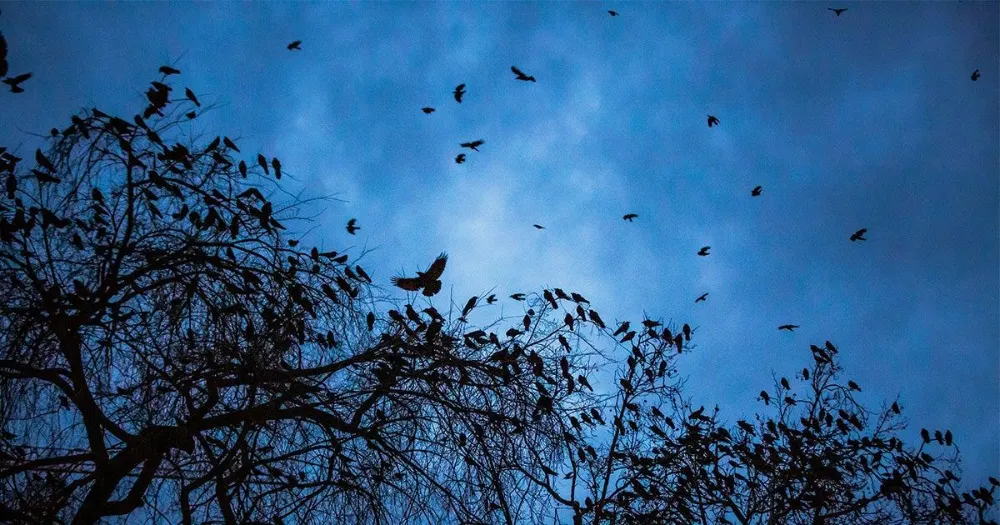
Communal roosts bring individual crows into contact, potentially providing opportunities to gain information from other birds.
Do Scientists Agree That Crow Roosts Are Information Centers?
Not completely.
Although some experiments support the information center hypothesis, other studies have questioned how broadly it explains communal roosting.
A 1991 study of carrion crows examined whether apparent food information transfer really resulted from birds following informed roost mates.
The researchers found that many birds arriving at a food source had already learned its location independently.
This could create the appearance of information transfer even when the birds had not obtained that information at the roost.
A 2010 scientific review argued for a broader understanding of the potential information available in communal roosts.
Birds may gain useful information not only about food, but potentially about danger, travel companions, and other social conditions.
However, several of these possibilities remain hypotheses requiring further testing.
The strongest conclusion is that information use is one potential benefit of communal roosting, not a proven universal explanation.
Why Do Crows Gather in Winter?
Large communal roosts are especially conspicuous among American crows during winter.
Outside the breeding season, many crows are less tied to the daily demands of defending nests and raising young.
This can allow individuals from different areas to join larger evening gatherings.
Winter food availability may also be patchy, making movement among feeding sites important.
Birds may take advantage of shared resting locations near agricultural fields, urban food sources, or other habitats.
Predator risk and local environmental conditions can further influence roost selection.
However, winter aggregation does not mean that crows stop maintaining all family or territorial relationships.
Some American crow populations continue using family territories during part of each day while also joining larger flocks or communal roosts.
How Many Crows Can Gather in One Roost?
Crow roost size varies enormously.
Some groups include only a few dozen or a few hundred birds.
Large winter roosts may contain thousands or tens of thousands.
The Cornell Lab of Ornithology reports that some American crow roosts can reach extraordinarily large numbers.
However, these largest observations should not be treated as the normal size of every roost.
Roost size depends on local crow abundance, available habitat, season, and how widely birds travel to reach the site.
It can also change from night to night.
Counts may be difficult because birds arrive and depart in moving groups, and some individuals remain concealed among branches.
Where Do Crows Sleep at Night?
American crows commonly sleep while perched in trees.
In communal roosts, many birds may occupy the branches of the same trees or groups of nearby trees.
Some roosts occur in woodlands, while others are located in parks, residential neighborhoods, or urban commercial areas.
Elevated perches provide places where birds can rest away from many ground-level disturbances.
The suitability of a roost depends on several factors:
Tree structure and available perches
Exposure to wind and weather
Predator risk
Human disturbance
Distance from daytime feeding areas
Not every crow population selects the same type of habitat.
Why Do Crows Gather in Cities?
Some American crow populations have established large communal roosts in urban areas.
Cities offer a mixture of potential advantages and disadvantages.
Urban trees can provide suitable perches, while artificial lighting and human activity change the nighttime environment.
Some researchers have proposed that urban areas may reduce the risk from certain predators or provide favorable microclimates.
Urban landscapes may also be near reliable food sources such as agricultural fields, refuse areas, or other human-influenced habitats.
However, it would be inaccurate to say that all crows move into cities simply because cities are warmer.
The exact reasons for urban roost selection are likely to vary between populations.
Urban roosts can also create conflicts involving noise, droppings, and the concentration of large numbers of birds.
Do City Lights Attract Crows at Night?
Artificial lighting may influence the way some birds use urban environments.
However, the presence of streetlights near a crow roost does not prove that the lights are the main reason the birds gather there.
Crow roosts can occur in areas with both artificial lighting and suitable trees, shelter, or other environmental features.
These factors may be correlated without one being the sole cause.
Researchers need controlled comparisons to establish which features directly affect roost choice.
For this reason, the statement that crows gather under streetlights because the light keeps them safe should be treated as a hypothesis rather than a universal fact.
Do Crows Gather to Stay Warm?
Protection from unfavorable weather is one possible benefit of choosing certain communal roost sites.
However, crows should not be assumed to use the same dense heat-sharing mechanism as emperor penguins.
American crows usually perch in trees rather than pressing their bodies into an extremely tight, ground-level huddle.
A sheltered location may reduce exposure to wind or other difficult conditions.
Yet a large group does not necessarily produce the same dramatic increase in local temperature documented inside dense emperor penguin huddles.
The possible thermal benefits of crow roosting need to be evaluated according to roost structure and environment.
Predator protection and social information may also be important.
Why Are Crows So Loud Before Sunset?
Large crow gatherings can be extremely noisy.
As birds arrive from different areas, they may call repeatedly, change perches, and interact with nearby individuals.
Crow vocalizations serve multiple social functions, including maintaining contact and responding to possible threats.
However, the precise meaning of every call at a large roost has not been established.
Some calls may be associated with movement, agitation, or social interactions.
Others may occur when birds notice unfamiliar animals or disturbances.
It is misleading to claim that every loud evening chorus means crows are holding a formal meeting or discussing food.
Large numbers of vocal birds can create considerable noise even when no single coordinated message is being transmitted.
Do Crows Have Meetings at Night?
The phrase "crow meeting" is a popular description of large gatherings, but it is not a scientific explanation.
Crows are intelligent, social birds with complex relationships.
They can recognize individuals, respond to threats, and learn from experience.
However, a communal roost is primarily a shared sleeping location.
Social information may be available there, but scientists have not demonstrated that the birds conduct organized discussions in a human-like way.
The better scientific terms are communal roosting, flocking, and social information use.
Are Crows Having a Funeral When They Gather?
Not necessarily.
Crows sometimes gather around dead crows, and researchers have studied these responses.
Such behavior may help individuals learn about environmental danger.
However, gatherings around a dead bird are different from large nightly communal roosts.
Roosting flocks form repeatedly, often at predictable locations and times.
They do not require the presence of a dead crow.
The popular idea that every large gathering of crows is a funeral is therefore incorrect.
Likewise, the phrase "murder of crows" is a traditional collective noun, not evidence that the birds are engaging in violence or a funeral ritual.
Do Crows Return to the Same Roost Every Night?
Some crow populations show considerable fidelity to the same general winter roosting area.
Birds may return repeatedly across many evenings or seasons.
However, the exact roosting trees and boundaries can shift.
Changes may occur because of weather, disturbance, vegetation, or other environmental factors.
Not every individual necessarily participates every night.
Some crows may use different locations depending on their daytime activities.
Consequently, a familiar roost should be understood as a recurring social and geographic gathering rather than a fixed arrangement of identical birds on identical branches.
Do Crow Families Stay Together at Night?
American crows can form cooperative family groups in which offspring remain with their parents after fledging.
Young birds sometimes help their parents raise later broods.
Family members may forage or move together during the day.
However, communal winter roosts can contain birds from many family groups and different areas.
Cornell's crow research indicates that family members can travel together toward larger roosts without necessarily remaining side by side within the crowd.
This means family-level social organization and large-scale communal roosting can coexist.
The two forms of social behavior operate at different scales.
Do Crows Sleep All Night?
Crows are generally diurnal birds, meaning that they are primarily active during daylight.
They commonly spend nighttime hours resting at roosts.
However, resting does not mean that every bird remains completely motionless and unresponsive from sunset until sunrise.
Birds can adjust their posture, respond to disturbances, and move between perches.
Severe weather, predators, and other environmental conditions may interrupt rest.
Scientists distinguish between behavioral resting and specific physiological stages of sleep.
Simply observing a crow perched quietly at night does not reveal its exact neural sleep state.
Are All Large Black Bird Flocks Crows?
No. Large evening flocks can include several other bird species.
European starlings, common grackles, blackbirds, and ravens may all gather in noticeable groups.
Their appearances can be similar at a distance, particularly near sunset.
However, their body shapes, flight patterns, calls, and social behavior differ.
Correct species identification is important before interpreting the purpose of a gathering.
For example, a starling murmuration is not the same phenomenon as an American crow winter roost.
Are Crows and Ravens the Same?
No. Crows and ravens are related members of the genus Corvus, but they are not the same species.
American crows (Corvus brachyrhynchos) are generally smaller than common ravens (Corvus corax).
Ravens typically have heavier bills and wedge-shaped tails when flying.
They also have different vocalizations and flight characteristics.
Both can display complex social behavior, but their grouping patterns and ecology are not identical.
Studies of common ravens may provide useful comparisons, yet they should not automatically be treated as direct evidence for American crow behavior.
Why Do Crows Suddenly Fly Away Together?
A large group of crows may take flight when one or more birds detect a possible threat or disturbance.
Movement by nearby individuals can influence others to leave their perches.
This can create the appearance of a coordinated wave of flight.
Possible triggers include predators, loud disturbances, changes in group movement, or relocation within the roosting area.
However, observing birds suddenly taking off does not reveal the cause by itself.
Not every synchronized departure is a predator escape.
In some situations, birds may simply be moving from a staging location to their final overnight roost.
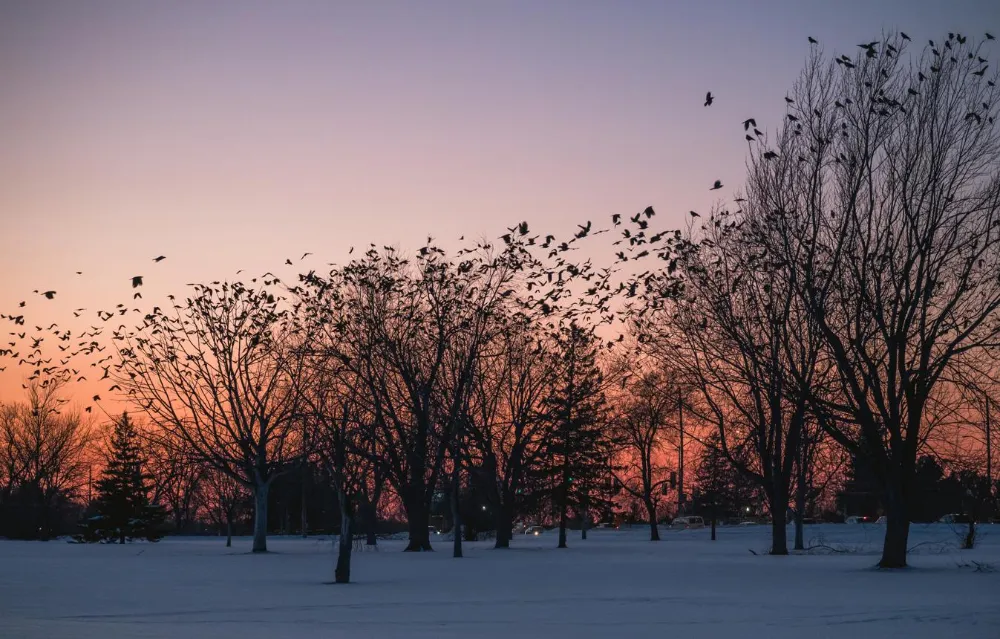
At dusk, crows may arrive in waves from different directions before settling at a communal sleeping area.
How Do Crow Roosts Affect Urban Environments?
Large crow roosts are natural wildlife gatherings, but they can create challenges when they occur in densely populated areas.
Residents may notice increased evening noise, droppings beneath trees, and large numbers of birds occupying public spaces.
Some people enjoy observing these gatherings, while others find them disruptive.
Management approaches should account for bird welfare, local wildlife laws, and the reasons birds are using the site.
Because crows are intelligent and adaptable, simple disturbances may not permanently move a roost.
In addition, dispersing birds from one location may cause them to settle nearby rather than eliminate the underlying conditions that attract them.
Wildlife professionals can help communities evaluate practical, humane management options when roosts create significant problems.
Do Crows Gather in Large Groups During Summer?
Crows can be social throughout the year, but the size and structure of gatherings often change with the season.
During breeding, some American crows spend more time associated with nesting territories and family groups.
In winter, large communal roosts become particularly conspicuous in many regions.
However, seasonal patterns differ among populations.
Some birds may join roosts outside winter, while others may use smaller or more dispersed sleeping groups.
The key point is that the famous winter crow aggregation is not necessarily the only time crows interact socially.
Communal Roosting vs. Mobbing vs. Foraging Flocks
| Behavior | Main Context | Typical Feature |
|---|---|---|
| Communal roosting | Nighttime resting | Birds gather at shared sleeping sites |
| Mobbing | Response to a perceived predator | Birds call and harass the threat |
| Foraging flock | Searching for food | Birds feed or travel together |
| Family group | Cooperative social life | Related birds remain associated |
| Staging gathering | Before final overnight settling | Birds assemble and may relocate nearby |
These behaviors can overlap in time and involve some of the same birds, but they are not interchangeable.
Why Is Crow Roosting Important to Scientists?
Crow communal roosts provide opportunities to study social behavior, animal navigation, predator avoidance, and information use.
Researchers can investigate how individuals choose resting locations and whether social associations influence their later movements.
Long-term observations also help scientists understand seasonal changes in group size and roost distribution.
Experimental studies of hooded crows have provided evidence that social information can affect food discovery.
Other studies demonstrate why careful experiments are needed to distinguish genuine information transfer from birds independently finding the same resources.
The broader lesson is that large animal groups may have several functions rather than one simple explanation.
Frequently Asked Questions
Why do crows gather at night?
Crows gather in communal roosts to spend the night. Possible benefits include predator protection, access to suitable resting sites, and opportunities to obtain information about food.
Why do crows gather in large groups at dusk?
Birds traveling from different daytime locations converge near shared sleeping areas as darkness approaches.
Why do crows gather in winter?
Many American crow populations form especially large winter roosts, when birds from different areas may gather outside the breeding season.
Where do crows sleep at night?
American crows commonly sleep perched in trees, sometimes alongside large numbers of other crows.
Do crows sleep together for warmth?
Favorable weather conditions may influence roost selection, but warmth alone has not been established as the universal reason for large crow roosts.
How many crows can be in one roost?
Roosts range from relatively small groups to gatherings containing many thousands of birds, with exceptionally large concentrations reported in some regions.
Do crows return to the same place every night?
Some populations repeatedly use the same general roost area, although exact trees and participating individuals may change.
Are crows gathering for a funeral?
Not usually. Large nightly roosts are different from the responses crows sometimes show around a dead bird.
Do crows share information about food?
Experiments with hooded crows support the idea that roost mates can help one another locate food indirectly, but this does not explain every communal roost.
Why are crows so loud in the evening?
Large numbers of arriving birds may call during social interactions and movement, creating considerable noise before settling.
Do crows stay with their families at night?
American crows maintain cooperative family relationships, but larger roosts contain many birds from different groups.
Is a large group of crows a bad omen?
No. Large crow gatherings are natural social and seasonal behaviors, not scientific evidence of a supernatural event.
The Bottom Line
Crows gather in large groups at night because communal roosting is an important part of their social behavior, especially during winter.
These gatherings may offer protection from predators, suitable resting conditions, and opportunities to gain information about food.
Research shows that information use can contribute to communal roosting in some crow populations, but scientists have also identified important limits to this explanation.
The most accurate conclusion is that crow roosts are complex social gatherings shaped by multiple ecological factors, not simply noisy nighttime meetings.
Sources & Further Reading
The following ornithological resources and peer-reviewed studies provide evidence for crow communal roosting, predator protection hypotheses, social behavior, and food-related information use.
Cornell Lab of Ornithology — Frequently Asked Questions About Crows. Discusses the major hypotheses for large communal roosts and the limitations of current explanations.
Cornell Lab of Ornithology — American Crow. Describes winter communal roosts, family structure, social behavior, and the size of crow gatherings.
Cornell Lab of Ornithology — How Do Birds Survive the Winter?. Explains crow winter roosting and possible advantages involving predators and information.
Sonerud, Smedshaug and Bråthen (2001) — Ignorant Hooded Crows Follow Knowledgeable Roost-Mates to Food. Experimental support for the information center hypothesis in hooded crows.
Richner and Heeb (1991) — Evolution of Avian Roosting Behaviour: A Test of the Information Centre Hypothesis. Examines limitations of apparent information transfer in carrion crow roosts.
Bijleveld et al. (2010) — Beyond the Information Centre Hypothesis: Communal Roosting for Information on Food, Predators, Travel Companions and Mates?. Reviews broader explanations for communal roosting and social information use.