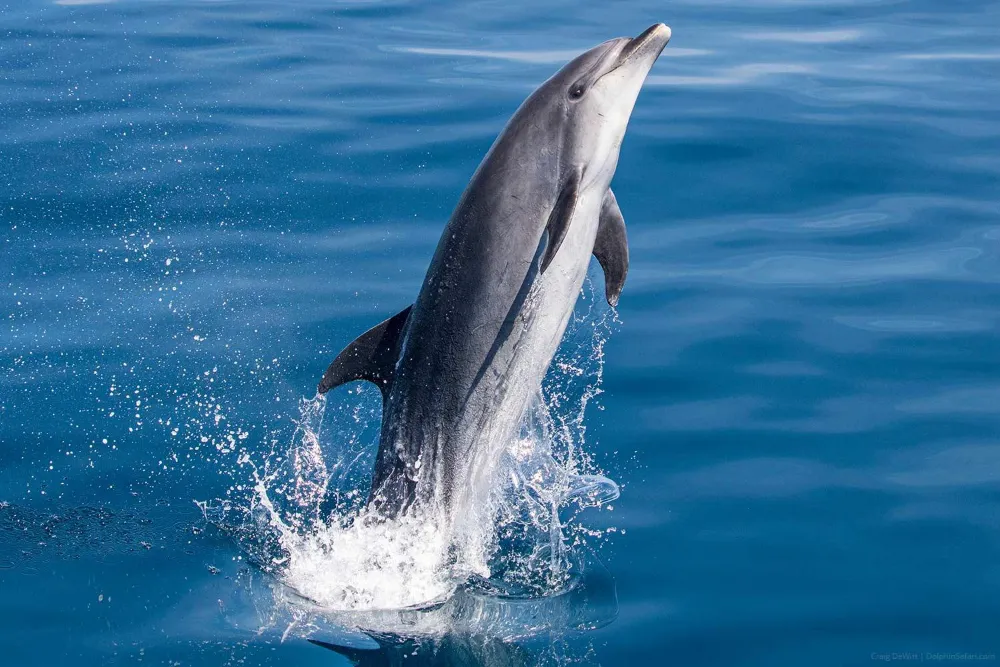
Dolphins jump out of the water for several reasons, including efficient high-speed travel, social communication, play, and responses to their surroundings. Some dolphins leap repeatedly while swimming quickly, a behavior called porpoising that can reduce water resistance. Other jumps occur during social interactions, while spectacular aerial spins are especially characteristic of spinner dolphins. However, a leap does not always mean a dolphin is happy. Scientists study the type of jump, the animal's behavior before and afterward, and its environment to understand what the movement might mean.
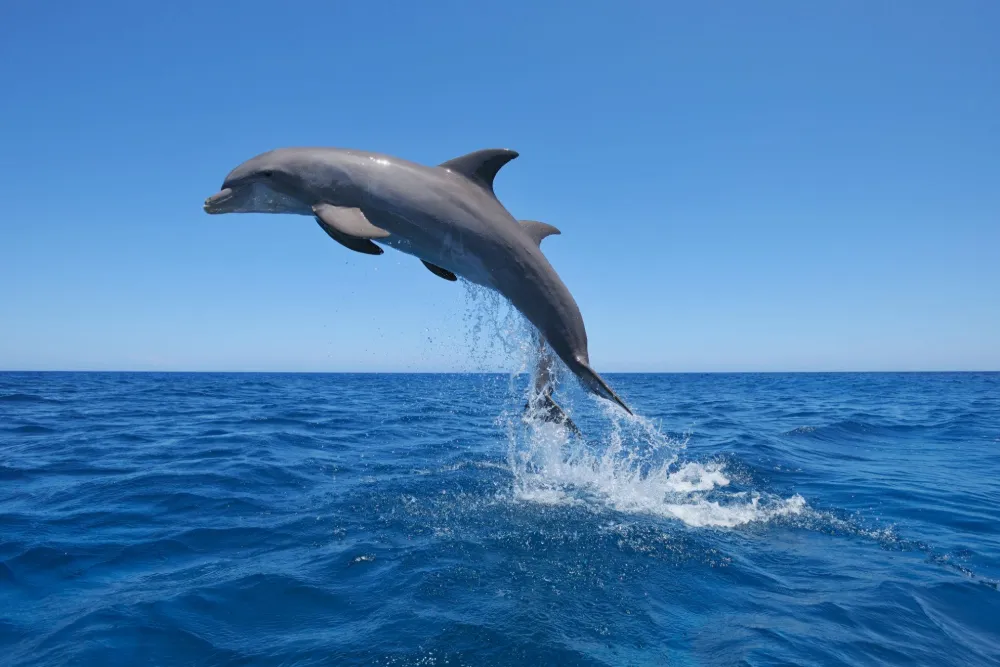
Dolphins perform different aerial movements, and the reason for a particular leap depends on species and context.
Why Do Dolphins Jump Out of the Water?
Dolphins are highly mobile marine mammals capable of powerful underwater swimming and spectacular aerial movements.
When a dolphin leaves the water, the behavior may be described as a leap, breach, or part of a repeated porpoising sequence.
Although these movements can look similar, they do not necessarily serve the same purpose.
Scientists have identified several explanations that may apply in different situations:
Efficient travel: Repeated leaps may reduce resistance during high-speed movement.
Social communication: Certain surface movements can convey information to other dolphins.
Play: Dolphins sometimes perform aerial movements during playful activity.
Foraging: Some leaps occur in association with hunting or prey movement.
Responses to disturbance: Increased aerial activity can occur when dolphins are approached or disturbed.
These explanations are not mutually exclusive.
A dolphin might perform similar movements in different situations for different reasons.
That is why researchers avoid interpreting every leap as a simple expression of excitement.
What Is Dolphin Breaching?
Breaching generally refers to a dolphin or other cetacean launching part or all of its body above the water surface.
Depending on the animal and the movement, a breach may involve an upward leap, a sideways movement, or a dramatic splash during re-entry.
Researchers studying dolphin behavior often distinguish among different aerial actions rather than grouping every movement under one label.
For example, a dolphin traveling rapidly may make a streamlined leap that continues its forward movement.
Another individual may rise sharply and land on its side.
These actions have different mechanical characteristics and may occur in different social or environmental contexts.
The term breaching is widely used, but it should not be treated as a precise explanation of motivation by itself.
Do Dolphins Jump Because They Are Happy?
Dolphins can perform aerial movements during play, but jumping alone does not prove that an individual is happy.
Play behavior has been documented in several dolphin species, especially bottlenose dolphins.
It can involve swimming games, object manipulation, social interactions, and acrobatic movements.
A 2024 study published in iScience examined playful communication in bottlenose dolphins and noted that aerial actions are among the behaviors associated with locomotor and social play.
However, behavioral context matters.
Dolphins can also leap during rapid travel, foraging, or responses to disturbances.
Scientists cannot reliably identify an animal's emotional state from a single photograph of it jumping.
The strongest evidence for play comes from observing how the activity fits into a broader behavioral sequence.
Does Jumping Help Dolphins Swim Faster?
Repeatedly leaving the water can help some dolphins travel efficiently at high speeds.
This form of movement is called porpoising.
During porpoising, an animal alternates between underwater swimming and brief airborne phases.
Water is much denser than air, so moving part of the travel distance above the surface can reduce hydrodynamic resistance.
However, jumping also requires energy.
The energetic benefit depends on whether the savings from reduced drag outweigh the cost of leaving the water and re-entering it.
At relatively low swimming speeds, continuous swimming may be more efficient.
At higher speeds, porpoising can become advantageous.
This relationship has been examined through mathematical models and measurements of free-ranging dolphins.
What Is Porpoising in Dolphins?
Porpoising is a form of fast swimming in which dolphins repeatedly leap above the surface while continuing in the same general direction.
The movement resembles a series of smooth arcs.
A dolphin swims underwater, accelerates toward the surface, emerges, travels briefly through the air, and returns to the water.
It may then repeat the process.
The behavior differs from an isolated aerial display that involves a sudden change in direction or a sideways landing.
Porpoising is especially associated with directional, high-speed travel.
The movement occurs in several cetacean species, although the conditions and mechanics vary.
Researchers have long investigated whether the reduced resistance during airborne travel makes the behavior energetically efficient.
What Did Scientists Discover About Dolphin Jumping in 2024?
A 2024 study published in the Journal of the Royal Society Interface investigated the swimming mechanics of wild dusky dolphins (Lagenorhynchus obscurus).
Researchers used uncrewed aerial vehicles to measure movement and estimate hydrodynamic forces during natural swimming.
The dolphins were observed at speeds ranging from approximately 0.9 to 6.9 meters per second.
At slower speeds, the animals generally remained submerged apart from breathing.
Porpoising became apparent as swimming speeds increased beyond approximately 4 meters per second.
The researchers found that the dolphins' effective drag decreased substantially with speed.
When porpoising occurred, time spent in the air provided an additional reduction in resistance.
The study estimated that porpoising could reduce effective drag by around 17 percent on average relative to the corresponding submerged movement under the measured conditions.
At the highest observed speed, the modeling indicated additional energetic benefits from alternating between water and air.
These findings support the idea that jumping can make rapid travel more efficient in dusky dolphins.
However, they do not prove that every aerial movement made by every dolphin species is primarily intended to save energy.
Why Is Water Resistance Important for Dolphins?
Water resistance, also called drag, opposes an animal's movement through water.
As an animal swims faster, its muscles must generate enough force to overcome the resistance associated with its movement.
Dolphins have streamlined bodies that help reduce drag.
Their swimming movements also influence how water flows along the body.
At high speeds, briefly traveling through air can further reduce the time spent encountering water resistance.
However, swimming efficiency is more complicated than the simple statement that air has less resistance than water.
The animal must still accelerate, leap, land, and maintain forward movement.
The shape of its body and the nature of the water flow also affect the total energy cost.
The 2024 dusky dolphin study helps explain why fast swimming can be energetically possible despite the apparently high forces involved.
Do Dolphins Jump to Communicate?
Some dolphin surface movements appear to serve communicative functions.
Dolphins use sounds, body positions, movements, and physical contact during social interactions.
Aerial activities can create visual displays and sounds when an animal lands on the water.
However, there is no single translation that applies to every dolphin jump.
A 2006 study of bottlenose dolphins in Doubtful Sound, New Zealand, investigated how different surface behaviors related to group activity.
The research found that aerial events did not belong to one simple behavioral category.
Some movements were associated with travel, while others occurred in social or more confrontational contexts.
The study suggested that particular actions, including side-flopping, may communicate information about transitions between activities.
These findings support the importance of interpreting the entire behavioral sequence rather than assuming every leap is a universal message.
What Did the 2006 Bottlenose Dolphin Study Find?
Researcher David Lusseau examined surface activities performed by bottlenose dolphins living in Doubtful Sound.
The study considered which behaviors occurred together and how they related to the dolphins' general activity.
Four broad categories emerged from the analysis:
Orientation-related behavior
Travel
Social displays
Fighting or confrontational activity
Aerial movements were distributed across different categories.
This indicated that jumping is not one behavior with one fixed purpose.
The study also suggested that side-flops and certain tail-slapping actions could convey information about changes in group activity.
However, the exact significance of these behaviors may differ across species, populations, and situations.
Scientists therefore rely on repeated observations and controlled analyses before assigning a communicative function to a specific movement.
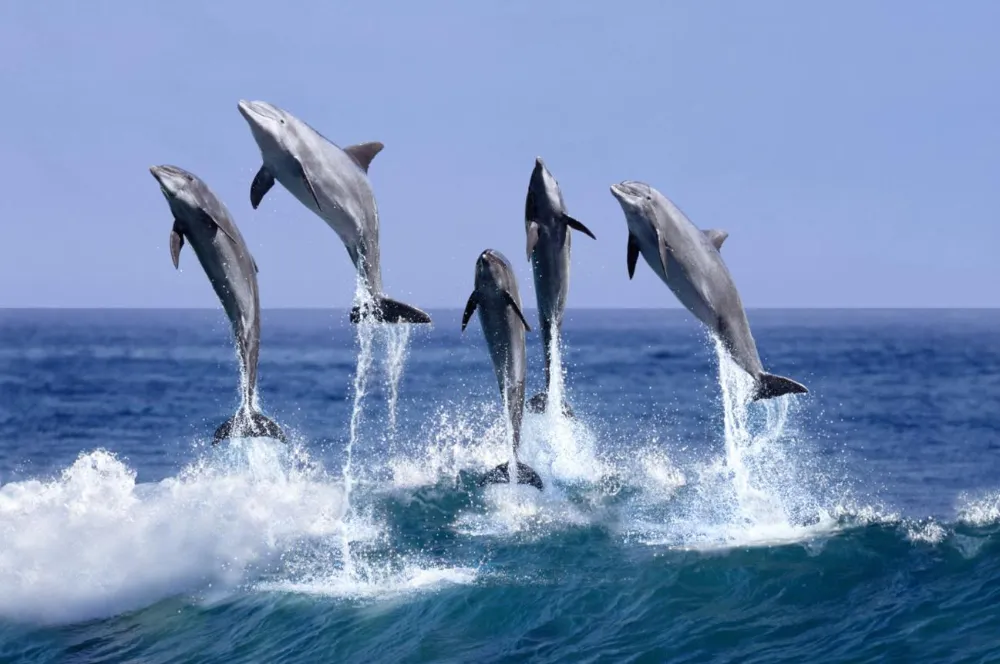
Some dolphin leaps occur during social activity, but their meaning depends on the behavior of the surrounding group.
Do Dolphins Jump to Attract Attention?
Aerial movements can be conspicuous to nearby dolphins.
A leap may create a visible body movement and a splash when the animal lands.
These signals can potentially attract attention over distances that depend on conditions.
However, attracting attention is not necessarily the purpose of every jump.
Researchers must distinguish between a movement that happens to be noticeable and one that functions as communication.
The 2006 bottlenose dolphin study provided evidence that certain surface actions occur at meaningful points in group activity.
This suggests that some movements convey useful social information.
Nevertheless, scientists cannot assume that all dolphins use an identical set of aerial signals.
Why Do Spinner Dolphins Spin in the Air?
Spinner dolphins (Stenella longirostris) are famous for their rapid aerial rotations.
They can leave the water and rotate repeatedly around the long axis of the body.
The spectacular movement has attracted scientific interest because it requires precise control of body motion and angular momentum.
Spinner dolphins do not generate all their rotation by twisting after leaving the water.
Instead, important rotational motion begins underwater before the leap.
A biomechanical study published in the Journal of Experimental Biology demonstrated how underwater movement and the forces acting on the fins can initiate the spin.
Once the dolphin enters the air, the reduced surrounding resistance allows the rotation rate to increase.
The model indicated that some spinner dolphins can complete up to seven rotations during a leap.
However, seven rotations should not be interpreted as the number achieved during every jump.
How Do Spinner Dolphins Spin So Fast?
A spinner dolphin begins preparing for a rotating leap while still underwater.
By adjusting its swimming movements and fin positions, it can generate angular momentum around its longitudinal axis.
The surrounding water resists rapid rotation.
When the animal emerges into air, that resistance is greatly reduced.
The dolphin can then rotate more rapidly during the airborne phase.
The 2006 biomechanical model by Frank Fish and Anthony Nicastro demonstrated that the rotational motion begins before the dolphin exits the water.
This explanation differs from the popular idea that a spinner dolphin simply starts twisting its body once airborne.
Later comparative research also found that body shape and the distribution of mass influence how many rotations different cetaceans can perform.
Do Spinner Dolphins Jump to Remove Parasites?
Removing attached organisms is one hypothesis for why spinner dolphins perform dramatic aerial rotations.
Some dolphins carry remoras, which are fish that attach to larger marine animals using specialized adhesive structures.
Rapid spinning and forceful water re-entry may create mechanical stresses capable of dislodging these attached fish.
The 2006 biomechanical study suggested that the forces involved could be sufficient to remove some remoras.
However, the study was primarily a mechanical analysis.
It did not demonstrate that every spinner dolphin leaps specifically to remove remoras.
Other possible functions, including social communication and play, remain subjects of investigation.
The most accurate conclusion is that parasite removal is a plausible benefit rather than a universally established motivation.
Do All Dolphins Spin When They Jump?
No. Dolphin species differ in body shape, swimming behavior, and aerial abilities.
Spinner dolphins are especially specialized for repeated axial rotations.
Other species, including bottlenose dolphins, can perform aerial movements but generally do not execute the same number of rapid rotations.
A 2024 study examining spinning performance across cetaceans found that body geometry and moment of inertia were important predictors of rotational ability.
Animals with different body shapes cannot necessarily achieve the same aerial performance even at similar swimming speeds.
Therefore, the spectacular movements of spinner dolphins should not be treated as typical of every dolphin species.
Do Dolphins Jump When Hunting?
Some dolphin aerial activities occur during feeding or prey-related behavior.
For example, dolphins may make rapid movements around schools of fish as they attempt to control or capture prey.
Scientists have proposed that certain leaps could contribute to herding prey or coordinating group activity.
However, these explanations are strongly dependent on species and hunting strategy.
The 2006 bottlenose dolphin study noted that feeding-related interpretations of aerial behavior cannot be applied universally.
Some dolphins do not regularly cooperate to hunt schooling fish near the surface.
Others use specialized techniques adapted to particular habitats.
Direct observation of the prey and surrounding group behavior is necessary before concluding that a leap served a hunting purpose.
Do Dolphins Jump to Escape Predators?
Escaping or avoiding predators is another possible context for rapid movement and aerial behavior.
Some researchers have proposed that repeated leaps might make it harder for a predator to maintain visual contact with a fast-moving dolphin.
However, this should not be treated as the established explanation for ordinary dolphin leaping.
Direct evidence connecting particular jumps to successful predator avoidance remains limited.
Dolphins may also respond to threats through rapid swimming, changes in direction, or coordinated group movement.
The importance of each tactic varies with the predator and situation.
Do Dolphins Jump to Breathe?
Dolphins must surface to breathe because they are mammals with lungs.
However, they do not need to leap completely out of the water every time they take a breath.
Ordinary breathing occurs when the blowhole briefly rises above the surface.
A dolphin can inhale and exhale without launching its entire body into the air.
Porpoising may combine forward movement with opportunities to breathe, but its aerodynamic and hydrodynamic effects are different from the basic requirement to access air.
Therefore, the statement that dolphins jump primarily because they cannot breathe underwater is too simplistic.
Do Dolphins Jump Near Boats Because They Are Happy?
Not necessarily.
Dolphins may approach vessels or travel near moving boats for several reasons.
Some animals ride or surf the pressure waves produced by vessels.
Others may alter their behavior because of disturbance.
NOAA Fisheries reports that spinner dolphins in Hawaiʻi can increase leaping, spinning, or tail-slapping behavior when approached closely by boats or swimmers.
Such reactions can be associated with disruption rather than pleasure.
This is especially important in daytime resting habitats.
A dolphin that leaps repeatedly near a boat may be responding to human activity, and observers should not automatically interpret the display as a positive interaction.
Can Boats Disturb Resting Dolphins?
Yes. Human activity can disrupt marine mammals during important resting periods.
Hawaiian spinner dolphins often forage offshore at night and use sheltered coastal habitats during the day.
They depend on relatively undisturbed periods for rest and recovery.
Repeated approaches by swimmers or vessels can cause changes in swimming behavior, group movement, and surface activity.
NOAA Fisheries explains that such disturbance can reduce time available for essential behaviors.
Over the long term, repeated disruption may affect energy balance and animal health.
The visible excitement of a marine mammal does not reliably indicate that it welcomes human attention.
Wildlife viewing should follow applicable local regulations and official guidance.
Do Baby Dolphins Jump Out of the Water?
Young dolphins can perform aerial movements as their swimming abilities develop.
Calves remain closely associated with their mothers during early life.
They learn to coordinate breathing, movement, and social interactions.
Dolphin play behavior can begin relatively early, and young animals may participate in energetic swimming and acrobatic activity.
However, the exact development of jumping behavior differs among species and individuals.
Scientists should not assume that every calf leap is a playful imitation of its mother.
Some movements may occur during travel or other social contexts.
Do Dolphins Jump Higher Than Other Marine Mammals?
Several marine mammals are capable of impressive aerial movements.
Dolphins, porpoises, and some whales can leap or breach.
However, comparing maximum jump heights is difficult because measurements depend on species, body size, speed, and the definition of a jump.
Spinner dolphins are particularly notable for rotational performance.
Other cetaceans may perform different types of leaps or powerful body rolls.
There is no simple universal ranking that can be applied to every species and every aerial maneuver.
How Are Dolphin Leaps Different From Whale Breaches?
Dolphins and whales are both cetaceans, but their body sizes and movement mechanics differ.
Many dolphins perform repeated streamlined leaps during fast swimming.
Large whales may breach by lifting much of their massive bodies above the water before falling back.
Whale breaches can produce enormous splashes.
Researchers have proposed different functions for whale breaching, including social signaling and other behavioral roles.
However, the functions documented for one species cannot automatically be transferred to another.
Even among dolphins, different aerial movements can have different meanings.
Dolphin Leaping, Porpoising, and Spinning Compared
| Behavior | What It Looks Like | Possible Function |
|---|---|---|
| Breaching | A conspicuous leap or body emergence | Varies with social and environmental context |
| Porpoising | Repeated forward leaps during fast travel | Can reduce drag at high swimming speeds |
| Spinning | Rotation around the body's long axis | Function uncertain; remora removal is one hypothesis |
| Side-flopping | Sideways movement and landing | Associated with behavioral transitions in some studies |
| Play-related leaps | Acrobatic movements during playful interactions | Locomotor or social play |
These descriptions help classify visible actions, but a single movement may occur in more than one behavioral situation.
Why Do Dolphins Leap in Groups?
Dolphins often travel and interact in social groups.
When several individuals move together, they may perform aerial activities during the same general period.
Some synchronized movements may relate to coordinated travel.
Others may occur in social or playful contexts.
However, observing several dolphins jump together does not prove they are performing a deliberately choreographed display.
Shared environmental conditions and group movement can also lead to similar actions.
Researchers examine timing, spacing, individual identity, and the behavior before and after the event to investigate coordination.
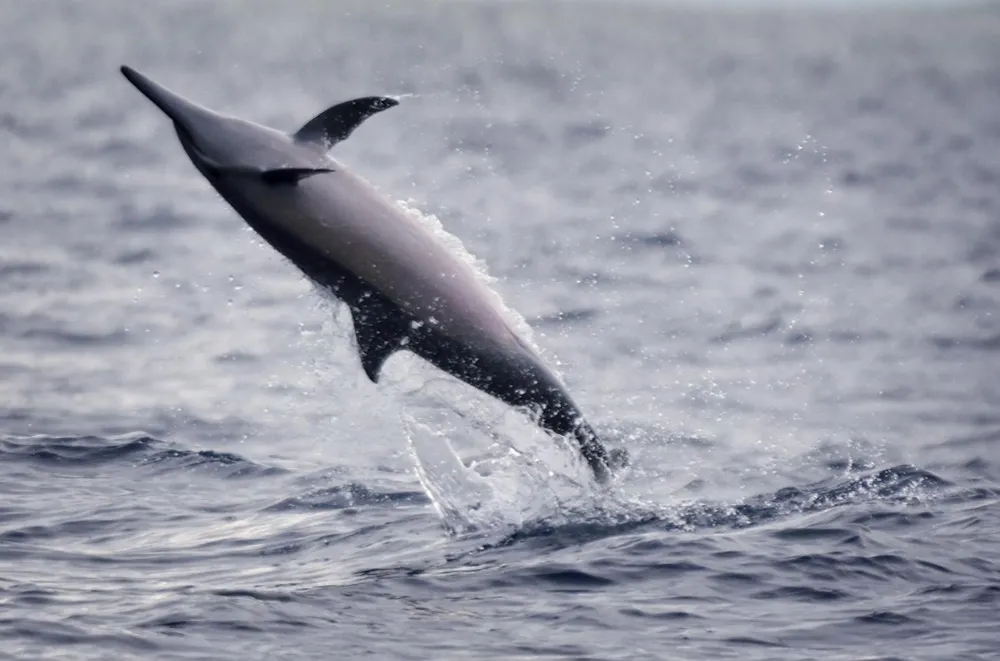
Spinner dolphins are known for spectacular aerial rotations, but their precise functions remain the subject of scientific investigation.
How Can Scientists Tell Why a Dolphin Is Jumping?
Researchers usually need more information than a single photograph or brief video.
They may record:
The dolphin species
The type and direction of the leap
Swimming speed before and after the movement
The activities of nearby dolphins
Whether prey is present
The presence of boats or other disturbances
Sounds produced before, during, or after the event
Repeated observations help reveal whether particular movements are consistently associated with specific activities.
Biomechanical models can then test whether a proposed function is physically plausible.
For example, the 2024 dusky dolphin research measured how porpoising affected estimated drag.
By contrast, studies of social displays investigate how different movements relate to group behavior.
These methods answer different questions and should not be confused.
Why Is Dolphin Jumping Important to Marine Science?
Dolphin aerial movements provide opportunities to study animal locomotion, communication, and responses to environmental conditions.
Scientists can use drones and other noninvasive technologies to measure swimming speed and body movement from above.
High-speed video can reveal how dolphins control their bodies during rapid leaps.
Behavioral observations help researchers determine the contexts in which different movements occur.
These findings can improve understanding of marine mammal biology and inform conservation practices.
They also illustrate why impressive animal behavior requires careful scientific interpretation.
The same outward movement can be associated with different underlying functions.
Frequently Asked Questions
Why do dolphins jump out of the water?
Dolphins jump for several reasons, including efficient high-speed travel, social behavior, play, and responses to environmental conditions.
Do dolphins jump because they are happy?
Some leaps occur during play, but jumping alone does not prove that a dolphin is happy.
What is dolphin porpoising?
Porpoising is repeated leaping during fast swimming. It can reduce time spent encountering water resistance and improve movement efficiency at high speeds.
Do dolphins jump to communicate?
Some surface movements appear to carry social information, but researchers have not assigned one universal meaning to all dolphin jumps.
Why do spinner dolphins spin?
Spinner dolphins begin rotating underwater and accelerate their spins after leaving the water. The behavior's exact purpose remains uncertain.
Do spinner dolphins spin to remove parasites?
Biomechanical modeling suggests rapid spinning could dislodge attached remoras, but this has not been established as the only or primary reason for all spins.
Do dolphins jump to breathe?
Dolphins must reach the surface to breathe, but they can do so without leaping completely out of the water.
Why do dolphins jump near boats?
Some dolphins interact with vessel-generated waves, while others may leap or change their behavior because of disturbance. A jump near a boat does not automatically indicate enjoyment.
Can baby dolphins jump?
Yes. Young dolphins can perform aerial movements as they develop their swimming and social abilities.
Do dolphins jump while hunting?
Some jumps occur during feeding or prey-related behavior, but the connection varies among species and hunting techniques.
Do all dolphin species jump?
Dolphin species differ in their aerial behavior. Some are especially acrobatic, while others perform different kinds of surface movements.
Is breaching the same as porpoising?
No. Breaching is a broad term for emerging from the water, while porpoising specifically involves repeated forward leaps during high-speed travel.
The Bottom Line
Dolphins jump out of the water for more than one reason.
Some leaps help animals travel efficiently by reducing water resistance. Other aerial movements occur during social interactions, play, feeding, or responses to disturbances.
Spinner dolphins are especially famous for rapid rotations, but scientists have not established one universal purpose for their spinning behavior.
The most accurate way to understand dolphin jumping is to consider the species, movement type, and surrounding behavior rather than assuming every spectacular leap has the same meaning.
Sources & Further Reading
The following peer-reviewed papers and NOAA resources explain dolphin leaping, porpoising, aerial spins, behavioral interpretation, and disturbance responses.
Lusseau (2006) — Why Do Dolphins Jump? Interpreting the Behavioural Repertoire of Bottlenose Dolphins. Analysis of dolphin aerial and surface behaviors in different social contexts.
Davis et al. (2024) — Drag Reduction and Locomotory Power in Dolphins: Gray's Paradox Revealed. Measurements and modeling of high-speed movement and porpoising in free-ranging dusky dolphins.
Dynamics of Dolphin Porpoising Revisited (2011). Biomechanical analysis of porpoising and its possible energetic advantages.
Fish and Nicastro (2006) — Dynamics of the Aerial Maneuvers of Spinner Dolphins. Mechanical model describing how spinner dolphins generate and accelerate aerial rotation.
Spin-Leap Performance by Cetaceans Is Influenced by Moment of Inertia (2024). Comparative study of the physical factors affecting aerial rotation.
Smiling Underwater: Exploring Playful Signals and Rapid Mimicry in Bottlenose Dolphins (2024). Research on dolphin play and communication, including acrobatic behavior.
NOAA Fisheries — Spinner Dolphin. Information about spinner dolphin behavior, resting patterns, aerial displays, and human disturbance.