Potty training a puppy is challenging in any home – but in an apartment, you don’t have a private garden, you may have elevators or stairs, and neighbours can hear every excited bark. The good news: with a clear plan and consistency, apartment puppies can be house-trained just as well as dogs in big houses.
This step-by-step guide is written for dog owners in the US and Europe who live in flats, condos or small city homes. You’ll learn:
How often to take your puppy out (by age)
Whether to use pee pads or go straight to outdoor toilet training
Exactly what to do the moment your puppy pees or poops (success or accident)
How to survive nights and bad weather without ruining your progress
1. Understand Your Puppy’s Bladder Limits
Very young puppies simply cannot hold it for very long. A common rough guideline is:
Maximum hours they can hold = age in months + 1 (during the day)
For example:
8-week-old (2-month) puppy: 2–3 hours max
3-month-old puppy: 3–4 hours max
4–6 months: 4–6 hours, depending on the individual dog
This is a guideline, not a guarantee. Small breeds often need to go more often, and puppies may need extra toilet breaks after:
Waking up (even from a short nap)
Eating or drinking
Play sessions and excitement
2. Choose Your Main Toilet Strategy: Outdoor, Indoor, or Mixed
In an apartment, you have three main options:
2.1 Outdoor-only toilet training
The puppy only toilets outside (on the street, in a nearby yard or designated dog area).
Best for:
Owners who can carry or walk the puppy outside frequently.
Buildings with quick access to outdoors.
Downside: hard if you live very high up, have long elevator waits, or severe weather.
2.2 Indoor-only toilet training (pads or balcony/terrace)
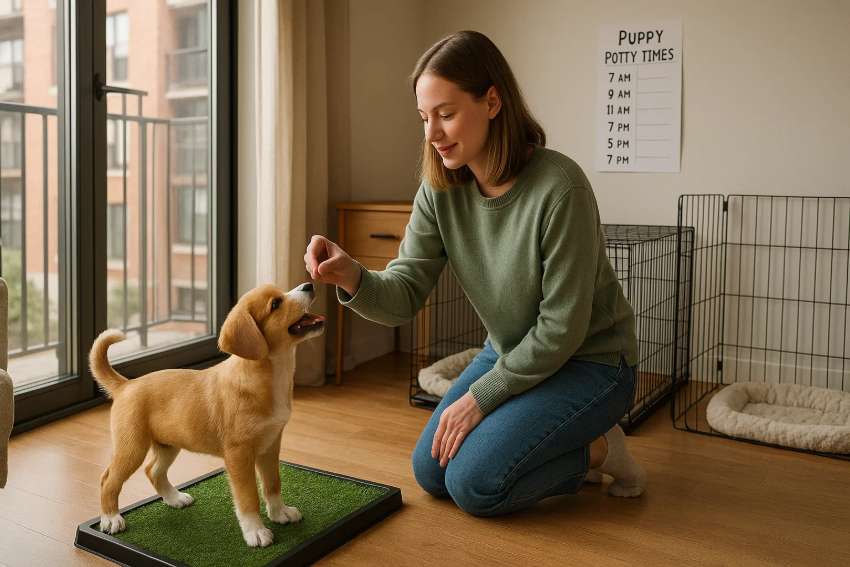
Use pee pads, a puppy toilet tray, artificial grass patch or a specific balcony/terrace area.
Best for:
Very young puppies in high-rise buildings.
Owners who cannot go outside every 2–3 hours.
Downside: you may need to later retrain the puppy to go outdoors instead of indoors.
2.3 Mixed strategy (indoor now, outdoor later)
Start with indoor pads or balcony for the first weeks.
Gradually move the toilet area closer to the door and eventually outside.
Useful in winter, bad weather, or for owners with limited mobility.
Decide one clear plan for the next 2–3 months and stick to it as much as possible. Mixed strategies still need consistency (for example, “pad in this corner + outside walks” – not “anywhere on the floor is fine”).
3. Set Up a Small “Puppy Zone” (Not Free Access to the Whole Apartment)
In the beginning, your puppy should not have free access to every room. Too much freedom makes accidents almost guaranteed.
Create a safe “puppy zone”:
A playpen attached to a crate
Or a small, puppy-proofed area (kitchen corner, hallway, etc.) blocked off with baby gates
In the puppy zone:
Put the bed or crate at one end.
If you are using pads, put the toilet area at the opposite end, as far as possible from the bed.
Offer toys, water and a chew to keep them busy.
Puppies naturally prefer not to soil their sleeping area. Making the space small helps them learn to hold it until you take them to the correct toilet spot.
4. Use a Crate Wisely (Optional but Very Helpful)
A crate can be a powerful potty training tool when used as a safe, cosy den – never as a punishment.
4.1 How a crate helps
Dogs rarely pee where they sleep if they can avoid it.
A correctly sized crate encourages your puppy to hold it until taken to the toilet area.
Helps prevent accidents when you can’t supervise closely (short periods only).
4.2 Crate basics
The puppy should be able to stand up, turn around and lie down comfortably – but not have huge extra space.
Use soft bedding (unless the puppy is chewing it dangerously).
Never leave the puppy crated for longer than their bladder can handle.
If you’re uncomfortable with crates, you can still potty train using a small pen + constant supervision, but you’ll need to watch your puppy more carefully.
5. Create a Toilet Schedule (Day & Night)
Consistency is everything. Set a schedule and follow it every day as closely as possible.
5.1 Daytime schedule example for a 2–3 month old puppy
Wake up → immediately carry or walk puppy to toilet spot
After breakfast → toilet
Every 2–3 hours → toilet break
After play sessions → toilet
After naps → toilet
Before bed → last toilet break
For each toilet break, go to the same spot (outdoor area, balcony patch or pee pad corner). This helps your puppy understand “this place is for peeing/pooping”.
5.2 Night-time
Very young puppies may need 1–2 toilet trips at night.
Set an alarm in the beginning (for example, 3–4 hours after bedtime).
Keep night toilet trips quiet and boring:
No play
No chatting or extra treats beyond the potty reward
6. The “Right” Way to Reward Toilet Success
How you react in the 10–30 seconds after your puppy pees or poops makes a huge difference.
6.1 When your puppy toilets in the correct place
Stay calm and quiet while they are going – don’t distract them.
As soon as they finish:
Mark it with a happy word like “Yes!” or “Good potty!”
Give a small, tasty treat within a couple of seconds.
Offer gentle praise and maybe a quick play if appropriate.
Your puppy learns: “Peeing here = good things happening.”
6.2 Use a toilet cue word
While they are starting to pee/poop, calmly say your chosen cue:
“Go potty”, “Toilet”, “Be quick” – choose something short.
Over time, this cue helps your dog understand what you want when you’re standing outside in bad weather or before bedtime.
7. How to Handle Accidents (Without Ruining Training)
Even with a perfect schedule, accidents will happen. How you respond is critical.
7.1 If you catch your puppy in the act
Say a short, neutral interrupter: “Ah-ah!” or “Oops!” – not shouting.
Quickly but gently pick them up (if small enough) or lead them to the toilet spot.
If they finish there, reward like normal.
7.2 If you find a puddle or poop later
Do not punish. Scolding after the event only teaches your puppy to:
Fear you when you approach pee/poop
Hide and toilet out of sight
Simply clean it thoroughly with an enzymatic cleaner (not just regular soap) to remove the smell.
Remember: your puppy is not being “spiteful”. They either couldn’t hold it or didn’t understand where to go. That’s a training problem, not a “bad dog”.
8. Special Tips for Apartment Living
8.1 Elevator and stair delays
If you know it takes a few minutes to reach the outside area:
Pick up very young puppies and carry them to avoid “leaks” on the way.
Give them a chance to go before stepping into lifts, if there’s a suitable area.
8.2 Balcony or indoor grass patches
Artificial grass trays or “balcony toilets” can be a lifesaver in high-rise buildings.
Treat them exactly like an outdoor toilet:
Consistent cue words
Immediate rewards when used correctly
8.3 Bad weather
Many puppies dislike rain, snow or wind at first.
Make outdoor trips short and business-focused:
Take them to the toilet area.
Wait calmly for them to go.
Reward, then head back inside.
9. Common Apartment Potty Training Mistakes
Giving too much freedom too soon
Letting the puppy roam the whole apartment before they’re reliable.
Solution: limit access; earn freedom room by room.
Inconsistent use of pee pads
Allowing the puppy to pee “around” the pad or on random rugs.
Solution: make the pad area clear, reward only for peeing on the pad, and clean accidents thoroughly.
Expecting too much too fast
Getting angry at a 10-week-old puppy for having accidents.
Solution: adjust expectations to their physical limits.
Using punishment
Rubbing noses in pee, shouting, or hitting.
Result: fear, confusion, and secret indoor toileting.
10. Example 2-Week Training Plan for an Apartment Puppy
Week 1: Foundation
Puppy confined to puppy zone + supervised time out of it.
Toilet trips every 2 hours (or more often for tiny breeds).
Use one consistent toilet spot (outdoor, pad or balcony).
Reward every successful pee/poop in the right place.
Expect many accidents; focus on observation and consistency.
Week 2: Building habits
Start to notice signs your puppy needs to go:
Sniffing, circling, suddenly wandering off, whining.
Respond quickly by taking them to the toilet spot.
If accidents are decreasing, allow supervised time in one extra room.
Keep the same schedule and reward pattern.
Most puppies will not be perfectly house-trained in just two weeks, but you should see a clear improvement in understanding and fewer accidents if you stay consistent.
11. When to Ask for Help
Consider speaking with your vet or a qualified dog trainer if:
Your puppy pees extremely frequently in tiny amounts (could be a medical issue).
They seem distressed, cry excessively, or never learn to use one spot.
You’ve been trying consistently for weeks with no progress.
Sometimes a small medical problem (like a urinary infection) or a simple training adjustment is all that’s needed to get back on track.
12. Final Thoughts: Apartment Puppies Can Be Fully House-Trained
Potty training a puppy in an apartment is absolutely possible. The key ingredients are:
Management: small puppy zone, maybe a crate, limited freedom
Routine: regular, predictable toilet breaks
Clear communication: same toilet spot, same cue words
Positive reinforcement: treats and praise for success, calm cleaning after accidents
Your future self – and your floors, rugs and neighbours – will thank you for putting in the work now. With patience and consistency, your apartment puppy will grow into a dog you can trust to hold it until the next walk, no matter how high up you live.