Many dogs in the US and Europe struggle when left alone. Some bark non-stop, some destroy furniture, and some even try to escape through doors or windows. If this only happens when you are gone (or getting ready to go), your dog may not be “naughty” – they may have separation anxiety.
This guide explains:
What separation anxiety really is (and what it’s not)
Common signs to watch for in your dog
Everyday mistakes that make the problem worse
Step-by-step home treatment tips to help your dog feel safer alone
When to talk to your vet or a behaviour professional
1. What Is Separation Anxiety in Dogs?
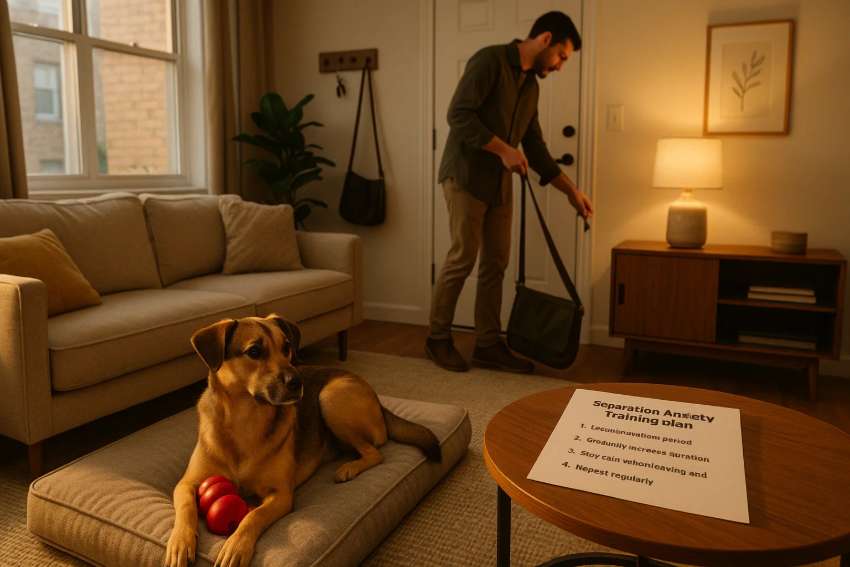
Separation anxiety is a panic-like response to being left alone or separated from a specific person. It is not simple boredom or “bad behaviour” – it’s a form of distress.
Dogs with separation anxiety often:
Become very anxious when they sense you’re preparing to leave (shoes, keys, bag, coat)
Show extreme stress only when alone or separated
Calm down quickly when their person returns
The dog isn’t trying to punish you. They are scared, confused or overwhelmed by being alone, and they’re doing whatever they can to cope or try to get you back.
2. Signs and Symptoms of Separation Anxiety
Not every noisy or destructive dog has separation anxiety. The key question is: does this behaviour happen only when the dog is alone or separated?
2.1 Common signs when left alone
Excessive barking, whining or howling that goes on for minutes or hours
Destructive chewing or scratching around:
Doors and door frames
Windows and blinds
Crate bars or edges
Accidents indoors (urine or stool) despite being house-trained
Pacing, drooling, panting or trembling
Attempts to escape:
Scratching or pushing at doors
Jumping fences or gates
2.2 Behaviour before you leave
Following you from room to room
Getting restless when you pick up keys, shoes or your bag
Whining, pacing, or blocking the door as you try to leave
2.3 What separation anxiety is not
Boredom alone: A bored dog may chew some things, but usually not with panic-level intensity.
Lack of house-training: If your dog has accidents even when you’re home, that’s a different issue.
Normal puppy protest: Many puppies cry a bit at first when left, but calm down quickly; true separation anxiety is more intense and persistent.
3. Common Causes and Risk Factors
Separation anxiety can develop for many reasons, often a mix of genetics, personality and life experiences.
Big changes in routine:
Owner returning to work after working from home
Moving house or country
Change in family (new baby, divorce, roommate leaving)
Rehoming and shelter history:
Dogs that have been rehomed, abandoned or spent time in shelters may be more vulnerable.
Lack of gradual alone-time training as a puppy:
Dogs never taught to feel safe alone suddenly face long separations.
Individual sensitivity:
Some dogs (and some breeds) are naturally more attached, sensitive or anxious.
Often, owners blame themselves (“I spoiled my dog”). But separation anxiety is usually not caused by love – it’s caused by fear and lack of coping skills when alone.
4. First Steps: Check for Medical Problems
Before assuming it’s behavioural, talk to your vet. Some medical issues can:
Increase urination or defecation
Cause pain that makes a dog more restless or vocal
Trigger sudden behaviour changes in older dogs (for example, cognitive decline)
Ask your vet to:
Rule out urinary tract infections, digestive issues and pain
Review your dog’s general health and medications
Once medical causes are excluded or managed, you can focus on behaviour training with more confidence.
5. Home Treatment Basics: Help Your Dog Feel Safe Alone
The main idea is simple but requires patience:
Teach your dog that being alone = safe, predictable and boring, not scary.
5.1 Avoid big, sudden absences at first
If your dog panics after 5 minutes alone, leaving for 4 hours will only make things worse.
Use management (see below) so your dog is not pushed far beyond their current comfort level.
5.2 Management tools (short-term support)
Dog sitters, neighbours or family: Ask for help so your dog isn’t alone for very long while you train.
Dog daycare: For some dogs, a few days per week can reduce alone time (not suitable for all personalities).
Take your dog with you when possible: Short errands, dog-friendly cafés or workplaces if appropriate.
These are not permanent solutions, but they protect your dog from constant panic while you build their independence training.
6. Gradual Alone-Time Training (Desensitization)
The most effective behaviour plan is called gradual desensitization: teaching your dog, step by step, that short separations are safe – and then gently increasing the time.
6.1 Step 1: Start with very small separations
Begin with your dog relaxed (after a walk, some play and calm settling).
Go to another side of a baby gate or close a door briefly:
For extremely anxious dogs, you might start with just 1–10 seconds out of sight.
Return before your dog becomes distressed.
The key is to always come back while your dog is still calm or only mildly aware, not already panicking.
6.2 Step 2: Add small pre-departure cues
Put on your shoes, pick up your keys, or grab your bag – then:
Go to the other room or just step outside the door for a few seconds.
Return, ignore for a few moments, then calmly say hello.
Repeat many times until these signals do not automatically mean “long scary absence”.
6.3 Step 3: Gradually increase the duration
Slowly build from seconds to minutes, then longer.
Change durations randomly (for example, 10s, 30s, 20s, 1 minute) instead of always increasing in a straight line; this prevents your dog from predicting “longer and longer” every time.
Always come back before they cross into clear distress (howling, scratching, frantic pacing).
You may need weeks or months of short, frequent sessions. Progress may be slow, but this is how real, stable confidence is built.
7. Make Alone Time More Pleasant: Enrichment and Comfort
7.1 Use special “alone-time-only” rewards
Stuffed KONGs or similar chew toys filled with:
Wet dog food, mashed banana, a little peanut butter (xylitol-free)
Long-lasting chews (appropriate for your dog’s size and chewing style)
Snuffle mats with dry food scattered inside
Give these only when you leave or start a training separation – they become part of a positive routine: “When human leaves, my special treats appear.”
7.2 Calming environment
Leave a light on if your dog is anxious in the dark.
Try low-volume background noise (TV, radio, white noise) if it seems to help.
Ensure your dog has:
A comfortable bed
Fresh water
A safe, not-too-large confinement area (room, pen or crate if they like it)
8. What Not to Do (Mistakes That Make It Worse)
Punishing the dog for anxiety behaviours
Shouting at chewed doors or accidents when you get home does not teach them “don’t do it next time”.
It only teaches them you are scary when you return, which can increase overall anxiety.
Letting them “cry it out” for hours
This doesn’t teach them to cope – it just puts them through repeated panic.
Making a huge drama when leaving or coming home
Very emotional goodbyes and reunions can reinforce the idea that separations are a “big deal”.
Instead, keep departures and arrivals calm and low-key.
Changing everything at once
Try to adjust your schedule slowly rather than going from “home all day” to “away 9–10 hours”.
9. Can Medication or Supplements Help?
In moderate to severe cases, your vet or a veterinary behaviourist might suggest:
Short- or long-term anti-anxiety medication to lower panic levels
Calming supplements or pheromone products (sprays, diffusers, collars) as part of a wider plan
Medication is not “cheating” and does not replace training. It can make the dog calm enough to benefit from behaviour therapy, especially when anxiety is extreme.
10. When to Call a Professional Behaviourist
Seek help from a qualified trainer or behaviourist (ideally one who uses positive, science-based methods) if:
Your dog severely damages doors, windows, or injures themselves trying to escape.
Neighbours complain about howling or barking that lasts a long time.
You feel overwhelmed, guilty or stuck, and nothing seems to help.
A professional can:
Help you assess the severity of the problem
Design a step-by-step desensitization plan tailored to your schedule
Work together with your vet if medication might be useful
11. Frequently Asked Questions
Q1: Should I get another dog so my anxious dog isn’t alone?
Sometimes another dog helps with loneliness, but it does not always fix panic about being without a specific person. In some cases, you just end up with two anxious dogs. Address the underlying anxiety first before adding a second dog.
Q2: Will my dog “grow out of it”?
Mild clinginess may improve as puppies mature, but true separation anxiety usually does not disappear on its own. Without training, it often gets worse.
Q3: Is crate training good or bad for separation anxiety?
It depends on the dog:
If your dog finds the crate comforting, it can be part of a safe alone-time setup.
If your dog panics in the crate (chewing bars, hurting themselves), forcing crating can make anxiety worse.
12. Final Thoughts: Separation Anxiety Is Treatable
Separation anxiety can feel exhausting and emotional – for you and your dog. But it is not a sign that your dog is “spoiled” or that you’ve failed as an owner. It’s a sign that your dog needs:
Gentle, structured training to learn that alone time is safe
Management to prevent repeated panic episodes
Possibly medical support in more serious cases
With patience and consistency, most dogs can improve dramatically. Even if your lifestyle can’t be perfect, every step that reduces your dog’s fear makes their life – and yours – calmer and happier.