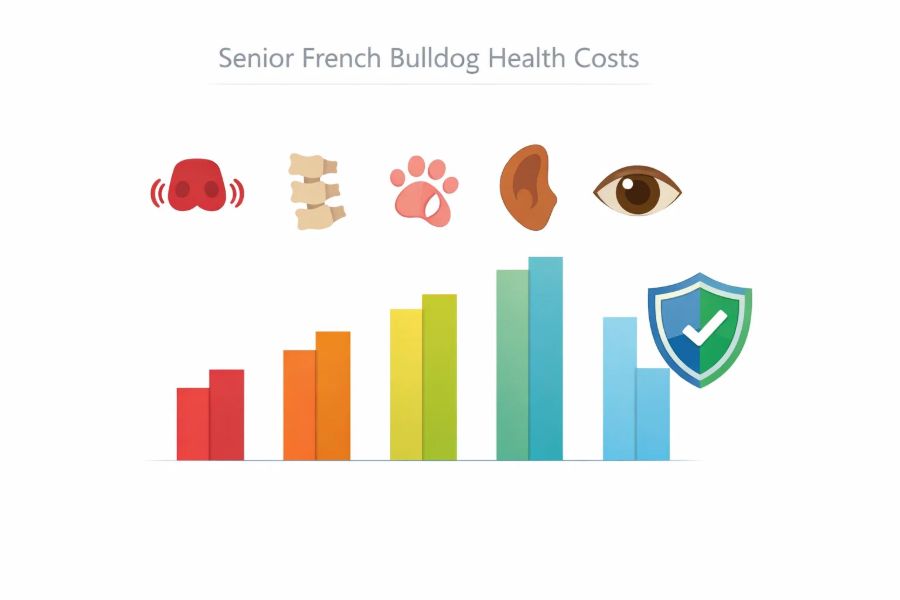
French Bulldogs are lovable, people-focused dogs—but biologically, they’re also one of the highest-risk popular breeds for expensive medical problems, especially as they enter their senior years (often ~7+). Large datasets and veterinary reports consistently flag the breed’s heavy burden of breathing disease (BOAS), skin/allergy disease, eye problems, ear infections, and spinal disorders (including IVDD and vertebral malformations).
So in 2026 the question isn’t “Does insurance ever pay off?”—it’s: Will it pay off for your older Frenchie, given high premiums, age limits, and exclusions for pre-existing conditions?

1) The senior Frenchie reality: the “genetics + anatomy” cost stack
French Bulldogs are a brachycephalic (“flat-faced”) breed. Their skull shape and soft tissues predispose many of them to Brachycephalic Obstructive Airway Syndrome (BOAS), and veterinarians have publicly expressed concern about the welfare consequences of these traits.
Meanwhile, population studies point to very high rates of chronic and recurring issues:
A Germany survey-based study reported high owner-reported/diagnosed rates of allergies/hypersensitivities (52%), otitis (36%), stenotic nares (35%), elongated soft palate (26%), hemivertebrae (25%), intervertebral disc herniation (18%), plus skin fold dermatitis (20%) and eye issues.
VetCompass work from the UK highlights predisposition to problems including breathing issues, skin fold dermatitis, cherry eye, eye ulcers, and patellar luxation.
French Bulldogs can show very high prevalence of vertebral malformations (hemivertebrae) on imaging—even when neurologically normal—meaning spinal findings are common and clinically tricky.
As dogs age, the “cost stack” grows: more chronic disease management, more diagnostics, and a higher chance that something becomes pre-existing (which matters a lot for insurance).
2) The big-ticket problems that drive the “worth it” calculation
Below are the conditions most likely to make a senior Frenchie financially risky and the most likely to collide with insurance fine print.
Table: Common French Bulldog issues, typical costs, and insurance “gotchas”
Costs vary widely by country/city, emergency vs scheduled care, and specialist vs GP. These are typical order-of-magnitude ranges from veterinary/industry sources.
| Condition (common in Frenchies) | What it looks like | Typical vet costs (examples) | Why it matters for insurance |
|---|---|---|---|
| BOAS / airway obstruction | noisy breathing, heat intolerance, collapse, exercise issues | Corrective airway surgery often ~$3,000–$5,000 (varies by severity/region). | If signs existed before policy start, it may be treated as pre-existing (or excluded under some policies’ hereditary/congenital language). |
| IVDD / disc extrusion / spinal pain | pain, weakness, paralysis; urgent neurologic emergency | IVDD surgery is often cited $2,000–$8,000 (not always “all-in”). Specialty “all-in” quotes can be much higher (e.g., $10,000–$15,000 including MRI, hospitalization, rehab). | Orthopedic/neuro issues are expensive and may face waiting periods; once noted, they’re commonly treated as pre-existing for future episodes. |
| Ear infections (otitis externa), often linked to allergy/skin disease | head shaking, odor, pain, recurrent infections | Claim data example: average otitis treatment ~$209 (U.S. insurer claim dataset). UK media example: ~£342 for ear infection treatment. | Chronic recurrence can lead to repeated claims—but if “chronic otitis” or allergy is documented pre-policy, it may be excluded. |
| Allergies / atopic dermatitis / skin fold dermatitis | itching, hot spots, recurrent infections, fold inflammation | Often requires lifelong management (medications, shampoos, rechecks, treating infections). | The #1 “trap” for seniors: even mild earlier itchiness may be interpreted as pre-existing once diagnosed. |
| Eye issues (e.g., corneal ulcers, cherry eye) | squinting, tearing, red mass at eyelid | Can range from meds to surgery; breed predisposition noted in VetCompass materials. | Eye problems can become recurrent and may become pre-existing after first diagnosis. |
| Patellar luxation / orthopedic issues | skipping gait, lameness | Often requires imaging and sometimes surgery; predisposition reported for the breed. | Orthopedic waiting periods and exclusions vary by policy—read the sample contract carefully. |
Bottom line: Frenchies have multiple pathways to “high cost”—but for seniors, the decision hinges on whether these issues are already present (or have symptoms already documented).

3) What pet insurance usually covers (and the senior-specific pitfalls)
Most pet insurance is reimbursement insurance: you pay the vet, then the insurer reimburses a percentage after deductible—though some companies offer direct pay to certain clinics.
Generally covered (accident & illness plans):
emergencies, injuries, diagnostics, hospitalization, surgery, medications (policy-dependent).
Common exclusions that matter a lot for senior Frenchies:
Pre-existing conditions (nearly universal), including conditions with signs before you enrolled or during waiting periods.
Waiting periods (time after purchase when claims aren’t covered).
Hereditary/congenital condition handling varies: many plans cover them if not pre-existing, but some policies may exclude or restrict them—read the policy wording.
Age limits at enrollment exist in some markets; for example, one Singapore policy document specifies the pet must be younger than 9 years old at first commencement, and local explainers note some insurers cap entry ages around 9.
4) 2026 costs: what you might pay for a senior French Bulldog policy
Premiums depend on country, zip code, plan limits, deductible, and reimbursement rate. But in 2026, the pattern is stable: French Bulldogs cost more than average dogs, and seniors cost much more than young adults.
U.S. snapshots (2025–Feb 2026 sources):
Average dog insurance cost cited around $47–$52/month for a mid-level plan structure in some analyses.
French Bulldog-specific estimates commonly land higher; one analysis puts French Bulldog average around $63/month. Another estimates ~$83/month for a $5,000 annual limit style policy and ~$130/month for unlimited coverage (example structure).
Age can be the deal-breaker: one insurer’s explainer shows French Bulldog premiums rising steeply, with an example around $130–$135/month at age 7.
UK snapshot (useful as a “different market” comparison):
A comparison site reports French Bulldog policies averaging higher than the general dog average (example: ~£24.54 vs £14.38 per month).
UK reporting in early 2026 suggests median annual lifetime premiums around £247 for dogs, with older-pet premiums holding steadier than mid-age drops.
5) A simple “break-even” way to decide if it’s worth it for a senior Frenchie
Think in expected value terms:
What you pay for insurance each year: premium + deductible + co-insurance (on claims)
What you avoid paying: the reimbursed portion of eligible bills
Example (not a quote; just math)
If a plan costs $130/month (~$1,560/year) with $500 deductible and 80% reimbursement, and your dog has an eligible $5,000 event:
Reimbursable base = $5,000 − $500 deductible = $4,500
Reimbursement ≈ 80% × $4,500 = $3,600
Your out-of-pocket for that event ≈ $1,400 (deductible + 20% share)
Add annual premium ≈ $1,560
Total with insurance ≈ $2,960 vs $5,000 without (a large win)
But if you have no big eligible claims, you likely lose the premium amount that year.
Table: “Worth it?” scenarios for seniors (conceptual)
| Scenario in the next 12 months | Typical outcome for a senior Frenchie | Insurance tends to be… |
|---|---|---|
| No major illness/injury; only routine care | Common (and routine care is often not covered without add-ons). | Not worth it financially (you mainly pay premium) |
| 1 medium event (imaging + meds + follow-ups) | Possible in seniors | Maybe worth it, depends on annual limit and exclusions |
| 1 major event (BOAS surgery, IVDD surgery, hospitalization) | Frenchies have multiple pathways to a big bill | Often worth it if the condition is not pre-existing and limits are adequate |
6) The “2026 answer”: when senior French Bulldog insurance is usually worth it
It’s more likely worth it if:
Your dog is still eligible to enroll (age rules vary).
Your dog has few or no documented chronic issues (so you’re not buying a policy that excludes most of what you need).
You choose a plan structure built for “catastrophes” (higher deductible, strong annual limit, coverage for diagnostics/hospitalization).
You can handle the cash-flow (most plans reimburse after you pay).
It’s less likely worth it if:
Your senior Frenchie already has diagnosed BOAS/allergies/ear disease/spinal issues (or even documented symptoms), because those may be treated as pre-existing and excluded.
Premiums are so high that you’d be better off “self-insuring” with a dedicated medical fund—especially if your dog’s likely expenses are mostly chronic management that insurers might exclude after prior signs.
Practical alternative for many senior Frenchie owners:
Use an “emergency fund” strategy (automatic monthly savings into a vet-only account) and consider accident-only coverage if comprehensive plans are too expensive or exclusions are too broad. (Accident-only is commonly cheaper than accident+illness.)
References (bibliography)
Hinze, M.A.G. et al. (2025). “Health status and disease prevalences in French bulldogs in Germany…” (survey-based study).
Royal Veterinary College (VetCompass) French Bulldog breed summaries and research notes (2023).
Tufts University Cummings School of Veterinary Medicine (2023). “Frenchies are #1 … and veterinarians are concerned.”
Kiplinger (2026). “What pet insurance does and doesn’t cover.”
Investopedia (overview). “What is not covered by pet insurance?”
AP / NerdWallet distributed explainer. “2 things pet insurance will cover (and 3 it won’t).”
WSJ Buy Side (Feb 2026). Pet insurance cost and best companies (pricing snapshots and factors).
Forbes Advisor (2025). French Bulldog pet insurance cost estimates.
Lemonade explainer (2025). Example French Bulldog premiums by age (illustrative).
SustainableVet (2025). BOAS surgery cost discussion (typical range).
PetMD (2025). IVDD overview and surgery cost range (varies by location).
Southeast Veterinary Neurology (specialty clinic example). “All-in” IVDD surgery cost estimate.
MoneySuperMarket (UK). French Bulldog insurance average vs overall dog average (comparison-site estimate).
The Guardian (Feb 2026). UK pet insurance pricing trends and median annual lifetime premiums.
Liberty Insurance Singapore PetCare policy wording (age eligibility example; exclusions).
Singapore Legal Advice (2025). Notes on age limits and exclusions in Singapore policies.
Pets Best blog (2023). Ear infection claim cost figure (insurer claims dataset).
Forbes Advisor UK (2023). Example cost to treat ear infection (UK).