Can they really “predict” heart issues before your vet?
As a zoologist looking at this from the lens of animal physiology + sensing technology, the honest answer is:
These collars can sometimes detect early warning signals that correlate with heart trouble (especially rising resting respiratory rate and resting heart rate), but they do not reliably “diagnose” or truly “predict” heart disease the way a veterinarian can with auscultation, ECG, chest X-rays, and echocardiography.
What they can do well in 2026 is continuous trend tracking—spotting changes that many owners miss, then prompting a vet visit sooner.
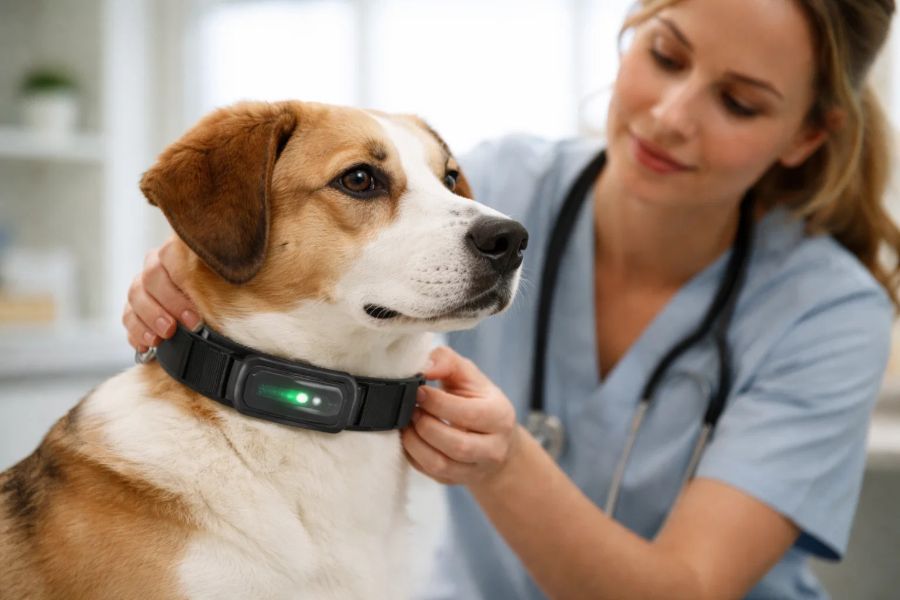
1) What “predicting heart issues” really means (biologically)
Most canine/cat heart diseases progress quietly for a long time. The first detectable changes are often physiological trends, not dramatic symptoms:
Resting / sleeping respiratory rate (RRR/SRR) rises when fluid starts accumulating in the lungs (congestive heart failure risk) and is widely used in monitoring left-sided cardiac disease.
Resting heart rate (RHR) may drift upward with stress, pain, fever, dehydration, or worsening cardiopulmonary function—useful as a signal, not a diagnosis.
Activity tolerance often declines before owners consciously notice (“slower walks,” “more rests,” “less playful”). Activity/sleep trackers can quantify that change.
A strong example of “early warning” value: one 2025 dataset describing dogs in their natural environment reported a CHF event characterized by increased respiratory rate, preceded by a ~120-day gradual heart-rate increase that the owner didn’t notice—exactly the kind of slow trend wearables are built to detect.
2) The core limitation: sensing is hard on animals
Pet wearables face challenges that are bigger than most human wearables:
Motion artifacts (dogs move in bursts; collars shift; fur thickness varies)
Species/breed differences in normal HR/RR ranges
Rest-only measurement windows for many systems (movement masks subtle pulsations)
So: even good collars will throw false positives (alert, but dog is fine) and false negatives (missed issues). Treat alerts as “check this,” not “your dog has heart disease.”
3) The 5 best AI-powered health collars (2026 picks)
Pick #1 — PetPace Smart Health Monitoring Collar
Best for: the most “clinical” continuous monitoring (multi-vital approach)
PetPace emphasizes heart rate, HRV, respiration, temperature, posture/activity, and AI-driven alerts, aiming at early illness detection and vet-sharing workflows.
Peer-reviewed work suggests PetPace-collected data can discriminate health states in at least some contexts (e.g., activity differences associated with osteoarthritis pain), supporting that it’s more than a toy pedometer.
Pick #2 — Invoxia Minitailz / Biotracker
Best for: AI analysis of resting heart + respiratory rate with a consumer-friendly app
Invoxia states it continuously measures resting heart rate and respiratory rate and uses AI to detect unusual variations.
Their own documentation notes the key constraint: biometric measurement is typically not possible while the dog is active, so the AI looks for rest moments.
Pick #3 — Tractive (Dog tracker with RHR/RRR monitoring)
Best for: a mainstream GPS tracker that also adds resting HR + resting RR baselines and alerts
Tractive announced heart and respiratory monitoring features (baseline building + daily tracking).
Independent tech coverage also notes Tractive’s dog tracker includes heart/respiratory monitoring and alerts when elevated (rest/sleep sampling).
Pick #4 — Fi Series 3+
Best for: behavior-based health flags + strong GPS (useful when “heart problems” show up first as subtle behavior shifts)
Fi markets AI-driven detection of behaviors such as scratching, licking, barking, eating, drinking, plus activity/rest trend tracking.
These signals can’t measure cardiac function directly, but they can reveal early deterioration (less activity/rest changes) that justifies a checkup.
Pick #5 — FitBark (collar-mounted monitor)
Best for: research-backed activity/sleep trend tracking (a practical “early decline” detector)
FitBark has peer-reviewed validation work showing correlations between FitBark activity outputs and observed activity in several settings.
FitBark also highlights adoption in research/vet-school contexts, which is a positive sign for data seriousness (though it still doesn’t replace medical diagnostics).
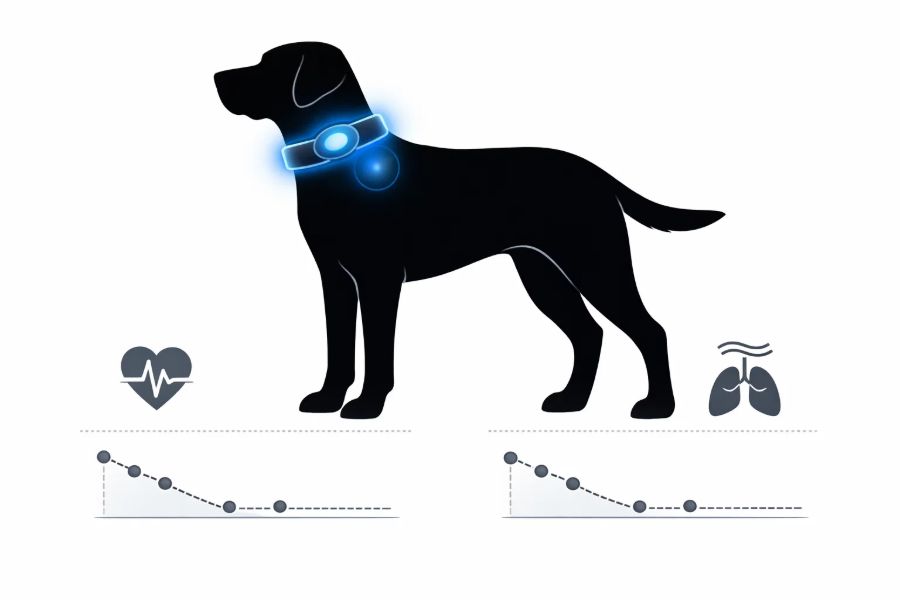
4) Comparison table: what each can (and can’t) do for heart early-warning
| Device (2026) | Measures HR/RR? | What AI is mainly doing | Heart “early warning” value | Biggest limitation |
|---|---|---|---|---|
| PetPace | Yes (HR, HRV, respiration, temp, etc.) | Converts multi-vital streams into alerts + sharable trend data | Strongest overall physiology-first approach | Cost + collar fit compliance; still not a diagnostic tool |
| Invoxia Minitailz | Yes (resting HR & RR) | Detects “unusual variations” from baseline; chooses rest moments | Very relevant because RHR/RRR trends can precede CHF signs | Mostly rest-only measurement; movement masks signals |
| Tractive (Dog) | Yes (resting HR & RR) | Baseline-building + anomaly alerts + weekly summaries | Good “everyday owner” early warning | Exact sensing method/accuracy varies with conditions; rest-only trends |
| Fi Series 3+ | Not positioned as HR/RR-first | Detects behavior pattern changes (scratching/licking/barking/eating/drinking) | Indirect (flags reduced tolerance/behavior shifts that prompt vet visit) | Not a cardiopulmonary measurement device |
| FitBark | No (activity/sleep focus) | Finds deviations in activity/rest over time | Indirect (great for “my dog is slowing down” quantification) | Doesn’t tell you why the dog is slowing down |
5) So… can they “predict heart issues before your vet”?
What they can realistically do
Detect trend shifts earlier than humans notice, especially slow, subtle changes (RHR/RRR creep, sleep changes, activity drop).
Create objective baselines, which is incredibly useful because “normal” varies by individual. Tractive explicitly builds a baseline over ~7 days for resting metrics.
Prompt earlier vet diagnostics, which is where the real life-saving value often lies.
What they cannot reliably do
Diagnose a heart murmur, valve disease stage, cardiomyopathy type, or specific arrhythmia. For that you need veterinary diagnostics and clinical interpretation (ACVIM staging for common diseases like MMVD is based on clinical findings, imaging, etc.).
Guarantee correctness in all real-world conditions (fur, collar placement, motion).
Best way to think about it:
A good AI collar is an early warning smoke alarm, not a cardiologist.
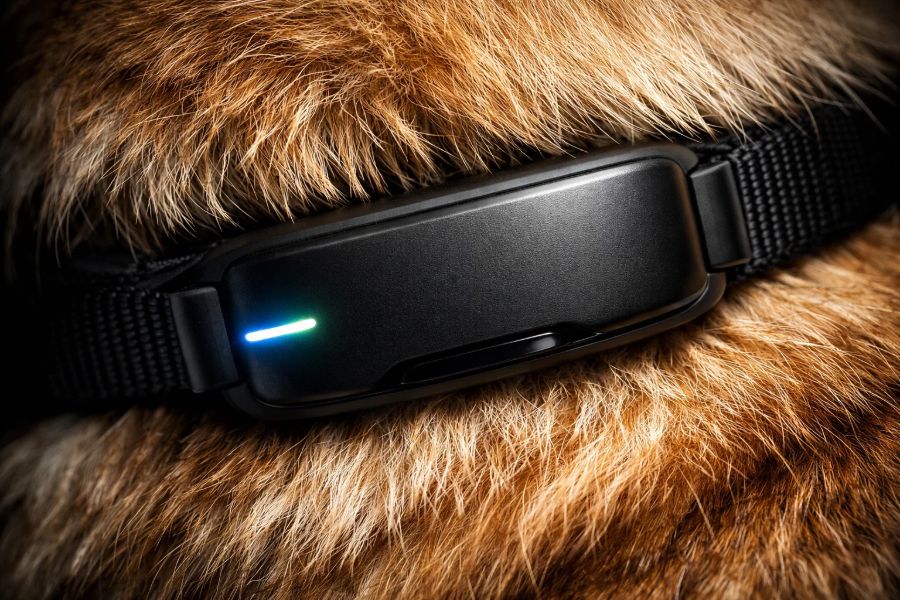
6) A vet-smart workflow if your collar flags “heart-related” anomalies
If your collar reports persistently elevated resting RR or resting HR for multiple days, consider:
Re-check basics first: collar fit, battery, recent unusual activity, heat stress, pain, excitement.
Look for clinical red flags: coughing at rest, fainting, blue/pale gums, labored breathing, sudden exercise intolerance → urgent vet.
Schedule a vet evaluation for trends: bring graphs/logs; ask about auscultation, chest X-ray, ECG, and echocardiography if warranted.
7) 2026 buying note you shouldn’t miss
If you were considering Whistle: Tractive acquired Whistle and the Whistle platform/devices were reported to stop functioning on Aug 31, 2025, so it’s not a safe “2026 buy” unless it’s explicitly migrated/replaced.
References (cited sources)
PetPace — “How it works” (vitals monitored: heart rate, HRV, respiration, temperature, posture, etc.).
PetPace — product overview emphasizing AI insights/alerts.
de Ortiz, A. R. et al. (2022). Study suggesting PetPace collar can detect differences between healthy dogs and OA-pain states.
Invoxia — Minitailz/Biotracker page (AI analysis; resting HR & RR).
Invoxia — explanation that HR/RR measurement works best at rest; AI selects measurement moments.
Tractive — press release / documentation for resting heart + respiratory monitoring and baseline approach.
Wired review noting Tractive dog tracker includes resting HR/RR monitoring and alerts (rest/sleep sampling).
Fi Series 3+ coverage (behavior detection and accuracy claims; Apple Watch integration).
Fi/industry announcement about behavior detection (scratching/licking/barking/eating/drinking).
Porciello, F. et al. (2016). Sleeping/resting respiratory rates used to monitor cardiac disease and identify CHF.
Chetboul, V. et al. (2025). Natural-environment monitoring; example CHF event preceded by long HR trend increase.
Keene, B. W. et al. (2019). ACVIM consensus for diagnosis/treatment (MMVD staging context).
Haghi, M. et al. (2025). Viewpoint on wearable challenges (motion artifacts, animal physiology differences).
Colpoys, J. et al. (2021). FitBark activity monitor evaluation/validation.
FitBark research adoption statement (research use cases).
The Verge (2025). Whistle platform/device shutdown timing after Tractive acquisition.