Few marine rivalries are as famous as Sperm Whale vs Giant Squid. For more than a century, this matchup has captured scientific and public imagination because it happens in the deep ocean, far below ordinary human view. A sperm whale (Physeter macrocephalus) is the largest toothed whale on Earth and a specialist deep-diving hunter that feeds mainly on squid. A giant squid (Architeuthis dux) is one of the ocean’s largest invertebrates, armed with long feeding tentacles, powerful sucker rings, and a body built for life in the dark mesopelagic and bathypelagic depths. The broad scientific consensus is that sperm whales do prey on giant squid, even though humans have almost never directly observed a live fight between them.

The short zoological answer is this: the sperm whale is usually the likely winner because giant squid are prey, not ecological equals, in this relationship. But that does not mean the squid is defenseless. Giant squid can and do fight back, and some of the best-known evidence comes from the circular scars left by squid suckers on the heads and bodies of sperm whales. In other words, this is less a “fair duel” than a dramatic example of a giant predator tackling dangerous prey in the deep sea.
Quick Comparison Table
| Feature | Sperm Whale | Giant Squid | Why It Matters |
|---|---|---|---|
| Scientific name | Physeter macrocephalus | Architeuthis dux | Defines the classic species pair |
| Typical role | Deep-diving apex predator | Large deep-sea cephalopod prey/predator | Predator-prey, not equal competitors |
| Approximate adult size | Adult males can reach about 24 m and up to about 50 metric tons | Giant squid can reach very great total lengths, mainly because of the tentacles | Whale has overwhelming mass advantage |
| Main weapons | Large conical teeth in lower jaw, suction feeding mechanics, immense body power, echolocation | Eight arms, two long feeding tentacles, powerful suckers and sucker rings | Squid can grip and slash, but whale can overpower |
| Main habitat | Deep offshore waters worldwide | Deep ocean, rarely seen alive | Most encounters happen far below the surface |
| Best strategy | Locate, pursue, seize, swallow | Detect predator, resist, entangle, escape if possible | Whale attacks; squid defends |
| Likely outcome | Usually favored | Dangerous but usually prey | Evidence strongly points to whale dominance |
These values are generalized because giant squid remain difficult to measure in life and much of what we know comes from stranded animals, remains, and indirect evidence.
Meet the Sperm Whale
The sperm whale is the largest living toothed predator. Britannica notes that males can reach roughly 24 meters in length and up to 50 metric tons in mass, and that sperm whales feed primarily on cephalopods, including giant squid. Their biology is heavily specialized for deep hunting: they dive to great depths, use powerful echolocation, and capture prey in darkness where vision is limited.
A 2016 tagging study on sperm whales showed fine-scale prey-capture behavior during deep foraging. The authors found that sperm whales switch into a terminal “buzz” phase during prey capture, linking sound production to close-range hunting attempts. That is important because it shows sperm whales are not simply wandering into squid by accident; they are active, highly adapted deep-sea pursuit predators.
Meet the Giant Squid
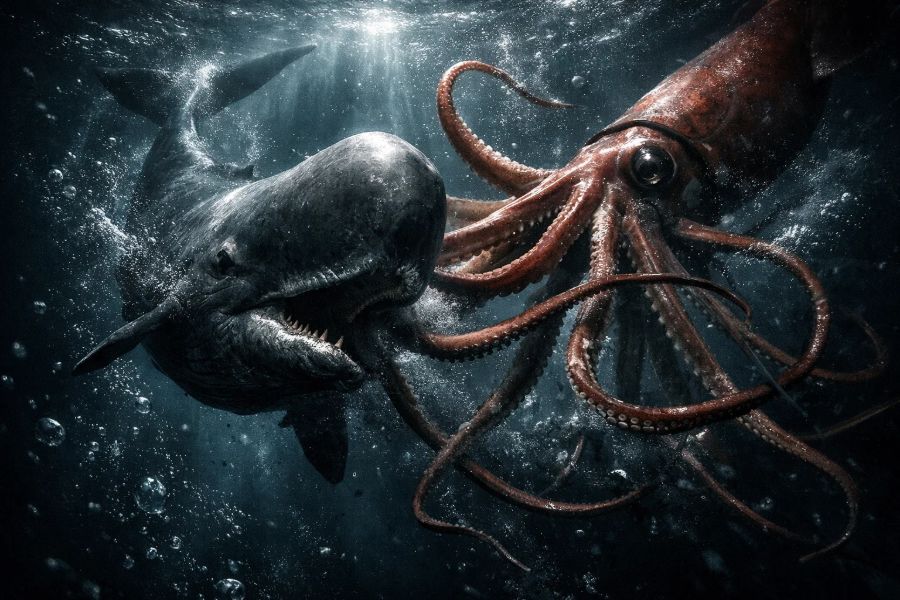
The giant squid is one of the largest invertebrates ever known. Britannica describes it as a huge cephalopod with a mantle, eight arms, and two long feeding tentacles equipped with suckers and sucker rings for capturing prey. Like other squid, it is an active predator, but on a scale that makes it one of the deep ocean’s most extraordinary animals.
Even so, giant squid remain hard to study. A technical review on large squid observations notes that direct observation of sperm whale–large squid interactions in the wild has been extremely limited, largely because both animals operate at great depth. That means much of the famous story comes not from watching live battles, but from piecing together physical evidence.
Size: Why the Whale Usually Has the Advantage
In overall bulk, the sperm whale is in a different league. Britannica states that an adult male sperm whale can reach about 24 meters and 50 metric tons, whereas giant squid, although capable of impressive total length, are nowhere near whales in mass. That size difference matters because body mass determines how much force an animal can bring to grappling, acceleration, shock absorption, and simple dominance during prey capture.
This is one reason the most scientifically honest framing is “predator vs dangerous prey,” not “equal rivals.” A giant squid can entangle and wound, but it does not usually have the raw mass to physically dominate a sperm whale. The whale’s advantage is not just length; it is total power.
Weapons: Teeth and Body Power vs Tentacles and Suckers
The sperm whale’s lower jaw carries large conical teeth, while the rest of its head and mouth are adapted for seizing soft-bodied prey. Britannica identifies squid as a major diet component, and the whale’s hunting system combines echolocation, close-range prey interception, and strong suction-feeding dynamics.
The giant squid’s best weapons are its arms and especially its long feeding tentacles. Britannica notes that those tentacles carry suckers and rings used to grasp prey. Smithsonian’s page on giant squid sucker marks explains that the circular scars commonly found on sperm whales are made by those powerful suckers, providing direct physical evidence that squid resist capture and make substantial contact during encounters.
So this is not a one-sided nonviolent feeding event. The whale may usually win, but the squid can leave visible, lasting marks. Older sperm whales often carry many such scars, which strongly suggests repeated encounters over a lifetime.

How Do We Know They Really Fight?
Humans have almost never watched a full live sperm whale–giant squid fight in the open ocean. The American Museum of Natural History explicitly notes that although this encounter is famous, it has never been directly witnessed in full by humans in the way popular art often imagines.
Instead, the evidence comes from several lines that point in the same direction. First, sperm whales are known squid specialists and giant squid are listed among their prey. Second, sperm whales often bear circular scars consistent with giant squid sucker marks. Third, giant squid remains have been found in sperm whale stomachs and related deep-sea cephalopod studies have long connected whale predation with squid ecology. Together, those lines make the interaction scientifically secure even without a complete filmed battle.
The Deep-Sea Context Matters
This rivalry happens in darkness. Sperm whales hunt far below the surface, using sound to find prey. Giant squid live in deep water where light is scarce and encounters are likely sudden, close, and violent. The very environment of the deep sea shapes the matchup: the whale is a mammal adapted to deep pursuit, while the squid is a soft-bodied ambush-capable predator trying not to become food itself.
Some researchers have proposed that giant squid eyes may help detect disturbances caused by approaching whales in the deep ocean. A 2013 paper summarized by Monash University notes that sperm whale predation has been hypothesized as an important selective pressure in discussions of giant squid sensory ecology. Even where scientists debate the exact evolutionary interpretation, the predator-prey connection itself is central.

So Who Wins?
If the question is who usually wins in a real biological encounter, the answer is the sperm whale. Sperm whales are the established predators in this relationship, and giant squid are among the dangerous prey they consume. The whale’s size, power, echolocation-guided hunting, and repeated evolutionary history of taking large squid all point in that direction.
If the question is whether the giant squid can hurt the whale, the answer is also yes. The squid’s tentacles and suckers can leave deep circular scars, and the existence of those scars is one of the clearest pieces of evidence that these encounters are not easy or risk-free for the whale.
So the most accurate verdict is this: the sperm whale is the dominant predator, but the giant squid is one of the most formidable prey animals in the deep ocean. It loses more often than it wins, but it does not disappear quietly.
The Broader Ecological Story
The deeper scientific interest in this matchup is not just spectacle. It helps explain how deep-ocean food webs function. Large squid are major prey for sperm whales and other toothed whales, while themselves acting as predators on fishes, crustaceans, and other cephalopods. That makes the whale-squid interaction a core part of deep pelagic ecology rather than an isolated curiosity.
The same pattern appears even beyond giant squid. Britannica’s colossal squid entry notes that sperm whales prey on adult colossal squid, reinforcing the broader point that large deep-sea squid are important prey for large toothed whales.
Conclusion
A zoologist would summarize Sperm Whale vs Giant Squid this way:
The sperm whale is the likely overall winner because it is the established predator.
The giant squid is the dangerous prey that turns predation into a struggle.
That is why this rivalry remains so compelling. It is not a fantasy monster fight. It is a real deep-sea predator-prey interaction between two of the ocean’s most extraordinary giants, one built to hunt in darkness and the other built to resist being eaten just long enough to matter.
References
Britannica. Sperm whale. Diet, size, and natural history.
Britannica. Giant squid. Body structure, tentacles, and general biology.
Smithsonian Ocean. Giant Squid Sucker Marks. Evidence from scars on sperm whales.
American Museum of Natural History. Sperm Whale & Giant Squid: Evidence of Conflict. Explanation of how the interaction is inferred despite lack of direct full observation.
Fais, A. et al. 2016. Sperm whale predator-prey interactions involve chasing and buzzing, but no acoustic stunning. Fine-scale evidence on sperm whale prey capture.
Kubodera review / Okinawa Churashima Foundation. Observations of mesopelagic large squids in the wild. Limits of direct observation and relevance to whale-squid interactions.
Schmitz, L. et al. 2013. Potential enhanced ability of giant squid to detect sperm whales... Summary of predator-driven sensory-ecology hypothesis.
Britannica. Colossal squid. Context for large deep-sea squid as sperm whale prey.