At first glance, Mantis vs Giant Hornet sounds like a straightforward insect duel: one animal built to grab and crush, the other armed with speed, jaws, and a painful venomous sting. Zoologically, however, this comparison is trickier than it looks. “Mantis” refers to thousands of predatory insects in the order Mantodea, which vary greatly in size and strength, while “giant hornet” most commonly refers to the northern giant hornet (Vespa mandarinia), also widely called the Asian giant hornet. The matchup therefore depends heavily on which mantis species is involved, whether the hornet is a worker or queen, and whether the encounter begins in the air, on vegetation, or at point-blank range.
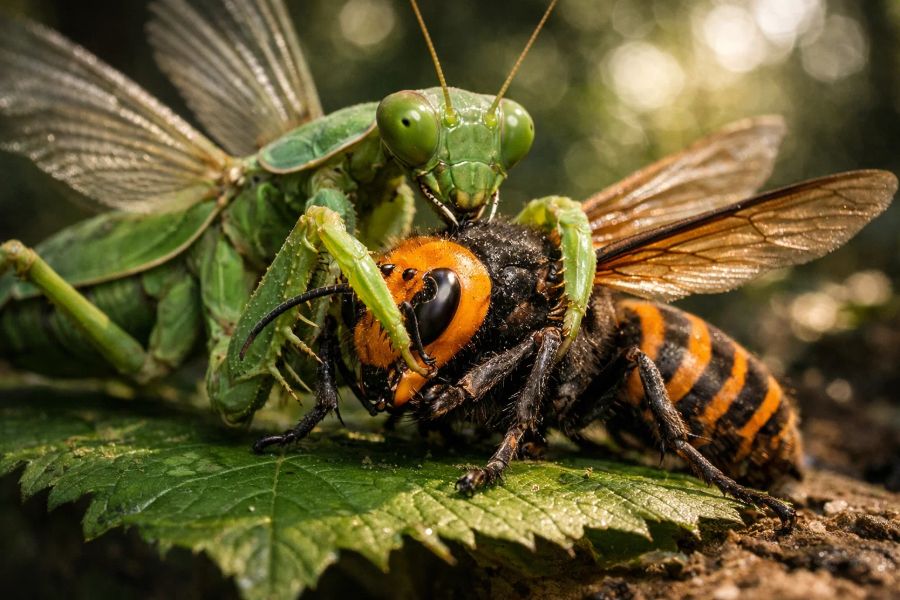
The short scientific conclusion is this: a large mantis can overpower a giant hornet if it secures the hornet in its raptorial forelegs before being stung, but the hornet has the edge if it keeps distance, attacks repeatedly, or lands an early sting or biting assault. In other words, this is a contest between control and counterattack. The mantis wants one clean catch; the hornet wants to avoid being pinned and punish the mantis immediately.
Quick Comparison Table
| Feature | Mantis | Northern Giant Hornet |
|---|---|---|
| Scientific scope | Order Mantodea, many species | Vespa mandarinia |
| General body plan | Sit-and-wait ambush predator with grasping forelegs | Large eusocial wasp with strong mandibles, wings, and sting |
| Main weapons | Spined raptorial forelegs, biting mouthparts, camouflage, fast strike | Mandibles, repeated stinging, flight, alarm/defensive aggression |
| Main strength | Can seize prey instantly and hold it in a vice-like grip | Can attack from range, maneuver in flight, and sting repeatedly |
| Main weakness | Vulnerable if prey resists before full control is established | Vulnerable if pinned and bitten before it can sting effectively |
| Best range | Point-blank ambush distance | Short to medium range, especially with flight room |
| Likely winner | Large mantis in a clean ambush | Giant hornet in a messy or repeated engagement |
This summary is based on general mantis morphology and natural history, plus published and reference material on Vespa mandarinia.
The Mantis: A Precision Ambush Predator
Mantises are classic ambush predators. Britannica notes that they rely heavily on vision, have unusually mobile triangular heads, and possess specialized front legs designed for seizing and holding prey. Many species sit motionless in vegetation, using camouflage to disappear into leaves, stems, bark, or flowers until prey comes within striking range.
A recent peer-reviewed review of mantis biology likewise describes mantises as important predators that capture a wide range of prey, including other insects and occasionally even small vertebrates. That matters because it reminds us that mantises are not fragile novelty insects; many are effective, fast, and surprisingly strong relative to their size. Some of the larger species can subdue prey that looks intimidatingly dangerous.
What makes a mantis dangerous is not brute force alone. It is the strike mechanism. The forelegs shoot outward, lock prey between rows of spines, and hold it close while the mantis begins eating. If that first grab lands across the thorax or behind the head, the prey may lose the ability to fight back effectively. Against many flying insects, that first fraction of a second decides everything.
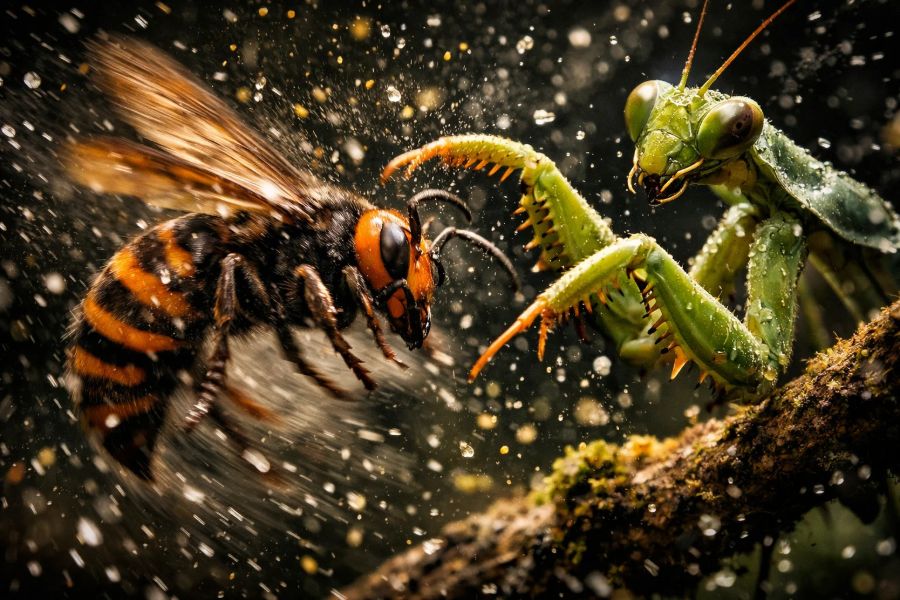
The Giant Hornet: A Flying Predator with Heavy Weapons
The northern giant hornet, Vespa mandarinia, is the largest hornet in the world. Animal Diversity Web reports worker body lengths of roughly 3.5–3.9 cm, queens exceeding 5 cm, and wingspans over 7.6 cm in queens. It also notes a stinger that can reach about 6 mm and venom potent enough to make the species medically significant.
Britannica likewise describes the species as a very large hornet with an extremely painful sting, the ability to sting repeatedly, and the capacity to inflict serious harm on people if provoked or encountered near nests. The hornet is not just a stinging insect; it is also a predatory wasp that hunts other insects and can dismantle honey bee defenses with coordinated attacks.
That combination matters in this matchup. A giant hornet is not helpless once grabbed. It has strong mandibles, a flexible abdomen that can bring the sting forward, and the flight power to jolt, twist, and resist. If the mantis catches it imperfectly, the hornet still has multiple ways to retaliate.
Size, Mass, and Why the Matchup Is Not Fixed
A big reason this contest is hard to generalize is that “mantis” is not one standard size. Mantodea includes small, medium, and large species, and larger mantises are much better equipped to handle dangerous prey than small ones. A medium mantis facing a giant hornet is very different from a large Hierodula, Sphodromantis, or Tenodera-type mantis facing the same hornet. This is an inference from mantis diversity and known variation in body size and prey range across the order.
The hornet, by contrast, is more standardized as an opponent. Workers are already formidable, and queens are substantially larger. So the matchup shifts with scale: a large mantis versus a worker giant hornet is biologically plausible as a predatory event, but a small mantis versus a queen is a much less favorable contest for the mantis.
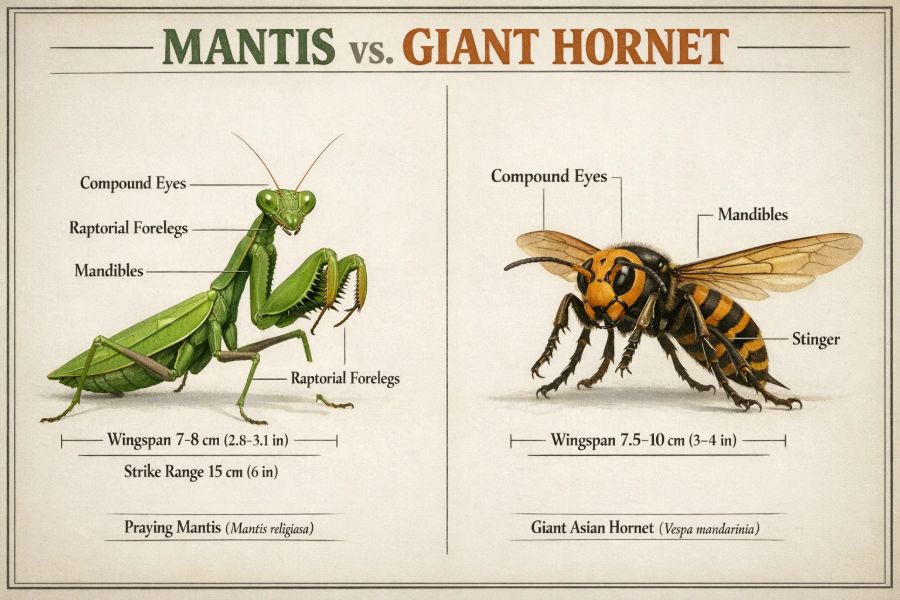
Weapons: Forelegs vs Sting
The mantis’s best weapon is the raptorial foreleg strike. Britannica describes those front legs as specialized for seizing and holding prey, and mantises depend heavily on eyesight to judge exactly when to launch. If the mantis catches the hornet across the thorax and folds it inward immediately, the hornet may have little room to orient its sting or use its wings effectively.
The giant hornet’s best weapon is the sting, not because it must kill instantly, but because it can disrupt the mantis before full control is achieved. Animal Diversity Web and Britannica both emphasize that V. mandarinia can sting repeatedly and delivers a large, medically important venom load. Even if a sting does not kill a mantis quickly, it may cause enough trauma to let the hornet break free or keep fighting.
The hornet also has mandibles, which are important. Giant hornets use their jaws effectively in predation and colony attacks. So the mantis is not just trying to avoid a sting; it is trying to neutralize an armed insect with both cutting jaws and a flexible venom-delivery system.
Hunting Style: The Mantis Wants One Perfect Mistake
Mantises are most effective when prey does not realize they are there until the strike begins. Britannica notes that camouflage is central to their success and that most species are ambush predators rather than active pursuers. That makes the ideal mantis–hornet scenario a close-range surprise catch on vegetation.
The giant hornet is more dangerous when it has flight room and can approach, veer off, or attack from an angle. It is an active hunter that regularly subdues other insects, and studies on its prey show that it takes a wide variety of insects, especially other social Hymenoptera. Its predatory behavior is therefore not passive or clumsy.
So this is not a simple predator-prey ladder. It is a clash between two predators that solve the same problem differently. The mantis is a trap. The hornet is a mobile assault unit.
What Do We Actually Know About Real Interactions?
There is strong evidence that mantises are capable of taking impressively dangerous prey in general, including large insects and occasionally even small vertebrates. There is also strong evidence that giant hornets prey on a wide variety of insects and are themselves formidable insect predators. What is much scarcer in the easily accessible literature is a large body of peer-reviewed field data specifically quantifying mantis–giant hornet encounters. So some parts of this comparison rest on comparative anatomy and predator behavior, not on a huge dataset of direct duel records.
That said, the mechanics are clear enough to support a careful conclusion. A mantis can win if it gets the hornet under control immediately. A hornet can win if the encounter remains dynamic, aerial, or only partially restrained. That is a biologically grounded inference from the weapon systems involved.
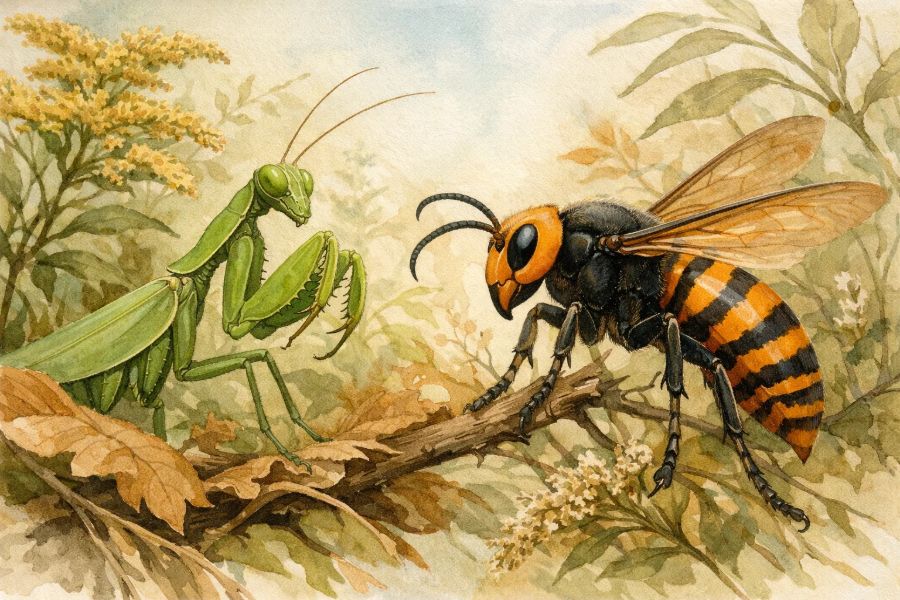
So Who Has the Edge?
If the scenario is a large mantis ambushing a worker giant hornet from vegetation, I would cautiously favor the mantis, because the mantis’s entire predatory system is designed around one sudden catch followed by immediate restraint and feeding. If it secures the thorax or neck region before the hornet can curl its abdomen and sting effectively, the hornet’s biggest weapon may never come fully into play.
If the scenario is an open, active confrontation where the hornet detects the mantis early, keeps moving, or attacks repeatedly, I would shift the edge toward the giant hornet. In that setting, the mantis loses the element of surprise and may have to handle a fast, armored, stinging insect that is still fully operational.
If the matchup is generalized across all mantises, the most accurate answer is this: big mantises can beat giant hornets, but giant hornets are dangerous enough that the outcome is highly size- and circumstance-dependent. A giant hornet is not just another fly-sized insect for a mantis to grab casually.
Ecology Matters More Than the “Fight”
There is also a broader ecological point worth making. Mantises and giant hornets are both predatory insects that help structure insect communities. Mantises reduce populations of various arthropods through ambush predation, while giant hornets can reshape local insect communities through predation on bees, wasps, and other large insects. In other words, both are high-level insect predators, and a direct encounter is really one node in a larger predatory web.
That is why this matchup fascinates people: it is not herbivore versus predator, but predator versus predator. Each is dangerous in its own domain, and each becomes vulnerable when forced to fight on the other’s terms.
Conclusion
A zoologist’s verdict would be:
A mantis usually wins by surprise and control.
A giant hornet usually wins by staying mobile and striking back early.
So the best overall answer is not “mantis always wins” or “giant hornet always wins.” It is this: in a clean ambush, a large mantis can be the more lethal insect; in a chaotic engagement, the giant hornet is one of the worst possible prey items for a mantis to mishandle.
References
Britannica. Mantis (mantid) — morphology, vision, camouflage, ambush behavior, and prey capture with specialized forelegs.
Mirzaee et al. 2024. Biology, ecology, and biogeography of eremic praying mantis Blepharopsis mendica — general review noting mantises as important predators of a wide range of prey.
Animal Diversity Web. Vespa mandarinia — size, wingspan, stinger length, habitat, and physical description.
Britannica. Northern giant hornet — risk to humans, repeated stinging, and general species overview.
Wilson et al. 2023. Insights into the prey of Vespa mandarinia — prey breadth and predatory ecology in Washington.
Norderud et al. 2021. Risk Assessment for the Establishment of Vespa mandarinia — largest hornet species, life cycle, and ecological risk context.