The Hidden Danger in Multi-Pet Households
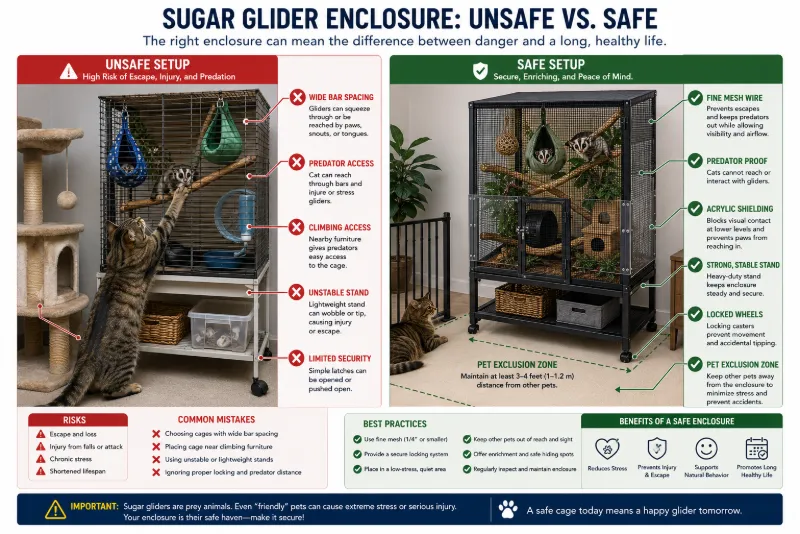
Sugar gliders are small prey animals. In the wild, they avoid owls, snakes, monitor lizards, cats, and other predators. Domestic cats and dogs may be affectionate family pets, but their hunting, chasing, and investigative instincts can still be triggered by the scent, sound, and rapid movements of a sugar glider.
A cat may sit silently beside the cage for hours, strike at moving tails through the bars, or climb onto the enclosure. A dog may bark, jump, nose the cage, or become excited when the gliders move at night.
These interactions are dangerous for two reasons:
Physical injury: claws, teeth, impacts, and cage tipping can cause severe wounds or death.
Chronic psychological stress: constant predator presence can interfere with sleep, feeding, social behavior, and normal activity.
Owners should never assume that a calm cat or dog is completely safe around a sugar glider. Predatory behavior can appear suddenly, especially when the glider jumps, vocalizes, or moves rapidly inside the cage.
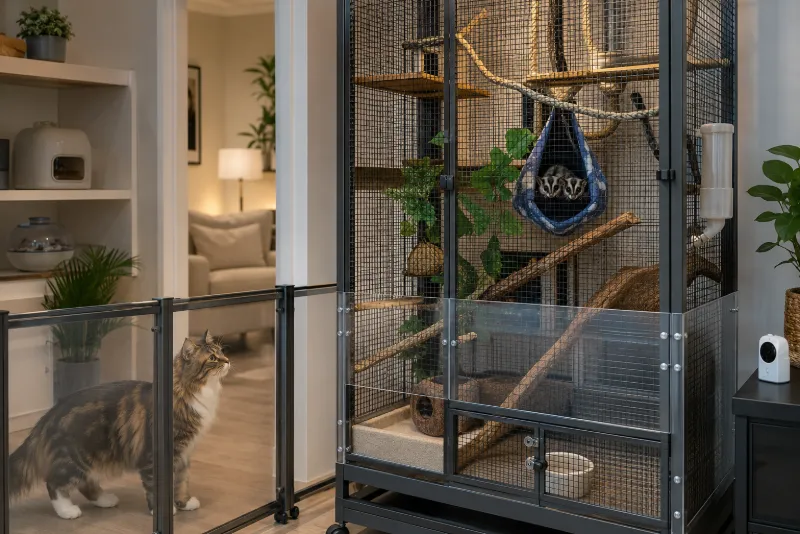
How Cats and Dogs Can Injure Sugar Gliders
| Risk | How It Happens | Possible Consequence |
|---|---|---|
| Clawing through cage bars | A cat reaches between widely spaced bars | Punctures, eye injuries, tail wounds |
| Cage impact | A dog jumps against or pushes the stand | Falls, broken accessories, trauma |
| Cage tipping | Large pet pulls, leans, or climbs on the enclosure | Severe injury or escape |
| Predator intimidation | Staring, barking, circling, or pawing | Chronic stress and disturbed sleep |
| Escape during cleaning | A door is opened while another pet is nearby | Chasing, biting, or fatal attack |
Signs That a Sugar Glider Feels Threatened
Sugar gliders may not always show obvious fear. Some freeze or hide rather than vocalize.
Possible stress signs include:
Remaining inside the sleeping pouch longer than usual
Repeated crabbing or defensive vocalization
Sudden biting or increased defensiveness
Reduced appetite
Frantic climbing or attempts to escape
Excessive grooming
Reduced nighttime activity
Changes in stool or urination
Self-injury in severe, prolonged cases
These signs can also indicate illness, pain, loneliness, or environmental problems. Persistent behavioral changes should be discussed with an exotic-animal veterinarian.
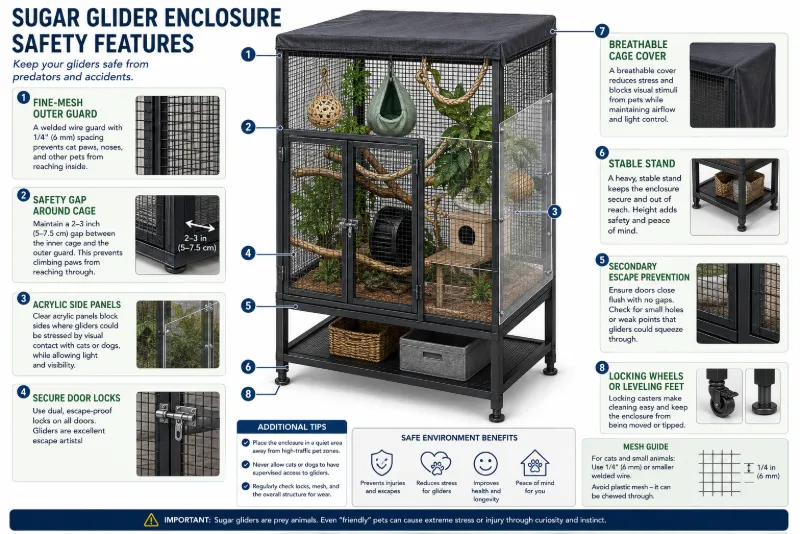
What Is a Sugar Glider Cage Guard?
A cage guard is an additional protective barrier placed around part or all of an enclosure. It is designed to prevent larger pets from reaching through the bars, climbing directly against the cage, or making close visual contact with the animals inside.
Common cage-guard materials include:
Fine welded metal mesh
Rigid hardware cloth
Acrylic panels
Heavy-duty fabric cage covers
Freestanding pet barriers
Protective outer cage frames
A guard should improve safety without blocking ventilation, creating sharp edges, or reducing access for routine cleaning.
1. Fine-Mesh Cage Guards
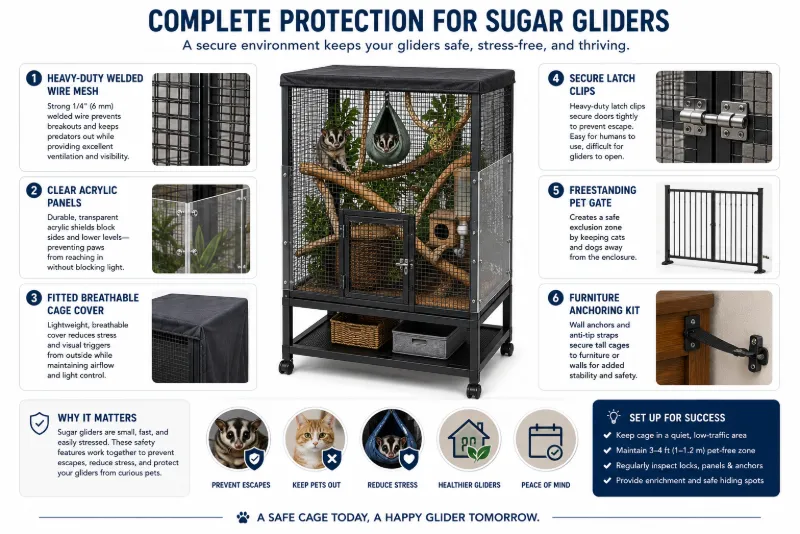
Fine-mesh guards are one of the most effective ways to stop cat paws from reaching through widely spaced cage bars.
The additional mesh is installed outside the main cage, creating a second barrier. Openings should be small enough that a cat cannot insert a paw, while still allowing good airflow and visibility.
What to Look For
Rigid welded mesh rather than soft netting
Small, consistent openings
Rust-resistant or coated metal
Smooth edges without sharp wire ends
Secure metal fasteners
Enough spacing from the original cage to prevent contact
Plastic garden netting is generally less suitable because cats may tear it and sugar gliders may chew it if they can reach it.
Create a Safety Gap
The outer mesh should ideally sit several centimeters away from the original cage bars. If it is attached directly against the cage, a cat claw may still pass through both layers.
A rigid frame or spacers can create a protective gap between the sugar gliders and the outer barrier.
2. Strategic Cage Placement
Even the strongest cage guard is more effective when the enclosure is placed correctly.
Use a Stable, Elevated Stand
The cage should rest on a wide, stable stand that cannot be easily tipped. Elevation may reduce casual access by some dogs, but height alone does not protect against cats, which can jump and climb.
Keep Launching Surfaces Away
Do not place the cage beside:
Bookcases
Sofas
Windowsills
Tables
Cat trees
Storage shelves
These surfaces can give a cat an easy route onto the cage roof.
Maintain an Isolation Zone
Leave open space around the enclosure so cats and dogs cannot sit directly against it. A freestanding pet gate or exercise-pen barrier can create a larger exclusion area around the cage.
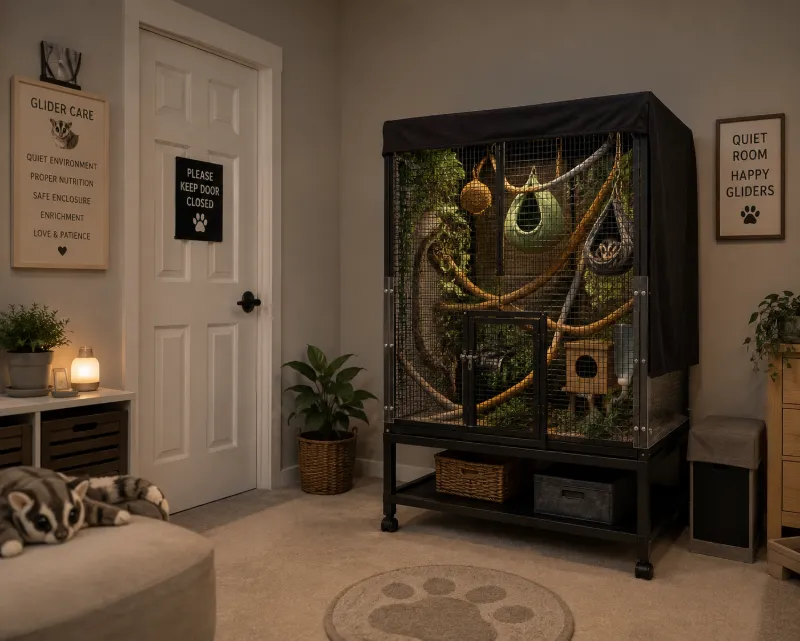
The most secure option is a dedicated sugar glider room with a closed door that larger pets cannot enter.
3. Acrylic Shielding
Clear acrylic panels can block paws, noses, drafts, thrown litter, and direct visual contact while preserving visibility.
Acrylic is especially useful on:
The lower sides of the cage
The wall-facing side
Areas beside cat-accessible furniture
The section nearest a dog walkway
Feeding zones where food may attract other pets
Important Ventilation Rules
Do not enclose the entire cage with solid acrylic. Sugar gliders need good airflow, and a fully enclosed setup may trap moisture, odor, heat, and ammonia.
Use acrylic as partial shielding rather than a sealed box. Leave large ventilated sections open and monitor the enclosure temperature.
Safe Installation
Mount panels on the outside of the cage.
Round or cover all sharp corners.
Use secure fasteners that cannot be chewed.
Leave space for airflow and cleaning.
Keep the panel away from heaters and direct sunlight.
4. Heavy-Duty Cage Covers
A cage cover can reduce visual stress, help darken the sleeping area during the day, and discourage cats from staring directly at the gliders.
However, a fabric cover is not a substitute for a rigid protective barrier. Cat claws can penetrate thin fabric, and a dog may pull a loose cover from the cage.
Choose a Safer Cover
Look for:
Thick, tightly woven fabric
Secure straps or fitted corners
Ventilation openings
Washable material
No loose strings, loops, or frayed edges
Only part of the cage should usually be covered. Sugar gliders still need airflow and a normal day-night cycle.
5. Upgrade to a Stronger Exotic-Pet Cage
Some lightweight cages are not suitable for homes with persistent cats or powerful dogs. A stronger enclosure may be necessary when the existing cage flexes, rolls, tips, or has large bar gaps.
Features of a Safer Cage
Heavy welded-metal construction
Narrow bar spacing suitable for sugar gliders
Strong door latches
Locking caster wheels
Wide, stable base
Secure removable trays
No easily bent wire panels
Enough height for climbing and gliding behavior
A bird cage is not automatically safe for sugar gliders. Bar spacing, coatings, door gaps, and latch design must all be evaluated carefully.
Recommended Safety Gear
| Safety Product | Best Use | Important Buying Feature |
|---|---|---|
| Heavy-duty welded wire mesh | Preventing cat paws from reaching through bars | Small openings and smooth coated edges |
| Acrylic shielding panels | Blocking paws and direct visual contact | Proper thickness and ventilation spacing |
| Fitted cage cover | Reducing visual stress during daytime sleep | Breathable, washable, secure fit |
| Freestanding pet gate | Creating an exclusion zone around the enclosure | Height, stability, and narrow openings |
| Heavy exotic-pet cage | Replacing a weak or unstable enclosure | Narrow bar spacing and strong locks |
| Furniture anchoring kit | Preventing the cage or stand from tipping | Weight rating and secure wall attachment |
Best Heavy-Duty Mesh for Cage Protection
For most cat-proofing projects, rigid welded wire mesh is safer than flexible netting. It should resist bending when pressed and should not contain exposed cut ends.
Measure the existing cage carefully before buying. The guard should cover all areas that a cat can access, including the sides, rear, doors, and sometimes the roof.
Choose materials intended for indoor animal enclosures or durable household use. Avoid metal with flaking paint, visible rust, unknown chemical coatings, or sharp galvanized edges that the gliders could contact.
Best Cage Covers for Nervous Sugar Gliders
A cover is most useful for reducing visual exposure, not stopping physical attacks.
The best covers are fitted to the cage dimensions and allow one or more sides to remain partly open. A breathable cover may help nervous gliders rest during the day when cats or dogs move through nearby rooms.
Wash covers regularly because fabric can retain urine odors, food residue, dust, and animal hair.
Best Cages for Multi-Pet Homes
In a multi-pet household, prioritize structural strength over decorative appearance. A suitable cage should remain stable when lightly pushed and should not have doors that a cat can manipulate.
For added protection:
Use secondary clips or small locks on doors.
Lock caster wheels after positioning the cage.
Anchor the stand or cage to a wall when practical.
Inspect welds and latches regularly.
Place food dishes away from outer edges.
Why Bar Spacing Matters
Bar spacing affects both escape risk and predator access. Gaps that are too wide may allow a sugar glider to squeeze out or a cat to insert part of its paw.
Because cage designs vary, owners should verify spacing recommendations with an experienced exotic veterinarian, reputable rescue organization, or knowledgeable sugar glider care specialist before purchasing a new enclosure.
Do Not Allow Supervised Nose-to-Nose Contact
Some owners believe that holding a sugar glider near a calm cat or dog will help the animals become familiar with one another. This is unsafe.
A dog can snap in a fraction of a second, and a cat can strike before a person has time to react. The size difference means even a brief contact may cause life-threatening injury.
Safe coexistence means secure separation, not physical introduction.
Safe Out-of-Cage Time
Sugar gliders need supervised opportunities to explore and exercise outside the enclosure, but cats and dogs must be completely removed first.
A safe play session should occur in a closed, escape-proof room with:
Locked windows and doors
Covered vents and small gaps
No ceiling fans in operation
No open toilets or water containers
No exposed electrical cords
No toxic plants
No other pets present
Do not rely on holding a cat or restraining a dog in the same room. Physical separation behind a closed door is safer.
Emergency Steps After a Cat or Dog Attack
Any direct contact with a cat or dog should be treated as an emergency, even when the sugar glider appears uninjured.
Cat teeth and claws can create tiny punctures that are difficult to see but may introduce dangerous bacteria. Dogs can cause crushing injuries without leaving obvious external wounds.
Separate the animals immediately.
Place the sugar glider in a quiet, warm travel carrier.
Do not apply household antiseptics or medications unless instructed by a veterinarian.
Contact an exotic-animal veterinarian or emergency clinic promptly.
Report all known bites, scratches, falls, and abnormal behavior.
Loss of appetite, weakness, swelling, breathing difficulty, bleeding, limping, or unusual quietness requires urgent veterinary attention.
A Practical Cat-Proofing Setup
A strong multi-layer setup may include:
A heavy-duty cage with narrow bar spacing
A rigid fine-mesh outer guard on exposed sides
Partial acrylic shielding near high-risk areas
A fitted breathable cover over part of the cage
A wide, stable stand with locked wheels
A freestanding exclusion barrier around the enclosure
A closed room that cats and dogs cannot enter unattended
No single accessory provides complete protection. Combining several barriers is more reliable than depending on one product.
Daily Safety Checklist
Confirm that every cage latch is secure.
Check the outer guard for gaps or loose fasteners.
Remove cat hair and debris from covers and barriers.
Verify that the cage is not touching nearby furniture.
Make sure caster wheels are locked.
Inspect acrylic panels for cracks.
Watch for stress-related behavior in the gliders.
Keep cats and dogs out of the room when nobody is supervising.
Final Recommendation
The best cage guard for a sugar glider is a rigid, fine-mesh barrier installed outside a strong enclosure with enough separation to prevent claws from reaching the cage bars. Acrylic panels can provide extra protection in high-risk areas, while breathable cage covers reduce visual stress.
However, accessories should support—not replace—responsible separation. In homes with cats or dogs, the safest arrangement is a secure, stable cage inside a room that larger pets cannot access without supervision. Protecting sugar gliders requires planning for both physical attacks and the less visible effects of chronic predator stress.
FAQs
Can a cat hurt a sugar glider through cage bars?
Yes. A cat may insert its claws through wide bars and injure a sugar glider's eyes, limbs, tail, or body. Fine-mesh guards and an outer safety gap can reduce this risk.
Are dogs dangerous to caged sugar gliders?
Yes. Dogs may bark, jump against the cage, knock over the stand, or frighten the gliders. Large or excitable dogs should not have direct access to the enclosure.
What mesh size is best for a sugar glider cage guard?
The openings should be small enough to prevent cat paws from passing through while maintaining good ventilation. Exact dimensions should be chosen according to the cage design and the size of the pets in the household.
Can I cover the entire cage with acrylic?
No. Completely enclosing the cage with solid panels may reduce ventilation and trap heat, moisture, odor, and ammonia. Acrylic should generally be used only on selected sections.
Will a cage cover protect sugar gliders from cats?
A cover may reduce visual stress, but fabric alone cannot reliably stop claws, bites, climbing, or cage tipping. It should be combined with rigid barriers and secure room separation.
Should cats and sugar gliders be introduced?
No direct introduction is recommended. Even a calm cat may suddenly strike when a sugar glider moves quickly. They should remain physically separated.
Is a large bird cage safe for sugar gliders?
Some large bird cages may be suitable, but only when the bar spacing, coating, latches, dimensions, and construction are appropriate for sugar gliders. Not every bird cage meets these requirements.
What should I do if my cat scratches my sugar glider?
Contact an exotic-animal veterinarian immediately. Small cat scratches and punctures can introduce serious bacterial infections even when the wound appears minor.