A lot of people in Spain are convinced they’ve seen a hummingbird: a tiny creature, hovering in mid-air, drinking nectar from flowers with fast-beating wings.
But here’s the key fact:
There are no wild hummingbirds in Spain or anywhere in Europe.
All true hummingbirds live exclusively in the Americas.
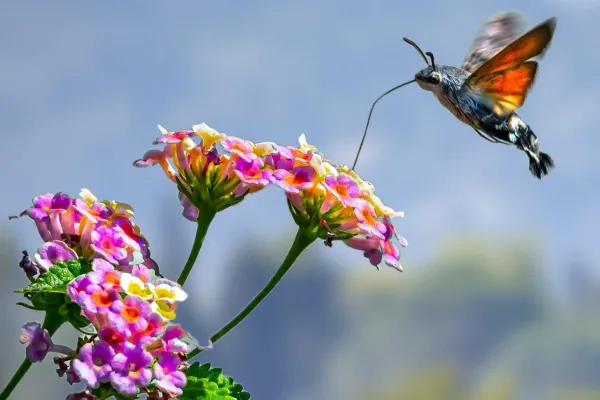
What people usually see in Spain is not a bird at all, but a day-flying moth called the hummingbird hawk-moth (Macroglossum stellatarum), which imitates hummingbird-style flight amazingly well.
Let’s clear up the confusion and answer all your questions.
Are There Hummingbirds in Spain or Europe?
Short answer
No, there are no native hummingbirds in Spain or in the rest of Europe.
Any “hummingbird” you think you’ve seen in Spain is almost certainly the hummingbird hawk-moth.
Where do real hummingbirds live?
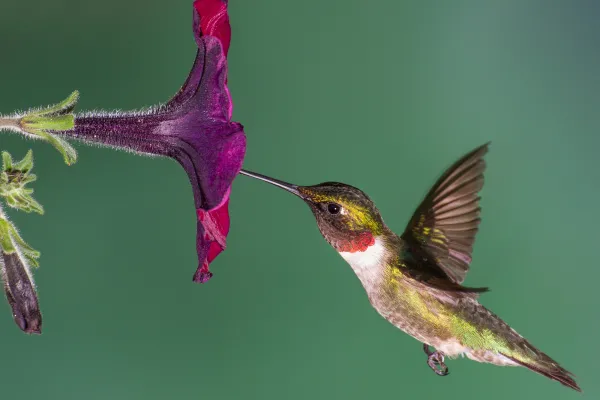
Real hummingbirds (family Trochilidae) are 100% American in distribution. They range:
From Alaska in the north
To Tierra del Fuego in the south
Their greatest diversity is in tropical regions, especially:
Why aren’t there hummingbirds in Europe?
It’s mainly a combination of evolution and geography:
Hummingbirds evolved in the Americas and never naturally colonized Europe.
Crossing the Atlantic Ocean would require:
Huge energy reserves
Suitable “stepping-stone” habitats or migration routes – which don’t exist for them.
European flowers and ecosystems evolved without hummingbirds, so:
Most flowers here are adapted to insects and other pollinators, not to the hover-feeding style of hummingbirds.
So if you see a tiny “hummingbird” in your Spanish garden… it’s time to meet the real culprit.
What Animal Looks Like a Hummingbird in Spain?
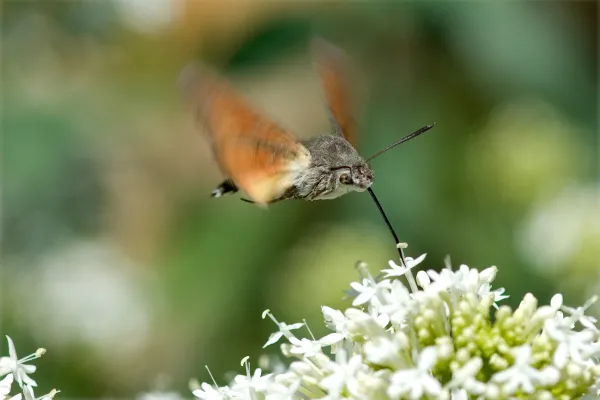
The animal that causes all the confusion is the hummingbird hawk-moth (Macroglossum stellatarum).
Despite its name:
It is not a bird
It is not a hummingbird
It is a day-flying moth in the family Sphingidae (hawk-moths)
Why people mistake it for a hummingbird
When you see it in action, it really does look like a tiny hummingbird:
Size: about 4–5 cm in length
Body: thick, covered with fine hair-like scales
Wings: beat very rapidly, producing a low humming buzz
Behavior:
Hovers in front of flowers
Drinks nectar while hanging in the air
Moves quickly between blooms, even flying backwards
Unlike most moths (which are nocturnal), the hummingbird hawk-moth flies in full daylight, often:
On sunny summer days
In gardens, parks and rural areas throughout Spain
It frequently visits:
Geraniums
Lavender
Honeysuckle
And many other nectar-rich flowers
Because of its hovering flight and feeding style, it’s incredibly easy to mistake it for a hummingbird at first glance.
Where Can You See the Hummingbird Hawk-Moth in Spain?
The hummingbird hawk-moth is actually very common and one of the easiest moths to observe in Spain.
Distribution in Spain
You can find it in:
Almost all of the Iberian Peninsula
Balearic Islands
Canary Islands
It is especially abundant in Mediterranean and southern regions, where mild temperatures allow it to stay active for much of the year.
Typical places to spot it
You’re likely to see it:
Urban gardens:
Feeding on ornamental plants like geraniums, lavenders, petunias and marigolds
Rural areas and open fields:
Where wildflowers are abundant
Mediterranean coastal zones:
Warm and dry conditions let it fly over a long season
Open woodland edges and mountain meadows:
Though it’s usually more common at lower altitudes
Terraces and balconies with flowering pots
If you have a sunny balcony full of flowers, chances are you’ll eventually receive a visit from this “fake hummingbird”.
What Does the Hummingbird Hawk-Moth Eat?
Just like real hummingbirds, the hummingbird hawk-moth feeds mainly on flower nectar.
Feeding technique
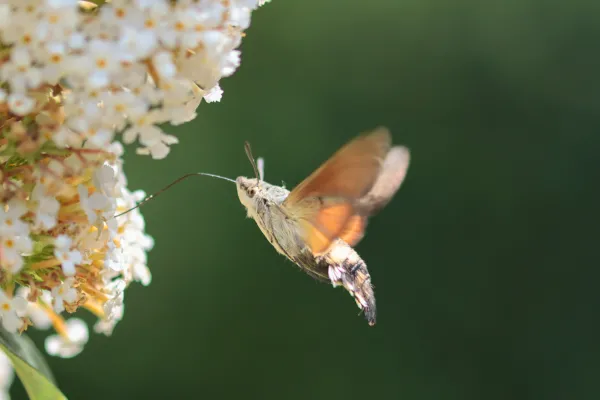
It has a long proboscis:
A flexible, tube-like “tongue” that stays coiled when not in use
When feeding:
It hovers in front of a flower
Unrolls its proboscis
Reaches deep into the flower to suck up the nectar
It usually does not land on the flower – it feeds in mid-air, just like a hummingbird.
Favorite flowers
It prefers nectar-rich, tubular flowers, such as:
Geraniums
Lavenders
Honeysuckles
Jasmines
Marigolds
Petunias
Valerian
Buddleia (the “butterfly bush”)
Because these plants are common in private gardens, the hummingbird hawk-moth is a regular visitor for many homeowners without them realizing what it really is.
Other Interesting Facts About the Hummingbird Hawk-Moth
Here are some extra curiosities that make this insect even more fascinating:
1. It can fly backwards
Like hummingbirds, this moth is able to reverse in mid-air.
This allows it to:
Switch flowers quickly
Adjust its position without landing
Very few insects can do this so precisely.
2. Its wings are incredibly fast
The hummingbird hawk-moth beats its wings at about 80 times per second.
This high speed:
Produces a distinctive humming sound
Lets it hover almost effortlessly
This humming is one of the reasons people immediately think “hummingbird”.
3. It tolerates cooler temperatures
Although it prefers warm climates, this moth can remain active at lower temperatures than many butterflies and moths.
That’s why you may still see it flying on relatively cool days.
4. It’s harmless and beneficial
It does not bite, does not sting, and does not damage plants or people.
On the contrary, it acts as a natural pollinator, helping many ornamental and wild plants reproduce.
So if you see it around your flowers, consider it a welcome guest, not a pest.
Hummingbird Hawk-Moth vs Real Hummingbird: Key Differences
Even though they look similar from a distance, they are completely different animals.
1. Insect vs bird
Hummingbird hawk-moth:
6 legs
Antennae
Wings covered in tiny scales
An insect (a diurnal moth)
Family: Sphingidae
Has:
Hummingbird:
Feathers
Beak
Two legs
Warm-blooded physiology
A bird
Family: Trochilidae
Has:
2. Size and weight
Hummingbirds:
Typically 7–13 cm in length
Weigh several grams depending on species
Hummingbird hawk-moth:
Usually 4–5 cm long
Much lighter, only a small fraction of a hummingbird’s weight
3. Body shape
Moth:
Shorter, thicker body
Covered with fine, velvety scales
Hummingbird:
More slender and elongated
Body shape streamlined for highly precise flight
4. Feeding structures
Both feed on nectar, but with different “tools”:
Moth:
Uses a coiled proboscis, like a flexible straw
Unrolls it to reach deep into the flower
Hummingbird:
Uses a long beak
Has a specialized tongue that extends beyond the beak to lap up nectar
5. Color and appearance
Hummingbirds:
Often have brilliant metallic feathers in green, blue, red and other iridescent colors
Sparkle in the sunlight
Hummingbird hawk-moth:
Mostly brownish and orange-toned
More discreet, better suited for camouflage rather than show
Final Takeaway
No, there are no wild hummingbirds in Spain or Europe.
What people commonly see is the hummingbird hawk-moth, a day-flying moth that:
Hovers in front of flowers
Drinks nectar with a long proboscis
Looks and sounds surprisingly like a tiny hummingbird
Now, next time you spot a “mini hummingbird” in a Spanish garden, balcony or field, you’ll know you’re actually watching one of Europe’s most fascinating moths at work.