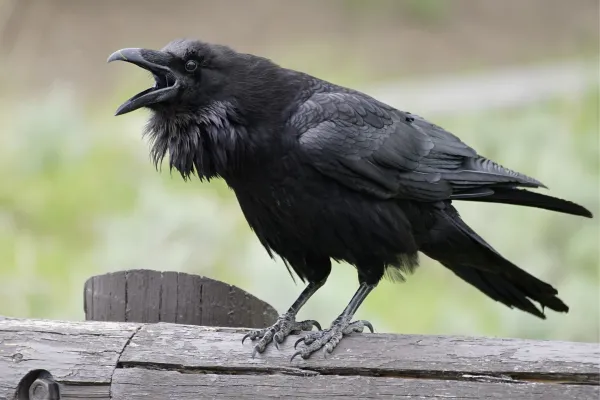
Crows are extraordinary birds with impressive intelligence and a surprising ability to vocalize and imitate sounds. They don’t “talk” in the same way humans do, and their vocal skills differ from those of parrots, but their mimicry still gives them powerful advantages in their environment.
If you’re wondering whether crows can talk, how they imitate human voices, and what this says about their intelligence, this guide will walk you through it step by step.
Can Crows Talk Like Parrots?
Both crows and parrots can mimic human speech, but they don’t do it in quite the same way.
How their “speech” sounds different
Parrots usually produce clearer, more articulated words. Many people can easily understand what a parrot is “saying”.
Crows, on the other hand, often sound:
More guttural or rough
Less clear in their pronunciation
Harder to understand if you’re not used to hearing them
Part of the problem is that most people are more familiar with parrots talking than with crows doing it, so our ears are simply not as trained to recognize crow “speech”.
How they learn: parrots repeat, crows really “work it out”
The learning process is also different:
Parrots:
Learn mainly through repetition
They hear a sound over and over and gradually reproduce it more accurately
Crows:
Use more complex cognitive processes
Rely heavily on memory and trial-and-error
Adjust their vocal output step by step until they get close to the human sound they’re trying to copy
You could simplify it like this:
Parrots repeat. Crows figure it out.
This doesn’t mean parrots aren’t intelligent—only that crow vocal learning is deeply tied to their problem-solving abilities and flexible thinking.

Why Can Crows Imitate Human Voices?
Crows don’t mimic sounds “for fun” only. In the wild, mimicry can give them real survival advantages.
Mimicry in nature
In their natural habitats, some crows have been observed imitating the barks or calls of other animals, such as:
The idea is that:
Imitating a predator’s sound can help them attract that predator to a carcass or prey,
The predator does the hard work,
The crow then takes advantage of the leftover meat (carrion).
So, the ability to imitate sounds is closely linked to finding food and surviving.
Living close to humans
Today, many crow species live near human settlements, where:
There is abundant food (garbage, crops, roadkill, etc.)
They frequently hear human voices, machines, car alarms, dogs, etc.
Because crows are:
Omnivorous (they eat almost anything)
Highly adaptable
Extremely curious and observant
They start to incorporate human sounds into their repertoire, including words, phrases and noises they hear all the time.
How Do Crows Produce These Sounds? The Syrinx
Like other birds, crows don’t have vocal cords like mammals. Instead, they produce sound using an organ called the syrinx.
The syrinx is located where the trachea splits into the bronchi.
It is made of cartilage, membranes and muscles.
By controlling the air that passes through the syrinx and adjusting the tension of the structures around it, crows can produce:
Harsh calls
Soft notes
Complex modulations
And even sounds that resemble human speech
Their precise control over airflow and muscle tension is what allows them to mimic such a wide variety of sounds.
Imitation vs. Language: Do Crows Understand What They Say?
This is the key question:
When a crow says “hello”, does it really mean “hello”?
Human language vs. bird vocalizations
Human language is a complex system:
Based on symbols (words) with shared meanings
Used intentionally to communicate ideas, emotions and information
Crow vocalizations, even the ones that sound like words, are not the same:
When a crow says “hello”, it doesn’t necessarily understand the concept of greeting like we do.
For us, a specific caw doesn’t automatically mean “danger” unless we’ve learned to interpret it.
So, from a strict scientific viewpoint:
Crows don’t “speak” a human language.
They imitate sounds, including words, that they have learned to associate with certain situations.
Do they ever use words appropriately?
Yes, and that’s where it gets interesting.
Because crows have:
Excellent memory
High intelligence
Strong ability to link cause and effect
They can learn to use certain human words in specific contexts, such as:
Saying “hello” when a person enters a room
Repeating a particular word when they expect food or attention
They may not “understand” the word like we do, but they associate it with a specific event or interaction, which is already a notable level of interpretation.
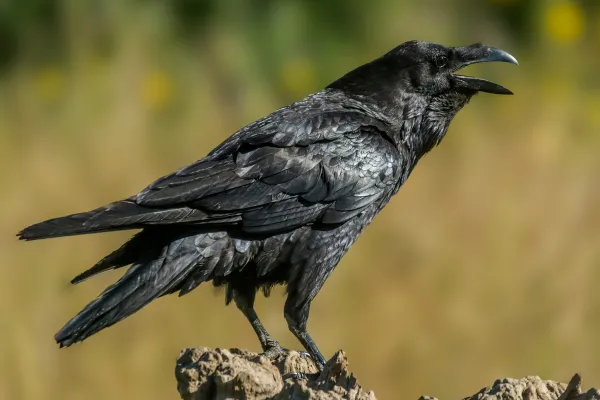
What Words and Sounds Can Crows Imitate?
Crows are extremely versatile mimics. They can copy:
Mechanical sounds:
Car alarms
Drills
Sirens
Human sounds:
Laughter
Crying
Coughs or sneezes
Other animals:
Dog barks
Calls of other birds
As for human words, they most often imitate short, common words, such as:
“Hello”
“Bye” / “Goodbye”
“Come”
Simple names or nicknames
With enough practice, some crows can memorize and reproduce short phrases of up to three or four words, such as:
“How are you?”
Simple commands or joking phrases taught by their keepers
Again, the clarity varies: some individuals are very understandable, others sound more rough or distorted.
How Intelligent Are Crows Really?
Crow intelligence is highly developed and strongly linked to their social lifestyle.
Social brain theory
Crows often live in groups (flocks) and maintain:
Complex social relationships
Flexible hierarchies
Long-term alliances and family ties
According to the “social brain” theory, species with complex social lives tend to evolve larger or more efficient brains, because:
They need to recognize individuals
Remember past interactions
Predict behaviors
Communicate and coordinate actions
We see a similar pattern in primates, and crows are one of the best bird examples of this.
Their need to communicate and cooperate has likely helped shape:
Their advanced cognition
Their vocal flexibility
Their ability to learn and imitate human speech
Can You Teach a Crow to Talk?
Yes – it is possible to teach a crow to mimic words, especially in captivity, using positive reinforcement.
Basic training idea
The usual method is similar to training other animals:
Use a specific word or phrase (e.g. “hello”).
Say it repeatedly in a clear, consistent way.
When the crow produces a sound that approximates the word,
Reward it with food, treats or attention.
If it doesn’t respond, no reward is given.
Over time, the crow associates:
Specific sounds with
Specific rewards or interactions,
and gradually refines its imitation.
Bond matters
For this to work well:
Training is usually more effective if done by the same person
Crows have excellent memory and can form strong bonds with individual humans
They tend to respond better to someone they recognize and trust
An important ethical note
Even though crows can be trained to mimic human speech, it is not ethical to:
Capture wild crows
Remove them from their natural environment just to keep them as talking pets
Reasons:
Crows are highly social, intelligent wild animals that need space and stimulation.
They can remember human faces, especially negative experiences.
A person who captures or mistreats a crow may be remembered as a threat for life.
If you’re interested in vocal crows, it’s better to enjoy them through responsible observation, documentaries, or licensed rescue/education centers, rather than taking them from the wild.
Summary: Do Crows Really “Talk”?
Can crows mimic human speech?
➜ Yes, some can imitate words and phrases impressively well.Is it the same as human language?
➜ No. They imitate sounds and associate them with contexts, but don’t use language like humans do.How do they compare to parrots?
➜ Parrots repeat through imitation and repetition; crows often work sounds out via memory and trial-and-error, reflecting their problem-solving abilities.Why is this interesting?
➜ Because it reveals how flexible, social and intelligent crows are, and how their brains can reach complex behaviors very different from ours—yet surprisingly close in some ways.