The smallest bird in the world is the bee hummingbird (Mellisuga helenae), a tiny hummingbird that lives only in Cuba. An adult measures just 5–6 cm in length and weighs around 1.6–2 grams – lighter than many large insects.
Below you’ll find what you need to know about the bee hummingbird: size, appearance, habitat, diet, reproduction and conservation status, plus a few examples of other very small birds.
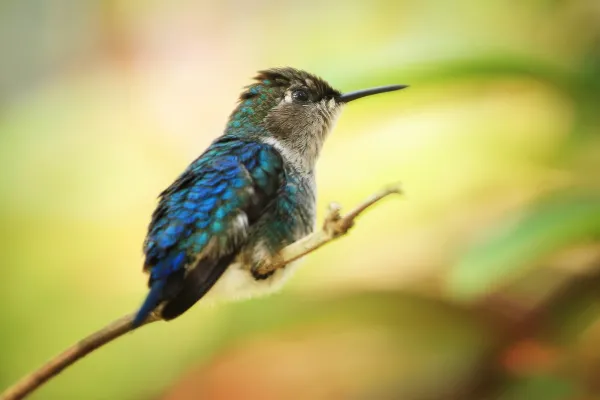
The Bee Hummingbird: the Smallest Bird in the World
The bee hummingbird (Mellisuga helenae), also known as zunzuncito, bee elf, trovador or hummingbird moth-bird, belongs to the hummingbird family Trochilidae.
It is:
The smallest hummingbird species
The smallest bird on Earth
With a body length of about 5.5–6.1 cm from bill to tail and a weight of roughly 1.8 g, it is so small that it can easily be mistaken for a large bee when flying.
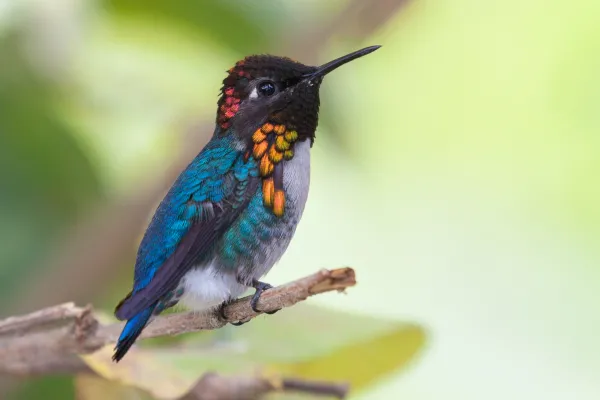
Main Characteristics of the Bee Hummingbird
The bee hummingbird has several features that make it unique, even within the hummingbird family.
Appearance and sexual dimorphism
There is a clear difference between males and females:
Male
Slightly smaller than the female
Head and throat: vivid bright red
Back and wings: metallic blue
Chest and belly: whitish to greyish
Female
Upperparts green-blue
White chest and belly
Small white spots at the tips of the tail feathers
Juveniles look similar to the female
Other key traits:
Bill: straight, slender and black, perfectly adapted to nectar feeding
Extremely small size: around 5.5–6.1 cm and about 1.8 g
Very few feathers: it is the bird species with the lowest feather count
Flight and physiology
Like all hummingbirds, the bee hummingbird is an incredible flier, but its performance is extreme even for the group:
Beats its wings about 80 times per second
Can hover in place for long periods while feeding on nectar
Consumes about half of its own body weight in food each day
Can drink up to 8 times its body weight in water daily
Has the highest body temperature of any bird, around 40 °C
Its metabolism is extremely fast, so it must feed almost constantly during the day to avoid losing too much weight.
Where Does the Bee Hummingbird Live?
The bee hummingbird is endemic to Cuba, meaning it does not naturally occur anywhere else in the world.
Historically, it was widespread across:
The main island of Cuba
The nearby Isle of Youth (Isla de la Juventud)
Today, due to habitat loss, it has disappeared from many former sites and is now mainly restricted to:
Guanahacabibes Peninsula
Sierra del Rosario
Zapata Swamp
Eastern Cuba: Holguín, Santiago and Guantánamo
Preferred habitats
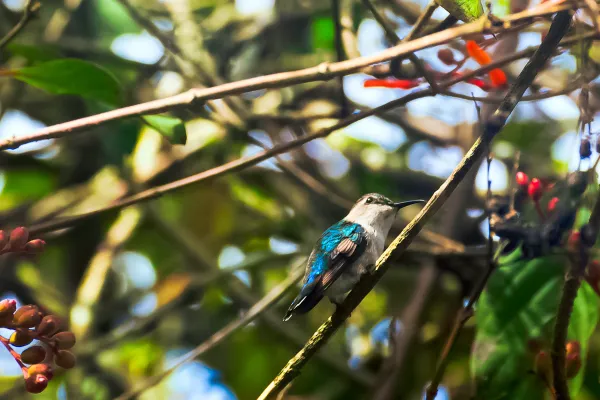
The species is closely associated with well-preserved vegetation:
Dense forests and forest edges with many shrubs
Mature forests with lianas and epiphytes
Occasionally:
Open fields
Swamps
Gardens
However, it depends heavily on intact, mature forests, and this reliance makes it vulnerable to deforestation and land-use change. Where it was once common, it is now considered rare.
What Does the Bee Hummingbird Eat?
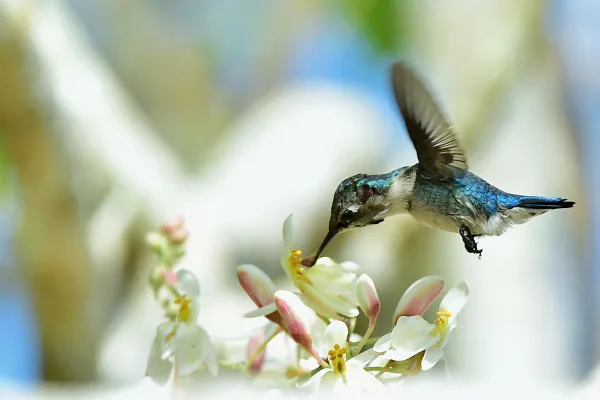
Like other hummingbirds, the bee hummingbird feeds mainly on flower nectar, but it also needs small insects for protein.
Nectar sources
It visits the flowers of many plant species, including:
Aloe
Laguncularia
Goethea
Hibiscus
Malvaviscus
Leucaena
Hamelia
Ixora
Russelia
Duranta
Black mangrove (Avicennia germinans)
By moving from flower to flower, it acts as an important pollinator for many Cuban plants.
Insects in the diet
Besides nectar, the bee hummingbird also eats tiny insects and other small arthropods:
Adults capture small insects while flying or picking them from foliage
Chicks left alone in the nest sometimes catch and eat tiny insects on their own, which provides vital protein for growth
How Does the Bee Hummingbird Reproduce?
The breeding season of the bee hummingbird runs approximately from March to June.
Nest and location
Nest height: usually 3–5 m above the ground
Built on a thin branch, often of:
Bucida buceras
Calophyllum antillanum
Nectandra coriacea
Nest materials:
Dry plant fibers
Soft inner layer of plant down (“vegetable wool”)
Exterior decorated with lichens, helping it blend into its surroundings
Often hidden among overhanging leaves
Construction time: about 10 days, done entirely by the female
Eggs and chicks
The female usually lays two eggs, one day apart
Incubation lasts about 21–22 days
Chicks:
Hatch naked and dark reddish in color
By 13–14 days, they have a full set of feathers
Practice flying for 4–5 days in or near the nest
Leave the nest at around 18 days of age
The female is solely responsible for building the nest, incubating the eggs and feeding the chicks.
Is the Bee Hummingbird Endangered?
According to the most recent IUCN Red List assessment (2021), the bee hummingbird is classified as Near Threatened.
Main threats
Its population is decreasing, mainly due to:
Habitat loss and degradation:
Deforestation
Conversion of native forests into agricultural land and pasture for livestock
Fragmentation of remaining forest patches
Reduction of nectar plant availability
As a result, the bee hummingbird has disappeared from many areas where it used to be common and survives only in a few key regions of Cuba.
Conserving native forests, mature woodland with epiphytes and flowering shrubs is essential for the long-term survival of this species.
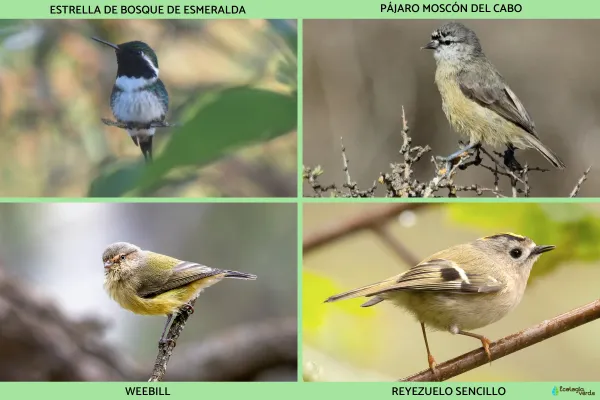
Other Very Small Birds in the World
Although the bee hummingbird holds the record as the smallest bird, there are several other species that are also remarkably tiny.
Emerald-bellied Woodstar (Chaetocercus berlepschi)
A very small hummingbird species
Lives in evergreen premontane and montane forests
Endemic to western Ecuador
Also ranks among the smallest birds in the world
Cape Penduline Tit (Anthoscopus minutus)
Tiny passerine bird, about 8–9 cm long
Weight: 6–7.5 g
Inhabits desert and semi-desert scrub, bushes and small trees in southern South Africa
Weebill (Smicrornis brevirostris)
The smallest passerine bird in Australia
Length: 8–9.5 cm
Weight: about 6 g
Lives in various wooded habitats across Australia
Goldcrest (Regulus regulus)
The smallest passerine in Europe
Length: around 9 cm, wingspan about 14 cm
Weight: 5–6 g
Found in coniferous and mixed forests across much of Europe and parts of Asia
Now that you know that the bee hummingbird is the smallest bird in the world, you can easily compare it with other tiny species and better appreciate how diverse birds can be in both size and lifestyle.
Bibliography
Chai, P. and G. M. Kirwan (2020). Bee Hummingbird (Mellisuga helenae), version In Birds of the World (J. del Hoyo, A. Elliott, J. Sargatal, D. A. Christie, and E. de Juana, Editors). Cornell Lab of Ornithology, Ithaca, NY, USA.
BirdLife International. 2021. Mellisuga helenae. The IUCN Red List of Threatened Species 2021: e.T22688214A178593744. https://dx.doi.org/10.2305/IUCN.UK.2021-3.RLTS.T22688214A178593744.en.