Bats are fascinating mammals that still carry a lot of mystery and myths. One of the most common questions people ask is: how do bats sleep?
Unlike most mammals, bats often sleep hanging upside down, choose dark, hidden roosts, and can enter special low-energy states like torpor and hibernation to save energy.
In this guide, you’ll learn:
Where bats sleep
Why many bats sleep upside down
The different types of rest they use (including torpor and hibernation)
How they protect themselves while sleeping
Why it’s so important to conserve bats and their roosts
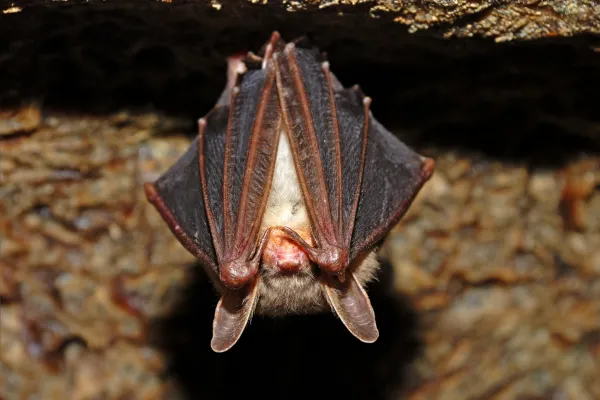
1. Where and How Do Bats Sleep?
Bats don’t usually sleep out in the open. To stay safe from sunlight, predators and temperature changes, they look for sheltered roosts. Depending on the species, these can include:
Dark, humid caves
Rock crevices
Hollows in trees
Folds of large leaves
Attics, barns, bridges, tunnels and other man-made structures
Bat boxes installed for conservation
These places provide a stable microclimate, which is crucial for animals that depend on precise temperature control to manage their metabolism.
Most bats are nocturnal, so they spend much of the daytime resting in these roosts and become active at night to feed.
Why do they choose these places?
Stable temperature
Complete darkness, ideal for light-sensitive species
Surfaces or structures that make it easy to hang upside down
Protection from land predators and many birds
Bats are very selective about their roosts, and the loss of these safe places is one of the main reasons many bat species are in decline.
Hanging vs. lying down
When it comes to sleeping posture:
Many bat species sleep hanging upside down, gripping:
Cave ceilings
Rock overhangs
Branches and other elevated surfaces
Other species prefer to sleep lying or tucked inside:
Tree cavities
Cracks
Large leaves or tight bark crevices
So not all bats sleep in exactly the same way, but hidden, sheltered roosts are always essential.
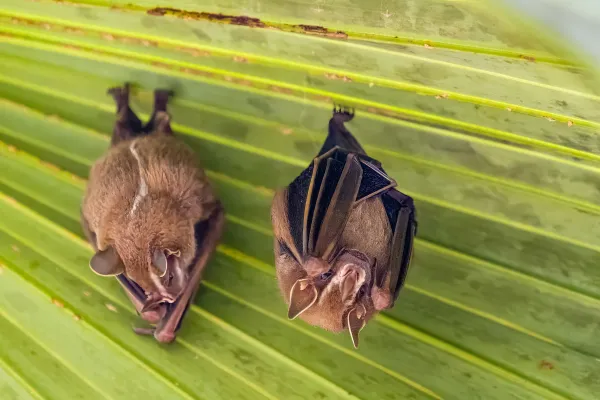
2. Why Do Bats Sleep Upside Down?
One of the most striking features of bats is their habit of roosting head-down. This unusual posture has several evolutionary advantages.
Easier take-off
Unlike many birds, bats can’t easily launch into flight from flat ground. Their anatomy is better suited to gliding into flight from a height.
By hanging upside down, they can:
Let go and drop
Open their wings
Use the downward fall as a natural boost to get airborne
This makes take-off:
Faster
More efficient
Less energy-expensive than jumping from the ground
Avoiding predators
Sleeping high up on ceilings or steep, vertical surfaces helps bats avoid many predators, such as:
Snakes
Raptors
Ground-dwelling mammals
These positions are hard to reach, and their dark roosts offer extra protection.
Anatomy built for hanging
Bat legs and feet are not like other mammals’:
They have a passive locking mechanism:
When a bat hangs, its own body weight pulls on tendons that automatically lock the claws closed.
This means the bat doesn’t use energy to hold on.
It only needs to contract muscles to release its grip, not to maintain it.
Their wings can fold around the body:
Helping conserve heat in cooler climates
Providing extra protection inside the roost
Together, these adaptations make upside-down roosting not just possible, but ideal for most bat species.
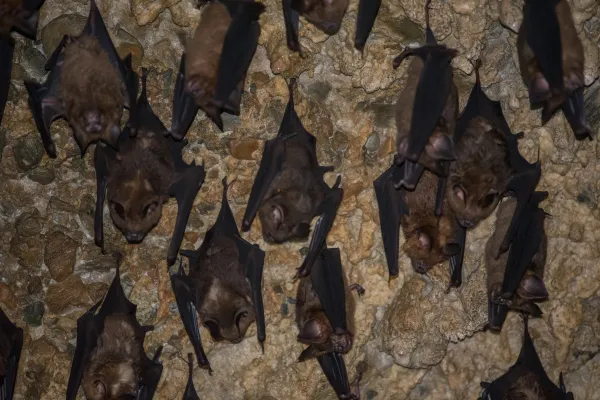
3. Types of Rest in Bats: Sleep, Torpor and Hibernation
Bats don’t always rest in the same way. Their sleep and energy-saving strategies vary with:
Species
Climate
Food availability
Daily rest and “siestas”
Most nocturnal bats spend the daytime inactive in their roosts.
Some may also take short rest periods or “naps” during the night between feeding bouts.
Staying still during the day:
Saves energy
Helps them avoid daytime predators and competition
Torpor: short-term energy saving
Torpor is a temporary state in which bats:
Lower their body temperature
Slow down their metabolism
Torpor can last from a few hours to several days, and bats often use it:
On cold days
When food is scarce (for example, fewer insects flying)
It’s a highly effective way to reduce energy consumption when conditions are not ideal.
Hibernation: long-term survival strategy
In colder climates, some bat species enter seasonal hibernation:
Body temperature drops close to the ambient temperature
Metabolic rate, heart rate and breathing slow dramatically
They can spend weeks or months in a state of very low activity
Choosing the right microclimate inside the roost (temperature, humidity, airflow) determines:
How long they can safely remain in torpor or hibernation
How much energy they use over the winter
These strategies are crucial for surviving winter or long periods with little food.
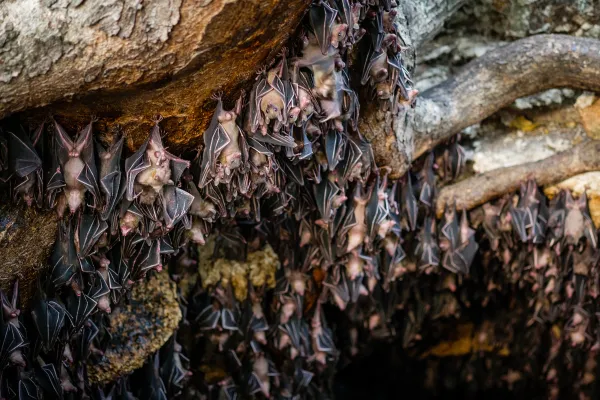
4. How Do Bats Protect Themselves While Sleeping?
Bats show a huge variety of social and roosting behaviors. Some species sleep alone, while others form colonies of hundreds or thousands of individuals.
Benefits of sleeping in groups
Group roosting offers several advantages:
Collective thermoregulation – huddling helps them retain heat
Increased safety – more eyes (and ears) to detect danger
Better breeding opportunities in large colonies
In big colonies, you may see bats:
Forming tight clusters on cave ceilings to keep warm
Spreading out into different rooms or zones of a cave based on temperature needs:
Colder sections for hibernation
Milder areas for regular rest
Tree-roosting or more solitary species, on the other hand, choose:
Small, hidden places like bark folds, leaf tubes or tiny hollows
Spots that offer both shelter and camouflage
Vigilance and response to threats
Even when resting, bats aren’t completely “switched off”:
They can wake quickly if there are:
Sudden noises
Sharp temperature changes
Vibrations or disturbances nearby
Unlike some birds and marine mammals, there’s no strong general evidence that bats regularly use unihemispheric sleep (sleeping with only half the brain at a time).
Research focuses more on how quickly they can enter and exit torpor, depending on conditions.
5. Why Is It Important to Protect Bats and Their Roosts?
Bats are essential for healthy ecosystems. Depending on the species, they:
Control insect populations (including agricultural pests)
Pollinate many plants
Help disperse seeds, especially in tropical forests
Understanding how and where bats sleep helps us avoid disturbing them, particularly in sensitive periods.
Disturbing bats in their roost—especially in winter—can cause:
Huge energy loss when they’re forced to wake up
Death from exhaustion or starvation
Abandonment of the roost site
Long-term declines in colony size
Key conservation actions
To protect bats and their sleep:
Preserve natural roosts:
Caves
Old trees
Rock crevices
Avoid entering caves or disturbing roosts during hibernation season.
Install bat boxes in areas where natural roosts have been lost.
Protect bridges, buildings and other structures bats already use as safe day roosts.
By respecting their resting sites, we’re not just helping bats — we’re also supporting natural pest control, pollination and overall ecosystem balance.
Now that you know how bats sleep, why they hang upside down, and how crucial their roosts are, you can better understand why they deserve protection, not fear.