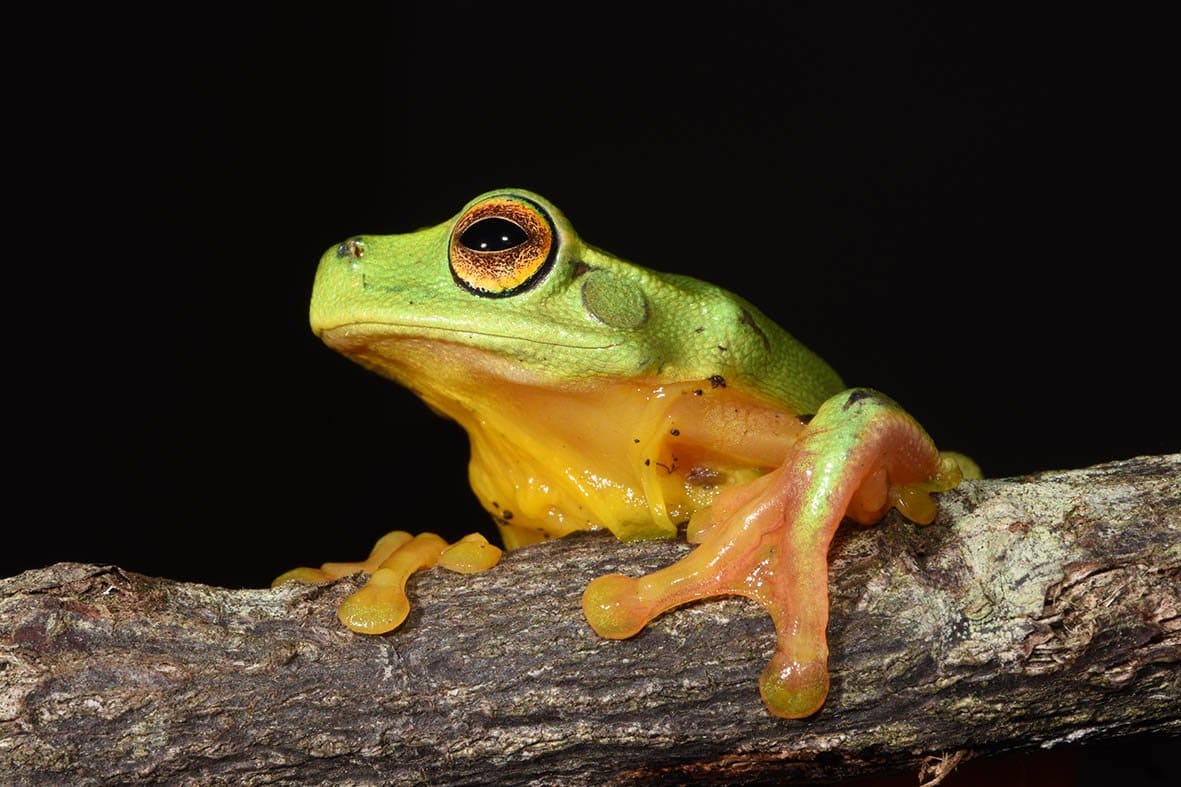
The Vampire Flying Frog (Rhacophorus vampyrus) is a striking and highly specialised tree frog from the montane forests of southern Vietnam. It belongs to the family Rhacophoridae and the genusRhacophorus, a group often referred to as “flying frogs” because of their extensive webbing and gliding ability. The species gets its name from the unusual “vampire-like” fangs of its tadpoles and the adult’s capacity to glide between trees.
Taxonomy & Names
Common name: Vampire Flying Frog;
Scientific name: Rhacophorus vampyrus;
Family: Rhacophoridae (Asian tree frogs);
Genus: Rhacophorus.
Appearance
Adults are typical “flying frogs”, while the tadpoles are uniquely equipped with fang-like structures:
Body size: adults are around 4–5 cm in snout–vent length, with females generally larger than males;
Body shape: somewhat flattened body with a broad profile suited to perching on leaves and branches;
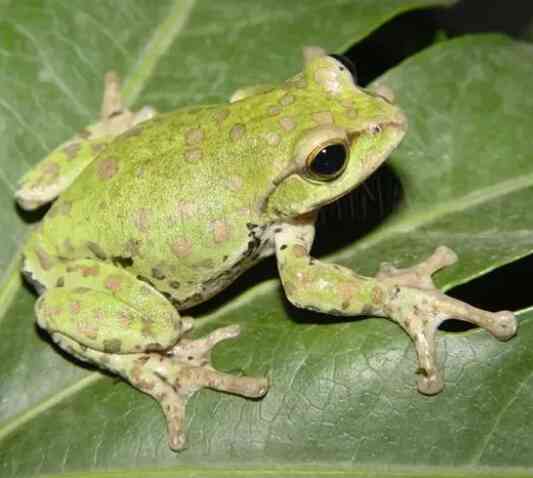
Dorsal colour: usually green or olive-green, sometimes with subtle patterning that blends with foliage;
Belly: pale underside, often creamy or yellowish;
Limbs and webbing: long limbs, especially the hind legs, and very broad toe webbing that acts like a parachute when the frog leaps and glides between trees;
Toe pads: expanded adhesive toe pads that allow firm attachment to leaves, branches and tree trunks;
Tadpole “fangs”: tadpoles possess a pair of dark, curved keratinised hooks around the mouth that resemble tiny vampire fangs. These are used to cling to the walls of tree holes and to scrape at egg masses and organic material, not to suck blood.
Distribution & Habitat
The Vampire Flying Frog is a range-restricted species known from montane forests in southern Vietnam:
occurs in high-elevation evergreen and cloud forests of the southern Vietnamese highlands;
most records are from elevations of roughly 1,000–2,000 m.
Key habitat features include:
moist, closed-canopy montane forest with high humidity;
proximity to streams, ravines or seepage areas where trees can develop water-filled cavities;
abundant tree holes and small arboreal waterbodies that serve as specialised breeding sites.
Behaviour
The species is a nocturnal, arboreal flying frog:
by day, adults typically hide among foliage, in crevices or near tree holes high above the ground;
at night they become active, climbing and leaping among branches and using their webbed feet to glide short distances;
they spend most of their time in the canopy and sub-canopy layers rather than on the forest floor.
Diet
Adult Vampire Flying Frogs feed mainly on small invertebrates:
flying insects in the forest canopy, such as moths and small beetles;
arthropods active on leaves and branches at night;
prey is captured using a rapid flick of the sticky tongue in classic frog fashion.
Tadpoles living in tree holes feed by scraping egg masses and organic material from the walls and water surface, a lifestyle very different from typical pond-dwelling tadpoles.
Reproduction & Tree-Hole Development
The breeding strategy of the Vampire Flying Frog is one of its most fascinating aspects:
breeding coincides with rainy periods that help fill tree holes and arboreal cavities with water;
females lay egg clutches inside tree holes, often attached to the wall just above the waterline;
upon hatching, tadpoles move or fall into the small water pool within the tree cavity;
their “vampire” fangs help them cling to surfaces and feed on eggs and organic debris inside the hole;
the entire larval development takes place in these elevated microhabitats, which reduces exposure to many ground-based predators.
Conservation Status & Threats
Because of its narrow distribution and dependence on intact montane forest, the Vampire Flying Frog is often treated as a threatened highland species (for example, assessed as Endangered, EN, in global listings).
Major threats include:
deforestation, logging and agricultural expansion in montane regions, which fragment and reduce suitable forest habitat;
conversion of highland forest to coffee, rubber or other plantations that alter canopy structure and local hydrology;
climate change, which may modify cloud cover, humidity and rainfall patterns, affecting the formation and persistence of tree-hole waterbodies;
the species’ naturally small range and limited population size, which make it especially sensitive to environmental change.
Protecting remaining montane forests, limiting high-elevation land conversion and monitoring known breeding sites are essential for the long-term survival of the Vampire Flying Frog.