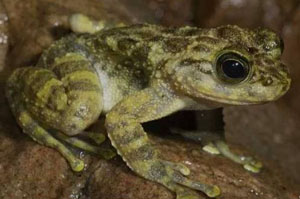
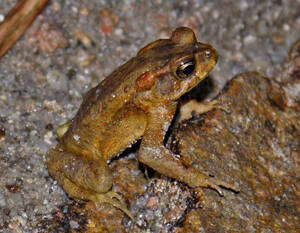
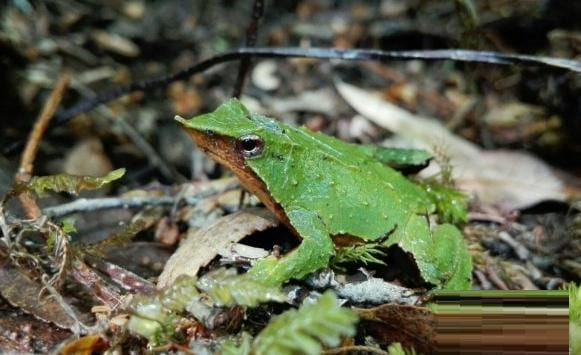
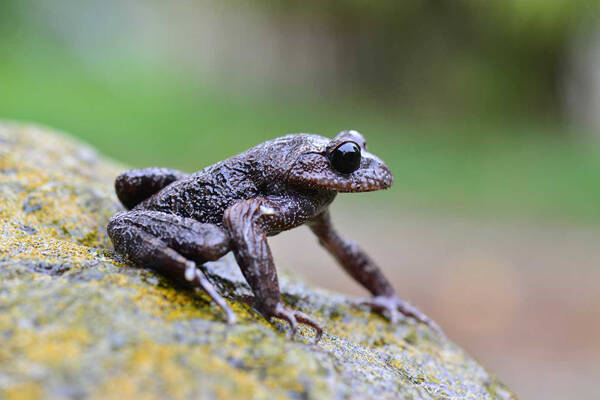
The Green Stream Frog (Litoria phyllochroa) is a small to medium-sized frog from eastern Australia that is closely associated with fast-flowing forest streams and moist gullies. It is a typical “stream frog”, often seen or heard along rocky creeks in high-rainfall areas.
Taxonomy & Names
English name: Green Stream Frog
Scientific name: Litoria phyllochroa
Genus: Litoria (tree frogs and allies)
Appearance
The Green Stream Frog has a fairly slender build and subtle, stream-adapted colouration:
Body size: adults are usually around 3–5 cm long, with females generally slightly larger than males;
Dorsal colour: olive-green, grass green or greenish-brown, sometimes with faint mottling;
Side stripe: a dark stripe typically runs from the snout through the eye and over the eardrum along the side of the body, often bordered by a paler or golden edge;
Belly: underside is pale – whitish or yellowish – sometimes with fine marbling on the throat or belly;
Skin texture: dorsal skin is mostly smooth with a few small warty bumps, and lateral glands are not highly prominent;
Limbs: relatively long limbs, with well-developed hind legs for jumping, partially webbed toes and small toe pads that help the frog cling to wet rocks and streamside vegetation.
Distribution & Habitat
The species is endemic to eastern Australia:
occurs mainly in parts of New South Wales and south-eastern Queensland;
associated with coastal ranges and upland areas that receive relatively high rainfall.
The Green Stream Frog is strongly tied to forest streams and moist gullies:
found along clear, fast-flowing creeks, cascades and small waterfalls;
uses rocks, logs, leaf litter and vegetation along stream banks and in shaded gullies as shelter and calling sites;
prefers habitats with good water quality and intact native vegetation.
Behaviour
This species is a nocturnal frog closely associated with water:
by day it usually hides under rocks, logs, leaf litter or within dense vegetation near streams;
at dusk and during the night it moves along stream margins, often perching on rocks, branches or low plants;
when disturbed it may leap into the water or quickly retreat into crevices and vegetation.
Call
Male Green Stream Frogs call during the breeding season from positions close to water:
the call consists of short, repeated notes, often described as a series of clear “reek” or “chirp”-like sounds;
males typically call from rocks, banks or vegetation beside streams and pools;
on wet nights, their calls blend with the sound of running water in forested gullies.
Diet
The Green Stream Frog feeds mainly on small invertebrates:
small flying insects such as midges, mosquitoes and moths near the water surface and stream banks;
small beetles, ants and spiders living among rocks, leaf litter and plants;
other tiny invertebrates encountered along the forest floor and stream margins.
Individuals often wait on rocks or leaves and capture passing prey with a rapid tongue flick.
Breeding & Life Cycle
Breeding is closely linked to rainfall and stream conditions:
breeding usually occurs in warmer, wetter months when stream flows and pools are suitable;
males call from the edges of streams, riffles and small pools to attract females;
eggs are laid in shallow water in pools, slow-flowing reaches or small adjacent ponds;
tadpoles develop in streams and pools, requiring good water quality and adequate flow;
after metamorphosis, juvenile frogs move onto land but generally remain close to the stream environment.
Conservation Status & Threats
On the IUCN Red List Litoria phyllochroa is currently assessed as Least Concern (LC), reflecting its relatively stable status over much of its range.
However, local populations may be affected by:
loss and fragmentation of forest and riparian vegetation through logging, agriculture and urban development;
degradation of water quality from sedimentation, pollution and changes to natural flow regimes;
potential disease impacts and long-term changes in rainfall and stream flow patterns.
Protecting forested catchments, maintaining clean, free-flowing streams and preserving native streamside vegetation are all important for the long-term conservation of the Green Stream Frog and other stream-dwelling amphibians.