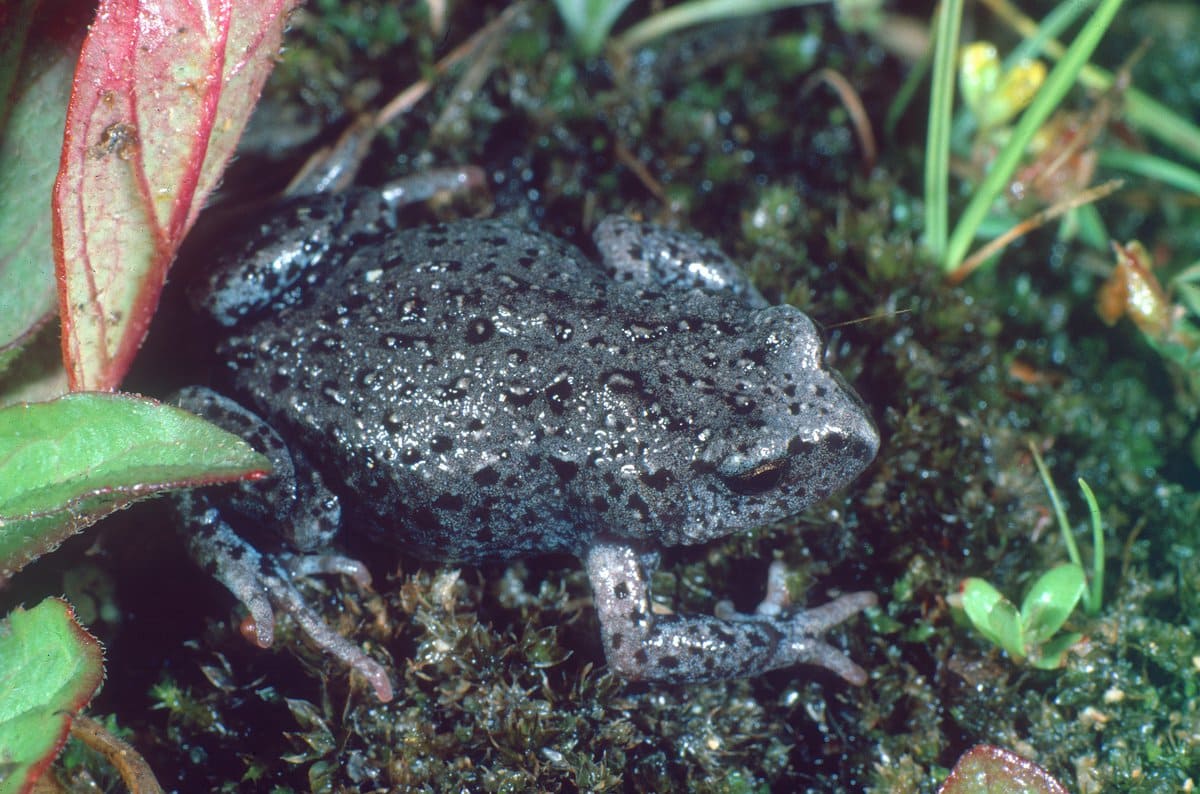
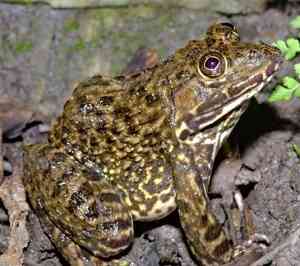
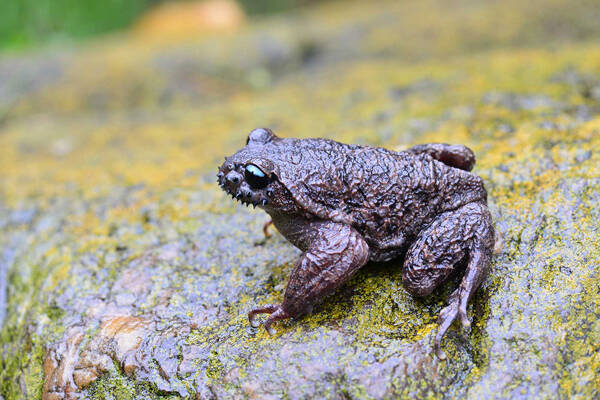
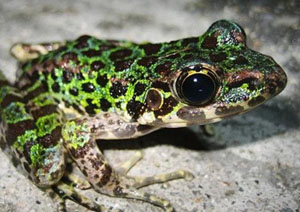
The Northern Sandhill Frog (Arenophryne rotunda) is a small, round-bodied burrowing frog endemic to a tiny stretch of coastal dunes in Western Australia. It belongs to the Australian ground frog family Myobatrachidae and is one of the very few frog species that burrow head-first into sand rather than backwards.
Taxonomy & Names
Common name: Northern Sandhill Frog (also simply Sandhill Frog)
Scientific name: Arenophryne rotunda
Family: Myobatrachidae (Australian ground frogs)
Genus: Arenophryne
Appearance
The Northern Sandhill Frog is small but very distinctive in shape:
Body size: adult males are about 26–30 mm snout–vent length, females 28–33 mm;
Body shape: short, squat and rounded body with a relatively small but broad head and short limbs;
Dorsal colour: off-white, cream, light grey or pale brown background with irregular blotches and speckles of brown, brick-red or green;
Skin texture: loose-looking skin, especially around the hindquarters, with small warts and low ridges;
Belly: underside dull white to greyish, usually without strong patterning;
Limbs: short, powerful limbs; forelimbs are particularly strong with short, broad fingers adapted for forward burrowing through coarse sand;
Tympanum: external eardrum is not clearly visible.
Distribution & Habitat
The Northern Sandhill Frog is endemic to a very restricted part of coastal Western Australia:
found in white coastal dunes from the Edel Land peninsula and nearby Shark Bay region to parts of Dirk Hartog Island;
occurs at low elevations from sea level to around 150 m above sea level.
Its habitat is highly specialised:
inhabits coarse-grained coastal sand dunes with very little standing surface water;
survives by burrowing down into layers of moist sand where residual soil moisture is retained;
the species is closely associated with arid to semi-arid coastal dune systems rather than permanent wetlands.
Behaviour & Adaptations
The Northern Sandhill Frog is a fossorial (burrowing), nocturnal species:
by day it remains underground, typically tens of centimetres below the surface in cool, moist sand;
as the dry season progresses, individuals may burrow deeper to stay in contact with moist layers;
at night, especially in the cooler, wetter months, they emerge to forage on the dune surface.
It is one of only a few Australian frogs that dig head-first:
the broad head, strong forelimbs and short limbs are all adaptations for pushing into sand face-first;
this forward-burrowing habit contrasts with the backward burrowing seen in many other frogs.
Dealing with Dry Conditions
Living in an environment with very little free water, the Northern Sandhill Frog has several adaptations to aridity:
uses its skin to absorb moisture directly from damp sand at depth;
avoids surface heat and evaporation by staying underground during the day and during very dry periods;
is most active during the cooler, wetter parts of the year and at night;
has a reproductive strategy that does not rely on open water, with eggs laid underground and direct development.
Diet
The Northern Sandhill Frog feeds mainly on small invertebrates:
ants make up a major part of the diet;
it also eats other small insects and arthropods active on the dune surface at night;
frogs move slowly over the sand, snapping up prey with quick tongue flicks.
Breeding & Life Cycle
The breeding biology of this species is highly specialised:
breeding is associated with cooler, wetter seasons when conditions in the dunes are most favourable;
males call from near the surface or from within shallow burrows with a short, squelching call;
after pairing, males and females burrow deeper together into moist sand;
females lay a small clutch of relatively large eggs underground, sometimes up to around ten eggs;
development is direct – embryos develop entirely within the egg, and tiny froglets hatch out without a free-swimming tadpole stage;
adults and developing young may remain underground for months until conditions are suitable for more frequent surface activity.
Conservation Status & Threats
According to the IUCN Red List, the Northern Sandhill Frog is currently listed asLeast Concern (LC), with populations considered stable within its limited range.
Nonetheless, the species faces a number of potential threats:
its very restricted distribution makes it vulnerable to local habitat disturbance and changes;
off-road vehicles, coastal development and tourism infrastructure can damage dune habitats if not carefully managed;
climate change and altered rainfall patterns may affect dune moisture regimes and the availability of suitable moist sand layers.
Much of its range lies within protected and World Heritage–listed areas around Shark Bay, which helps safeguard habitat and support long-term population stability.