The Southern Ornate Nursery Frog is a tiny, beautifully patterned rainforest frog from eastern Australia. It belongs to a group of “nursery frogs” in which many species have largely terrestrial breeding and direct development, meaning the young can hatch as miniature frogs rather than free-swimming tadpoles.
Taxonomy & Naming (Overview)
The common name “Southern Ornate Nursery Frog” is used in a broad sense for part of the ornate nursery frog complex in eastern Australia. Different sources may apply the name to slightly different, closely related forms. For this reason, this profile is written as a general account of a southern ornate nursery frog type.
Common name: Southern Ornate Nursery Frog;
Chinese name (here): 南部华丽育幼蛙(descriptive translation);
Probable family: Microhylidae (narrow-mouthed frogs);
Probable genus: Cophixalus (rainforest nursery frogs and relatives);
Scientific name: often treated as part of the ornate nursery frog complex within Cophixalus, with the exact species name depending on the taxonomic authority.
Appearance
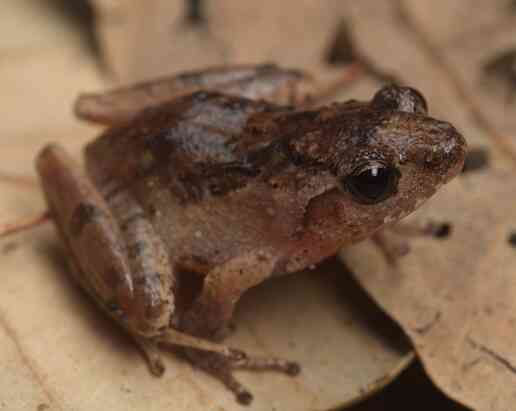
Southern ornate nursery frogs are classic tiny rainforest ground frogs with ornate patterns despite their small size:
Body size: adults are generally about 2–3 cm in snout–vent length, with females slightly larger than males;
Body shape: short, rounded body with a relatively blunt snout and slender limbs;
Dorsal colour: various shades of brown, grey-brown or olive-brown, often with fine dark mottling, spots or more defined markings; some individuals show a pale mid-dorsal line or pale shoulder patches;
Belly: underside pale cream, greyish or light yellow, sometimes lightly speckled;
Skin texture: slightly rough or finely granular on the back, giving a matte appearance rather than a glossy one;
Limbs & toes: slender limbs with small toe pads and minimal webbing, adapted for walking and hopping among leaf litter and moss rather than swimming;
Overall impression: a very small frog with surprisingly intricate markings, fitting the “ornate” part of its name.
Distribution & Habitat
The Southern Ornate Nursery Frog is associated with rainforests and moist forests of eastern Australia, particularly in southern parts of the ornate nursery frog range:
occurs in sections of eastern Queensland and northern New South Wales, especially in upland and hill country;
most common in cooler, moist forested regions with reliable rainfall.
Key habitat features include:
rainforest and wet sclerophyll forest with a well‑developed leaf litter layer and mossy ground;
moist gullies, creek lines, dripping rock faces and shaded slopes;
shelter sites under logs, rocks, roots and within deep leaf litter, where humidity remains high.
Behaviour
This species is a nocturnal, ground-dwelling rainforest frog:
by day it hides in damp refuges such as leaf litter, rock crevices and mossy cavities to avoid drying out and predators;
emerges at night when humidity rises, particularly during or after rain;
movements are usually limited to a small home area, with short hops and slow walking among leaves and roots.
Call
As with many nursery frogs, the call is a key feature for identification:
males give short, single-note or pulsed calls often described as soft “tink”, “peep” or “tick” sounds repeated at intervals;
calling typically takes place on moist nights near seepages, small creeks or dripping rock faces;
the precise pitch and rhythm help distinguish southern ornate forms from other nursery frog species in the same region.
Diet
Southern ornate nursery frogs feed mainly on tiny invertebrates:
small ants, beetles, springtails, mites and other litter-dwelling arthropods;
small flies and other insects encountered on the forest floor and low vegetation;
they forage slowly at night, snapping up any suitably sized prey that moves within reach.
Reproduction & Development
Nursery frogs are best known for their largely terrestrial, often direct-developing reproductive strategy:
males usually call from moist ground-level microhabitats rather than from the edges of large open ponds;
females lay eggs in damp, sheltered sites such as deep leaf litter, moss cushions or soil cavities;
in many nursery frog species, embryos develop within the egg until they hatch directly as tiny froglets, bypassing a free-swimming tadpole stage;
in some cases males may remain near the egg clutch, providing a simple form of parental care.
The Southern Ornate Nursery Frog is thought to follow a similar pattern, reducing dependence on permanent surface water and relying instead on humid terrestrial microhabitats.
Conservation Status & Threats
Available information suggests that many ornate nursery frog forms are of relatively low global conservation concernat present, although their distributions can be localised and their dependence on moist rainforest makes them sensitive to habitat change. Because the name “Southern Ornate Nursery Frog” may refer to more than one taxonomic unit, no single global Red List category is given here.
Potential threats include:
loss and fragmentation of rainforest and moist forest habitats through logging, clearing and infrastructure development;
disturbance of creek lines, gullies and mossy rock faces by road building and tourism;
changes in rainfall patterns and increased frequency of drought associated with climate change;
invasion by weeds or introduced predators that alter the structure and food web of rainforest floor communities.
Protecting intact rainforest, maintaining shaded, humid gullies and minimising fragmentation are all important for supporting southern ornate nursery frogs and other small rainforest amphibians.