Andrews' beaked whale (Mesoplodon bowdoini) is a medium-sized, extremely poorly known beaked whale in the family Ziphiidae. It is considered one of the most mysterious whales in the world: virtually everything we know about the species comes from a few dozen stranded individuals in the Southern Hemisphere rather than from direct observation at sea.
Taxonomy and naming
Andrews' beaked whale belongs to Class Mammalia, Order Cetacea, Suborder Odontoceti, Family Ziphiidae and Genus Mesoplodon. The genus comprises numerous medium-sized, deep-diving beaked whales, many of which are themselves rarely seen. The species was first described in 1908 by American scientist Roy Chapman Andrews from a specimen stranded at New Brighton Beach, Canterbury, New Zealand. The specific name bowdoini honours George S. Bowdoin, a donor and trustee of the American Museum of Natural History. The English common name commemorates Andrews as the describing scientist, while alternative names include Bowdoin's beaked whale and splay-toothed beaked whale.
Physical characteristics
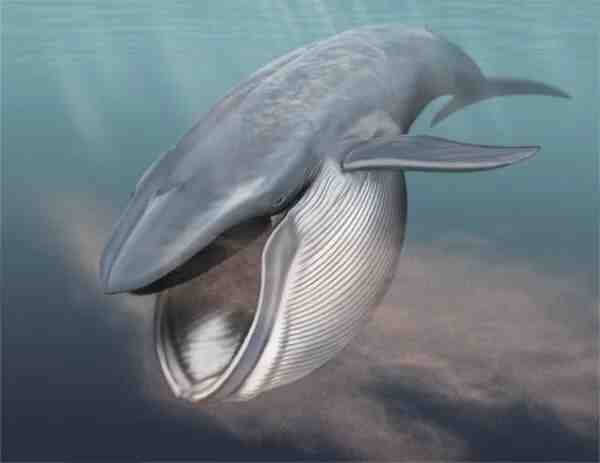
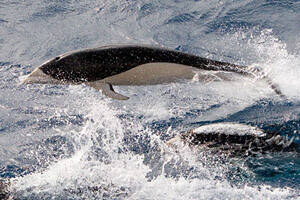
Compared with many other Mesoplodon species, Andrews' beaked whale has a relatively robust, spindle-shaped body with the greatest girth around the midsection. Adults are believed to reach around 4–5 m in length, with females slightly larger on average than males, and calves measuring about 2–2.2 m at birth. Overall colouration is dark: males are generally dark grey to almost black with a paler saddle-like marking between the blowhole and dorsal fin, while females are slate grey with paler flanks and belly. Both sexes often bear circular cookiecutter shark bites and numerous fine scars; adult males in particular are crisscrossed with pale linear scars from male–male combat.
The melon is low and the beak is short and thick. The lower jaw rises sharply in the middle, and in adult males a pair of wide, flattened teeth emerge from this raised portion of the jaw and protrude over the upper beak, sometimes visible even when the mouth is closed. This unusual “splay-toothed” lower jaw is the key identifying feature of the species. The dorsal fin is small and located about two-thirds of the way along the back, and the tail flukes are relatively broad, all adaptations suited to deep diving and long-distance swimming.
Distribution and habitat
Andrews' beaked whales are thought to inhabit cool temperate to subpolar waters of the Southern Hemisphere, probably in a roughly circumpolar band associated with the Antarctic Convergence. Around half of the known strandings have occurred in New Zealand, with additional records from southern Australia (including Tasmania), Macquarie Island, the Falkland Islands, Tristan da Cunha and the coast of Argentina. Based on these records and what is known of related species, Andrews' beaked whales are believed to favour offshore waters over 200 m deep, far from land, where they likely spend most of their time deep beneath the surface.
Behaviour and lifestyle
The behaviour of Andrews' beaked whale remains almost entirely unknown because the species has virtually never been observed alive in the wild. By analogy with other Mesoplodon species, it is presumed to be a deep-diving, acoustically oriented whale that spends long periods at depth foraging, surfacing only briefly to breathe. It likely forms small groups and undertakes regular long dives to mesopelagic and bathypelagic depths. The extensive scarring on adult males indicates intense male–male competition, probably involving jaw and tooth contact during fights.
Diet
Stomach content analyses of stranded individuals suggest that Andrews' beaked whale feeds mainly on deep-water cephalopods, especially midwater and deepwater squids, and probably also consumes some deep-sea fishes. It likely uses echolocation in near-total darkness to locate prey in the water column, then captures fast-swimming squid with quick lunges and suction feeding. As a mid-level predator in cold, deep offshore waters, it plays a role in transferring energy from mesopelagic prey to higher trophic levels.
Reproduction and life cycle
Very little is known about the reproduction of Andrews' beaked whale. Limited records of stranded females with fetuses or calves off New Zealand suggest that calving may peak in late summer and autumn in that region. As with other beaked whales, the species is thought to give birth to a single calf after a gestation period of roughly a year. Calves are around 2 m long at birth and remain with their mothers while they learn to dive and forage. Although precise longevity is unknown, Andrews' beaked whales are presumed to live for several decades, similar to other medium-sized beaked whales.
Relationship with humans
There is currently very little direct interaction between Andrews' beaked whales and humans. The species has never been a target of commercial whaling and there are no confirmed reports of large-scale bycatch. Most human encounters involve stranded animals examined by scientists. For whale watchers and the general public, Andrews' beaked whale remains essentially invisible, a deep-ocean species that has so far escaped regular observation.
Conservation status and threats
On the IUCN Red List, Andrews' beaked whale is classified as Data Deficient, reflecting the extreme lack of information on population size, trends and threats. While there is no evidence of intense direct exploitation, the species is expected to be sensitive to many of the same pressures that affect other beaked whales, including anthropogenic noise (such as naval sonar and seismic surveys), climate-driven changes in ocean structure and prey distribution and pollution, particularly plastics and chemical contaminants. Continued development of acoustic monitoring and dedicated offshore surveys will be essential to improving our understanding of this elusive whale and assessing whether targeted conservation measures are required.