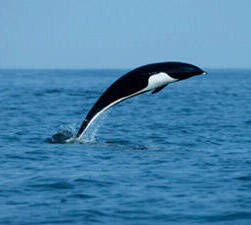
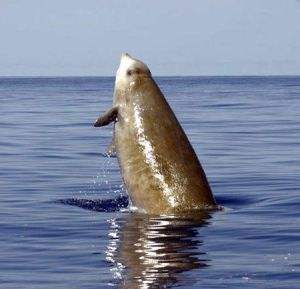
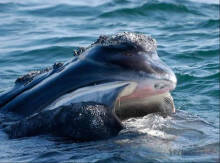
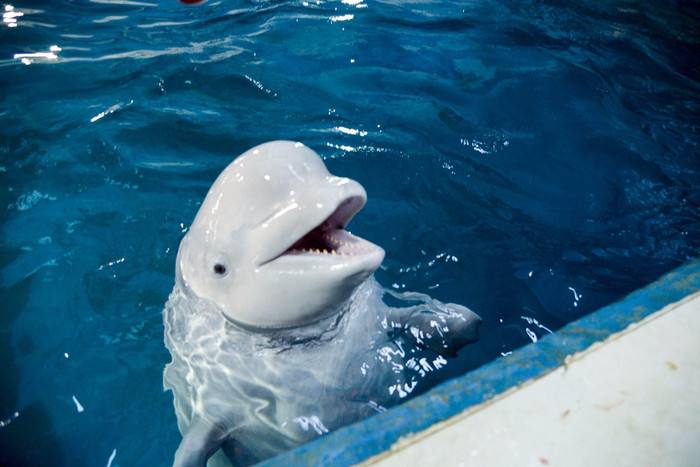
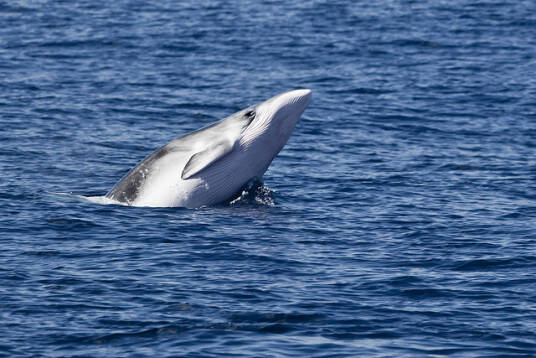
The ginkgo-toothed beaked whale (Mesoplodon ginkgodens) is an elusive deep-diving toothed whale in the beaked whale family (Ziphiidae). It spends much of its life far offshore in deep water, surfacing briefly and quietly, which is why confirmed sightings at sea are uncommon. Much of what we know about the species comes from strandings, occasional encounters and comparisons with other Mesoplodon beaked whales.
The common name “ginkgo-toothed” refers to the distinctive teeth of adult males. In many Mesoplodon species, adult males develop a pair of erupted teeth used mainly in social display and competition. In this species the exposed teeth are unusually shaped and are often described as ginkgo-leaf or fan-like—hence the name. Females and juveniles typically have teeth that do not erupt visibly, making field identification especially challenging.
Taxonomy and naming
This species is a marine mammal in order Cetacea, suborder Odontoceti (toothed whales), family Ziphiidae (beaked whales) and genus Mesoplodon. The genus contains many externally similar species, and reliable identification often depends on tooth position/shape, skull features and genetic data.
Physical characteristics
Ginkgo-toothed beaked whales are streamlined, with a relatively long, narrow beak and a low-profile appearance at the surface. Colouration is typically dark grey to grey-brown with a paler underside. Like many beaked whales, individuals often show scars, scratches and mottled marks on the skin, which may come from social interactions (including tooth rakes), prey handling or contact with the environment.
Adult males may show the species’ hallmark: a pair of erupted lower-jaw teeth positioned relatively far back, shaped in a fan- or leaf-like form. Females and juveniles usually lack visibly erupted teeth, so they can be hard to separate from other Mesoplodon whales without close views or strandings.
Distribution and habitat
Records indicate an Indo-Pacific distribution, particularly in the Indian Ocean and the western Pacific, in warm-temperate to tropical waters. The species is associated with deep offshore habitats such as continental slopes, seamount regions and waters around island chains where deep-sea prey can be abundant.
Because detections are rare, many details about population structure, seasonal movements and local “resident” groups remain uncertain.
Behaviour and lifestyle
As with other beaked whales, ginkgo-toothed beaked whales are believed to travel in small groups (often just a few animals). They surface briefly between long dives and can be difficult to approach or observe. Beaked whales are specialised deep divers and use echolocation to locate prey at depth, sometimes diving hundreds of metres or more during foraging bouts.
Beaked whales are widely considered sensitive to intense underwater noise. In multiple regions, beaked whales have been involved in unusual stranding events linked to strong noise sources, so reducing high-intensity sound in key deep-water habitats is often considered a precautionary conservation measure.
Diet
The diet is thought to be dominated by deep-water squid and other cephalopods, with additional deep-sea fish and crustaceans likely taken opportunistically. Many beaked whales feed by suction, drawing prey into the mouth after locating it with echolocation.
Reproduction and life cycle
Direct reproductive data for this species are limited. Like many toothed whales, females likely have a long gestation (around a year or longer) and usually give birth to a single calf. Calves have an extended dependency period and learn diving, foraging and social behaviour from the mother and group.
Lifespan is probably measured in decades, as is common in beaked whales, but precise estimates for this species remain uncertain due to limited long-term monitoring.
Relationship with humans
Because the species lives mainly offshore, direct interactions with people are uncommon. Key risks are indirect: bycatch and entanglement in pelagic fisheries, disturbance from intense underwater noise (naval sonar, seismic surveys and heavy shipping), accumulation of marine pollutants, and changes to prey availability driven by ocean warming and shifting productivity.
Conservation status and threats
Global status assessments for the ginkgo-toothed beaked whale carry substantial uncertainty because sightings and population data are scarce. It is often treated as Data Deficient (DD) or “information-limited” in conservation discussions. Commonly cited threats include fisheries interactions (bycatch/entanglement), underwater noise, plastic and chemical pollution, and the vulnerability of small or local populations to extreme events.
Practical conservation tends to focus on risk-source management: reducing fisheries interactions, limiting intense noise in important deep-water areas, improving stranding response and scientific sampling (including genetic identification), and building long-term monitoring programs to fill major knowledge gaps.