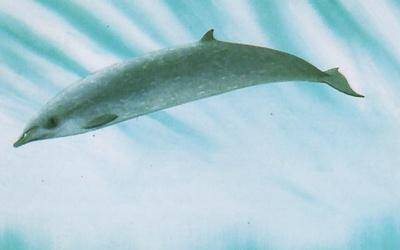
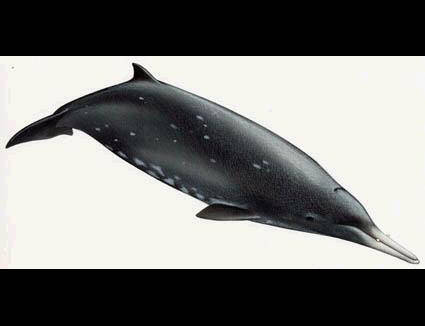
Longman’s beaked whale (Indopacetus pacificus)—also called the “tropical bottlenose whale” or “Indo‑Pacific beaked whale”—is one of the least‑known beaked whales. It typically inhabits warm, deep, offshore waters in the tropical and subtropical Indian and Pacific Oceans. Because it surfaces briefly and spends much of its life at depth, the species was historically known from only a handful of stranded specimens.
Over the past two decades, more at‑sea sightings have improved our understanding of its appearance and behaviour. It is larger than most beaked whales and can be identified (when conditions allow) by a pronounced melon, a long tube‑shaped beak, and a relatively large dorsal fin set behind the mid‑back. Groups are often cohesive and can be larger than those of many other local beaked whales.
Taxonomy and naming
This species is a toothed whale in the family Ziphiidae (beaked whales) and the genus Indopacetus, which contains only one species. It was first described from skeletal material and named after H. A. Longman (1926).
Appearance
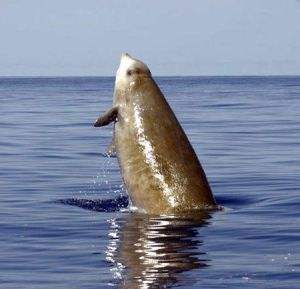
Longman’s beaked whales have a robust body and a fairly large, hooked dorsal fin located behind the midpoint of the back. The forehead (melon) is well defined and can appear almost perpendicular to the long beak, sometimes separated by a slight crease. Colouration is variable but often includes darker grey‑bronze/olive tones and a noticeable darker banding pattern along the back and face. The lower jaw bears two conical teeth near the tip; in adult males the erupted teeth are more evident, though they can be difficult to see in the field. Scars from interactions and cookie‑cutter shark bites may be present.
Range and habitat
The species is associated with warm, deep pelagic waters across the tropical and subtropical Indian and Pacific Oceans. In U.S. waters, sightings are most frequent offshore of the Hawaiian Islands. Strandings and reports exist from parts of Africa, northern Australia, the Maldives, Sri Lanka, the Philippines, and southern Japan, indicating a broad Indo‑Pacific distribution, although the full range remains incompletely known.
Behaviour
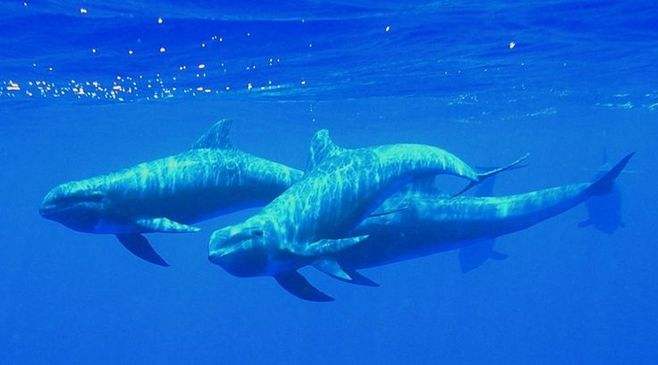
Unlike many beaked whales that occur in small groups, Longman’s beaked whales are often found in tight, cohesive groups averaging about 10–20 animals, and occasionally in much larger aggregations. Dives may last on the order of tens of minutes, and the blow is typically low and bushy. They may be sensitive to disturbance and have been observed moving rapidly away from vessels at the surface.
Diet
Feeding ecology is poorly known, but as with other beaked whales, scientists believe they dive deep to forage. Stomach‑content evidence from stranded individuals suggests cephalopods (such as squid and octopus) can dominate the diet.
Reproduction and life history
Life‑history information is limited. Newborn calves have been measured at roughly 7.7–9.5 feet (about 2.3–2.9 m). Weight and lifespan are not well established and are often reported as unknown in authoritative species accounts.
Conservation status and threats
The IUCN Red List assesses Longman’s beaked whale as Least Concern (LC; 2020 assessment). Even so, it remains a data‑limited deep‑diving species and global abundance and trends are difficult to quantify. Documented and potential threats include entanglement/bycatch in fishing gear and sensitivity to human‑caused ocean noise (e.g., naval sonar and seismic activities), along with marine debris and pollution pressures.