Arnoux's beaked whale (Berardius arnuxii) is a large beaked whale in the family Ziphiidae and one of the least-known cetaceans on the planet. It is the Southern Hemisphere counterpart of Baird's beaked whale (Berardius bairdii) in the North Pacific, and for many years scientists debated whether the two were actually the same species. Today they are recognised as closely related but separate species that live in opposite hemispheres.
Taxonomy and naming
Arnoux's beaked whale belongs to Class Mammalia, Order Cetacea, Suborder Odontoceti, Family Ziphiidae and Genus Berardius. The genus currently includes Baird's beaked whale in the North Pacific, Arnoux's beaked whale in the Southern Ocean and a more recently described North Pacific species. Arnoux's beaked whale was described in 1851 by the French anatomist Duvernoy from a skull found near Akaroa, New Zealand. The genus name honours Admiral Auguste Bérard, whose vessel brought the type specimen back to France, while the specific name arnuxii honours the ship's surgeon Maurice Arnoux, who collected the skull. Common English names include Arnoux's beaked whale, southern four-toothed whale and New Zealand beaked whale.
Physical characteristics
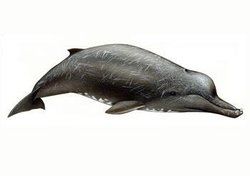
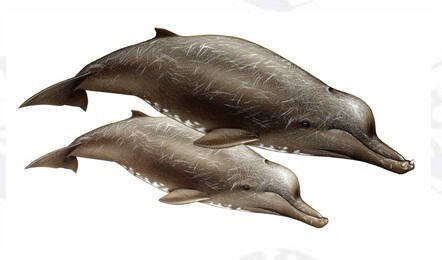
Arnoux's beaked whale is among the larger members of the beaked whale family. Adults are generally reported to reach about 8–10 m in length, with some accounts suggesting maximum lengths of 11–12 m, and weigh several tonnes. The body is robust and spindle-shaped, with the greatest girth around the midsection. The head has a prominent melon and a long, distinct beak, giving the animal a “giant dolphin” appearance. The lower jaw is longer than the upper, and in sexually mature animals four teeth erupt at the front of the lower jaw and can remain visible even when the mouth is closed—a hallmark of the genus Berardius.
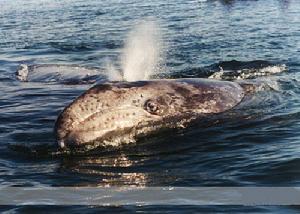
Overall colouration is dark grey to almost black, with a paler underside. As individuals age, their bodies accumulate numerous pale, linear scars from social interactions and fights, especially in males, as well as circular cookiecutter shark bites. The dorsal fin is relatively small and set far back, about two-thirds along the back. The flippers are small and rounded, and the tail flukes are broad, all features well suited to deep diving and sustained swimming in cold offshore waters.
Distribution and habitat
Arnoux's beaked whales inhabit cool temperate to subpolar waters of the Southern Hemisphere, forming a broad circum-Antarctic distribution. Strandings and sightings have been recorded off New Zealand, southern Australia and Tasmania, South Africa, Argentina and Uruguay, as well as around subantarctic islands such as South Georgia and Macquarie Island. The species appears to favour offshore waters deeper than about 200 m, particularly along continental slopes, seamounts and the dynamic frontal zones associated with the Antarctic Convergence, where productivity and prey densities are high.
Behaviour and lifestyle
Like most beaked whales, Arnoux's beaked whale is rarely seen at sea and its behaviour is poorly documented. By analogy with Baird's beaked whale and other relatives, it is presumed to be a deep-diving species that spends long periods at mesopelagic and bathypelagic depths, surfacing only briefly to breathe. Groups ranging from a few individuals to several dozen have been observed, and the heavy scarring on adult males suggests intense male–male competition involving jaw and tooth contact. When at the surface, the whales tend to surface quietly and can be difficult to detect in rough or icy seas.
Diet
Stomach content analyses from stranded whales indicate that Arnoux's beaked whale feeds primarily on deep-water cephalopods and fishes, including midwater and deepwater squids. The species probably relies on echolocation to locate prey in near-total darkness and uses rapid lunges combined with suction feeding to capture fast-swimming squid and fishes. As a mid- to upper-level predator in the cold Southern Ocean, it plays a role in transferring energy from mesopelagic prey to higher predators.
Reproduction and life cycle
Very little is known about the reproduction of Arnoux's beaked whale. Limited records of stranded females with fetuses and calves suggest that calving may occur in late summer and autumn in at least some parts of its range. As with other beaked whales, females are thought to give birth to a single calf after a gestation period of roughly a year. Newborn calves are about 3–4 m long and stay with their mothers while learning to dive and forage. Although exact longevity is unknown, Arnoux's beaked whales are presumed to live for several decades, similar to other large toothed whales.
Relationship with humans
Arnoux's beaked whale has never been heavily targeted by commercial whaling, and confirmed records of bycatch are rare. Because the species usually lives far from shore in cold Southern Ocean waters, direct interactions with human activities are limited. Most human encounters involve stranded animals examined by scientists. For whale watchers and the general public, Arnoux's beaked whale remains an elusive “ghost of the Southern Ocean”, seldom if ever seen alive.
Conservation status and threats
Globally, Arnoux's beaked whale is currently listed as Least Concern (LC) on the IUCN Red List, reflecting the absence of evidence for major declines across its broad circumpolar range and the lack of significant direct exploitation. However, overall abundance and population trends remain unknown, and as with other beaked whales, the species is likely sensitive to anthropogenic underwater noise (such as naval sonar and seismic surveys), deep-water fisheries, marine debris and climate-driven changes in ocean structure and prey availability. Continued research, including passive acoustic monitoring and dedicated offshore surveys, is important to better understand population status and to ensure that emerging threats in the Southern Ocean are detected early.