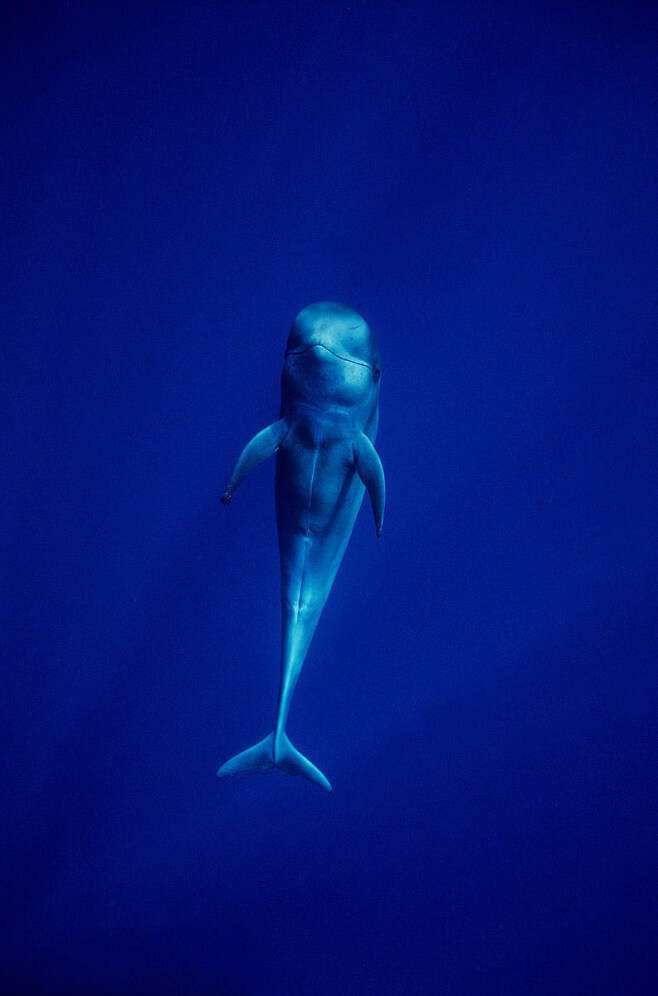
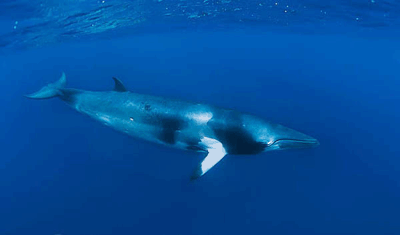
Blainville's beaked whale (Mesoplodon densirostris) is a medium-sized deep-diving toothed whale in the family Ziphiidae. It is one of the best-known members of the genus Mesoplodon and is widely distributed in tropical and warm-temperate oceans worldwide. The species is particularly noted for its extreme diving capabilities and the conspicuous pair of tusk-like teeth that erupt from the lower jaw of adult males.
Taxonomy and naming
Blainville's beaked whale belongs to Class Mammalia, Order Cetacea, Suborder Odontoceti, Family Ziphiidae and Genus Mesoplodon. The genus contains numerous similar-looking beaked whale species whose identification at sea can be challenging. The species name densirostris refers to the very dense, thickened bones of the rostrum in this whale, especially in males. In Chinese it is often called 布氏喙鲸 or 布氏中喙鲸.
Physical characteristics
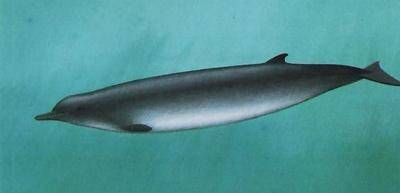
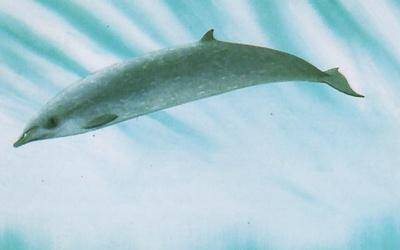
Blainville's beaked whales have a slender, torpedo-shaped body with a small head and a moderately long beak. The melon (forehead) is low and slopes gently into the beak, lacking the pronounced blocky forehead of sperm whales. Adults are typically about 4.5–5.4 m in length, with females slightly larger on average than males, and weigh in the range of roughly 800–1200 kg.
The dorsal fin is small, falcate and positioned well back on the body. The flippers are short, and the flukes are broad without a deep central notch. Body colour is usually slate grey, bluish-grey or brownish-grey with a paler underside. The skin is often heavily marked with irregular scars and spots, including white circular scars from cookiecutter shark bites and linear scratches from interactions with conspecifics. Adult males possess a distinctive pair of robust, triangular teeth that erupt from the middle of the lower jaw and protrude above the upper jaw, a key feature for species identification. Females and juveniles lack erupted teeth and appear more smooth-jawed. A pale, crescent-shaped marking from the eye towards the corner of the mouth is also characteristic of this species.
Distribution and habitat
Blainville's beaked whale inhabits deep offshore waters of tropical and warm-temperate seas worldwide, including the Atlantic, Indian and Pacific Oceans. It is commonly associated with continental slopes, island slopes, submarine canyons and other steep underwater topography where water depths quickly drop to several hundred or more than a thousand metres.
The species is rarely seen close to shore except where deep water occurs near islands or steep coasts. Because it spends much of its time at great depth and surfaces only briefly to breathe, it is difficult to observe at sea. Much of our knowledge of its distribution and biology comes from strandings, acoustic monitoring and occasional sightings during dedicated deep-water surveys.
Behaviour and lifestyle
Blainville's beaked whale is an extreme deep diver. Tagged individuals have been recorded diving to depths exceeding 1000 m and remaining submerged for 45–60 minutes or more while foraging, followed by series of shorter, shallower recovery dives. The species typically occurs in small groups of around 3–10 animals, though solitary individuals and larger aggregations are sometimes observed.
At the surface, Blainville's beaked whales are usually inconspicuous, surfacing quietly and only briefly before diving again. Adult males often bear heavy scarring from tooth raking and body contact during intraspecific conflicts over mates. Like other beaked whales, they rely on echolocation clicks to navigate and hunt in the dark depths, and they are generally very sensitive to underwater noise.
Diet
The diet of Blainville's beaked whale consists mainly of mid-sized squids and deep-water fishes, making it a mid- to upper-level predator in offshore pelagic ecosystems. Most prey species inhabit mesopelagic and bathypelagic zones hundreds to more than a thousand metres below the surface. The whales use suction feeding and rapid lunges to capture prey detected via echolocation.
Because they forage far offshore and at depth, their direct interaction with most coastal fisheries is limited. However, bycatch can occur in deep-set longlines and other pelagic fishing gears operating in their core habitat.
Reproduction and life cycle
Detailed reproductive data for Blainville's beaked whale remain limited, but available information suggests a life history similar to that of other medium-sized toothed whales. Females give birth to a single calf after a gestation estimated at around 12 months. Newborn calves are about 2–2.5 m long and remain closely associated with their mothers, nursing and gradually learning to dive and forage.
Tooth and bone growth studies indicate that individuals can live for roughly 30–40 years. The species matures relatively late and has a low reproductive rate, which restricts its capacity for rapid population increase if adult survival declines.
Relationship with humans
Blainville's beaked whale has not been a major target of commercial whaling, but individuals may be taken incidentally in small-scale hunts or as bycatch in some fisheries. The species is occasionally encountered during offshore whale-watching trips in areas with deep-water canyons and slopes, though sightings are far less frequent than for more coastal or surface-active cetaceans.
Human activities that may affect Blainville's beaked whales include anthropogenic underwater noise from naval mid-frequency sonar, seismic surveys and other industrial sources, as well as entanglement in fishing gear and ingestion of plastic debris. A number of mass stranding events involving beaked whales have been associated with naval sonar exercises, raising concern about the vulnerability of these deep-diving cetaceans to intense, mid-frequency sound.
Conservation status and threats
Globally, Blainville's beaked whale is currently listed as Least Concern (LC) on the IUCN Red List, reflecting its wide distribution and the lack of clear evidence for a rapid, global-scale decline. However, population sizes and trends are poorly known in many parts of its range, and the species is considered data-poor, with potentially significant local impacts from human activities.
Conservation priorities include improving monitoring through visual and acoustic surveys, identifying and protecting key habitats such as submarine canyons and slope waters, mitigating the impacts of naval sonar and other high-intensity noise sources, reducing bycatch in deep pelagic fisheries and addressing marine debris, particularly lost fishing gear and plastics, in offshore environments.